Related Issues

Related Issues

Statement from Senator Coons on Delaware’s No Child Left Behind Waiver

WASHINGTON – U.S. Senator Chris Coons (D-Del.) issued the following statement on Tuesday after the U.S. Department of Education announced it had granted Delaware a waiver from select No Child Left Behind requirements.

“This waiver will provide Delaware with the flexibility it needs to develop and implement its own plan to increase student achievement,” Senator Coons said. “This flexibility enables schools to focus on state-specific needs and ensure that we are properly educating students to be leaders of tomorrow.” 

Senator Coons has been an outspoken advocate for improving America’s education system, with a focus on college access. In March, Senator Coons introduced legislation to help increase the number of low-income students able to access and complete a college education. The bipartisan American Dream Accounts Act encourages partnerships among schools, colleges, non-profits and businesses to develop secure, web-based student accounts that contain information about academic preparedness, financial literacy and high-impact mentoring and would be tied to a college savings account.

# # #

Senator Coons visits Uganda to assess U.S. and regional efforts to counter the LRA

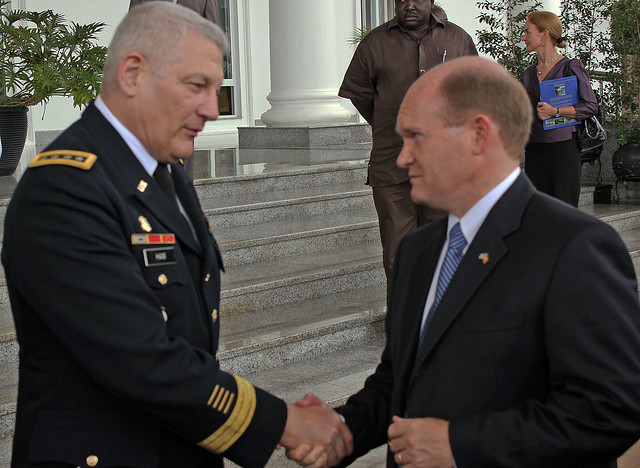
Villager welcoming Coons

KAMPALA, Uganda – U.S. Senator Chris Coons (D-Del.), chairman of the Senate Foreign Relations Subcommittee on African Affairs, met on Sunday with AFRICOM Commander General Carter Ham and U.S. advisors to assess the multinational effort to remove Joseph Kony from the battlefield and counter the Lord’s Resistance Army (LRA).  During a two-day visit to Uganda, the Senator met with President Museveni and thanked him for the efforts of the Ugandan military to root out the LRA and for the strong partnership between the U.S. and the Ugandan people. Senator Coons also visited the northern Uganda community of Gulu, where the United States is supporting efforts to rebuild communities affected by the LRA.

“I was encouraged to hear from commanders on the ground in Uganda about progress that’s being made in the U.S. mission to advise and assist regional militaries in the hunt for Joseph Kony,” Senator Coons said. “Kony represents the worst of mankind, and he and his lieutenants must be held accountable for the war crimes they have committed in Central Africa. I was glad to receive an update and assessment from AFRICOM Commander General Ham and U.S. advisors working with the Ugandan military, and I thanked President Museveni for his support of multilateral efforts to counter the LRA.  I was also heartened by the scope and impact of U.S. efforts to rebuild communities in Northern Uganda, where communities were devastated by the LRA.  While the people of Gulu will never fully heal from the deep scars left by the LRA, there is a brighter future ahead thanks, in part, to the commitment of the United States.”

The Ugandan military, with the assistance of advisors from the United States, is leading the mission to capture or kill Kony and his top commanders, who are responsible for crimes against humanity across Central Africa. In LRA-affected communities in Northern Uganda, the United States is helping to rebuild government office buildings, schools and teacher houses, health clinics and health clinic housing, markets, boreholes, and police and justice facilities, among other programs. Senator Coons visited the Northern Uganda Development of Enhanced Livelihoods (NUDEIL) program, clinics, and other projects supported by NGOs and USAID.

Coons also met with Ugandan Minister for Water Resources and Member of Parliament Betty Bigombe, the last Ugandan to negotiate with Kony.  In 2004 and 2005, Bigombe was the lead mediator of a proposed peace treaty with the Lord’s Resistance Army, which collapsed at the last minute when Kony refused to sign. 

Earlier this year, Senator Coons led 40 of his Senate colleagues in introducing a bipartisan resolution condemning the crimes against humanity committed by the LRA and supporting ongoing U.S. and regional efforts to remove Kony from the battlefield. In April, he chaired an African Affairs Subcommittee on U.S. policy to counter the LRA. 

To download the pictures from the CODEL, click here.

To read more about Senator Coons’ work on Joseph Kony and the LRA, click here.

###

Statement from Senator Coons honoring Memorial Day

WILMINGTON, Del. – U.S. Senator Chris Coons issued the following statement honoring America’s heroes in observance of Memorial Day.

“Memorial Day provides a somber opportunity to pause and honor our service members who have made the ultimate sacrifice. Their heroic work defending our freedoms will never be forgotten.

“We also remember the Delawareans and Americans still serving in harm’s way, and pray for their safe return. We are deeply grateful when our service members return home safely to their loved ones, as the 1049th Transportation Company did this month.

“Today, and every day, we thank our military members, past and present, for the sacrifices they have made to keep America safe.”

Senator Coons participated in the Newark Memorial Day Parade on Sunday, May 20.

###

President Obama signs Senator Coons’ bill to avert crisis in America’s bankruptcy courts

WASHINGTON – President Obama signed into law the Temporary Bankruptcy Judgeship Extension Act on Friday, averting a crisis in America’s bankruptcy court system by reauthorizing 29 temporary judgeships in 14 states and Puerto Rico — including five judgeships in Delaware. The law, which was introduced in the Senate in November by U.S. Senator Chris Coons (D-Del.), will ensure that the judgeships are not lost due to the retirement, resignation, death or removal of the judge. With the President’s signature, the judgeships’ authorizations have now been extended until May 21, 2017 — five years from today.

“No one wants to see people and companies file for bankruptcy, but when they do, it’s important that their cases be handled expeditiously and with appropriate consideration of all parties involved,” Senator Coons said. “This law will stave off a grave shortage of bankruptcy judges in many districts around this country, which could have impaired the abilities of courts in those districts to do just that. Our federal bankruptcy courts protect American jobs every day, and they were facing a crisis that I am relieved to be able to say we have now averted. I am grateful to my colleagues in the Senate and in the House for lining up behind this bill, and to President Obama for signing it into law and giving America’s bankruptcy courts system the certainty it needs to continue supporting our economic recovery.”

Delaware’s bankruptcy judges, who are hailed for their experience, speed and predictability, handle more than one-third of the nation’s largest bankruptcies. Five of Delaware’s six judgeships have temporary authorizations that had expired. One additional Wilmington-based bankruptcy judge is on loan from the eastern district of Pennsylvania, which district also had a temporary authorization that had expired.

Faced with increasing demand on the federal court system, Congress has created dozens of temporary bankruptcy judgeships over the last 20 years to help the courts keep pace. The Temporary Bankruptcy Judgeships Extension Act of 2012 heeded the recommendations made last year by the non-partisan Judicial Conference of the United States, whose biennial review urged Congress to prevent the expiration of 30 temporary bankruptcy judgeships by extending each by five years. The statutory authorizations to fill these judgeships, had they been vacated, had all lapsed.

One of the bankruptcy judgeships identified by the Judicial Conference and covered in the original version of the bill — in the Southern District of New York — had lapsed after its authorization had expired. With Senator Coons’ support, the legislation was modified in the House of Representatives last week to reflect the judge’s retirement.

“Having a full bench of bankruptcy court judges will allow for a renewed economic stability for many who have fallen into financial hardships,” Senator Coons said. “Talented bankruptcy judges can help turn a likely economic loss into a successful reorganization that protects jobs and creditors. This legislation will ensure that these judgeships remain in place and continue to fairly and expeditiously resolve bankruptcy claims — a key component of our economy as companies and individuals get back on their feet.”

The Temporary Bankruptcy Judgeship Extension Act of 2011 was introduced in the Senate in November and passed out of the Senate Judiciary Committee in December. The House of Representatives passed the legislation on December 8. Amended and passed unanimously by the Senate on April 19, 2012, the House made a technical change to the bill and passed it again on May 9. The Senate then passed the final version unanimously on May 10.

Nineteen districts in 14 states, plus Puerto Rico, have temporary judgeships extended by the law, including:

  • The central district of California: 3 judgeships
  • The eastern district of California: 1 judgeship
  • The district of Delaware: 5 judgeships
  • The southern district of Florida: 2 judgeship
  • The southern district of Georgia: 1 judgeship
  • The district of Maryland: 3 judgeships
  • The eastern district of Michigan: 1 judgeship
  • The northern district of New York: 1 judgeship
  • The eastern district of North Carolina: 1 judgeship
  • The middle district of North Carolina: 1 judgeship
  • The eastern district of Pennsylvania: 1 judgeship
  • The western district of Pennsylvania: 1 judgeship
  • The district of Puerto Rico: 2 judgeships
  • The eastern district of Tennessee: 1 judgeship
  • The western district of Tennessee: 1 judgeship
  • The district of Nevada: 1 judgeship
  • The district of New Jersey: 1 judgeship
  • The district of South Carolina: 1 judgeship
  • The eastern district of Virginia: 1 judgeship

The Temporary Bankruptcy Judgeship Extension Act was co-sponsored by Senators Richard Burr (R-N.C.), Lindsay Graham (R-S.C.), Tom Carper (D-Del.), Kay Hagan (D-N.C.), Lamar Alexander (R-Tenn.), Dianne Feinstein (D-Calif.), Kirsten Gillibrand (D-N.Y.), Johnny Isakson (R-Ga.), Bill Nelson (D-Fla.), Dean Heller (R-Nev.), Chuck Schumer (D-N.Y.), and Bob Corker (R-Tenn.).

###

In Uganda, Senator Coons urges stand against bill to criminalize homosexuality

KAMPALA, Uganda – U.S. Senator Chris Coons (D-Del.), chairman of the Senate Foreign Relations Subcommittee on African Affairs, met with Ugandan President Yoweri Kaguta Museveni and leaders of the lesbian, gay, bisexual and transgender community in Kampala, offering support for efforts to stand against the Anti-Homosexuality Bill being considered by the Ugandan parliament. The bill would criminalize homosexuality and mandates sentences of life imprisonment or, for repeat “offenses,” the death penalty.

“LGBT rights are human rights, no matter where in the world a person lives,” Senator Coons said. “People of all nations are entitled to live free from discrimination, hate and fear. Turning individuals into criminals because of their sexual orientation or gender identity is unacceptable anywhere, including Uganda. The proposed Anti-Homosexuality Bill is particularly heinous and I appreciate the efforts being made by many here in Uganda, including President Museveni, to prevent it from becoming law. In my meeting with the President this morning, I reiterated what President Obama and Secretary Clinton have made clear: it is the policy of the United States that human rights abuses against LGBT individuals will not be tolerated.”

Senator Coons, a strong advocate for civil rights in the United States and abroad, met with 10 Ugandan activists in Kampala Sunday evening to discuss their work in promoting equality. He met with President Museveni earlier in the day on an array of economic, security, and social issues. Senator Coons has repeatedly called on African leaders to abandon efforts to criminalize homosexuality, including Uganda’s anti-homosexuality bill in May 2011 and the Nigerian Senate’s criminalization bill in November 2011.

In December of 2011, Secretary of State Hillary Clinton delivered a speech in front of the United Nations where she declared “gay rights are human rights, and human rights are gay rights.” Secretary Clinton also stated “The Obama Administration defends the human rights of LGBT people as part of our comprehensive human rights policy and as a priority of our foreign policy.”

To read more about Senator Coons’ work for equality and civil rights, click here

To read more about Senator Coons’ work as Chairman of the Senate Foreign Relations Subcommittee on African Affairs, click here.

Statement from Senator Coons on passing of Jim Ford

WASHINGTON – U.S. Senator Chris Coons (D-Del.) issued the following statement on the passing of former City of Wilmington Fire Chief James Ford:

“The City of Wilmington has lost a true hero today. Jim Ford served the citizens of Wilmington with compassion, and sacrificed so much for the safety of our community. Chief Ford had the deep respect of people throughout Delaware and the region, and his presence will be profoundly missed. Annie and I extend our sincere condolences to Jim’s family.”

###

Senator Coons participates in roundtable discussion on boosting biotech manufacturing

WASHINGTON – U.S. Senator Chris Coons (D-Del.) participated in a roundtable discussion of ideas for strengthening the biotechnology-manufacturing sector on Wednesday. The meeting was hosted by the

Senate Manufacturing Caucus, of which Senator Coons is a member, and featured leaders from ten companies and organizations that specialize in biotechnologies, including the president of Delaware Bio, Bob Dayton.

“This event is important to me because I believe innovation is the lifeblood of our economy,” Senator Coons said. “It drives productivity, creates new products and improves others to make our country more competitive. Biotech companies are some of our most innovative companies and their success is critical to our country’s success. They are especially important in Delaware, which is home to a number of cutting-edge biotech companies with great potential for job growth.”

The hour-long discussion focused on improving startups’ access to capital, opening new international markets, and legislation to reauthorize the Small Business Innovation Research and Small Business Technology Transfer programs.

Senator Coons also discussed three pieces of legislation he has introduced that would help the biotechnology-manufacturing sector grow and create jobs.

  • The AGREE Act, which he introduced last fall with Senator Marco Rubio (R-Fla.), includes a series of tax, immigration and regulatory provisions designed to help high-growth companies.
  • The SMART Jobs Act, which he introduced last week with Senator Lamar Alexander (R-Tenn.), focuses specifically on creating a clear path for those who receive advanced STEM education in the U.S. to stay in the U.S. to pursue their innovations and create jobs.
  • The Startup Act 2.0, which he introduced this week with Senators Rubio, Mark Warner (D-Va.), and Jerry Moran (R-Kan.), includes a series of provisions designed to help innovative startup companies grow and create jobs.

The Senator also talked about the Research and Development Tax Credit, which has helped tens of thousands of successful companies create jobs by incentivizing investment in innovation. “The problem is,” Senator Coons offered, “is that only well-established companies can benefit. We need to help innovative startups gain access to the R&D credit, as well. The highly innovative ‘gazelle’ companies with the potential to move from five employees to 50 to 500 or 5,000 – will continue to fuel our recovery, so it is essential that we support them early on, with a tailored research credit to help high-growth startup firms unlock critical capital.”

Senator Coons’ idea for tackling that challenge was part of the Startup Act 2.0 this week, and will be introduced on its own later this spring.

Senators Debbie Stabenow (D-Mich.) and Bob Menendez (D-N.J.) also participated in the discussion.

###

Senator Coons calls for increased efforts to protect American intellectual property

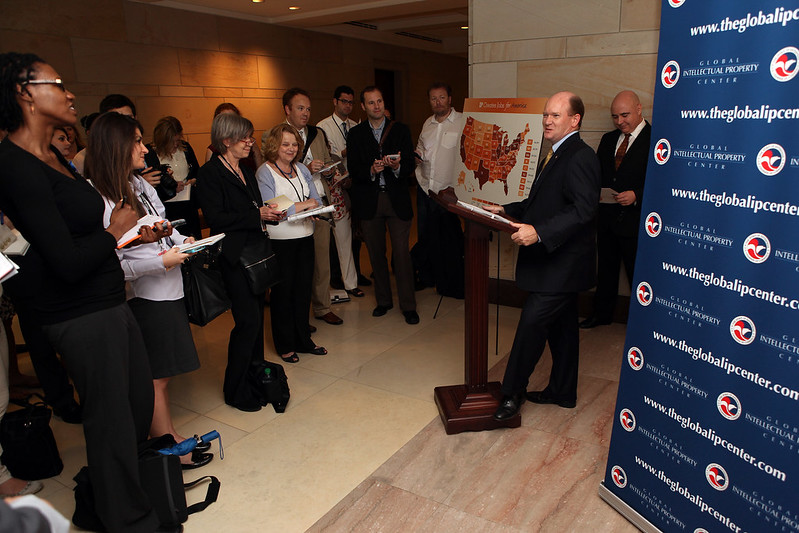
Photo of Senator Coons speaking at event on intellectual property

WASHINGTON – Speaking at an event hosted by the U.S. Chamber of Commerce’s Global Intellectual Property Center on Wednesday, U.S. Senator Chris Coons (D-Del.) praised new research that maps the broad impact that intellectual property has on the American economy and called for increased work by Congress to protect the ideas and innovations powering our economic recovery.

“Protecting American innovation means protecting American jobs,” Senator Coons said. “When thieves steal American intellectual property, they’re stealing American jobs. It really is just that simple. Offline and online, protecting American intellectual property is an economic security imperative.”

Wednesday’s event unveiled new research, which is available online at www.IPCreatesJobs.com, found that intellectual property supports 150,110 jobs in Delaware — including 57,692 direct jobs. Delaware’s intellectual property accounts for $4.9 billion in exports annually. The study also found that Delaware companies invest more than 40 percent  in research and development than the national average.

Senator Coons, who is a member of the Senate Judiciary Committee and has introduced several bills to strengthen American innovation and intellectual property, pointed to two Delaware companies whose success depends on the sanctity of their intellectual property.

“Frank Masley started stitching gloves to solve a key problem – military-issue gloves that were warm and waterproof were too bulky for key tasks,” Senator Coons said. “He used materials from several Delaware companies to develop a better glove, perfect for flying Chinooks and other military aircraft. Masley Enterprises in Newark now has military contracts and 40 employees making gloves using a proprietary tooling process. If a competitor had access to his trade secrets, his company couldn’t continue to grow. He couldn’t create more jobs.”

“IP has a real impact on companies like Adesis — a small organic chemistry company in New Castle, Delaware,” Senator Coons said, “which was crippled when a disgruntled employee walked away to a competitor with Adesis’ trade secrets in hand. As that company prospered, Adesis was forced to lay off half of its 40 employees. Adesis won the court case and is on the rebound with 55 employees today, but imagine where they could be were it not for that setback.”

A fact sheet on the impact of intellectual property on the Delaware economy can be found here: http://www.theglobalipcenter.com/sites/default/files/delaware-2012.pdf

###

Senators Coons, Rubio, Warner, and Moran introduce bill to help startups create jobs

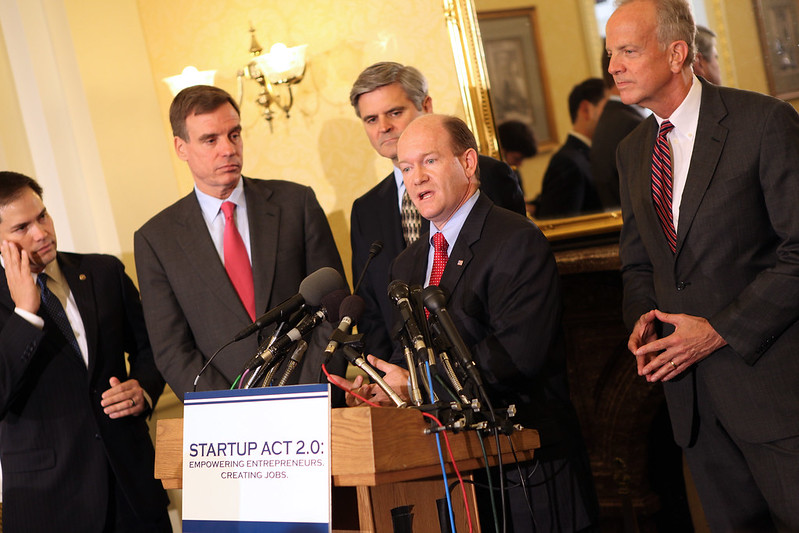
Photo from Startup Act 2.0 press conference

WASHINGTON – U.S. Senators Chris Coons (D-Del.), Marco Rubio (R-Fla.), Mark R. Warner (D-Va.), and Jerry Moran (R-Kan.) introduced bipartisan legislation, Startup Act 2.0, on Tuesday to help jumpstart the economy through the creation and growth of new businesses and jobs.  It is based upon research showing that for close to three decades, companies less than five years old have created almost all of the net new jobs in America, averaging about three million new jobs each year.

Startup Act 2.0 seeks to help move university-based research from the laboratory to the marketplace more quickly. It also makes targeted changes to the tax code to encourage investments in younger, smaller startup companies, and the bill also seeks to ease regulatory requirements that could make it more difficult for smaller businesses to expand and create jobs. Startup Act 2.0 also creates new opportunities for American-educated, entrepreneurial immigrants to remain in the U.S., where their talent and ideas can fuel growth and create American jobs.

Startup Act 2.0 builds upon the original Startup Act introduced by Sens. Warner and Moran in December, and it has been strengthened by including widely-supported provisions of S. 1866, the AGREE Act, introduced by Sens. Coons and Rubio in November. Startup Act 2.0 picks up where the JOBS Act left off by doing more to create an environment in which entrepreneurs can succeed. 

“A central tenet of the AGREE Act, which Senator Rubio and I introduced last fall, was that there is not a shortage of good ideas for helping our economy create jobs, but a shortage of political will to come together and advance them,” Senator Coons said. “Startup Act 2.0 builds on that philosophy, containing an array of smart ideas for supporting our innovative entrepreneurs. I am proud to join Senators Moran, Warner and Rubio in introducing those ideas today, and look forward to working with them to help Startup Act 2.0 become law.”

Startup Act 2.0 includes the following provisions:

  • Creates a new STEM visa so that U.S.-educated foreign students, who graduate with a master’s or Ph.D. in science, technology, engineering or mathematics, can receive a green card and stay in this country where their talent and ideas can fuel growth and create American jobs. It also creates an Entrepreneur’s Visa for legal immigrants so they can remain in the United States, launch businesses and create jobs, and eliminates the per-country caps for employment-based immigrant visas, which hinders U.S. employers from recruiting the top-tier talent they need to grow.
  • Makes permanent the exemption of capital gains taxes on the sale of startup stock held for at least five years, so investors can provide financial stability at a critical juncture of firm growth.
  • Creates a targeted research and development tax credit for young startups less than five years old and with less than $5 million in annual receipts. This R&D credit is designed to allow startups to offset employee taxes, freeing up resources to help these young companies expand and create jobs.
  • Uses existing federal R&D funding to better support university initiatives designed to bring cutting-edge R&D to the marketplace more quickly, where it can propel economic growth.
  • Requires government agencies to conduct a cost-benefit analysis of proposed “major rules” with an economic impact of $100 million or more. This new requirement will help determine the potential impact of proposed regulations on the formation and growth of new businesses.
  • And Startup Act 2.0 directs the U.S. Department of Commerce to assess state and local policies that aid in the development of new businesses. Through the publication of reports highlighting these “best practices” from across the country, policymakers will be better equipped to encourage entrepreneurship by adopting the most effective and successful policies.

“When Senator Coons and I introduced the AGREE Act last fall, we hoped it would lead to greater cooperation on job creation policies that already enjoy broad bipartisan support,” Senator Rubio said. “Teaming up with Senators Moran, Warner and Coons on Startup Act 2.0 is a worthy effort to break through Washington’s gridlock and help entrepreneurs create new jobs through key reforms to our tax, visa and regulatory systems. Startup Act 2.0 is built on ideas that have bipartisan support and could become law tomorrow if Washington stopped playing games and started working for the people.”

“Startup 2.0 offers smart, commonsense steps to support and encourage America’s innovators and entrepreneurs,” Senator Warner said. “Working together, we have put together bipartisan proposals that will help us compete and win the global contest for talent. We also propose responsible steps that will help our colleges and universities move taxpayer-funded R&D out of the lab and into the marketplace. Startup 2.0 the logical ‘next step’ following enactment of the bipartisan JOBS Act earlier this year.”

“Our bipartisan economic growth plan sets out to prove the critics wrong: Congress can get something done during an election year by coming together to strengthen the economy and create jobs,” Senator Moran said. “To get America’s economic engine roaring once again, entrepreneurs – both American and foreign-born – must be free to pursue their ideas, form companies in the United States, and hire employees. Startup Act 2.0 will create jobs for Americans by creating a circumstance in which entrepreneurs can succeed and the United States can win the global battle for talent.” 

Many of the principles included in Startup Act 2.0 are endorsed by the President’s Council on Jobs and Competitiveness, which was represented at today’s announcement by Steve Case, a co-founder of AOL. 

“The passage of the JOBS Act demonstrated that despite a tough political climate, Democrats and Republicans can come together around policies that will help entrepreneurs innovate and create jobs,” Steve Case said. “Startup Act 2.0 builds on that momentum and its passage will help solidify America’s position as the world’s most entrepreneurial nation. I am particularly pleased the bill includes a provision that will enable highly skilled engineers and entrepreneurs to start companies in the United States, as winning the global battle for talent is essential if we are going to keep our entrepreneurial economy moving forward. I commend Senators Moran, Warner, Rubio and Coons for their leadership and their willingness to come together in a bipartisan manner to focus on what unites us: a desire to create jobs, accelerate economic growth, and ensure our nation remains competitive globally.”

Startup Act 2.0 had been endorsed by TechAmerica, Financial Services Forum, National Small Business Association, CONNECT, CEA and the Computer and Communications Industry Association.

###

Congressional Delegation hosts free grant fair and workshop in Dover

DOVER, Del. — More than 200 people visited Delaware State University on Monday for a free grant fair and workshop hosted by U.S. Senators Tom Carper and Chris Coons, and U.S. Representative John Carney (all D-DE).  The event was to help Delawareans better understand the process for finding and securing grant opportunities, as well as put them in contact with 25 funders from state and federal agencies, private businesses, and the non-profit community.  In addition, participants could attend two workshops offered during the day focused on grant writing, the grant evaluation process, and best practices for securing funding.

“Today’s fair gave grant seekers an opportunity to ask questions and get answers to help them with the grant application process,” said Sen. Carper. “It’s our job to ensure that the hard working organizations seeking funding to help their communities, as well as our state, get access to the best information possible so they can compete and hopefully win critical federal grant money. Going forward, I hope these organizations continue to utilize our Congressional Delegation’s offices as a helpful resource for the grant application process.”

“This grant fair and workshop succeeded at forging connections between grant seekers and grant writers,” Sen. Coons said.  “Researching, writing and applying for grants can be a daunting process, and I’m hopeful that this event made the system easier and more accessible for small business owners, entrepreneurs and non-profits.  I look forward to hearing success stories where connections were made, applications were filed, and ultimately grants were awarded.”

“Today’s grant fair was about helping Delawareans who are doing great work in our community get better access to the resources and support they need to be successful,” said Congressman Carney.  “The state and federal grant process can be very competitive and complicated.  I’m hopeful that the lessons shared and connections made today will result in more grants awarded to deserving Delaware organizations.”

Dr. Harry L. Williams, president of Delaware State University, said that this is just another example of the teamwork of the Delaware Congressional Delegation as they continually strive for the success and prosperity of the residents of the First State.

“As our faculty here at Delaware State University has learned, there is a lot that goes into successful federal grant writing,” said Dr. Williams. “And just as this University has been able to obtain millions of dollars in federal grants, this unique opportunity has provided others with valuable information and insight that could bring more federal dollars into Delaware.” 

###