Related Issues

Related Issues

Eighty-three senators outline core principles of a final agreement with Iran in letter to President Obama

WASHINGTON – Eighty-three U.S. Senators wrote President Obama to outline core principles they believe should define any final agreement with Iran on its nuclear weapon program.

The letter was spearheaded by Senators Menendez (D-NJ), Graham (R-SC), Schumer (D-NY), Kirk (R-IL), Coons (D-DE) and Ayotte (R-NH).

In their letter, the eighty-three senators write: “Most importantly, Iran must clearly understand the consequences of failing to reach an acceptable final agreement.  We must signal unequivocally to Iran that rejecting negotiations and continuing its nuclear weapon program will lead to much more dramatic sanctions, including further limitations on Iran’s exports of crude oil and petroleum products.” 

The letter appears below and here.

President Barack Obama
The White House
1600 Pennsylvania Avenue NW
Washington, D.C. 20500

Dear Mr. President:

We all hope that nuclear negotiations succeed in preventing Iran from ever developing a nuclear weapons capability.  For diplomacy to succeed, however, we must couple our willingness to negotiate with a united and unmistakable message to the Iranian regime.

We believe, as you do, that the pressure from economic sanctions brought Iran to the table, and that it must continue until Iran abandons its efforts to build a nuclear weapon.  We also agree pressure will intensify if Iran violates the interim agreement, uses the talks simply as a delaying tactic, or walks away from the table. 

For twenty years, Congress has consistently focused attention on the threat of the Iranian program and taken the lead in initiating sanctions.  Congress has repeatedly stated that preventing an Iranian nuclear capability is a key goal of U.S. foreign policy.  Nine separate pieces of sanctions legislation have passed Congress since 1996.  We appreciate your continued commitment to preventing Iran from obtaining nuclear weapons and your efforts to implement the sanctions, which isolated and pressured the regime into negotiations.

We believe that Congress has a continuing role to play to improve the prospects for success in the talks with Iran.  As these negotiations proceed, we will outline our views about the essential goals of a final agreement with Iran, continue oversight of the interim agreement and the existing sanctions regime, and signal the consequences that will follow if Iran rejects an agreement that brings to an end its nuclear weapons ambitions.

We write now to express our support for the following core principles we believe are consistent with your administration’s positions, and urge you to insist on their realization in a final agreement with Iran:

  • We believe that Iran has no inherent right to enrichment under the Nuclear Non-Proliferation Treaty.
  • We believe any agreement must dismantle Iran’s nuclear weapons program and prevent it from ever having a uranium or plutonium path to a nuclear bomb.
  • We believe Iran has no reason to have an enrichment facility like Fordow, that the regime must give up its heavy water reactor at Arak, and that it must fully explain the questionable activities in which it engaged at Parchin and other facilities. 
  • We believe Iran must fully resolve concerns addressed in United Nations Security Council resolutions, including any military dimensions of its nuclear program.
  • We believe Iran must also submit to a long-term and intrusive inspection and verification regime to achieve the goal described in the Joint Plan of Action of “reaffirm[ing] that under no circumstances will Iran ever seek or develop any nuclear weapons.”
  • Finally, we believe Iran must not be allowed during these negotiations to circumvent sanctions.  We view this period as one fraught with the danger of companies and countries looking to improve their commercial position in Tehran, especially given recent reports of rising purchases of Iranian oil.  Iran cannot be allowed to be open for business. As you have stated, we must come down on those who are undermining sanctions “like a ton of bricks.”  

We also believe that any agreement with Iran that could lead to the proliferation of nuclear weapons or nuclear enrichment programs in the region should be rejected.

As you have said, Congress has always been a partner in presidential efforts to impose economic sanctions on Iran.  Should an acceptable final agreement be reached, your administration will need to work together with Congress to enact implementing legislation to provide longer term sanctions relief beyond existing waiver authorities – either through suspension, repeal or amendment of statutory sanctions.  Should negotiations fail or Iran violate the Joint Plan of Action, Congress will need to ensure that the legislative authority exists to rapidly and dramatically expand sanctions.  We need to work together now to prepare for either eventuality.

Most importantly, Iran must clearly understand the consequences of failing to reach an acceptable final agreement.  We must signal unequivocally to Iran that rejecting negotiations and continuing its nuclear weapon program will lead to much more dramatic sanctions, including further limitations on Iran’s exports of crude oil and petroleum products. 

Mr. President, the negotiations with Iran are likely to be arduous. We look forward to working with you on a bipartisan basis to protect America and our allies by preventing Iran from ever developing or building nuclear weapons. 

Sincerely,

Robert Menendez

Lindsey Graham

Charles E. Schumer

Mark Kirk

Christopher A. Coons

Kelly Ayotte

Richard J. Durbin

Mitch McConnell

Tim Kaine

John McCain

Mark Begich

James E. Risch

Benjamin L. Cardin

Dan Coats

Kay R. Hagan

Susan M. Collins

Barbara A. Mikulski

Orrin G. Hatch

Michael F. Bennet

Pat Roberts

Mark L. Pryor

Rob Portman

Debbie Stabenow

Mike Crapo

Sheldon Whitehouse

Patrick J. Toomey

John Walsh     

John Boozman

Heidi Heitkamp

Roger F. Wicker

Mazie K. Hirono

Mike Johanns

Martin Heinrich          

Dean Heller

Joe Donnelly

Tim Scott

Angus S. King, Jr.

Jeff Sessions

Mary L. Landrieu

David Vitter

Cory Booker

John Hoeven  

Patty Murray

Richard Burr

Robert P. Casey, Jr.

Ron Johnson

Kirsten E. Gillibrand

Jerry Moran

Jeanne Shaheen

Chuck Grassley

Al Franken

Johnny Isakson

Christopher Murphy

Lisa Murkowski

Mark Udall

Michael B. Enzi

Claire McCaskill

Thad Cochran

Jon Tester

Ted Cruz

Elizabeth Warren

Mike Lee

Edward J. Markey

John Cornyn

Lamar Alexander

John Thune

Mark R. Warner

Deb Fischer

Richard Blumenthal

Jeff Merkley

Joe Manchin III

Saxby Chambliss

Amy Klobuchar

Richard C. Shelby

Maria Cantwell          

John Barrasso

Tom Coburn   

Ron Wyden    

Roy Blunt      

Tom Udall

Jack Reed

Marco Rubio

Bill Nelson
Carper, Coons, Carney to host job fair in Sussex County on May 19

REHOBOTH BEACH, Del. – To take advantage of the nation’s continuing economic recovery and to assist local businesses in helping them find employees as the summer tourism approaches, U.S. Senators Tom Carper and Chris Coons, and U.S. Representative John Carney announced Wednesday that they will host a job fair on Monday, May 19 from 10 a.m. to 2 p.m. at the Rehoboth Beach Convention Center (229 Rehoboth Avenue) for those seeking jobs. This will be the third job fair hosted by the delegation this year.

Interested companies seeking to fill positions can contact Senator Coons’ office at 302-573-6345 or via email at workshop@coons.senate.gov. Businesses will be on hand at the fair to meet potential new employees, and only employers with positions to fill will be permitted to attend. Delawareans are encouraged to come dressed for success with resumes in hand.

“This job fair in Sussex County is an outstanding opportunity for all Delawareans, but particularly for those downstate, searching for jobs to connect with prospective employers,” Senator Carper said. “I encourage all looking to enter the workforce to attend this job fair and meet the dozens of companies looking to hire Delawareans. At every job fair I attend, I talk to employers who are hungry for qualified workers and ready to hire now. Fostering a nourishing environment for job creation in Delaware and across the country continues to be one of my top priorities.”

“Continuing to connect job seekers with businesses who are looking to hire is the most effective way to help people network and find employment,” Senator Coons said. “The Sussex County job fair brings area businesses together with job seekers from the region in hopes they can find good, steady jobs in their towns.”

“The economy is slowly improving, but there are still far too many Delawareans struggling to find jobs to support themselves and their families,” Congressman Carney said. “We’ve hosted two job fairs already this year and connected thousands of skilled job seekers with employers looking to hire.  We plan to build on this success in Rehoboth and help more Delawareans find job opportunities.”

Since 2011, the Congressional delegation has hosted 18 job fairs in Delaware, including six specifically for veterans. 

For more information on how to participate as an employer or job seeker, please call Senator Coons’ office at 302-573-6345, or emailworkshop@coons.senate.gov. Pre-registration is not required.

United States Senate condemns violence in the Central African Republic

WASHINGTON – The United States Senate on Thursday voted unanimously to condemn the ongoing violence in the Central African Republic, welcome international peacekeeping and humanitarian efforts, and urge President Obama to work with our international partners to develop a strategy for achieving a cease-fire and establishing a sustainable peace. U.S. Senators Chris Coons (D-Del.) and Jeff Flake (R-Ariz.), chair and ranking member of the Senate Foreign Relations Subcommittee on African Affairs, introduced the resolution following a hearing they held in the Subcommittee on the crisis in the Central African Republic.

“Stopping the violence in the Central African Republic requires the support and sustained engagement of the international community,” Senator Coons said. “Half of the population of CAR is in need of humanitarian assistance, and there are nearly a million refugees and internally displaced persons as a result of this crisis.  There have been horrific incidents of ethnically-based violence including mass killings and lynchings, along with the mass exodus of Muslims from the country. What we are seeing today in CAR is ethnic and religious partitioning of the country, and it requires a stronger immediate response from the international community. I am grateful to Senator Flake and my other colleagues in the Senate for unanimously supporting U.S. and international efforts to end the violence, protect civilians, and address root causes of conflict.”

Since a coup in March 2013, the Central African Republic has experienced escalating violence and lawlessness. The unrest has forced Central Africans to flee their homes – resulting in approximately 700,000 internally displaced persons and another 290,000 refugees within neighboring countries – and half the population is in need of humanitarian assistance.  Approximately 6,000 African peacekeepers and 2,000 French forces have been deployed to the Central African Republic, and last week the UN Secretary General recommended transitioning the AU-led mission to an official UN peacekeeping operation. Senator Coons chaired a hearing on the situation in CAR in the African Affairs Subcommittee in December 2013.

The resolution can be downloaded as a PDF here: http://bit.ly/1guqgI3.

Full text of the resolution is below:

RESOLUTION


Concerning the crisis in the Central African Republic and supporting United States and international efforts to end the violence, protect civilians, and address root causes of the conflict.

Whereas, for more than 50 years, successive governments in the Central African Republic have struggled to build a durable system of democratic institutions, to effectively secure and control the country’s territory and borders, and to ensure a basic level of socio-economic development for the country’s people;

Whereas, despite its natural resource wealth, the Central African Republic remains one of the poorest countries in the world and one of the lowest ranking countries in terms of human development according to the United Nations Development Program;

Whereas, in January 2013, regional leaders brokered the Libreville Agreements between the government of then-President Francois Bozizé and the loosely allied rebel militia known as Séléka, which resulted in the formation of a government of national unity;

Whereas, despite the Libreville Agreements, President Bozizé was ousted in March 2013 by the Séléka coalition, and the Séléka leader, Michel Djotodia, declared himself president;

Whereas, in April 2013, regional leaders issued the N’djamena Declaration in an effort to pursue a return to constitutional order based on the Libreville Agreements;

Whereas an influx of foreign fighters, especially from Chad and Sudan, has been a major factor in the increased number of Séléka fighters, from approximately 5,000 in March 2013, to an estimated 20,000 as of December 2013;

Whereas both Séléka forces and armed militia groups known as “anti-balakas”, some of which formed initially as a means of protecting communities against Se1le1ka, have been implicated in ethnically-motivated violence and grave and systemic human rights abuses against civilians;

Whereas, over the course of the crisis, Séléka and anti-balaka groups have displayed weak control and command structures, and committed crimes against humanity with impunity;

Whereas, according to UNICEF, thousands of child soldiers are involved in armed groups in the Central African Republic, amid the near-total collapse of the country’s primary education system;

Whereas interethnic, intercommunal, and interreligious tensions and violence have risen to alarming levels and led to systematic human rights abuses in the Central African Republic, including targeted killings, rapes, acts of torture, looting, and arbitrary detention;

Whereas the United States Embassy in Bangui suspended operations on December 28, 2012, and the ordered departure of country team staff has temporarily suspended the diplomatic presence and consular services of the United States in the Central African Republic;

Whereas more than 700,000 civilians have been internally displaced; another 290,000 have sought refuge in neighboring countries, including the Democratic Republic of the Congo, Chad, Cameroon, and South Sudan; 2,600,000 people, or over half of the population of the Central African Republic, are in need of humanitarian assistance; and 60 percent of households have no available food stocks;

Whereas a failure of the international community to appropriately respond to and address the rapidly deteriorating situation in the Central African Republic could result in further atrocities, mass displacement, and protracted instability with significant repercussions for regional and international security;

Whereas United Nations Security Council Resolution 2127 (2013) called for urgent and increased international assistance to the African Union International Support Mission in the Central African Republic (MISCA) to ensure that the force can fulfill its mandate to restore security and protect civilians, and placed an arms embargo on the Central African Republic;

Whereas United Nations Security Council Resolution 2127 requested the Secretary-General to establish an international commission of inquiry to investigate reports of human rights abuses in the Central African Republic in order to ensure accountability for perpetrators of violence;

Whereas the United Nations Integrated Peacebuilding Office in the Central African Republic has been hindered by a lack of resources and constrained by insecurity;

Whereas, consistent with United Nations Security Council Resolution 2127, the Government of France launched a stabilization operation, Operation Sangaris, in the Central African Republic to assist MISCA in fulfilling its mandate;

Whereas, on March 3, 2014, United Nations Secretary-General Ban Ki-moon recommended to the United Nations Security Council a transition to a United Nations peacekeeping mission with a primary mandate to protect civilians; and

Whereas the United States Government has provided crisis and humanitarian assistance commitments totaling $182,500,000 in response to instability in the Central African Republic, including support for conflict resolution efforts, humanitarian assistance to refugees and internally displaced persons, and assistance to troop contributing countries to MISCA such as airlift, non-lethal equipment, military logistics, and training, as well as logistical support for French forces: Now, therefore, be it

Resolved, That the Senate—

(1) condemns the violence, atrocities, abuses, and human rights violations committed by all parties to the conflict in the Central African Republic;

(2) commends the efforts of religious and community leaders in the Central African Republic condemning violence and engaging in conflict prevention and conflict resolution activities;

(3) welcomes the mobilization of international peacekeeping, conflict mitigation, humanitarian, and diplomatic resources, and encourages continued efforts to help address humanitarian needs, bring an end to the violence, and develop sustainable democratic institutions in the Central African Republic;

(4) welcomes the January 2014 decision of the Transitional National Council on the election of Catherine Samba-Panza as the Central African Republic’s new transitional president;

(5) commends the African Union and its troop and police contributing countries for their work establishing and supporting MISCA;

(6) recognizes the Economic Community of Central African States (CEEAS) for its leadership in the political transition process;

(7) commends France for its swift intervention under United Nations Security Council Resolution 2127, and for its contributions to stabilization efforts and other forms of assistance;

(8) welcomes the United Nations Security Council support for MISCA and the Department of Peacekeeping Operation’s ongoing contingency planning for a possible transition to a United Nations peacekeeping operation;

(9) affirms support for multilateral peacekeeping and policing capacities and recognizes the important contributions these efforts have made in protecting civilians in the Central African Republic and promoting international peace and stability;

(10) calls on the President to work with international partners to develop a short-term strategy to support a full and immediate cessation of armed conflict in the Central African Republic, including attacks targeting civilians and the recruitment of child soldiers;

(11) calls on the President to develop a long-term United States strategy, in support of international and domestic efforts, to establish a durable peace and greater security for the Central African Republic and to enhance regional stability, including—

(A) engagement and coordination with the international community, including the African Union, the Economic Community of Central African States, the United Nations, and other partners;

(B) appropriate assistance to help provide emergency relief and support reconciliation for the people of the Central African Republic;

(C) technical, logistical and other forms of assistance, as appropriate, in support of effective disarmament, demobilization, and reintegration of fighters; and

(D) support for appropriate mechanisms to ensure accountability for perpetrators of human rights abuses and violence; and

(12) urges the Secretary of State to consider the expeditious reestablishment of a United States diplomatic presence in the Central African Republic.

Senator Coons cosponsors bill to increase federal minimum wage

WASHINGTON – U.S. Senator Chris Coons (D-Del.) has cosponsored a bill to raise the federal minimum wage for the first time in five years. The Minimum Wage Fairness Act would increase the minimum wage from $7.25 to $10.10 per hour over three years, boosting the earnings of more than 78,000 Delawareans and lifting more than 11,000 Delaware families out of poverty.

The bill would provide for automatic annual increases to the minimum wage to keep pace with inflation and would also gradually raise the minimum wage for tipped workers — which currently stands at just $2.13 an hour — for the first time in more than 20 years.

“While our economy has grown over the last four years, minimum-wage workers have been left behind,” Senator Coons said. “The purchasing power of the minimum wage has declined by more than 30 percent over the last four decades, leaving millions of full-time workers and their families living in poverty. If we want to continue on the path to sustainable, long-term growth, we have to expand economic participation by helping workers climb out of poverty and ensuring access to a fair, living wage into the future. Raising the minimum wage is the right thing to do for our economy, our businesses, and our middle class, and I hope my colleagues in the Senate will come together to get it done this spring.” 

The minimum wage today pays just $15,000 per year — $3,000 below the poverty level for a family of three. The Minimum Wage Fairness Act would boost the annual minimum wage to $21,000, lifting millions of families above the poverty line.

Nationally, the Minimum Wage Fairness Act would increase the wages of more than 30 million American workers, more than half of whom are women. In Delaware, where women make up nearly two-thirds of all minimum wage workers, 47,000 women would receive a raise, helping to close the state’s longstanding gender wage gap.

In January 2014, the Delaware legislature passed — and Governor Markell signed into law — legislation raising the minimum wage in Delaware to $8.25 per hour over two years. Beginning in June 2014, the state’s hourly minimum wage will go up 50 cents to $7.75, increasing again to $8.25 in June 2015. 

Senator Coons testifies about his election-reform legislation

WASHINGTON – U.S. Senator Chris Coons (D-Del.) testified before the Senate Committee on Rules and Administration on Wednesday about his bill to make substantial improvements to the administration of elections and to make voting faster and more accessible to all voters. The Fair, Accurate, Secure and Timely (FAST) Voting Act would create a competitive grant program to encourage states to aggressively pursue election reform. The states that demonstrate the most comprehensive and promising reform plans would earn a greater portion of the grant funding.

“Voting is the ultimate civil right in our free society, and we should treat it accordingly,” Senator Coons testified. “The November 2012 elections were a wake-up call. Tens of thousands of Americans, including Republicans and Democrats in both ‘red states’ and ‘blue states,’ saw their fundamental right to vote for the candidate of their choice eroded by exceptionally long lines and confusing procedures in well over a dozen states. It does not have to be this way. We can pass the FAST Voting Act to accelerate the adoption of efficient and effective practices for administering elections.” 

“This bill creates incentives for a ‘Race to the Top’ structure to encourage states to adopt many of the best practices, and I think that’s a great idea too,” Rules Committee Chairman Chuck Schumer said. “To have the states compete to do better and give them a reward for doing better worked very well in Race to the Top, and I think it will work very well in elections too, where you have the same idea: federal interest, but basically state laws governing.” Watch the Chairman’s opening remarks here: http://bit.ly/1g9NKRK

The bill was originally introduced in November 2012, just over a week after an Election Day that saw extraordinarily long lines and a myriad of voting issues in more than a dozen states, including Florida, Pennsylvania, Colorado, Ohio, New York, Massachusetts, Wisconsin, Virginia, South Carolina, Montana, Tennessee, Hawaii, Arizona, Rhode Island, and more. 

This bill authorizes a federal program that would award grants based on how well applicant states are able to improve access to the polls in at least nine specified ways, including:

  • Providing flexible registration opportunities, including same-day registration;
  • Providing early voting, at a minimum of 9 of the 10 calendar days preceding an election;
  • Providing absentee voting, including no-excuse absentee voting;
  • Providing assistance to voters who do not speak English as a primary language;
  • Providing assistance to voters with disabilities, including visual impairment;
  • Providing effective access to voting for members of the armed services;
  • Providing formal training of election officials, including state and county administrators and volunteers;
  • Auditing and reducing waiting times at polling stations; and
  • Creating contingency plans for voting in the event of a natural or other disaster.

The program also requires an assessment of steps the state has taken to eliminate statutory, regulatory, procedural and other barriers to expedited voting and accessible voter registration.

The New York Times offered its support for the FAST Voting Act in November 2012: http://nyti.ms/T5DvnK, as did the Washington Post in December 2012: http://bit.ly/TmwS6b

Senator Coons’ full testimony is below:

– As Delivered on March 12, 2014 –

Thank you, Chairman Schumer, and thank you Ranking Member Senator Roberts for inviting me to testify. Thank you especially Senator Warner, for his leadership and advocacy for the legislation I am here to present on – the Fair, Accurate, Secure and Timely – (FAST) – Voting Act.

I also thank Senator Warner, for his leadership and advocacy for the legislation I am here to discuss – the Fair, Accurate, Secure and Timely – (FAST) – Voting Act.

The FAST Voting Act draws on the framework of the successful Race to the Top education reform program to reward states that make substantial improvements in the administration of their elections to make voting faster and more accessible to all citizens.

The legislation incentivizes states to put forward their best efforts to improve elections.  As a competitive grant program, the best proposals with the greatest impact are rewarded with the seed money to make it happen. 

The critical metrics of this evaluation are clear – Indeed, the bipartisan Presidential Commission on Election Administration (PCEA) report highlights the need for all states to improve in the following areas, which are also enumerated in the FAST Voting Act:

Online voter registration to enhance both accuracy of the voter rolls and efficiency; Early Voting – either by mail or in-person voting so that all people who work can also vote; Improving the ability of military and overseas voters to access ballots and other voting materials; Electronic pollbooks – for greater accuracy and efficiency; Enhancing training of poll workers; and Addressing the needs of voters with disabilities and those with limited English proficiency.

We know what needs to be done. Now it’s time to get moving. The November 2012 elections were a wake-up call.

Tens of thousands of Americans, including Republicans and Democrats in both “red states” and “blue states,” saw their fundamental right to vote for the candidate of their choice eroded by exceptionally long lines and confusing procedures in well over a dozen states.

We saw errors on voter rolls in Ohio and delays in counting ballots in Arizona.

We saw voters waiting in line five hours in Virginia and eight hours in Florida. 

In Colorado, voters said they checked the box on the touchscreen panel to vote for Mitt Romney, but that the machine kept switching their pick to President Obama, while in Pennsylvania, voters reported the same problem in reverse – that their selection of President Obama was registered as a vote for Governor Romney.

This is unacceptable.  Voting is the ultimate civil right in our free society, and we should treat it accordingly. 

When a polling station runs out of ballots, our friends and our neighbors are effectively disenfranchised.  Likewise, when the lines at a polling station are too long, our fellow citizens are forced to choose between losing their job and forfeiting their right to vote.

It does not have to be this way.  We can pass the FAST Voting Act to accelerate the adoption of efficient and effective practices for administering elections.  

While many states are struggling, there are also good examples for others to follow.

In my home state of Delaware, we have an exceptional State Election Commissioner, Elaine Manlove, who has helped lead the way through her tireless efforts to improve the voting experience in Delaware. An instructive example is her leadership on e-Signature, or electronic signature. eSignature is a voter registration method that can be implemented at registration sites – including Departments of Motor Vehicles – to streamline the process through which many Americans register to vote.

In the old system, the need for a signature was accomplished on a paper application, which would then be collected from DMV locations, transferred to the Election Commission, reviewed, entered by another person, and then archived. Now, with an electronic signature available on the same interface as DMV transactions, the data is transmitted directly and error-free to the voter rolls. 

Because of Elaine Manlove’s leadership, Delaware voters will experience fewer errors, less wait time, and lower costs.

We owe it to our fellow citizens to help spread the technology, the policies, and the lessons learned in states like Delaware to make elections run better everywhere.

Our Democracy is the oldest in the world, and currently it is showing its age. We cannot stand idly by as our elections become a ritual in embarrassment.

Let’s continue to be a leader in the free world, and help our states conduct the elections our constituents deserve. 

I look forward to working with this committee to pass the FAST Voting Act.

Senator Coons participates in roundtable with women business leaders

Steering Committee meeting with women business leaders

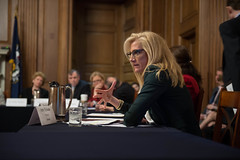
WASHINGTON – U.S. Senator Chris Coons (D-Del.) participated in a roundtable discussion with women business leaders in the Capitol on Wednesday focused on job creation, STEM education, and fostering women’s leadership. Amy Ericson, President of Alstom, Inc. and a Wilmington, Delaware native, was among the participants and briefed senators on Alstom’s groundbreaking work in the power generation and rail transportation sectors. As the female head of a major U.S. company, she also offered her perspective on the need to expand opportunities for qualified women to take on business leadership positions.

“If America is to lead the world in innovation, manufacturing, and business, we need to utilize the talents of all of our citizens,” Senator Coons said. “Though more women are leading companies today than ever before, they are still in the vast minority, particularly in critical STEM fields. Business leaders like Amy Ericson are proof positive that women make strong and capable executives in every field. As a father, I am thankful for the example Amy and her peers set for my daughter, and I look forward to continuing to work with them to expand opportunity for all American workers.”

Steering Committee meeting with women CEOs“As a leader of an energy and rail transport technology company, and mother of four daughters, economic recovery is a constant focus for me at work and at home,” said Amy Ericson, President of Alstom, Inc. “Innovation is critical to driving economic recovery and growth and yet we’ve been slow to expand the nation’s pool of innovative thinkers.  We need to break from traditional recruitment methods and significantly broaden our efforts so we attract a new and diverse mix of students and business leaders.” 

Alstom is a global leader in power generation, power transmission, and rail infrastructure. The company employs 7,000 workers in the U.S., including 50 in Delaware, where its New Castle maintenance and supply facility services both of Delaware’s Amtrak facilities and the Acela train sets. Alstom’s global services include integrated power plant solutions for energy sources including hydro, nuclear, gas, coal and wind, as well as a wide range of solutions for power transmission, with a focus on smart grids. The company has produced 7,000 of the nation’s subway and rail transit vehicles and is responsible for developing the world’s fastest train and highest capacity automated metro.


Senator Coons votes to reform broken military justice system

WASHINGTON – U.S. Senator Chris Coons (D-Del.) voted Monday to approve reforms to the military justice system aimed at addressing the crisis of sexual assault in the military. The Victims Protection Act of 2014, which would reform the military justice system to better protect victims and prevent sexual assault, was approved by a unanimous vote of 97-0. Senator Coons was a cosponsor of an alternative bill, defeated in the Senate on Thursday, which would have would have reformed the justice system by removing the prosecution of all crimes punishable by a year or more in confinement from the chain of command, except crimes that are uniquely military in nature.

“Our servicemen and women put their lives on the line to protect our country, but they should never have to fear for their safety within their own ranks. The crisis of sexual assault in our military has shaken faith in one of our most respected institutions and revealed tragic shortcomings in the code of military justice that must be addressed. The bill passed by the Senate today, together with reforms passed by Congress last year, represents an important step forward to strengthen protections for victims of sexual assault and increase accountability in the chain of command. These reforms will give victims greater input into where cases are tried and greater recourse to address instances of possible retaliation. They will ensure perpetrators cannot use good military character as a defense and that commanding officers are held accountable for the treatment of victims in their respective units. I am grateful for the progress made today and for the leadership of Senators McCaskill and Gillibrand in elevating this critical issue. The men and women who dedicate themselves to keeping us safe deserve the same unwavering commitment from us in return.”

Carper, Coons, Carney announce $3.2 million grant from FEMA

WASHINGTON- Today, Senators Tom Carper and Chris Coons, and Representative John Carney (all D-Del.) announced an award from the Emergency Management Performance Grant Program (EMPG) by the Federal Emergency Management Agency (FEMA). Awards from the grant are used to enhance emergency response capabilities of states. In FY 2014, Delaware will be awarded $3.2 million, an increase from $3.06 million in FY2013.

“The Federal Emergency Management Agency’s Emergency Management Performance Grant Program is a critical source of funding for our state’s first responders and emergency management personnel,” said Senator Carper, Chairman of the Committee on Homeland Security and Governmental Affairs. “As a low-lying, coastal state, Delaware has seen its share of natural disasters, particularly in the past few years. The funds from the grant will help to ensure that our emergency management agencies are prepared to take on whatever may come next and save lives.” 

“The safety of our communities depends on the investments we make in emergency-preparedness,” said Senator Coons. “As the lowest mean elevation state in the country, Delaware and our coastal communities are often among the hardest hit when extreme weather occurs. This funding will help us continue to invest in making our state more resilient and will ensure our first responders have the resources they need to protect Delawareans in an emergency.”

“Delaware’s emergency responders work hard to protect us.  They often put themselves in danger to ensure the health and safety of others,” said Congressman Carney.  “This funding helps provide the equipment and training they need to be successful.  It’s an investment that pays off for our entire state.”

The EMPG is an annual grant from the Department of Homeland Security that provides resources to assist state, local, tribal, and territorial governments in preparing for disasters. Total funding for the program in the FY2014 is $350,100,000. Funding from the program is supposed to be put towards planning, operations, equipment acquisitions, training, exercises, construction and renovation in enhancing and sustaining a state’s disaster response capabilities. For more information about the grant, visit FEMA’s website: http://www.fema.gov/grants. 

President Clinton, leading experts on Africa highlight third annual Opportunity: Africa Conference

WILMINGTON, Del – U.S. Senator Chris Coons (D-Del.), chair of the Senate Foreign Relations Subcommittee on African Affairs, hosted more than 1,200 attendees Monday at the third annual Opportunity: Africa conference at the Chase Center on the Riverfront. The conference, highlighted by former President Bill Clinton’s keynote address, brought Delaware businesses, faith communities, and individuals together with top experts on Africa to share insights on trade opportunities and issues including human rights challenges, sustainable development, food security, and global health.

This year’s conference focused on the key opportunities and challenges facing Africa today: addressing energy poverty, promoting business development, combatting wildlife trafficking, and empowering women leaders.

“When I began hosting this conference two years ago, I did so with the intention of uniting Delawareans focused on Africa, to help connect and cultivate the community among us,” said Senator Coons. “Today, a diverse group of individuals from five different countries and 18 different states came together to hear from some of the most extraordinary experts, including former President Bill Clinton, about the incredible opportunities and ongoing challenges presented by the continent of the 21st century – Africa.”

The Clinton Foundation invests heavily in programs to strengthen African health systems and expand access to lifesaving treatments; to provide African farmers with the tools they need to increase their incomes and strengthen their communities; and to address climate change by working to improve energy efficiency, reverse deforestation, and help cities to develop sustainably.

While in the White House, President Clinton signed into law the landmark African Growth and Opportunity Act (AGOA), which has supported the growth of an African middle class, reduced dependence on development assistance, and further opened African markets to American companies.

President Clinton discussed some of the key issues impacting Africa and how the United States can be a force for growth and empowerment on the continent. He cited the impact the U.S. has already made through AGOA and efforts to expand access to HIV/AIDS treatment, and emphasized the important work that must continue to expand access to opportunity, improve agricultural productivity, and combat the crisis of wildlife trafficking throughout Africa.

“My belief is that we live in an interdependent world that is full of possibilities, but that the world we live in is being severely constrained by too much inequality – inequality in access to education and healthcare, employment, training, and capital – and by too much insecurity, ” President Clinton said.

Despite the security challenges we face across the continent, Clinton said, “we dare not let ethnic and tribal conflicts overwhelm the staggering human potential in Africa.” 

“No American official has demonstrated a greater commitment to Africa than President Bill Clinton, whose leadership on health, gender equality, trade, and food security began with his presidency and continues today with the Clinton Global Initiative and Clinton Foundation,” said Senator Coons.

Carper, Coons, Carney welcome more than 90 companies, 2,000 job seekers to job fair

WILMINGTON, Del. – A job fair hosted by U.S. Senators Tom Carper and Chris Coons, and U.S. Representative John Carney in conjunction with Brandywine Counseling and Community Services drew more than 2,000 job seekers to the Chase Center on the Riverfront to meet more than 90 employers from Delaware.

Companies such as AAA Mid Atlantic, Amazon, Bank of America, DoubleTree by Hilton Downtown, and Mountaire Farms received hundreds of applications and in some cases conducted on-the-spot interviews with candidates. Attendees also participated in workshops presented by the Office of Personnel Management on how to apply for federal jobs as well as a motivational and personal branding seminar by author S. Renee Smith.

“We just learned yesterday that jobless claims in the U.S. have fallen to the lowest level in three months,” said Senator Carper. “I’m encouraged by that and what I’m hearing from employers and job seekers across the state. However, I realize a lot of people are still unemployed and still hurting. I’m optimistic that our job fair today helped some of our unemployed or under-employed get on a path to gainful employment. I will keep working with Senator Coons and Congressman Carney to create a nourishing environment for job growth until we’ve got everyone back to work.”

“Even with unemployment in Delaware at a five-year low, many of our neighbors are still looking for work,” said Senator Coons. “We have a strong, dedicated workforce, ready and willing, as evidenced by today’s turnout, to fill open positions at our local businesses. These job fairs are a simple way to help connect Delawareans with real job opportunities and make a positive difference in our neighbors’ lives.” 

“Today’s job fair connected nearly 2,000 job seekers with employers ready to hire,” said Congressman Carney.  “It’s an important opportunity for those who attended and walked away with information and connections that will help in their job search.  It also shows that we have a lot more to do so that every Delawarean has the chance to work and support their family.  I look forward to our next job fair later this year in Sussex County.”  

Since 2011, the Congressional delegation has hosted 19 job fairs in Delaware, including five specifically for veterans.