Related Issues

Related Issues

Sen. Coons in hearing on Dobbs decision: “what other fundamental rights might… be at risk?”

WASHINGTON – Today, U.S. Senator Chris Coons (D-Del.), a member of the Senate Judiciary Committee, spoke at a hearing focused on the Supreme Court’s recent ruling in Dobbs v. Jackson, the decision that overturned Roe v. Wade and reversed nearly 50 years of precedent on abortion access and reproductive health care. Senator Coons questioned witnesses about the impacts of this decision on the rights and health of women and girls, as well as the long range implications of this interpretation of the constitution on other fundamental rights. 

You can see his full questioning below. 
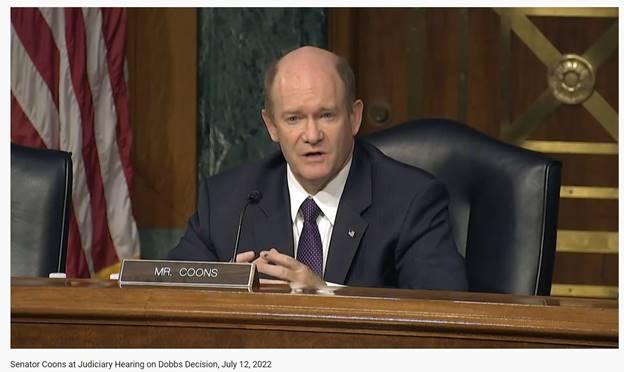
WATCH HERE

Sen. Coons: As we’ve heard today, in testimony both from my colleagues and from this panel, the conservative activist majority on the Supreme Court abandoned decades of precedent protecting the rights of women to choose their reproductive health care course, and it has immediate consequences for the autonomy and the health of millions and millions of women in this country. I’m concerned that the restrictions that we’ve seen in Dobbs’ wake will further exacerbate inequalities in access to health care in this country. Some of the states, as my colleague Senator Booker just observed, that are rushing to restrict this right also have among the highest maternal mortality rates in this country. I am grateful that President Biden promptly took steps to mitigate the impacts of the Court’s policy decision. These topics are intensely emotional and divisive and are challenging for us to work through in an appropriate, safe, and constructive way in the democratic process.  They are and should be the focus of discussion, debate, and action in the months ahead. So I’m going to focus my questions today on the radical legal implications of this activist Court’s decision in Dobbs, and the very real human consequences and impact. Weeks ago generations of women and girls in our country understood the Constitution protected them against being forced to bear children against their will. Today, those same women and girls have been told that the right to make their own decisions about reproductive health is not a freedom guaranteed under our laws, and depending on where they live, that the state may force them to carry a pregnancy to term and give birth. If I might, Professor Bridges, the conservative history and tradition analysis, as I understand it, seems to fundamentally shortchange the rights of women and other groups of peopleracial [and] religious minoritieswho had no power in the democratic process at the relevant time when key decisions were made, and this is fundamentally flawed. I’d be interested in your brief comments on what’s the danger of the justices’ reliance on selective historical analyses to roll back a fundamental and protected constitutional right? And if this majority can engage in a moment of activism to reverse precedent that guarantees protections for women’s bodily autonomy, what other fundamental rights might reasonably be imagined to be at risk?

Professor Khiara Bridges: So looking to the nation’s history, whether that, you know, date is 1787, when the Constitution was ratified, 1789, when the Bill of Rights was ratified, or 1868, when the 14th Amendment was ratified, is to look at periods of the nation’s histories in which marginalized populations today were completely erased. So I can talk about the LGBTQ community. They were not contemplated by the framers, by those who ratified the Constitution, their ability to live lives that are—have dignity, their ability to love who they love and to marry who they marry. That just wasn’t contemplated by those folks who ratified the Constitution. People of color, immigrants, people with disabilities, people with the capacity for pregnancy, right. All of those groups were not simply thought of and their interests were not considered during that moment in the nation’s history. So, I can tell you the litany of cases that we ought to be wary about being reversed–Obergefell v. Hodges, Lawrence v. Texas, Loving v. Virginia, Skinner v. Oklahoma.

Sen. Coons: Professor, what’s the common thread across all those cases? Some folks who are watching may not know as much as you do about the specifics of what kinds of freedoms are protected by that whole line of cases.

Professor Khiara Bridges: The court framed these, these cases, the link that links them, is this using the liberty term of the due process clause to recognize that people need the capacity to make decisions about their personal lives, about whether they create a family, about how they raise their family, about decisions regarding love and sex and marriage, and, and so, to pull Roe out of that thread of cases, that have all recognized the right to privacy and liberty interest, is to create a chaos and create uncertainty with regard to those cases that came after and that’s Lawrence vs. Texas protecting same sex contact, same sex marriage, as well as the cases that came before.

Sen. Coons: Thank you, Professor. That’s an insightful comment on how much else is at risk here and why this impacts fundamental rights that we’ve, many of us, millions of us, come to rely on to make decisions about our own life, about our families, about who we love, how we love, and when and how we choose to have children. Lieutenant Governor, if I might, I’m almost out of time. Nothing in the Dobbs opinion, blocks states from subjecting abortion providers, women, and girls, and others seeking abortion care and trying to help them access abortion care to criminal penalties, is that correct? There’s nothing in the Dobbs decision that block states from imposing criminal penalties for seeking to access abortion care. Do you expect, as a result of this decision, we’ll have now a whole series of efforts at the state level that will result in contentious litigation and imposition, potentially, of criminal penalties on folks who are simply trying to help family members access abortion care?

Hon. Juliana Stratton: I think that we are in the midst of seeing the kind of chaos that has been created by this decision and what is happening all across the country, where we are seeing different decisions, legislation that’s been both proposed and passed. We’ve seen trigger laws; we’ve seen people seeking to travel from state to state and cross state lines. It is chaotic and it is something that is causing harm and causes insurmountable challenges, quite frankly, for those who are trying to figure out what’s possible. We need to make sure that people have the right to make decisions about what’s best for them with their physician, not from politicians, and that’s exactly what has been opened up with this decision.

Sen. Coons:  Thank you.


###

Sens. Coons, Sasse announce legislation to reduce polarization and support community bridgebuilding

WASHINGTON—Leading up to the celebration of Independence Day,  U.S. Senators Chris Coons (D-Del.) and Ben Sasse (R-Neb.) today announced they would introduce a Senate companion to the Building Civic Bridges Act, bipartisan legislation that would empower communities to assist local civic and community organizations with ongoing efforts to address contentious civic issues and reduce polarization at the local level. The House companion bill was introduced by Rep. Derek Kilmer (D-Was.) and Andy Barr (R-Ken.) in February.

“This bipartisan bill with Senator Sasse would strengthen America’s civic fabric as we approach the country’s birthday,” said Senator Coons. “The roots of democracy lie not in the halls of Congress, but in conversations between neighbors who see the word differently and seek to understand one another. This bill will play a crucial role in nourishing those roots, and I am grateful to Reps. Kilmer and Barr for helping spearhead this effort.”

“America only works if we pass the American idea onto the next generation and right now that isn’t happening as well as it should. Americans are capable of doing big things, and most of that begins at the local level— in rotary clubs, schools, and community non-profits. This bill recognizes that civics starts locally and it provides tools to these local communities to promote civic engagement,” said Senator Sasse.

“Universities have a unique role to play in fostering civil discussion, and that kind of earnest engagement across deep divides is more important now than ever before,” said Association of American Universities President Barbara R. Snyder. “I applaud Sens. Coons and Sasse for introducing the Building Civic Bridges Act in the Senate as a smart way to encourage civic engagement and to renew our commitment to democracy.”

“The Building Civic Bridges Act invites us to truly engage with one another as fellow Americans. This is a time to build bridges, not barriers,” said Eboo Patel, Founder & President of Interfaith America. “By empowering local leaders to expand trust and deepen relationships within our communities, we can focus on that which unites us, rather than the issues that pull us apart. I commend the co-sponsors for the moral imagination behind this bill and welcome the opportunity to ensure that local bridgebuilding efforts flourish in our country.”

“The U.S. Chamber of Commerce supports the Building Civic Bridges Act and thanks the co-sponsors for crafting this important bill to help local communities foster civic discourse to address shared challenges.  We believe this bill would provide important tools to leaders in America address many challenges.  The Chamber supports this legislation,” said Neil L. Bradley, Executive Vice President, Chief Policy Officer, and Head of Strategic Advocacy for the U.S. Chamber of Commerce

“These days it seems nearly impossible to find areas where Americans from both parties can agree. AmeriCorps is that exception. It brings us together as a community and helps us find common ground as a country. So, it is only fitting that an Office of Civic Bridgebuilding should reside within the AmeriCorps agency,” said AnnMaura Connolly, President of Voices for National Service. “We’re grateful to the bipartisan House and Senate leaders who have come together around this legislation with a goal of building relationships across lines of difference through service.”

“Whether at protest rallies or on social media, Americans have become adept at criticizing each other, often twisting the truth in the process.  But we have allowed our skills of respectful listening and building bridges across differences to atrophy. We urgently need initiatives that bring us together, not around a lowest common denominator, but around the intersection of our deepest convictions,” said Galen Carey, Vice President of Government Relations for the National Association of Evangelicals

A recent report from the Bipartisan Commission on the Practice of Democratic Citizenship points out that the U.S. government spends tens of millions of dollars through the National Endowment for Democracy trying to foster social cohesion and support civic bridgebuilding in other countries to strengthen democracy abroad — yet it does none of that work here in the United States. Meanwhile, political polarization here at home continues to trend upward; According to an NBC News poll conducted in January 2022, 70 percent of Americans agree with the statement that “America has become so polarized that it can no longer solve the major issues facing the country — and that those differences will only continue to grow,” up from 45 percent in 2010.

The Building Civic Bridges Act would work to rectify this problem by creating a new non-partisan pilot program, led by an Office of Civic Bridgebuilding within AmeriCorps, focused on building relationships to increase public trust and reduce polarization. Among other things, the office would be empowered to allocate federal grants on a competitive basis to bolster civic organizations and support AmeriCorps members in developing skills that could bridge public divides.

A one-pager for this bill is available here.  

The bill text is here

A full list of supportive organizations and quotes is available here


###

Sen. Coons joins bipartisan congressional delegation to NATO Summit as path clears for Finland & Sweden’s accession

(Washington, DC) – U.S. Senator Chris Coons (D-Del.), member of the Senate Foreign Relations Committee and the Senate NATO Observer Group, joined Senators Jeanne Shaheen (D-N.H.), Thom Tillis (R-N.C.), Dick Durbin (D-Ill.), Deb Fischer (R-Neb.), Roy Blunt (R-Mo.) and Joni Ernst (R-Iowa) in a joint statement reacting to the announcement that Turkey will drop its hold on Finland’s and Sweden’s application to join the transatlantic Alliance. The senators are currently on a delegation participating in the NATO summit in Madrid. The delegation previously stopped in Finland and Sweden to meet with heads of state and partake in other bilateral meetings with the respective nations’ administration officials. 

“It is important that all NATO Allies work together to accelerate Finland and Sweden’s accession into NATO, which is why we are very encouraged that an agreement was reached that will allow their applications to advance,” said the lawmakers. “Finland and Sweden’s contributions to the Alliance will strengthen our response to an emboldened and revisionist Vladimir Putin. We appreciate the Secretary General and U.S. and allied officials working diligently with President Erdogan and Finland and Sweden’s leadership to reach this moment. Our bilateral and multilateral meetings with NATO member states and NATO aspirant nations have been productive, and we look forward to sharing that progress with fellow lawmakers upon our return to the United States to increase U.S. support for NATO and push for a swift approval process in the Senate for Finland and Sweden. For more than seventy years, NATO has upheld transatlantic security. That mission endures, and with the inclusion of Finland and Sweden, we are best positioned to rebuke Putin’s aggression that is targeting Ukraine and threatening democracies worldwide.” 

###

Sen. Coons Statement on Dobbs v. Jackson Women’s Health Organization Decision

WASHINGTON—Senator Chris Coons (D-Del.), a member of the Senate Judiciary Committee, issued the following statement after the release of the Dobbs v. Jackson Women’s Health Organization decision, which appears to overturn the half-century-old Roe v. Wade precedent:

“Reversing Roe’s long-settled protections is the shameful end result of a decades-long conservative campaign to construct a Supreme Court that would gut the right to choose. It’s the definition of conservative judicial activism: overthrowing a 50 year-old settled legal precedent without regard and laying the groundwork for extremists to go after even more long-held fundamental rights.

“Today’s decision puts at risk women’s access to birth control and allow states to criminalize women seeking access to reproductive health care, even in cases of rape or incest. States are already following through on that; roughly half the states in our country will make all or nearly all abortions illegal, leading to gross inequalities in access. 

“Every woman in America deserves the chance to make their own reproductive health care choices, and it’s now more important than ever that we work to make sure women broadly have access to reproductive health care.”  


###


Sen. Coons statement on Senate passage of the Bipartisan Safer Communities Act

WASHINGTON–Senator Chris Coons (D-Del.), a member of the bipartisan group of 20 senators that negotiated the agreement to address gun safety and mental health, released the following statement today after voting to pass the Bipartisan Safer Communities Act:

“Today, we are one step closer to keeping Americans safer from gun violence. By closing the so-called “Boyfriend Loophole,” bolstering red flag laws, investing in community violence intervention, and making substantial investments in community mental health, the Bipartisan Safer Communities Act will help save lives. It is proof bipartisanship can still work in the U.S. Senate.

“I’d like to thank Senator Murphy, Senator Sinema, Senator Cornyn, and Senator Tillis for their determined efforts to make this legislation a reality. I am even more grateful to the millions of Americans who have worked tirelessly to keep this issue front and center. When this bill passes the House and President Biden swiftly signs it into law, this will be their victory.”


###

Sen. Coons Statement on New York State Rifle & Pistol Association v. Bruen decision

WASHINGTON – U.S. Senator Chris Coons (D-Del.), a member of the bipartisan group of 20 senators that negotiated an agreement to address gun safety and mental health, released the following statement today after the Supreme Court issued its opinion on New York State Rifle & Pistol Association v. Bruen, finding that there is a constitutional right to carry a handgun outside the home for self-defense:

“On a day when the U.S. Senate is about to pass historic, bipartisan gun safety legislation that will save lives, the current Supreme Court has issued a decision that will likely put more lives at risk. Today’s decision is the product of a generations-long right-wing effort to alter the Court. Today’s court is led by conservative judicial activists who twist Constitutional analysis to substitute their own policy preferences for laws passed by Congress or the states.

“I am grateful that Democrats and Republicans are standing together to send a message that reasonable laws to prevent gun violence don’t threaten constitutional rights—they save lives. We must pass the Bipartisan Safer Communities Act as soon as we can.”   


###

Coons, Portman introduce legislation to advance trade negotiations with the United Kingdom

WASHINGTON – U.S. Senators Chris Coons (D-Del.) and Rob Portman (R-Ohio), co-founders and co-chairs of the Senate UK Trade Caucus, today introduced the Securing Privileged Economic, Commercial, Investment, And Legal Rights to Ensure Longstanding Atlantic Trade and Investment Opportunities and Nurture Security, Happiness, Innovation, and Prosperity Act, or the SPECIAL RELATIONSHIP Act. The new legislation would give the president five years to take advantage of “fast-track” authority, and secure an up-or-down vote in Congress on any comprehensive trade agreement negotiated with the United Kingdom.

“The United Kingdom is one of our oldest trading partners and strongest allies. Negotiating a robust, comprehensive free trade agreement with the UK is in the interest of Delaware workers, businesses, and consumers,” said Senator Coons. “The Biden administration has advanced our engagement through the U.S.-UK Dialogue on the Future of Atlantic Trade, and by passing this bill Congress can demonstrate bipartisan support for a new trade deal that includes ambitious international standards for our shared priorities on climate, labor protections, digital trade, and intellectual property rights.” 

“As one of our oldest trading partners, resuming trade talks with the United Kingdom is a no brainer. We are close allies and trading partners and a trade agreement would strengthen our relationship and economic competitiveness, especially with respect to non-market economies,” said Senator Portman.  “We need to get back into the business of expanding trading relationships around the world so we can export more American-made products and create jobs here at home.  Reaching a bilateral trade agreement with the United Kingdom will benefit U.S. workers and businesses and strengthen the economic and security ties between our two countries.”

The U.S.-Mexico-Canada Agreement, which passed the Senate with overwhelming bipartisan support in 2020, set high standards in areas of labor rights, environmental protection, digital trade, and intellectual property rights, and the SPECIAL RELATIONSHIP Act encourages the executive branch to build on those standards in negotiations with the UK. As the bill notes, the robust labor and environmental protections enforced in both countries would reduce the risk of businesses offshoring operations to take advantage of laxer regulations and ensure that U.S. workers and companies can compete on a level playing field.

While the UK government has recently moved to override the Northern Ireland Protocol, which sets the post-Brexit trade rules in Northern Ireland, the SPECIAL RELATIONSHIP Act emphasizes that any U.S.-UK trade agreement must uphold peace and stability in Ireland and Northern Ireland.  


###

Sen. Coons statement on bipartisan gun legislation

WASHINGTON—U.S. Senator Chris Coons (D-Del.), a member of the bipartisan group of 20 senators that negotiated an agreement to address gun safety and mental health, issued the following statement today after the announcement of legislative text for that agreement: 

“I am grateful to the leadership of Senator Murphy, Senator Sinema, Senator Cornyn, and Senator Tillis and their staffs as they have created this bill to address gun violence and mental health. After spending years working to address the scourge of gun violence in America, we now have a bill that I believe will save lives if enacted. It will finally close the “boyfriend loophole,” provide hundreds of millions of dollars to states to adopt and implement red flag laws, fund community violence intervention programs to stop violence before it happens, strengthen background checks and make generational investments in mental health across the country. This text represents real and meaningful progress, and I hope my colleagues will join me in voting for this bill and swiftly enacting it into law.”

###

Sen. Coons on President Biden’s upcoming trip to the Middle East

WASHINGTON – U.S. Senator Chris Coons (D-Del.), a member of the Senate Foreign Relations Committee, released the following statement today after the White House announced that President Biden will travel to the Middle East on July 13-16 to visit Israel and the West Bank and to attend a Gulf Cooperation Council (GCC) summit in Jeddah, Saudi Arabia:

“President Biden’s visit to the Middle East next month will advance American values and interests. By traveling to Israel and the West Bank, he will reaffirm our vital relationship with Israel, one of our most valued allies, as well as his strong support for a two-state solution. In meeting with nine regional leaders at the GCC summit, President Biden will engage with our partners in advancing regional security, joint efforts to contain Iran’s nuclear program and destabilizing activities, support the ongoing cease-fire in Yemen, advocate for human rights, deal with crises in international energy and food security, and expand trade and economic ties throughout the Middle East.”

###

Coons, Cornyn bill to extend security for SCOTUS justices & families heads to President’s desk


WASHINGTONU.S. Senators Chris Coons (D-Del.) and John Cornyn (R-Texas) released the following statements after their Supreme Court Police Parity Act, which would allow the Supreme Court of the United States Police to provide the families of Supreme Court Justices with around-the-clock security protection, passed the House of Representatives:

“Threats and actual violence against members of the judiciary have risen to truly horrifying levels, including the murder of a retired Wisconsin state judge and the home invasion and murder of the son of a federal judge in New Jersey by a crazed killer who also had been tracking Supreme Court Justice Sonia Sotomayor. Just this week, law enforcement also arrested an individual for plotting to kill Justice Kavanaugh.  We have to look at threats of violence against the judiciary as acts that endanger the rule of law and our democracy, and as responsible elected officials, we all ought to lower the temperature of our rhetoric when it comes to the third branch. In the meantime, we must also take these threats seriously as they happen. That’s why I’m glad to see the House pass our bipartisan legislation to strengthen protections for Supreme Court justices and their families, and I look forward to President Biden swiftly signing this into law,” said Senator Coons.  

“Last week we received a terrifying reminder of the threats against the Justices and their families, and we don’t have time to spare when it comes to providing the protection they desperately need,” said Senator Cornyn. “After sitting on this bill for more than a month, I’m glad House Democrats allowed a vote on this legislation, and I’m grateful to Congressman Issa for his hard work in ushering this through the House. I strongly urge President Biden to sign this into law immediately.”

Background:

If enacted, the Supreme Court Police Parity Act would extend security protection to Supreme Court Justices and their families in line with what is provided to certain Article I and Article II officers and their families. The legislation passed the Senate in early May and was led in the House by Congressman Darrell Issa (CA-50).


###