Related Issues

Related Issues

Bipartisan coalition of 117 House Members and 22 senators push to extend 2011 energy efficiency initiative in federal buildings

WASHINGTON — Rep. Cory Gardner (R-CO), Rep. Peter Welch, (D-VT), Sen. Chris Coons (D-DE) and Sen. John Boozman (R-AR), joined by 117 House colleagues and 22 Senate colleagues, are calling for a 5-year extension of President Obama’s federal buildings energy efficiency initiative. 

In 2011, the President kicked off a 2-year initiative to achieve $2 billion in energy savings in federal buildings. The bipartisan, bicameral coalition of legislators is calling on the President to continue the successful use of performance contracting in federal facilities by launching a 5-year, $5 billion extension of the 2011 initiative.

The 2011 executive order employed the use of Energy Savings Performance Contracts (ESPCs) and Utility Energy Services Contracts (UESCs) to achieve energy savings in federal buildings. Under an ESPC or UESC, an energy services company or a utility negotiates a contract with a federal agency that specifies the amount of energy savings it will achieve through retrofits and other measures. The company or utility is then paid for its performance out of the savings it achieves rather than through appropriated funds. 

The federal government spends over $6 billion annually on energy use in federal facilities. 

Rep. Gardner, Rep. Welch, and Senator Coons have introduced legislation (H.R.2689 and S.1308) to advance the use of ESPCs and UESCs in the federal government that mirrors the expansion proposed in the coalition’s letter to the President. 

The legislators point out in their letter that the 2011 initiative has led to “a substantial increase in federal facility upgrades carried out by private-sector entities without any upfront cost to the taxpayer … There is still substantial potential for achieving more savings and the success of the past two years’ effort has created important momentum that should now be continued.”

117 House Members, including 70 Democrats and 47 Republicans, have signed onto the Gardner-Welch letter which can be read here. 22 Senators, including 16 Democrats and 6 Republicans, have signed the identical Coons-Boozman letter which is still open for signatures in the Senate.

The following Representatives and Senators have signed the Gardner-Welch-Coons-Boozman letter to date:

HOUSE SENATE
Rep. Mark Amodei Sen. Chris Coons
Rep. Andy Barr Sen. John Boozman
Rep. John Barrow Sen. Ron Wyden
Rep. Marsha Blackburn Sen. Rob Portman
Rep. Earl Blumenauer Sen. Bernie Sanders
Rep. Bruce Braley Sen. Lamar Alexander
Rep. Paul Broun Sen. Tom Udall
Rep. Julia Brownley Sen. John Hoeven
Rep. Vern  Buchanan Sen. Jeanne Shaheen
Rep. Cheri Bustos Sen. Saxby Chambliss
Rep. Lois  Capps Sen. Brian Schatz
Rep. Tony Cardenas Sen. Jim Inhofe
Rep. Matt Cartwright Sen. Al Franken
Rep. Judy Chu Sen. Jeff Merkley
Rep. Howard Coble Sen. Mark Begich
Rep. Mike Coffman Sen. Martin Heinrich
Rep. Steve Cohen Sen. Ed Markey
Rep. Doug Collins Sen. Richard Blumenthal
Rep. Gerald  Connolly Sen. Chris Murphy
Rep. John Conyers Sen. Robert Menendez
Rep. Jim Cooper Sen. Jack Reed
Rep. Rodney Davis Sen. Dick Durbin
Rep. John Delaney

Rep. Rosa DeLauro

Rep. Jeff Denham

Rep. Charlie Dent

Rep. Donna Edwards

Rep. Renee Ellmers

Rep. Anna Eshoo

Rep. Sam Farr

Rep. Stephen Fincher

Rep. Mike Fitzpatrick

Rep. Bill Flores

Rep. Trent Franks  
Rep. Cory Gardner

Rep. Chris Gibson

Rep. Phil Gingrey

Rep. Paul Gosar

Rep. Tim Griffin

Rep. Raul Grijalva

Rep. Brett Guthrie

Rep. Ralph Hall

Rep. Richard Hanna

Rep. Denny Heck

Rep. Jim Himes

Rep. Rush Holt

Rep. Mike Honda

Rep. Jared Huffman

Rep. Randy Hultgren

Rep. Lynn Jenkins

Rep. Pitts Joseph

Rep. Bill Keating

Rep. Joseph P. Kennedy, III

Rep. Derek Kilmer
Rep. Adam Kinzinger  
Rep. Anne McLane Kuster  
Rep. Jim Langevin  
Rep. Barbara Lee  
Rep. Zoe Lofgren  
Rep. Alan Lowenthal  
Rep. Dan Maffei  
Rep. Jim Matheson  
Rep. Doris Matsui  
Rep. Michael McCaul  
Rep. Betty McCollum  
Rep. Jim McDermott  
Rep. Jim McGovern  
Rep. Mike McIntyre  
Rep. David McKinley  
Rep. George Miller  
Rep. Jim Moran  
Rep. Mick Mulvaney  
Rep. Patrick Murphy  
Rep. Richard Nolan  
Rep. Alan Nunnelee  
Rep. Bill Owens  
Rep. Frank Pallone  
Rep. Bill Pascrell  
Rep. Erik Paulsen  
Rep. Ed  Perlmutter  
Rep. Scott Peters  
Rep. Pingree Pingree  
Rep. Mark Pocan  
Rep. Jared Polis  
Rep. Bill Posey  
Rep. David Price  
Rep. Mike Quigley  
Rep. Charlie Rangel  
Rep. Reid Ribble  
Rep. Raul Ruiz  
Rep. Tim Ryan  
Rep. John Sarbanes  
Rep. Jan Schakowsky  
Rep. Kurt Schrader  
Rep. Robert “Bobby” Scott  
Rep. Carol Shea Porter
Rep. Mike Simpson  
Rep. Krysten Sinema  
Rep. Jackie Speier  
Rep. Lee Terry  
Rep. John Tierney  
Rep. Paul Tonko  
Rep. Niki Tsongas  
Rep. Fred Upton  
Rep. Chris Van Hollen  
Rep. Greg Walden  
Rep. Jackie Walorski  
Rep. Henry Waxman  
Rep. Daniel Webster  
Rep. Peter Welch  
Rep. Ed Whitfield  
Rep. Roger Williams  
Rep. Joe Wilson  
Rep. Frank Wolf  
Rep. Steve Womack  
Rep. John Yarmuth  
Rep. Todd Young  

The letter is backed by a broad and diverse coalition of groups including:

ABM
AO Smith Corporation
Alliance for Industrial Efficiency
Alliance to Save Energy
Ameresco
American Council for an Energy Efficient Economy (ACEEE)
Boulder County Board of County Commissioners
Business Council for Sustainable Energy (BCSE)
Conservation Services Group (CSG)
Constellation
Danfoss
Digital Energy & Sustainability Solutions Campaign (DESSC)
Energy Future Coalition
Environment America
Environmental and Energy Study Institute (EESI)
Federal Performance Contracting Coalition (FPCC)
Honeywell
Information Technology Industry Council (ITIC)
Institute for Market Transformation (IMT)
Johnson Controls
National Association of Energy Service Companies (NAESCO)
National Association of State Energy Officials (NASEO)
National Electrical Manufacturers Association (NEMA)
National Grid
Natural Resources Defense Council (NRDC)
NORESCO
Northeast Energy Efficiency Council (NEEC)
Schneider Electric
Siemens
Sierra Club
Trane/Ingersoll Rand
U.S. Chamber of Commerce
U.S. Green Building Council

Senator Coons works to boost hiring of veterans

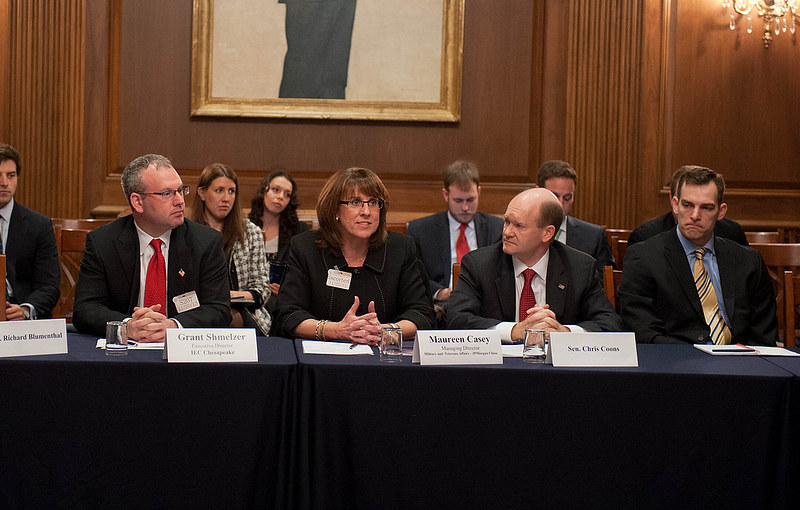
Senator Coons was joined by Maureen Casey and U.S. Army First Lieutenant Anthony K. Odierno, both of JPMorgan Chase's Military & Veterans Affairs Department at a Senate roundtable on boosting the hiring of veterans held in the Capitol on November 20, 2013.

WASHINGTON – U.S. Senator Chris Coons (D-Del.) participated in a roundtable discussion in the Capitol on Wednesday focused on initiatives to expand career opportunities for veterans. The meeting featured leaders from businesses and organizations that have demonstrated a strong commitment to employing veterans and providing them with the resources and support necessary for success.

Maureen Casey, JPMorgan Chase’s Director for Military and Veterans Affairs, was among the participants and briefed senators on the company’s successful practice of hiring veterans as part of the 100,000 Jobs Mission, a coalition of companies committed to providing job opportunities for veterans. Other participants shared their perspectives on how private organizations can work with the Senate to strengthen programs that help veterans successfully transition to civilian employment. 

“America’s highly trained veterans bring valuable skills and experience to the civilian workforce,” Senator Coons said. “Yet too many veterans come home to find their opportunities limited rather than enhanced by their time spent serving our nation. No veteran should return from defending our country abroad only to face unemployment or underemployment at home. Today’s discussion highlighted successful programs that have helped businesses, like JPMorgan Chase in Delaware, recruit more of our nation’s talented veterans. I look forward to working with my colleagues to build and expand upon these important efforts so we can get more of our veterans back to work.”

At 10 percent, the national unemployment rate for post-9/11 veterans is significantly higher than the overall national rate of 7.3 percent. In October, the Bureau of Labor Statistics estimated that 750,000 veterans were without jobs of approximately 11 million of working age.

“It’s important for the public and private sectors to continue working together to position our nation’s military veterans for success in their post-service careers,” Casey said.  “Veterans have the knowledge, skills and experience employers need, so hiring them isn’t just the right thing to do for veterans, it’s also the right thing to do for our business. That’s why JPMorgan Chase has hired more than 6,000 veterans since 2011 and why we are proud to be part of the 100,000 Jobs Mission, whose members have collectively hired nearly 93,000 veterans so far.” Casey is JPMorgan Chase’s Director for Military and Veterans Affairs.

The 100,000 Jobs Mission was launched in 2011 as a coalition of 11 companies committed to hiring 100,000 veterans by 2020, and has since grown to 126 members representing nearly every sector of the U.S. economy. After hiring a combined 92,869 veterans in less than three years, coalition members have doubled their goal to hire 200,000 veterans.

Senator Coons, colleagues introduce innovative bipartisan infrastructure bill

WASHINGTON – A bipartisan coalition of ten U.S. senators that includes U.S. Senator Chris Coons (D-Del.) introduced legislation Thursday to establish a new infrastructure financing authority to help states and localities better leverage private funds to build and maintain the nation’s outdated infrastructure. The Building and Renewing Infrastructure for Development and Growth in Employment Act, or BRIDGE Act, helps to address the nation’s alarming investment shortfall in maintaining and improving its transportation network, water and wastewater systems, and energy infrastructure. The legislation would provide an additional financing tool for states and localities, which can create new jobs here at home while also increasing our nation’s economic competitiveness.

“Investments in America’s infrastructure are investments in American jobs,” Senator Coons said. “Construction jobs, production jobs, and jobs at nearly every American business all depend on functioning infrastructure. Our country needs to be investing more in its infrastructure, not less. The bipartisan BRIDGE Act is an innovative approach to getting the funding we need to sustain and strengthen America’s critical infrastructure.”

America currently spends roughly 2 percent of its GDP on infrastructure — about half what it did 50 years ago. By comparison, Europe spends around 5 percent, and China spends 9 percent of GDP on infrastructure. According to the World Economic Forum’s Global Competitiveness Report, the United States currently ranks 19th among 148 countries surveyed in quality of overall infrastructure compared to our global competitors. 

“We put off and put off these investments because it’s politically convenient, but when we do, we’re only putting off the inevitable,” Senator Coons continued. “The American Society of Civil Engineers estimates that in the next five years, our country will come up about $1.1 trillion short of what it needs to bring American infrastructure to even adequate condition. When we neglect America’s infrastructure, we’re actually adding to America’s debt. We cannot keep kicking this can down the road, especially since this road is falling apart.” 

To begin addressing this shortfall, the BRIDGE Act will establish an independent, nonpartisan financing authority to complement existing U.S. infrastructure funding. The authority would provide loans and loan guarantees to help states and localities fund the most economically viable road, bridge, rail, port, water, sewer, and other significant infrastructure projects.  The authority would receive initial seed funding of up to $10 billion, which could incentivize private sector investment and make possible up to $300 billion in total project investment. The authority is structured in such a way as to make it self-sustaining over time.

  • The BRIDGE Act includes broad eligibility for funding: 
    Projects would have to be at least $50 million in size, and be of national or regional significance to qualify. Five percent of the authority’s overall funding would be dedicated to projects in rural regions, and rural projects would be required to be $10 million in size.
  • The BRIDGE Act addresses current gaps in infrastructure financing:
    The authority would finance no more than 49 percent of the total costs of the project in order to avoid crowding out private capital. Loans and loan guarantees would be subject to modest additional fees, which will allow the authority to quickly become self-sustaining over time. 
  • The BRIDGE Act establishes independent, non-partisan operations:
    Having project finance experts in-house will help states and localities go toe-to-toe with private sector partners to ensure that taxpayers are getting good value for our investments through public-private partnerships. The authority would operate independently of existing federal agencies, led by a Board of Directors with seven voting members and a CEO, all of whom would be required to demonstrate proven expertise in financial management and be confirmed by a vote of the Senate.

In addition to Senator Coons, the BRIDGE Act is sponsored by Senator Mark Warner (D-Va.), Roy Blunt (R-Mo.), Lindsey Graham (R-S.C.), Kirsten Gillibrand (D-N.Y.), Dean Heller (R-Nev.), Amy Klobuchar (D-Minn.), Roger Wicker (R-Miss.), Claire McCaskill (D-Mo.), and Mark Kirk (R-Ill.).

Senators Coons, Kirk introduce bipartisan bill to create a national manufacturing strategy

WASHINGTON – U.S. Senators Chris Coons (D-Del.) and Mark Kirk (R-Ill.) introduced the American Manufacturing Competitiveness Act on Thursday to bolster the competitiveness of the manufacturing industry in the United States. The bill would require the development of a national manufacturing strategy, boosting the traditional and high-tech manufacturers that employ nearly 12 million Americans. This simple bill does not cost the federal government any money, and will have a powerful impact on manufacturing jobs.

“Manufacturing has enormous power to create jobs and drive America’s economic recovery,” Senator Coons said. “While many of our global competitors have clear national industrial policies, the U.S. government does not have a coordinated strategy for supporting America’s manufacturers. We need a national strategy that looks at skills training, R&D, trade, and the wealth of factors that contribute to our manufacturers’ success. This is a common-sense, bipartisan bill that will ensure the federal government is doing everything it can to create the conditions necessary to help America’s manufacturers grow and create jobs.” Senator Coons is the founder of the Manufacturing Jobs for America initiative in the Senate, which this bill will now join.

“The United States is a worldwide leader in manufacturing, and keeping this industry competitive is crucial to maintaining our economic edge in the global marketplace,” Senator Kirk said. “Manufacturers in Illinois employ more than half a million workers with quality jobs and account for 13.3 percent of the total state economic output. Our bill will ensure that the United States manufacturing industry remains competitive and creates new high quality jobs for generations to come.”

Senators Sherrod Brown (D-Ohio) and Roy Blunt (R-Mo.) are also cosponsors of the bill. Representative Dan Lipinski (D-Ill.-3) introduced companion legislation in the House (HR 2447) earlier this year.

The manufacturing industry contributes $1.8 trillion to the U.S. economy each year, and on its own would rank as the world’s tenth largest economy. Current federal programs and incentives support conditions for growth in the industry, yet there is no overarching national strategy. The American Manufacturing Competitiveness Act sets goals for a U.S. manufacturing strategy and requires the Administration to analyze every four years factors that impact manufacturing competitiveness.

The bill is supported by the Alliance for American Manufacturing, American Iron and Steel Institute, American Small Manufacturers Coalition, Association for Manufacturing Technology, Dow Chemical Company, DuPont, International Association of Machinists, National Council for Advanced Manufacturing, National Defense Industry Association, National Tooling and Machining Association, North American Die Casting Association, Precision Machined Products Association, Precision Metalforming Association, United Steelworkers, and United Auto Workers.

Senator Coons derides “chilling” push for delay in trials of Kenyatta, Ruto

WASHINGTON – U.S. Senator Chris Coons (D-Del.), chair of the Senate Foreign Relations Subcommittee on African Affairs, issued the following statement Wednesday in response to reports that Rwanda and several other members of the United Nations Security Council (UNSC) are seeking a vote in the UNSC on a resolution to suspend the International Criminal Court (ICC) proceedings against Kenyan President Uhuru Kenyatta and Deputy President William Ruto. The two men have been charged with crimes against humanity for their alleged roles in masterminding the violence that swept across Kenya and left more than 1,100 dead following the disputed 2007 Kenyan presidential election.

“It is unfortunate that several members of the UN Security Council are seeking a vote on a resolution to suspend the International Criminal Court proceedings against Kenyan President Uhuru Kenyatta and Deputy President William Ruto. The move is divisive and sends a chilling signal of impunity for perpetrators of political violence. The Kenyan government’s request for procedural flexibility, such as allowances for videoconference appearances, is understandable given their positions and need to govern. However, such requests can be addressed through existing mechanisms that guide the operation of the Court rather than suspending the process or taking action through the UN. I therefore urge the Government of Kenya and the defendants to cooperate fully with the ICC. Ensuring justice and accountability for victims must remain the paramount principle as this process moves forward, and I strongly oppose a vote on this matter at the UN.”

Several members of the UNSC, led by the Government of Rwanda, have indicated support for a one-year deferral of the ICC proceedings against Uhuru Kenyatta and William Ruto to allow the two leaders to protect and enhance regional peace and security in light of persistent terrorism threats. Ruto’s trial started in September; the start of Kenyatta’s trial has been postponed until February. 

In budget conference committee, Senator Coons focuses on budget’s impact on long-term unemployed

WASHINGTON – In Wednesday’s meeting of the budget conference committee, U.S. Senator Chris Coons (D-Del.) questioned the head of the Congressional Budget Office about the impact of Congress’ current spending decisions on the nation’s long-term unemployed.

“While short-term unemployment has come back down, long-term unemployment remains very high, and is persistent — and worryingly so, both in terms of the human cost, and the long-term cost for our economy,” Senator Coons said.

Questioning Congressional Budget Office Director Douglas Elmendorf, Senator Coons continued: “You’ve testified before that not all cuts are the same, and that there are some ways in which we are cutting that are hurting our long-term competitiveness — that short-term cuts in things like education, or infrastructure, or research and development produce longer-term reductions in our capacity; and that we should be prioritizing things that will accelerate growth; that we should not be simply trying to get through this difficult fiscal time in a way that focuses on austerity; that we should also be investing in a way that sustains growth.”

Asked about policies that could accelerate growth and help the long-term unemployed, Director Elmendorf said, “Of all non-defense discretionary spending, half represents investment of some sort. About 20 percent of non-defense discretionary spending is investment in physical capital, such as highways, another 15 percent goes for education and training, and about 10 percent goes for R&D, such as health research. Over all, we think those investments help to build a stronger economy in the future and cutbacks in those investments would reduce output and income in the future.” 

The problem of long-term unemployment, Elmendorf noted, also “has important economic effects over time… It poses a very large risk of there being some set of people who will not find their way back to work at all or will not find their way to the productive sort of work that they were in before they lost their jobs.”

Elmendorf said the CBO has “reviewed the evidence on a large number of different ways of trying to help people get back into the labor force,” a number of which “have been successful on a small scale and have not been tried on a large scale.” Elmendorf pledged to work with Senator Coons on developing policies that help the long-term unemployed get back to work.

Delaware’s long-term unemployment rate is 3.1 percent. The state’s overall unemployment rate is 7.3 percent. 

Senator Coons is one of 29 members of the conference committee appointed by leaders of the House and Senate to reconcile the two chambers’ respective budgets. If the conference committee is able to negotiate and approve a budget by December 13, the House and Senate appropriations committees will attempt to move forward on a spending bill for the remainder of Fiscal Year 2014. As a member of the committee, Senator Coons has called for balanced deficit reduction that enacts a circle of protection around the most vulnerable and promotes our long-term competitiveness and economic growth.

Senator Coons is a member of both the Senate Budget Committee and the Senate Appropriations Committee.

Senator Coons, colleagues introduce bill to expand access to high-quality early education

WASHINGTON, D.C.—Today, U.S. Senator Chris Coons (D-Del.) joined Senator Tom Harkin (D-Iowa), Chairman of the Senate Health, Education, Labor, and Pensions (HELP) Committee, and 10 of their colleagues to introduce the Strong Start for America’s Children Act, legislation to expand access to high-quality early learning programs for children from birth to age five. Similar legislation was introduced in the U.S. House of Representatives today by George Miller, senior Democrat on the House Education and Workforce Committee, and Rep. Richard Hanna (R-NY). 

“We owe it to our children to give them every chance to succeed in school and beyond,” Senator Coons said. “Too often, children enter elementary school already lagging behind classmates who have developed critical skills in prekindergarten programs. This bill will help more children access high-quality early learning programs and enter the classroom prepared to reach their full potential. These are investments in a brighter future for our children, and every child, regardless of income, deserves the opportunity for a strong start.”

Building on the framework put forward by President Obama in his 2013 State of the Union address, the bill would focus on four key goals: boosting funding for high-quality preschool programs serving low- and moderate-income families; increasing the quality of infant and toddler care offered by providers; supporting broad-scale quality improvements to child care programs; and encouraging continued support for the Maternal, Infant, and Early Childhood Home Visiting program.

“Delaware PTA is honored to have Senator Coons co-sponsor legislation to support early childhood learning,” said Yvonne Johnson, president of Delaware’s Parent Teacher Association. “As a national organization, PTA recognizes the importance of early education for all children. This important piece of legislation will make these opportunities available to all children no matter where they live. PTA believes that providing early education will result in a more successful path K through 12, resulting in more students college and career ready. It is never too early to educate a child! Thank you Senator Coons for your continued support of children.”

The early childhood education proposal is a 10-year initiative to expand and improve early learning opportunities for children across the birth to age 5 continuum. The bill would fund preschool for 4-year old children from families earning below 200% of the federal poverty level, and encourage states to spend their own funds to support preschool for young children with family incomes above that income level. The legislation would establish a new federal-state partnership with formula funding for 4-year old preschool, with a state match, to all eligible states, based on each state’s proportion of 4-year olds under 200% of the federal poverty level. States would provide sub-grants to high-quality, local providers, including school districts and community-based providers, such as child care and Head Start programs. The bill also authorizes a new Early Head Start partnership with child care to improve the quality of care for infants and toddlers.

In 2011, Delaware was one of just nine states to win federal funds in the Race to the Top – Early Learning Challenge. To qualify for the award, Delaware developed a comprehensive plan for transforming their early learning system with better coordination, clearer learning standards, and meaningful workforce development.

The bill’s other cosponsors include Senators Patty Murray (D-Wash.), Robert P. Casey, Jr. (D-Pa.), Bernie Sanders (I-Vt.), Chris Murphy (D-Conn.), Tammy Baldwin (D-Wis.), Elizabeth Warren (D-Mass.), Mazie Hirono (D-Hawaii), Tim Kaine (D-Va.), Kirsten Gillibrand (D-N.Y.), and Ron Wyden (D-Ore.).

Bipartisan support for Master Limited Partnerships Parity Act grows

WASHINGTON – Bipartisan support continues to grow for the Master Limited Partnerships Parity Act, which would help level the energy playing field by giving investors in renewable energy projects access to a decades-old corporate structure whose tax advantage is available now only to investors in fossil fuel-based energy projects. The bill’s lead sponsor, U.S. Senator Chris Coons (D-Del), announced Tuesday the co-sponsorship of U.S. Senators Mary Landrieu (D-La.) and Susan Collins (R-Maine).

“Creating jobs and boosting America’s domestic energy resources are goals shared by both Democrats and Republicans,” Senator Coons said. “Too many job-creating renewable-energy projects fail because they can’t secure the critical early-stage private capital they need. This common-sense legislation can make a real difference for the country, and I’m proud that Senators Landrieu and Collins have joined our diverse and strategic team of cosponsors.”

Senator Landrieu is chair of the Senate Small Business and Entrepreneurship Committee and is a member of both the Senate Energy and Natural Resources Committee and the Senate Appropriations Committee. Senator Collins is also a member of the Senate Appropriations Committee. They join Senators Jerry Moran (R-Kan.), who is a member of the Senate Appropriations Committee, Debbie Stabenow (D-Mich.), who chairs the Senate Finance Subcommittee on Energy, Natural Resources, and Infrastructure, and Lisa Murkowski (R-Alaska), who is the ranking member of the Senate Energy and Natural Resources Committee.

The Master Limited Partnerships Parity Act is a straightforward, powerful modification of the federal tax code that could unleash significant private capital by helping additional energy-generation and renewable fuels companies form master limited partnerships, which combine the funding advantages of corporations and the tax advantages of partnerships. 

A master limited partnership is a business structure that is taxed as a partnership, but whose ownership interests are traded like corporate stock on a market. By statute, master limited partnerships have only been available to investors in energy portfolios for oil, natural gas, coal extraction, and pipeline projects. These projects get access to capital at a lower cost and are more liquid than traditional financing approaches to energy projects, making them highly effective at attracting private investment. Investors in renewable energy projects, however, have been explicitly prevented from forming master limited partnerships, starving a growing portion of America’s domestic energy sector of the capital it needs to build and grow.

“The bipartisan Master Limited Partnerships Parity Act levels the playing field to help clean and renewable energy projects compete fairly with traditional energy projects,” Senator Coons said. “This market-driven solution supports the all-of-the-above energy strategy we need to power our country for generations to come. Our legislation will unleash private capital, create jobs and modernize our tax code. That’s why it has earned broad support from Republicans and Democrats in Congress, as well as academics, outside experts, business leaders, and investors.”

The MLP Parity Act has been endorsed by more than 200 businesses, trade associations, environmental advocates, think tanks and research institutes, and finance and investment groups.  

A more detailed white paper on the MLP Parity Act can be downloaded here: http://www.coons.senate.gov/download/mlp-white-paper

The legislation itself can be downloaded as a PDF here: http://www.coons.senate.gov/download/mlp-parity-act

Senator Coons urges International Olympic Committee to reconsider ruling on Russian anti-LGBT law

WASHINGTON – U.S. Senator Chris Coons (D-Del.) and ten of his colleagues have written to Thomas Bach, President of the International Olympic Committee (IOC), expressing their concern about the IOC’s recent declaration that it is “fully satisfied” that a Russian law banning “homosexual propaganda” does not violate the Olympic Charter.

The senators noted that the Olympic Charter requires the IOC to take action against any form of discrimination. According to the Olympic Charter, “any form of discrimination with regard to a country or a person on grounds of race, religion, politics, gender or otherwise is incompatible with belonging to the Olympic Movement.”

“In that regard, we write to express our deep concern about the IOC’s recent declaration that ‘as long as the Olympic Charter is upheld, we are fully satisfied,’ ” the senators wrote. “We disagree with this position, and strongly urge you to reconsider given that the Russian law banning ‘homosexual propaganda’ is clearly inconsistent with the Olympic Charter.”

In the letter, the senators also asked Dr. Bach to provide more details about how the IOC and Russian authorities intend to ensure the equal rights and safety of lesbian, gay, bisexual, and transgender (LGBT) athletes and spectators during the upcoming 2014 Winter Olympics, which will be held in Sochi, Russia.

“Although some Russian Authorities have indicated that the law will not affect Olympic spectators and participants, we have yet to see a satisfactory explanation of what type of activities or behavior will be permitted. If LGBT individuals or supporters were to be arrested or harassed during the Olympics, the reputation of the IOC would be damaged,” the senators wrote. “We are not reassured by vague public statements from some Russian Federation authorities that there will be ‘no discrimination,’ when the very nature of this law is discriminatory, and when other senior Russian Federation officials have publicly warned that those who ‘spread propaganda’ will ‘also be held accountable.’ ”

The full text of the letter follows, and the letter can be downloaded at http://1.usa.gov/1j0uYic.

November 8, 2013 

Dr. Thomas Bach
President
The International Olympic Committee
Chateau de Vidy
1107 Lausanne, Switzerland

Dear President Bach:

Congratulations on your recent election as President of the International Olympic Committee (IOC). 

As members of the United States Senate, we would like to express our strong appreciation and support for the Olympics’ mission—to promote peace through international engagement and athletic competition. Unfortunately, we believe that the recent law passed by the Russian Federation targeting members of the Lesbian, Gay, Bisexual and Transgender (LGBT) community runs contrary to the Fundamental Principles of Olympism.

In that regard, we write to express our deep concern about the IOC’s recent declaration that “as long as the Olympic Charter is upheld, we are fully satisfied.” We disagree with this position, and strongly urge you to reconsider given that the Russian law banning “homosexual propaganda” is clearly inconsistent with the Olympic Charter.

According to the Olympic Charter, “any form of discrimination with regard to a country or a person on grounds of race, religion, politics, gender or otherwise is incompatible with belonging to the Olympic Movement.” Discrimination based on an individual’s sexual orientation is inconsistent with the Charter, and clearly contrary to the spirit of the Olympics.  

The Russian Federation’s recently enacted law singles out LGBT individuals and their supporters and prohibits them from fighting discrimination or seeking equal protection under the law. This law has already led to threats and arrests of LGBT individuals and their supporters. A 24-year-old man was recently charged with violating the law after he held up a pro-LGBT sign, and four Dutch filmmakers making a documentary about LGBT Russians were arrested in July.

In addition, this anti-LGBT propaganda law has had other serious consequences. Neo-Nazi and other bigoted groups have used it as an opportunity to brutally attack LGBT individuals. We have been deeply alarmed by images of Russian LGBT men and women being harassed, threatened and severely beaten for advocating for their rights. Sadly, it appears that the police do little or nothing to protect them. 

Many in the international community—including United Nations’ human rights experts and U.S. President Barack Obama—have spoken out in opposition to this law. President Obama noted that the anti-LGBT law is a violation of universal rights, and we could not agree more. This law is not only an affront to basic principles of non-discrimination and equality, it also contradicts the rights enshrined in the International Covenant on Civil and Political Rights, to which the Russian Federation is a party. 

In light of the situation in the Russian Federation, we are very concerned about the harmful impact this law could have on the upcoming Winter Olympic and Paralympic Games in Sochi. The United States will be sending both LGBT athletes and spectators to these Games. Although some Russian Authorities have indicated that the law will not affect Olympic spectators and participants, we have yet to see a satisfactory explanation of what type of activities or behavior will be permitted. 

If LGBT individuals or supporters were to be arrested or harassed during the Olympics, the reputation of the IOC would be damaged. We are not reassured by vague public statements from some Russian Federation authorities that there will be “no discrimination,” when the very nature of this law is discriminatory, and when other senior Russian Federation officials have publicly warned that those who “spread propaganda” will “also be held accountable.”

Therefore, we respectfully request more detailed information about the IOC’s preparations for the Winter Olympic and Paralympic Games in Sochi, including how the IOC will work to ensure the Olympic Charter is upheld for athletes and spectators alike. Specifically, we ask that you provide responses to the following questions:

1. Have you received official confirmation from the Russian Federation regarding how the law will be enforced—if at all—during the Winter Olympic and Paralympic Games? For example, will self-identification as an LGBT individual, including via news or social media, be permitted by Russian Federation authorities during these Games? Are you aware of any actions by LGBT individuals or supporters that would put them at risk of prosecution under the discriminatory law by Russian Federation authorities?

2. Will spectators and participants enjoy protection from prosecution under the discriminatory law if they leave the Olympic village host city, including during travel to or from the Winter Olympic and Paralympic Games in Sochi?

3. What concrete assurances will visitors and athletes have that local law enforcement outside of Sochi will not be permitted to enforce the anti-LGBT law with respect to foreign nationals? 

The IOC has a responsibility to ensure that the values of Olympism are upheld and, as the Olympic Charter states, “act against any form of discrimination” —including equal rights for LGBT individuals. This is not an issue of politics; it is an issue of fundamental human rights.

As such, we look forward to working with the IOC to ensure the safety and human rights of all athletes and spectators at the Winter Olympic and Paralympic Games in Sochi are protected. Furthermore, we strongly encourage the IOC to reconsider its position and adhere to the letter and spirit of the Olympic Charter by insisting that the host country comply with the principle of nondiscrimination.

Thank you for your attention to this request.

Sincerely,

Chris Murphy
United States Senator

Barbara Boxer
United States Senator

Jeff Merkley
United States Senator

Dick Durbin
United States Senator

Lisa Murkowski
United States Senator

Jeanne Shaheen
United States Senator

Sheldon Whitehouse
United States Senator

Claire McCaskill
United States Senator

Al Franken
United States Senator

Elizabeth Warren
United States Senator

Chris Coons
United States Senator

Mark Udall
United States Senator

Statement from Senator Coons honoring Veterans Day

WILMINGTON, Del. – U.S. Senator Chris Coons issued the following statement to mark Veterans Day:

“While our nation’s brave servicemen and women deserve our respect and gratitude every day of the year, Veterans Day gives us the opportunity to pause and honor the courage, dedication, and sacrifice of those who have given so much in the service of our freedom. As Americans across the nation celebrate military heroes past and present, we must sustain our commitment to ensuring all returning veterans receive the benefits they have earned and the resources they need to succeed here at home. America’s highly trained and uniquely talented veterans bring valuable skills and expertise to the civilian workforce, and we can and should do more to connect them to high quality jobs upon their return.

“This fall, I was honored to welcome the Delaware National Guard’s 153rd Military Police Company home from Afghanistan after nine months of exemplary service to our nation. The ceremony was a reminder of the tremendous community of soldiers, families, and friends that make ours the greatest military in the world. Today, and every day, they have my sincere gratitude and my pledge to continue working to keep America’s promise to our veterans.”