Related Issues

Related Issues

Carper, Coons, Carney host job fair for more than 1,000 jobseekers

DOVER, Del. – More than 1,000 job seekers packed in to the Education Technology Building Conference Center at Delaware Technical Community College Terry Campus for the first job fair of the year hosted by U.S. Senators Chris Coons and Tom Carper, and U.S. Representative John Carney in Kent County. The fair brought more than 45 private and public entities together to meet candidates in hopes of filling over 500 open positions.

The Kent County job fair was organized with the help of Brandywine Counseling and Career Services, and service and government employment agencies were also on hand to facilitate job-search skills workshops, career counseling, and resume reviews.

In 2013, the Delaware delegation hosted seven job fairs for more than 3,500 job seekers. Since 2011, the delegation has hosted 17 jobs fairs in Delaware, including four specifically for veterans.

Senator Coons applauds new partnership between Bank of America, U2, and (RED) to stop the spread of HIV/AIDS

WILMINGTON, Del. – U.S. Senator Chris Coons (D-Del.), chair of the Senate Foreign Relations Subcommittee on African Affairs, praised a new partnership between Bank of America, rock group U2, and global HIV/AIDS fundraising organization (RED) announced at the World Economic Forum in Davos, Switzerland on Thursday. The bank, which employs 7,000 in Delaware, announced a multi-pronged commitment to the global fight against HIV/AIDS, including:

  • A $10 million donation to the Global Fund to Fight AIDS, Tuberculosis and Malaria.
  • The donation of $1 to the Global Fund for each free download (up to $2 million total) of a new U2 song, “Invisible” to be unveiled in a commercial during the Super Bowl on February 2.
  • A campaign to encourage Bank of America customers and employees to join the fight. 

“Stopping the spread of HIV/AIDS and its destructive impact on families, communities and even countries is a global health priority,” Senator Coons said. “Without the funding to set up and run clinics, train medical personnel, and educate at-risk populations about prevention, the tremendous progress made by the Global Fund and its partners over the last decade would not have been possible. Bank of America’s commitment to the global effort to eradicate mother-to-child transmission of HIV by 2015 can and will make a difference in the lives of millions of Africans.” 

Bono, the lead singer of U2, said, “Bank of America coming on as a (RED) partner to help the Global Fund’s efforts to eliminate AIDS is great news.  It’s the kind of game-changing influence that will not just deliver millions of dollars but raise consciousness and keep public pressure on putting an end to this devastating pandemic which has already taken the lives of 35 million people.  And just in… the bank’s commitment of $10 million has resulted in the Gates Foundation, SAP and Africa’s Motsepe Family matching for a total of $22 million. Incredible.” 

(RED) funds are fighting AIDS in eight African countries – Ghana, Kenya, Lesotho, Rwanda, South Africa, Swaziland, Tanzania, and Zambia – and are used to support HIV/AIDS grants which provide treatment, testing and prevention, and care services, with a focus on ending mother-to-child transmission of HIV and achieving an AIDS-free generation. Of the more than $240 million generated by (RED), 100 percent has gone directly to the Global Fund for on-the-ground services, with no overhead taken out by (RED).

More from Bank of America here:

http://newsroom.bankofamerica.com/press-releases/corporate-philanthropy/red-u2-and-bank-america-partner-fight-aids

President’s elections commission includes recommendations addressed by Senator Coons’ election reform bill

WILMINGTON, Del. – In its report to President Obama on Wednesday, the Presidential Commission on Election Administration (PCEA) included several recommendations that would be addressed by the Louis L. Redding Fair, Accurate, Secure and Timely (FAST) Voting Act, first introduced by U.S. Senator Chris Coons (D-Del.) after the 2012 elections. Among other key recommendations, the Commission urged:

  • An expansion of online voter registration by the states to enhance both accuracy of the voter rolls and efficiency;
  • The expansion of voting before Election Day, recognizing that the majority of states now provide either mail balloting or in-person early voting and that voters are increasingly seeking these options;
  • Improving the ability of military and overseas voters to access ballots and other voting materials through the states’ websites;
  • The increased use of electronic pollbooks for greater accuracy and efficiency;
  • Assuring that polling places are accessible to all voters, are located close to where voters live and are designed to function smoothly;
  • Increasing and enhancing training and recruitment of poll workers, in the recognition that volunteer poll workers are voters’ primary source of contact during the actual voting process;
  • Addressing the needs of voters with disabilities and those with limited English proficiency.

“As Americans, the right to vote is among our most fundamental values,” Senator Coons said. “The 2012 elections were a wakeup call, revealing that significant challenges and dysfunction still plague the election process in many districts. I introduced the FAST Voting Act to jumpstart states’ election reforms, and I am glad to see that the recommendations released today by the PCEA reflect the same core ideas embedded in that legislation. We can and must take steps now to improve the voting experience across America. It’s time for Congress to pass the FAST Voting Act and follow through on the strong recommendations put forth today by the PCEA. Americans deserve better in 2014.”

Prominently featured throughout the 71-page PCEA report (http://bit.ly/1kY29ZX) is the testimony of Delaware State Election Commissioner Elaine Manlove, who appeared before the Commission on September 4, 2013.

“I am especially proud of the significant contribution made by Delaware State Election Commissioner Elaine Manlove to the PCEA’s report,” Senator Coons said. “Commissioner Manlove and Delaware’s state leaders are leading efforts to improve the voting process for our citizens, and their model will help to set the standard for free and fair elections across the country.” 

The FAST Voting Act would create a competitive grant program to encourage states to aggressively pursue election reform. The states that demonstrate the most comprehensive and promising reform plans would earn a greater portion of the grant funding. Applicant states are encouraged to improve access to the polls in at least nine specified ways, including: 

  • Providing flexible registration opportunities, including same-day registration;
  • Providing early voting, at a minimum of 9 of the 10 calendar days preceding an election;
  • Providing absentee voting, including no-excuse absentee voting;
  • Providing assistance to voters who do not speak English as a primary language;
  • Providing assistance to voters with disabilities, including visual impairment;
  • Providing effective access to voting for members of the armed services;
  • Providing formal training of election officials, including State and county administrators and volunteers;
  • Auditing and reducing waiting times at polling stations; and
  • Creating contingency plans for voting in the event of a natural or other disaster.

The bill, which is cosponsored by Senators Mark Warner (D-Va.), Sheldon Whitehouse (D-R.I.), Richard Blumenthal (D-Conn.), and Kirsten Gillibrand (D-N.Y.), also requires an assessment of steps the state has taken to eliminate statutory, regulatory, procedural and other barriers to expedited voting and accessible voter registration.

The New York Times (http://nyti.ms/T5DvnK) and Washington Post (http://bit.ly/TmwS6b) offered their support for the FAST Voting Act in late 2012.

Senator Coons reacts to President’s remarks on NSA surveillance of Americans

WILMINGTON, Del. – U.S. Senator Chris Coons (D-Del.), a member of the Senate Judiciary Committee, reacted Friday to President Obama’s policy directive on signals intelligence activities.

“Delawareans deserve a full and informed debate about our nation’s intelligence-gathering procedures and their intrusion on our privacy rights,” Senator Coons said. “They also deserve a Congress that insists on keeping our nation safe and respects our most cherished privacy protections. While surveillance procedures certainly have a role to play in keeping our nation safe, the last several months have shown that their extent and depth far exceed Americans’ awareness and cross what I believe are a number of innate privacy boundaries.” 

“The changes to the National Security Agency’s data-collection programs announced by President Obama today are a welcome first step, but they fall short of restoring the privacy safeguards that Americans deserve,” the Senator continued. “I appreciate the President’s support for the inclusion of a public advocate role in the FISA court, as would be accomplished by legislation I cosponsored last summer, but remain concerned about the fundamental suspicion-less collection of Americans’ data, regardless of whether it is the government or a private contractor that stores that data. In fact, this shift raises as many new concerns as it addresses. Finally, I am disappointed that today’s announcement only scratches the surface of the surveillance program’s greater transparency problems. An annual review of FISA court decisions for potential declassification is insufficient for Congress to perform the oversight it must.” 

“The President’s policy directive today is progress, but needs to be the start of a conversation with Congress, not the end,” Senator Coons concluded. “I look forward to hearing more details about how the intelligence community will implement the changes proposed today. I remain convinced that the choice between liberty and safety is not a choice between one or the other – we expect both — and I believe both are possible with thoughtful public scrutiny and meaningful Congressional oversight.”

In the Senate Judiciary Committee on Tuesday, Senator Coons questioned members of the President’s Review Group on Intelligence and Communications Technologies. To view his questioning, click here: http://youtu.be/SXY4eA_NjGA

In September, Senator Coons and eight colleagues on the Judiciary Committee sent a letter to the inspector general of the intelligence community calling for a full-scale review of the use of surveillance authorities and to make public the findings. http://1.usa.gov/Lq92ni

In August, Senator Coons cosponsored the FISA Court Reform Act of 2013, which would create an Office of the Special Advocate tasked with advocating in the FISA courts’ closed proceedings for legal interpretations that minimize the scope of intrusion into our privacy. He also cosponsored the FISA Accountability and Privacy Protection Act of 2013 to require the government to be more transparent in how it publicly reports on its surveillance activities. http://1.usa.gov/1j8UJ1L

In June, Senator Coons and 26 other senators sent a letter asking Director of National Intelligence James Clapper to publicly provide information about the duration and scope of the program and provide examples of its effectiveness in delivering unique intelligence, if such examples exist. http://1.usa.gov/Lq92ni

Ahead of his vote against the reauthorization of the FISA Amendments Act in December 2012, Senator Coons spoke on the Senate floor in support of the legislative predecessors to both of these bills. His speech can be viewed and read here: http://1.usa.gov/ZEli97

Congress restores funding to life-saving bulletproof vest program for police officers

WASHINGTON – U.S. Senator Chris Coons (D-Del.), a member of the Senate Budget Committee and Senate Appropriations Committee, voted Thursday evening for a federal funding bill that includes $22.5 million for a life-saving bulletproof vest program. The Bulletproof Vest Partnership is a competitive grant program that subsidizes the purchase of bullet-resistant and stab-resistant body armor by state and local law enforcement agencies. The program has supplied Delaware law enforcement with nearly 4,000 vests in the last five years.

The President’s budget proposal for FY14 zeroed out funding for the program, but Senator Coons, co-chair of the Senate Law Enforcement Caucus, pushed to restore it in the omnibus bill passed by Congress on Thursday.

“Police officers put their lives on the line every day to keep our communities safe,” Senator Coons said. “We should be doing everything we can to keep them safe, too. Just last year, vests purchased through the federal Bulletproof Vest Partnership saved the lives of two officers when a gunman opened fire at the New Castle County Courthouse. With many police departments facing shrinking budgets, the Bulletproof Vest Partnership makes these vests – which can cost more than $500 each — more affordable, ensuring that officers are outfitted with the best protection possible. I am thankful that the funding in this bill will allow this critical program to continue to save lives.” 

Thousands of vests have been purchased by Delaware law enforcement through the Partnership over its 14-year history, including 3,852 in the last five years. Nationwide, the program has subsidized more than a million vests, saving the lives of more than 3,000 police officers, according to the U.S. Department of Justice. Agencies can be reimbursed for up to 50 percent of the cost of body armor that complies with National Institute of Justice standards.

On February 11, 2013, bulletproof vests purchased through the federal Bulletproof Vest Partnership saved the lives of two Capitol Police officers, Sergeant Michael Manley and Corporal Steve Rinehart, during a shooting at the New Castle County Courthouse in Wilmington. Both officers were struck, but survived because of their vests.

Last May, Senator Coons and Judiciary Committee Chairman Patrick Leahy (D-Vt.) re-introduced the Bulletproof Vest Partnership Grant Act to reauthorize the program, which is administered by the Bureau of Justice Assistance.

Senator Coons votes for bipartisan funding bill

WASHINGTON – U.S. Senator Chris Coons (D-Del.), a member of the Senate Budget Committee and Senate Appropriations Committee, voted Thursday evening for a federal funding bill that supports investment in a number of key Delaware priorities.

“The appropriations bill approved by the House on Wednesday and the Senate tonight is a compromise,” Senator Coons said. “It is by no means a perfect bill, but it does make important investments in our country’s economic growth. After years of governing on autopilot with continuing resolutions, it is also a small but important step toward a responsible and regular fiscal process.

“In Delaware and across the nation, the bill invests in our workforce, makes our communities safer, and builds a circle of protection around the most vulnerable in our society. Together, these investments make up the foundation of a safer, more just, and more inclusive nation.  By combining them with key investments in research, innovation, and infrastructure, we are laying the groundwork for growth and shared prosperity today and tomorrow.”

“The omnibus appropriations bill will keep federal meat inspectors from being furloughed and once again endangering Delaware’s poultry industry. It will prevent deeper cuts to the operations of Delaware’s federal courts, and it will prevent steep reductions in Amtrak service and personnel. The bill also provides $20 million for the deepening of the Delaware River — a critical project that is necessary to keep the Port of Wilmington competitive with the coming expansion of the Panama Canal.”

“It is my sincere hope that by passing this bipartisan funding bill, we can put an end to a cycle of manufactured crises. I hope it means we can and will work together to confront the many challenges that remain in front of us.”

Senator Coons introduces bipartisan bill to restore protections in Voting Rights Act

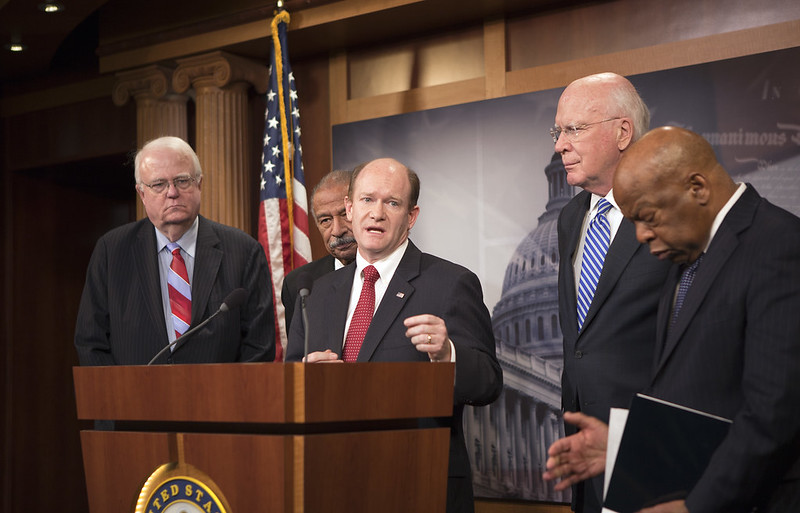
Senator Coons speaks at a press conference on Capitol Hill on Thursday with (l-r) Congressman Jim Sensenbrenner (R-Wis.), Congressman John Conyers (D-Mich.), Senator Patrick Leahy (D-Vt.) and Congressman John Lewis (D-Ala.).

Senator Coons speaks at a press conference on Capitol Hill on Thursday with (l-r) Congressman Jim Sensenbrenner (R-Wis.), Congressman John Conyers (D-Mich.), Senator Patrick Leahy (D-Vt.) and Congressman John Lewis (D-Ga.).

WASHINGTON – U.S. Senator Chris Coons (D-Del.), a member of the Senate Judiciary Committee, joined Judiciary Committee Chairman Patrick Leahy (D-Vt.) and Judiciary Subcommittee on Civil Rights Chairman Dick Durbin (D-Ill.) on Thursday in introducing bipartisan legislation to modernize the Voting Rights Act. The bill comes seven months after the Supreme Court issued a ruling striking down a key section of the historic law. U.S. Representatives Jim Sensenbrenner (R-Wis.) and John Conyers (D-Mich.) introduced companion legislation in the House of Representatives on Thursday.

“Free and fair elections are fundamental to our democracy,” Senator Coons said. “In the seven months since the Supreme Court’s decision, proposed changes to local and state election laws have proven that the protections in the Voting Rights Act are still critically necessary. The bill we’re introducing today doesn’t look at discrimination through the lens of our past, and instead looks clearly and soberly at the modern challenges facing voters. It makes the process of protecting voting rights more transparent, and has been written in a way that is both effective and can pass in Congress. I am proud to support this bill and will work hard to ensure it becomes law.”

The legislation — supported by a range of civil rights groups — is a bicameral, bipartisan response to the Supreme Court’s Shelby County decision, which struck down a core provision in the Voting Rights Act. That provision determines how states are covered under Section 5 of the law, which requires federal preclearance to protect against discriminatory voting measures. The bill updates the coverage formula by making all states and jurisdictions eligible for the coverage formula based on voting violations in the last 15 years. States and jurisdictions that have had a clean record over the last 15 years would not be subject to coverage. 

Key provisions in the bill include:

  • A coverage provision based on current conditions. The bill establishes a rolling nationwide trigger that covers states or jurisdictions that have a persistent record of recent voting rights violations in the last 15 years.
  • Allows our federal courts to bail-in the worst actors for preclearance. The current law permits states or jurisdictions to be bailed in for intentional violations, but the new legislation amends the Act to allow states or jurisdictions to be bailed in for results-based violations.
  • Greater transparency in elections so that voters are made aware of changes. The additional sunlight will deter discrimination from occurring and protect voters from discrimination.
  • Allows for preliminary relief to be obtained more readily, given that voting rights cannot often be vindicated after an election is already over.
  • Includes modest provisions that continue to permit states to enact reasonable photo identification laws.

The full text of the legislation can be downloaded here.

Carper, Coons, Carney announce more than 30 employers seeking to fill hundreds of positions at Kent County Job Fair

DOVER, Del. – Committed to continuing to help out-of-work Delawareans find employment, U.S. Senators Tom Carper and Chris Coons, and U.S. Representative John Carney, in partnership with Brandywine Counseling and Community Services, will welcome more than 30 employers seeking to hire for more than 500 jobs to the Education Technology Building Conference Center at Delaware Technical Community College Terry Campus (North Delaware Tech Drive, Dover, DE 19904). The job fair will take place Thursday, January 23 from 10 a.m. to 2 p.m.

The list of potential employers reflects Delaware’s diverse industries in Kent County, ranging from agriculture to education, law enforcement, and banking. Interested companies seeking to fill positions can contact Senator Coons’ office at 302-573-6345 or via email at workshop@coons.senate.gov.

Confirmed attendees include Advance Student Transport, City of Dover Police, Wilmington Police Department, Work America, RRW Inc. Home Instead Senior Care, Mountaire Farms of Delaware, Delaware State Police, University of Delaware Recruiting, Delaware Transitions to Teaching Partnership, Synerfac Technical Staffing, Citizens Bank, Greater Wilmington Radio Association, USDA, NRCS, Seawatch International, Wilmington University, Dr. Energy Saver, Express Employment Professionals, Interim Healthcare, Griswold Homecare, James Sevens & Daniels, Laborers Apprenticeship Program, New Castle County Police and  Paramedics, Dover Downs Hotel and Casino, Lowes, Peoples Place, Delaware Department of Transportation, Delaware Transit Corporation, IT Works, and Perdue.

Businesses will be on hand at the fair to interview potential new employees. Delawareans are encouraged to come dressed for success with resumes in hand.

In addition to companies hiring to fill vacancies, the job fair will also have a resources area for job seekers including vendors Brandywine Counseling, Job Centers@ Delaware Libraries, Delaware Department of Labor, Goodwill of Delaware, University of Delaware (Professional & Continuing Studies), Food Bank of Delaware, and ACA Health Exchange Navigators.

Since 2011, the Congressional delegation has hosted 16 job fairs in Delaware, including four specifically for veterans.

For more information on how to participate as an employer or job seeker, please call Senator Coons’ office at 302-573-6345, or email workshop@coons.senate.gov. Pre-registration is not required.

11 senators urge TPP negotiators to address barriers to chicken trade

WASHINGTON – U.S. Senators Chris Coons (D-Del.) and Johnny Isakson (R-Ga.), with nine of their Senate colleagues, wrote to U.S. Trade Representative Michael Froman and U.S. Secretary of Agriculture Tom Vilsack on Tuesday to urge them to make removing barriers to chicken exports a priority in the negotiations over the Trans-Pacific Partnership (TPP).

The TPP is a trade agreement currently being negotiated by Australia, Brunei, Chile, Canada, Japan, Malaysia, Mexico, New Zealand, Peru, Singapore, the United States and Vietnam

“The TPP represents a significant opportunity to expand U.S. chicken exports and bring increased economic benefits to chicken growers and companies across the country,” the senators wrote.  

“We are particularly concerned about Canada’s supply management program that severely limits U.S. chicken exports to our northern neighbor. As you know, despite ratification of the North American Free Trade Agreement (NAFTA), Canada has continued to impose restrictions on imports of U.S. chicken products and the U.S. has been unsuccessful in lifting those restrictions. We urge you to continue to work to address this long-standing, unjustified issue during the TPP negotiations and create true free trade for U.S. poultry. 

“Similarly, we are concerned about Australia and New Zealand’s use of non-scientific barriers related to poultry disease that prohibit trade of U.S. chicken products to these countries. If Australia and New Zealand are to participate in the TPP, they should conform to World Organization for Animal Health (OIE) standards.

“Finally, Japan’s administrative guidance sets an unofficial quota on U.S. chicken products. Japan is a significant potential market for U.S. chicken products and a truly open trade agreement would create substantial opportunity for growth.”

Senators Coons and Isakson lead the bipartisan Senate Chicken Caucus. The letter was also signed by U.S. Senators Tom Carper (D-Del.), Roger Wicker (R-Miss.), Barbara Mikulski (D-Md.), John Cornyn (R-Texas), Mark Warner (D-Va.), Rob Portman (R-Ohio), Ben Cardin (D-Md.), Saxby Chambliss (R-Ga), and Tim Kaine (D-Va.).

The Senate Chicken Caucus will host regular meetings, briefings, and other events to educate members and staff about chicken industry perspectives on timely issues, including food safety, international trade, labor, immigration, and the environment. 

The text of the letter is below. A PDF can be downloaded here: http://1.usa.gov/L6GWwA

January 14, 2013

Ambassador Michael Froman
United State Trade Representative?
Office of the United States Trade Representative
600 17th Street, NW
Washington, DC 20508 

The Honorable Thomas Vilsack
Secretary of Agriculture
United States Department of Agriculture
1400 Independence Avenue, SW
Washington, DC  20250

Dear Ambassador Froman and Secretary Vilsack:

We write to express our concern regarding trade restrictions on U.S. chicken products by several countries participating in the Trans-Pacific Partnership (TPP) and to urge you to consider them and do everything you can to provide for open markets and fair trade of U.S. chicken products. The TPP represents a significant opportunity to expand U.S. chicken exports and bring increased economic benefits to chicken growers and companies across the country. We are encouraged by the progress you have made during the latest round of trade talks. Your ongoing commitment to seek the highest possible standard agreement is appreciated.

As you know, the U.S. chicken industry is a major economic driver in communities across the country. The industry supports over 1 million jobs and generates over $200 billion in annual economic impact. Nearly 20% of broiler chickens and products produced in the U.S. are exported, representing a significant portion of total sales, and a critical part of the success of the industry. There is incredible potential to grow the level of exports from the U.S, and addressing these barriers to U.S. chicken products during the TPP negotiations is critical to making that potential a reality.

We are particularly concerned about Canada’s supply management program that severely limits U.S. chicken exports to our northern neighbor. As you know, despite ratification of the North American Free Trade Agreement (NAFTA), Canada has continued to impose restrictions on imports of U.S. chicken products and the U.S. has been unsuccessful in lifting those restrictions. We urge you to continue to work to address this long-standing, unjustified issue during the TPP negotiations and create true free trade for U.S. poultry.

Similarly, we are concerned about Australia and New Zealand’s use of non-scientific barriers related to poultry disease that prohibit trade of U.S. chicken products to these countries. If Australia and New Zealand are to participate in the TPP, they should conform to World Organization for Animal Health (OIE) standards.

Finally, Japan’s administrative guidance sets an unofficial quota on U.S. chicken products. Japan is a significant potential market for U.S. chicken products and a truly open trade agreement would create substantial opportunity for growth.

Thank you again for your ongoing commitment to moving the TPP negotiations forward. We urge you to continue to fully engage the other eleven participating countries on these priority issues for U.S. chicken producers. We look forward to working with you on these issues going forward.

Sincerely, 

U.S. Senator Chris Coons (D-Del.)
U.S. Senator Johnny Isakson (R-Ga.)
U.S. Senator Tom Carper (D-Del.)
U.S. Senator Roger Wicker (R-Miss.)
U.S. Senator Barbara Mikulski (D-Md.)
U.S. Senator John Cornyn (R-Texas)
U.S. Senator Mark Warner (D-Va.)
U.S. Senator Rob Portman (R-Ohio)
U.S. Senator Ben Cardin (D-Md.)
U.S. Senator Saxby Chambliss (R-Ga)?
U.S. Senator Tim Kaine (D-Va.) 
Senator Coons introduces bipartisan bill to protect drivers’ privacy

WASHINGTON – U.S. Senator Chris Coons (D-Del.) joined Senators John Hoeven (R-N.D.) and Amy Klobuchar (D-Minn.) on Tuesday in introducing the Driver Privacy Act, legislation that protects a driver’s personal privacy by making it clear that the owner of a vehicle is also the owner of any information collected by an event data recorder (EDR).

“Americans’ privacy rights need to keep pace with their technology,” Senator Coons said. “Automobiles’ event data recorders can be very useful safety tools, but they can also expose drivers to privacy invasions. We need to ensure that Americans’ privacy is protected when using these devices, and this bipartisan legislation will go a long way toward doing that.”

An EDR has the ability to continuously collect at least 45 pieces of information about a vehicle’s operation that can be retrieved at any time. This includes direction, speed, seatbelt usage and other data. The legislation would ensure that the vehicle owner controls the data to protect personal privacy.

The National Highway Traffic Safety Administration (NHTSA) estimates that more than 96 percent of new 2013 car models are currently equipped with an EDR, but in December 2012 the agency proposed rules that would mandate the installation of EDRs in all light-duty vehicles. The proposal raised widespread questions and concerns regarding the ownership of the data that the legislation attempts to address.

Fourteen states have passed laws related to EDRs, including Arkansas, California, Colorado, Connecticut, Maine, Nevada, New Hampshire, New York, North Dakota, Oregon, Texas, Utah, Virginia, and Washington. These state laws, however, apply only in the states that have them; drivers are unprotected in states that do not. To address privacy concerns regarding the device, the legislation specifies that data from an EDR may not be retrieved in any state unless:

  • Authorized by a court of law;
  • The vehicle owner or lessee consents to the data retrieval;
  • The information is retrieved pursuant to a NHTSA recall and all personally identifiable information is not disclosed;
  • The information is retrieved in determining the need for emergency medical response following a motor vehicle crash (used in vehicles equipped with Advanced Automatic Crash Notification systems); and
  • The information is retrieved for traffic safety research.

Additional cosponsors of the bill include Senators Roy Blunt (R-Mo.), Joe Manchin (D-W.Va.), Johnny Isakson (R-Ga.), Mark Begich (D-Alaska), Saxby Chambliss (R-Ga.), Ron Wyden (D-Ore.), Angus King (I-Maine), Orrin Hatch (R-Utah), Michael Bennet (D-Col.), Mike Johanns (R-Neb.), Mazie Hirano (D-Hawaii), Mark Kirk (R-Ill.), and Rob Portman (R-Ohio).