Related Issues

Related Issues

Judiciary Committee approves bill to overturn Citizens United decision

WASHINGTON – The Senate Judiciary Committee on Thursday approved a resolution cosponsored by U.S. Senator Chris Coons (D-Del.) to overturn the Supreme Court’s ruling in Citizens United and restore Congress’ authority to regulate spending on campaigns. S.J. Res. 19, a constitutional amendment, responds to recent Supreme Court rulings in Citizens United and McCutcheon v. FEC, which reversed long-established precedent and ushered in a period of limitless spending on federal elections. 

“I wish it weren’t necessary for us to be debating today an amendment to the United States Constitution,” Senator Coons said. “I don’t take this lightly at all… but recent decisions by this Supreme Court, by a narrow majority – by an activist, conservative majority – have thrown over what was a century of settled balance in the concerns over free speech and the impact – the corrupting and corrosive impact – of money in politics. In my view, we can’t fail to act.”

“One of the things that concerns me most deeply about the recent trend of the Supreme Court is the recognition of the legal fiction of a corporation as a person, and the throwing open of corporate treasuries and the resources – both of labor and corporations – to flood their dollars into the political marketplace of ideas,” Senator Coons said. 

The amendment – which would restore Congress and the States’ authority to set reasonable limits on campaign expenditures – reflects broad public consensus about the corrupting influence of money in the political system. Recent polling found that Americans, on average, believe as many as three-quarters of politicians are corrupted by campaign donations and lobbyists. Another poll found 79 percent of Americans – and 78 percent of Republicans – would support limitations on the raising and spending of money by congressional candidates.

Senator Coons urged the Committee to adopt the amendment so Americans can have the opportunity to weigh in on the issue during the required state-by-state ratification process.

“I hope the people of Delaware, the people of Hawaii, the people of Texas, the people of Iowa have a chance to have their say on whether or not the current Supreme Court has overthrown the balance that long-existed between corporate power and money in politics, and the rights of individual citizens to be heard in debate.”

In addition to S.J. Res. 19, Senator Coons is also a cosponsor of the DISCLOSE ACT, which would improve transparency by requiring organizations that spend $10,000 or more during an election cycle to disclose their spending to voters.

Senator Coons spoke on the Senate floor in May about the growing influence of big spending on the political system. Watch and read his remarks here: http://1.usa.gov/1mj4dNc

House approves legislation that includes five Manufacturing Jobs for America provisions

WASHINGTON – The House of Representatives approved legislation Wednesday that includes five innovative skills-training provisions from the Senate’s Manufacturing Jobs for America campaign. U.S. Senator Chris Coons (D-Del.), who leads Manufacturing Jobs for America, applauded passage of the bipartisan, bicameral Workforce Innovation and Opportunity Act (WIOA), which will reauthorize, streamline, and improve the nation’s workforce training programs for the first time since 1998. The legislation, which passed the House by a nearly unanimous vote of 415-6, was approved by the Senate in June and now heads to the President for signature.

WIOA modernizes and strengthens national workforce training programs, creating smaller, more strategic state and local workforce development boards and allowing them to tailor programs to meet local needs. The bill also eliminates 15 ineffective or underutilized programs to ensure resources are focused on the most effective initiatives.

“To keep America competitive, we have to make sure our workers have access to effective and relevant job-training,” Senator Coons said. “The most in-demand skills vary by region and industry, and training programs need to reflect these diverse and evolving needs. The Workforce Innovation and Opportunity Act takes critical steps to better align workforce training programs with local demand and ensure workers have the skillsets manufacturers are looking for. The bipartisan action taken in both chambers to pass this important bill is proof that Congress can still come together to get things done for the middle class. I hope we can continue working together to pass more of the innovative Manufacturing Jobs for America bills that are ready for consideration today.”

Led by Senator Coons, more than 25 senators have contributed more than 30 bills to the Senate’s Manufacturing Jobs for America initiative. Roughly one-third of these bills are focused on skills training. Provisions from five of the bills were included in WIOA. They are detailed below:

Adult Education and Economic Growth Act (S. 1400)

Jack Reed (D-R.I.), Sherrod Brown (D-Ohio)

WIOA includes key portions of S.1400, which seeks to increase investment in adult education, expand access to technology and digital literacy skills for adult learners, require better coordination and integration of adult education with state workforce development systems and postsecondary education, and strengthen English and civics education for new Americans.

America Works Act (S. 453)

Kay Hagan (D-N.C.), Joe Donnelly (D-Ind.), Dean Heller (R-Nev.), Amy Klobuchar (D-Minn.), Chuck Schumer (D-N.Y.)

WIOA includes provisions from S. 453, which seeks to prioritize federal funding for job training programs that offer portable, national and industry-recognized credentials. This reform would promote job-training programs that match the skills of workers with the needs of local employers, thereby training individuals for the jobs that are available in their communities right now. 

On-the-Job Training Act (S. 1227)

Jeanne Shaheen (D-N.H.), Thad Cochran (R-Miss.)

WIOA includes aspects of S. 1227, to significantly expand opportunities for on-the-job-training. WIOA requires state workforce investment boards to disseminate information identifying on-the-job-training opportunities and boosts incentives for employers to participate in on-the-job-training programs.

SECTORS Act (S. 1226) 

Sherrod Brown (D-Ohio), Bob Casey (D-Pa.), Susan Collins (R-Maine), Dick Durbin (D-Ill.)

WIOA includes provisions from S.1226 to require state and local Workforce Investment Boards to establish sector-based partnerships between employers, educators, and local workforce administrators to train workers for the most in-demand 21st century jobs.

Community College to Career Fund (S. 1269)

Al Franken (D-Minn.), Mark Begich (D-Alaska), Dick Durbin (D-Ill.), Brian Schatz (D-Hawaii)

WIOA includes aspects of S.1269 to create partnerships between businesses and schools that facilitate effective job training. 

Seven Manufacturing Jobs for America proposals have become law since the initiative’s launch in October 2013. In addition to the five provisions included in WIOA, two provisions – to clarify conflicting guidance for small businesses under federal contracts and make the valuable R&D tax credit more accessible to small businesses – have been enacted. An additional five bills have passed the Senate Finance and Commerce committees and are awaiting consideration by the full Senate. 

Carper, Coons, Carney join Delaware State Fire School to announce life-saving grant

PHOTOS:  http://bit.ly/1msk2Pn

DOVER, Del. – U.S. Senators Tom Carper and Chris Coons and U.S. Representative John Carney (all D-Del.) joined members of the Delaware State Fire School to announce a $234,600 grant from the federal Assistance to Firefighters program that will help the school purchase new and updated equipment. The funds will improve safety by allowing the school to replace protective “turnout gear” purchased more than 25 years ago.

“I am so grateful to the men and women who sacrifice their safety to save and protect our homes and loved ones from fire,” said Sen. Carper, Co-Chair of the Congressional Fire Services Caucus. “The best way to properly thank those who serve and protect us is to give them the tools and education they need. That is why I’m so happy to announce that this funding that is going toward new fire school gear, software and tools at the Delaware Fire School, where firefighters learn best practices to safely and effectively perform their duties.”

“I can’t imagine we would send a firefighter into a fire with a broken Halligan tool, with a nozzle that didn’t work, or a pumper that didn’t pump” said Sen. Coons. “Why would we send these instructors into a controlled burn or an actual fire scene with equipment this out of date? The help of the Assistance of Firefighters Grant, ensures the equipment, the resources, the software and the bunker gear for the instructors at the Delaware State Fire School is the best it can possibly be.”

“The hallmark of Delaware first responders is their unfailing willingness to put the safety of others ahead of their own.  Having joined many of them on ridealongs over the years, I know how dedicated they are to protecting those in our community,” said Congressman Carney, a member of the Congressional Fire Services Caucus.  “I also understand how important the right training and equipment is for their protection and the safety of all of us.  The Assistance to Firefighters Grant announced today will help our first responders get the top-notch training and field experience they need to protect all of us.   It’s an investment that will save lives and make all Delawareans safer.”

The Delaware State Fire School provides fire, rescue, emergency medical training, and public fire safety education to firefighters and rescue workers from Delaware and around the world. Delaware State Fire School educated 11,000 firefighters and 10,000 EMTs in 2013 and the school’s fire safety program reached over 20,000 members of the public.

The Delaware State Fire School will divvy the grant award as follows: $100,000 for turnout gear for the instructors that will replace gear purchased in 1988, $48,000 for portable radios, $38,000 for 27 tablet computers to replace desktop units, $35,000 for new projectors for 13 classrooms in Kent and New Castle County centers, $18,000 for fire command simulation software, and $5,000 for classroom polling devices. The Delaware State Fire School will pick up the remaining 15 percent of expenses.

Statement of Senator Coons on Supreme Court decision in Harris v. Quinn

WILMINGTON, Del. – U.S. Senator Chris Coons (D-Del.), a member of the Senate Judiciary Committee, issued the following statement on Monday following the Supreme Court’s ruling in Harris v. Quinn, which disallowed the ability of an Illinois public employee union to collect dues from many of those on whose behalf it negotiates.

“Collective bargaining is an important part of our economy and America’s middle class. The Supreme Court’s decision in Harris v. Quinn undermines America’s working families at a time when they are already being squeezed. While I am disappointed in the decision, it does not spell the end of the labor movement or the important work of public sector unions in representing those who serve our communities.”

Senator Coons condemns Supreme Court decision in Burwell v. Hobby Lobby

WASHINGTON – U.S. Senator Chris Coons (D-Del.), a member of the Senate Judiciary Committee, issued the following statement Monday after the Supreme Court ruled against women’s health care rights in the case of Burwell v. Hobby Lobby Stores Inc. The case challenged a requirement of the Affordable Care Act that qualifying health insurance plans offer women access to birth control at no cost.

“A woman’s choice in birth control should be between her and her doctor, and the religious beliefs of the woman’s boss should have no role in it. I am deeply disappointed in the Supreme Court’s decision in Burwell v. Hobby Lobby Stores Inc. today, declaring that a corporation should be allowed to deny its female employees insurance coverage for contraception that its owners find religiously objectionable. This decision fundamentally discriminates against women, particularly those who lack the financial means to pay for contraception out of pocket.

“While the First Amendment protects the rights of an individual to freely practice his or her religion, I fundamentally disagree with the idea that a for-profit corporation is capable of religious belief. Hobby Lobby is a nationwide chain employing more than 13,000 full-time employees and earning more than $2 billion in annual revenue. It is organized as a for-profit corporation and its owners receive all of the benefits that go along with that structure. The argument that such a business – as opposed to its owners – has religious beliefs is an unfortunate, if predictable, consequence of the decision in Citizens United v. FEC. The Court has decided that the religious beliefs of a corporation’s owners are more important than those of the vast majority of Americans who see no conflict between their religion and safe, legal methods of contraception.

“Decisions about a woman’s health care should be made in a doctor’s office, not in a boardroom. If certain contraceptive options violate a woman’s personal religious beliefs, she is free not to pursue those options, but her employer should not be allowed to make that decision for her.

“The Court’s ruling risks opening the floodgates for business owners who want to use religious freedom to exempt their businesses from offering any healthcare at all, or who wish to discriminate against LGBT employees in violation of state law, or against African-American employees or customers in violation of state and federal law. Although the Court’s holding is formally limited to the context of contraception, recent ‘religious freedom’ laws proposed in several states show that there are legions of plaintiffs who will be eager to expand upon today’s ruling. Our Constitution allows and respects all religious beliefs, but it does not provide an excuse for businesses to escape the responsibilities of generally applicable laws. I am very disappointed in the Supreme Court’s decision and am extremely concerned about the abuse it now invites.”

Senate passes Senator Coons’ bill to save vital advocacy centers for victims of child abuse

WASHINGTON – The Senate unanimously approved bipartisan legislation Thursday night to reauthorize the Victims of Child Abuse Act (VOCAA), which provides funding for Children’s Advocacy Centers that serve child abuse victims and help law enforcement hold perpetrators accountable. S.1799, the VOCAA Reauthorization Act of 2013, was introduced in December by U.S. Senators Chris Coons (D-Del.) and Roy Blunt (R-Mo.), co-chairs of the Senate Law Enforcement Caucus, and Senators Jeff Sessions (R-Ala.) and Mazie Hirono (D-Hawaii), members of the Senate Judiciary Committee.

Though the success of these federal-state and public-private partnerships has earned them broad bipartisan support, Congressional authorization for Children’s Advocacy Centers lapsed in 2005, and the President’s last three proposed budgets have either zeroed out or significantly cut federal funding. In addition to reauthorizing the program, the VOCAA Reauthorization Act of 2013 would strengthen accountability provisions and improve oversight of the program.

“We have a responsibility to protect our children from violence and abuse,” Senator Coons said. “Though we can’t prevent every tragedy, we can make sure that children and families have the resources they need to heal and obtain justice. Children’s Advocacy Centers bring all of these resources together under one roof for one mission – to deliver justice for children. Demand for these services has only grown since the Victims of Child Abuse Act was enacted more than two decades ago. Children’s Advocacy Centers served close to 300,000 children last year and 1,000 communities still have no access to a center when a child is the victim of a serious crime. I am grateful that the Senate has finally come together to reauthorize this vital program, and look forward to working with my colleagues in the House to get a bill to President Obama for his signature.”

The legislation adopted on Thursday night reflects two modifications from the bill approved by the Senate Judiciary Committee last week. The first change is a reduction in authorized funding level from $22.5 million per year to $20 million per year. This amount matches the most recent authorization level and is $1 million above the current fiscal year’s appropriation. The second modification is new language that will ensure that funds expended via the Crime Victim’s Fund, established under the Victims of Crime Act, are spent only for victim-assistance purposes. The reauthorization bill will also strengthen Victims of Child Abuse Act programs through enhanced accountability provisions, non-profit requirements, and limitations on conference expenditures. The reauthorization must now be approved by the House of Representatives, where a bipartisan companion bill, led by Congressman Ted Poe (R-Texas), is currently pending consideration.

“The Victims of Child Abuse Act funding received by the Children’s Advocacy Center of Delaware is critically important in our efforts to ensure that our CACs and our multidisciplinary team partners are able to provide the very best response possible when presented with allegations of child abuse,” said Randall E. Williams, Executive Director of the Children’s Advocacy Center of Delaware, Inc. “Our child victims deserve to receive the very best services available, and VOCAA funding has allowed our CACs and multidisciplinary team partners to receive the training, technical assistance, and support necessary to employ nationally recognized ‘best practices’ and ensure child victims are not further traumatized by the very systems designed to protect them. Yesterday’s reauthorization of the Victims of Child Abuse Act helps ensure that Children’s Advocacy Centers and Multidisciplinary Teams across the country will be able to continue to provide the very best services available to child victims of sexual and physical abuse. Our most vulnerable citizens, our children, deserve no less.”

“Nothing is more important than protecting children,” said Delaware Attorney General Beau Biden. “Children’s Advocacy Centers are on the front lines in the fight against predators. This funding will make our children safer.” 

Children’s Advocacy Centers employ a multi-disciplinary team of trained professionals to conduct forensic interviews of children who have been victims of abuse. These interviews are designed to be admissible in court, preventing children from being re-traumatized by having to tell their stories multiple times. In 2013 alone, nearly 300,000 children were served at over 800 Children’s Advocacy Centers across the United States, with over 200,000 cases reporting sexual abuse. Their use in child abuse cases saved, on average, more than $1,000 per case in court, child protection, and investigative fees.

Senator Coons has been an outspoken advocate for Delaware’s three Children’s Advocacy Centers. He visited the Wilmington Children’s Advocacy Center in October 2012 and the Dover Children’s Advocacy Center in April 2013. After the President’s proposed budget for FY15 cut support for Children’s Advocacy Centers by $8 million, Senator Coons led a successful effort to restore funding for the program in the Appropriations Committee’s annual funding bill for the Justice Department. The National Children’s Alliance honored Senator Coons at their annual conference in June for his efforts to sustain Children’s Advocacy Centers in Delaware and around the nation.

In addition to Senators Coons, Blunt, Sessions, and Hirono, the VOCAA Reauthorization Act of 2013 is cosponsored by Senators Kelly Ayotte (R-N.H.), Richard Burr (R-N.C.), Bob Casey (D-Pa.), John Cornyn (R-Texas), Deb Fischer (R-Neb.), Al Franken (D-Minn.), Orrin Hatch (R-Utah), John Hoeven (R-N.D.), Mike Johanns (R-Neb.), Angus King (I-Maine), Amy Klobuchar (D-Minn.), Pat Leahy (D-Vt.), Jeff Merkley (D-Ore.), Sheldon Whitehouse (D-R.I.), Ron Wyden (D-Ore.), Chuck Schumer (D – N.Y.), Lamar Alexander (R-Tenn.), Richard Blumenthal (D-Conn.), Dick Durbin (D-Ill.), and Chuck Grassley (R-Iowa).

The following organizations have endorsed the VOCAA Reauthorization Act of 2013: National Association of Police Organizations, Association of Prosecuting Attorneys, Major County Sheriffs’ Association, National Criminal Justice Training Center, Major Cities Chiefs’ Association, National Children’s Alliance, National Children’s Advocacy Center, National Center for Victims of Crime, Sergeants Benevolent Association of the New York City Police Department, and the National Child Protection Training Center.
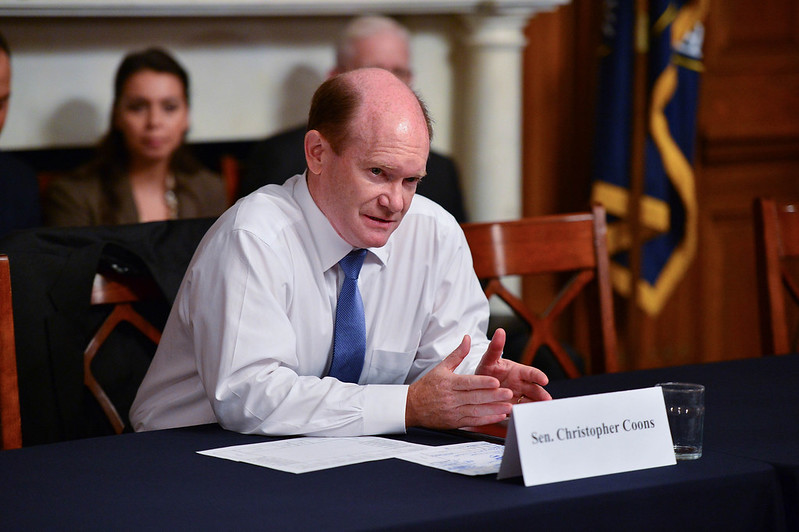
Senator Coons’ homeland security priorities included in appropriations bill

WASHINGTON – U.S. Senator Chris Coons (D-Del.), a member of the Senate Appropriations Committee, joined his colleagues on the Committee Thursday to approve the Senate’s FY15 Homeland Security appropriations bill, legislation that funds and strengthens Department of Homeland Security (DHS) programs to fight terrorism, improve national security, and better manage our nation’s borders. The bill also supports key grant programs for local fire departments in Delaware and improved regulations for cargo inspections at the Port of Wilmington. At the request of Senator Coons, the bill also directs DHS to reform dangerous deportation practices along U.S. borders and strengthens efforts to identify and confiscate illegal wildlife products smuggled through the nations’ ports. The bill will now move to the Senate floor for consideration.

“Keeping our communities safe and securing our nation’s borders is a never-ending task,” Senator Coons said. “As threats to our nation evolve, Congress must ensure the Department of Homeland Security has the resources it needs to adapt and respond. This bipartisan bill makes important investments to protect our communities and infrastructure and strengthen our resilience against natural disasters. The bill also supports critical programs for Delaware’s first responders and enhances the cargo inspections process to help the Port of Wilmington stay competitive during busy seasons. While working to keep American citizens safe, this bill also upholds our responsibility to non-citizens who cross our borders by ending deportation practices that endanger women and children. I’m grateful to my colleagues for supporting these important priorities, and to Senator Carper for his outstanding leadership on these issues each day as chairman of the Homeland Security and Governmental Affairs Committee.”

Throughout the appropriations process, including during Subcommittee negotiations, Senator Coons has fought for a number of Delaware and national priorities that were included in the bill approved by the Senate Appropriations Committee Thursday. They are highlighted below:

Firefighter Assistance Grants

Senator Coons successfully fought against cuts to two effective homeland security grant programs: the Assistance to Firefighters Grants (AFG) and the Staffing for Adequate Fire and Emergency Response program (SAFER). The President’s budget proposed $10 million in cuts to these programs, which have been instrumental in maintaining fire safety services for communities in Delaware and across the country. The SAFER program provides federal grants to understaffed fire departments to help them hire and pay new firefighters, and the AFG program provides funds for training and equipment. Cuts to these programs would have undercut safety and reduced the support available to communities in need at a time when many departments are facing state and local budget cuts.  

Port of Wilmington

Senator Coons advocated for language included in the bill that will ensure continued collaboration between Customs and Border Protection and the Animal and Plant Health Inspection Service (APHIS) as the agencies work to implement revised user fee regulations. Revised regulations will ensure perishable produce at the Port of Wilmington – the continent’s leading importer of bananas and fresh fruit – receive timely inspections during busy seasons. The changes will enable private companies to pay overtime costs for the Port’s agriculture inspectors to ensure adequate staffing during their busiest import seasons. Senator Coons has pushed for reforms to update the current outdated regulations and successfully advocated for inclusion of similar supportive language in the FY15 Agriculture appropriations bill, which provides funding for APHIS.

Ending Dangerous Deportation Practices

Senator Coons successfully advocated for language updating U.S. deportation protocols to better protect the health, welfare, and safety of deported individuals, including unaccompanied women and children. The language directs DHS to limit all deportations to daylight hours and avoid locations that are determined to have high indices of crime and violence, except in cases justified by compelling government interest or the informed consent of the adult being removed. The language also directs the Department to develop standardized procedures to prevent the separation of families during the deportation process. These concrete, commonsense changes will encourage interagency cooperation to improve the security and welfare of newly deported migrants.

 Combatting Wildlife Trafficking

Senator Coons advocated for language urging improved interagency coordination to track, confiscate, and pursue illegally traded wildlife and wildlife products moving through our nation’s ports. The U.S. is currently the world’s second largest market, behind China, for illegal wildlife products. The bill directs DHS to submit a report outlining the steps it is taking to address the issue, improve coordination with the Fish and Wildlife Service, and implement the U.S. National Strategy for Combating Wildlife Trafficking. Senator Coons is chair of the Senate Foreign Relations Subcommittee on African Affairs and co-chaired a hearing on the escalating wildlife trafficking crisis in May.

Senator Coons co-hosts Senate roundtable on nation’s critical infrastructure needs

Steering Meeting on Infrastructure Investment

WASHINGTON – U.S. Senator Chris Coons (D-Del.) co-hosted a roundtable discussion in the Capitol Wednesday focused on repairing America’s deteriorating infrastructure and fixing the Highway Trust Fund, which will run out of funding for road and bridge repairs this summer. The meeting comes just weeks after unexpected damage forced the closure of Delaware’s I-495 bridge, a critical artery that carries more than 90,000 drivers a day. Matthew Cummings, Senior Vice President of AECOM, the engineering company currently working with DelDOT to repair the bridge, briefed senators on the status of repair work and shared his perspective on the nation’s broader infrastructure challenges.

“This summer, commuters in Delaware and across the region are facing major disruptions to business, travel, and their everyday lives because a critical bridge in our community is currently out of service,” Senator Coons said. “We rely on our bridges, tunnels, and highways every day, but Congress isn’t making the investments necessary to maintain them. We are weeks away from exhausting the federal Highway Trust Fund, and the longer we delay critical repairs, the more communities will face costly infrastructure emergencies like the one affecting Delaware. Congress has to find new and innovative ways to finance our nation’s infrastructure needs, and I’m grateful to Matt for joining us to discuss the path forward.”

The federal Highway Trust Fund, which finances 80 percent of the costs of state highway maintenance projects, will run out of funding as soon as early August. The shortfall will put thousands of critical construction projects on hold and jeopardize the safety of the nation’s highway system.

Matthew Cummings of AECOM, which is leading the engineering and design work on the I-495 bridge, explained the critical role the Highway Trust Fund plays in maintaining our nation’s roadways and urged the senators to act quickly to ensure its solvency. 

“Our group gathered yesterday to urge Congress to address the Highway Trust Fund shortfall and create a reliable, long-term source of funding for our transportation infrastructure,” said Matthew Cummings, Senior Vice President of AECOM. “While the temporary closure of I-495 in Delaware is rapidly being repaired, it is a very real reminder of the importance of our transportation systems and the need to invest for the future.”

AECOM has offices in Wilmington and Philadelphia and has worked on a number of projects in Delaware, including several stimulus-funded projects on I-95. 

Senator Coons is a cosponsor of two bipartisan bills that would build innovative public-private partnerships to finance infrastructure projects. The BRIDGE Act and the BUILD Act would both establish an independent, nonpartisan financing authority to leverage private capital and complement existing U.S. infrastructure funding. 

Senator Coons spoke with Comcast Newsmakers’ Jill Horner on June 20 about the status of I-495 bridge repairs and bipartisan proposals to spur infrastructure investment. Watch his interview here: http://1.usa.gov/1lSp6wb

Five Manufacturing Jobs for America bills featured in workforce training legislation approved by Senate

WASHINGTON – U.S. Senator Chris Coons (D-Del.), leader of the Senate’s Manufacturing Jobs for America campaign, voted Wednesday to approve bipartisan, bicameral legislation that will strengthen our nation’s workforce training programs and help put Americans back to work. The Workforce Innovation and Opportunity Act (WIOA) streamlines and improves effective workforce development initiatives and eliminates 15 unnecessary programs. WIOA also includes five innovative skills-training provisions from the Manufacturing Jobs for America campaign to help prepare America’s workforce for the manufacturing jobs of the 21st century. The bill now heads to the House of Representatives for approval.

“Keeping America competitive means making sure our workers have the skills employers are looking for,” Senator Coons said. “America’s manufacturing sector helped build our nation’s middle class, but the advanced manufacturing jobs of today require higher-skilled workers than ever before. We have to align our workforce development programs with the needs of America’s manufacturers, and the Workforce Innovation and Opportunity Act takes important steps to do just that. This bill invests in local and regional partnerships that will ensure schools across the country are training workers to fill available jobs. The bill also streamlines and eliminates unnecessary programs to ensure investments are focused on the most effective initiatives. I’m glad the Senate has come together to invest in middle class workers and I urge my colleagues in the House to quickly approve this important legislation.”

Led by Senator Coons, more than 25 senators have contributed more than 30 bills to the Senate’s Manufacturing Jobs for America initiative. Roughly one-third of these bills are focused on skills training. Provisions from five of these bills were included in the Senate-passed WIOA reauthorization. They are detailed below: 

Adult Education and Economic Growth Act (S. 1400)

Jack Reed (D-R.I.), Sherrod Brown (D-Ohio)

WIOA includes key portions of S.1400, which seeks to increase investment in adult education, expand access to technology and digital literacy skills for adult learners, require better coordination and integration of adult education with state workforce development systems and postsecondary education, and strengthen English and civics education for new Americans.

America Works Act (S. 453)

Kay Hagan (D-N.C.), Joe Donnelly (D-Ind.), Dean Heller (R-Nev.), Amy Klobuchar (D-Minn.), Chuck Schumer (D-N.Y.)

WIOA includes provisions from S. 453, which seeks to prioritize federal funding for job training programs that offer portable, national and industry-recognized credentials. This reform would promote job-training programs that match the skills of workers with the needs of local employers, thereby training individuals for the jobs that are available in their communities right now.

On-the-Job Training Act (S. 1227)

Jeanne Shaheen (D-N.H.), Thad Cochran (R-Miss.)

WIOA includes aspects of S. 1227, to significantly expand opportunities for on-the-job-training. WIOA requires state workforce investment boards to disseminate information identifying on-the-job-training opportunities and boosts incentives for employers to participate in on-the-job-training programs.

SECTORS Act (S. 1226) 

Sherrod Brown (D-Ohio), Bob Casey (D-Pa.), Susan Collins (R-Maine), Dick Durbin (D-Ill.)

WIOA includes provisions from S.1226 to require state and local Workforce Investment Boards to establish sector-based partnerships between employers, educators, and local workforce administrators to train workers for the most in-demand 21st century jobs.

Community College to Career Fund (S. 1269)

Al Franken (D-Minn.), Mark Begich (D-Alaska), Dick Durbin (D-Ill.), Brian Schatz (D-Hawaii)

WIOA includes aspects of S.1269 to create partnerships between businesses and schools that facilitate effective job training.

Senator Coons urges Senate Republicans to support bill to restore Voting Rights Act

WASHINGTON – In the Senate Judiciary Committee on Wednesday, U.S. Senator Chris Coons (D-Del.) urged his colleagues to support legislation he introduced in January with Judiciary Committee Chairman Patrick Leahy (D-Vt.) and Judiciary Subcommittee on Civil Rights Chairman Dick Durbin (D-Ill.) to modernize the Voting Rights Act and restore critical protections stripped by the Supreme Court last year. Senator Coons expressed his disappointment that, despite Republicans’ historic role in the civil rights movement, no Senate Republican has yet agreed to cosponsor their Voting Rights Amendments Act.

“The day that we announced the introduction of this bill, I was proud to be joined by Republicans from the House,” Senator Coons said. “I continue to hope and pray that we will be joined by Republicans in the Senate in what I think is the result of compromise – responsible, reasonable, and absolutely essential response to this difficult case – the decision in Shelby County, and I think modernizing, strengthening, and implementing an updated Voting Rights Act is absolutely essential for our nation.”

Questioning the Rev. Dr. Francys Johnson, state president of the Georgia NAACP, Senator Coons highlighted Republicans’ historic role in the civil rights movement.

“I think one of the things for which the Republican Party has long, justifiably, been proud is the central role that Republican legislators played in the enactment of landmark civil rights legislation in the last century,” Senator Coons said. “Yet today we seem to see a partisan divide on this Voting Rights Amendments Act, when previous VRAs had been broadly bipartisan in their support.”

“Why do you think that this has become a partisan issue?”

“It’s a very good question, especially considering every reauthorization of this important act has been by a Republican president,” Dr. Johnson said. “This should not be a partisan issue – the right to vote – and it is sacred. It was paid for by the blood, sweat, and tears of so many.”

“We are seeing extraordinary success under the Voting Rights Act,” Dr. Johnson concluded. “I am here today to say, let’s not take away what has worked so well. Let’s keep it in place so that we don’t repeat the mistakes of history and go down a pathway that is quite dangerous.”

The Voting Rights Amendments Act — supported by a range of civil rights groups — is a bicameral response to the Supreme Court’s Shelby County decision, which struck down a core provision in the Voting Rights Act. That provision determines how states are covered under Section 5 of the law, which requires federal preclearance to protect against discriminatory voting measures. The bill updates the coverage formula by making all states and jurisdictions eligible for the coverage formula based on voting violations in the last 15 years. States and jurisdictions that have had a clean record over the last 15 years would not be subject to coverage. 

Key provisions in the bill include:

  • A coverage provision based on current conditions. The bill establishes a rolling nationwide trigger that covers states or jurisdictions that have a persistent record of recent voting rights violations in the last 15 years.
  • Allows our federal courts to bail-in the worst actors for preclearance. The current law permits states or jurisdictions to be bailed-in for intentional violations, but the new legislation amends the Act to allow states or jurisdictions to be bailed-in for results-based violations.
  • Greater transparency in elections so that voters are made aware of changes. The additional sunlight will deter discrimination from occurring and protect voters from discrimination.
  • Allows for preliminary relief to be obtained more readily, given that voting rights cannot often be vindicated after an election is already over.
  • Includes modest provisions that continue to permit states to enact reasonable photo identification laws.

The full text of the legislation can be downloaded here.