Related Issues

Related Issues

Coons, Gardner, Welch, Kinzinger Introduce Bipartisan Energy Efficiency Legislation

WASHINGTON – U.S. Senators Chris Coons (D-Del.) and Cory Gardner (R-Colo.) and U.S. Representatives Peter Welch (D-Vt.) and Adam Kinzinger (R-Ill.) announced today that they are introducing identical bipartisan bills in the Senate and House encouraging and expanding the use of Energy Savings Performance Contracts (ESPCs) and Utility Energy Service Contracts (UESCs) in federal government buildings.

ESPCs and UESCs are innovative public-private partnerships in which private companies use their own money and resources to make energy-efficiency upgrades to federal buildings. In exchange for making those upgrades, those private companies receive a portion of the money saved as a result of the increased efficiency in federal buildings. ESPCs and UESCs create private sector jobs upgrading the federal government’s estimated three billion square feet of office space at no real cost to taxpayers.

“Saving energy and taxpayer money at the same time just makes sense, and I’m excited to move this bill forward with my colleagues from across the aisle and across the Capitol,” Senator Coons said.  “All at once, this legislation will support local jobs, help the federal government save energy, and allow us to invest in clean energy, energy efficiency, and water conservation projects that are critical to our economic future.”

“The federal government is the largest consumer of energy in America,” Senator Gardner said. “Using ESPCs and UESCs to make the federal government more efficient while creating private sector jobs is the kind of commonsense solution that members of both parties can get behind. I’ve worked on this issue going back to my time in the House of Representatives and I made it one of the tenets of my Four Corners Plan for Colorado when I ran for Senate. I’m proud to join with my colleagues today and continue leading this effort.” 

“The federal government has over 3 billion square feet of building space and is the largest energy consumer in the country,” Representative Welch said. “This legislation would make federal buildings energy efficient while saving taxpayer dollars, improving the environment and create private sector jobs. In the previous Congress, the House demonstrated that energy efficiency is a practical idea that cuts through partisan gridlock. In this Congress, we’ll be redoubling our efforts to get bipartisan energy efficiency legislation on the President’s desk.”

“Currently, the federal government is missing out on an estimated $20 billion in savings by continuing to run outdated, energy inefficient federal facilities,” Representative Kinzinger said. “The Energy Savings through Public Private Partnerships Act is a bipartisan, commonsense solution that is guaranteed to help end wasteful spending on inefficient energy programs in order to deliver savings to the American taxpayers who are footing these energy bills.”

###


Senator Coons statement on President Ghani’s address to Congress

WASHINGTON – U.S. Senator Chris Coons (D-Del.) issued the following the statement after Afghan President Ashraf Ghani’s address to Congress today.

“Our nation’s relationship with the Afghan government deeply affects our broader interests in South and Central Asia and around the world, so I was encouraged this morning by President Ghani’s strong commitment to our countries’ continued collaboration.  The United States has sacrificed a tremendous amount to ensure Afghanistan has a government worthy of the Afghan people and is no longer a safe haven for terrorists. Those sacrifices must now be followed by a continued commitment to a stable, democratic Afghanistan, and President Ghani appears ready to be our partner in that commitment.

“In his remarks, President Ghani outlined an important change of direction from the previous regime, emphasizing stability, reform, and true partnership with the United States. That partnership is critical, and as we maintain our troop presence in Afghanistan this year, I will continue to seek and support strategies that serve American interests.”

###

Carper, Coons, Carney kick off job fair season by welcoming more than 400 to Dover

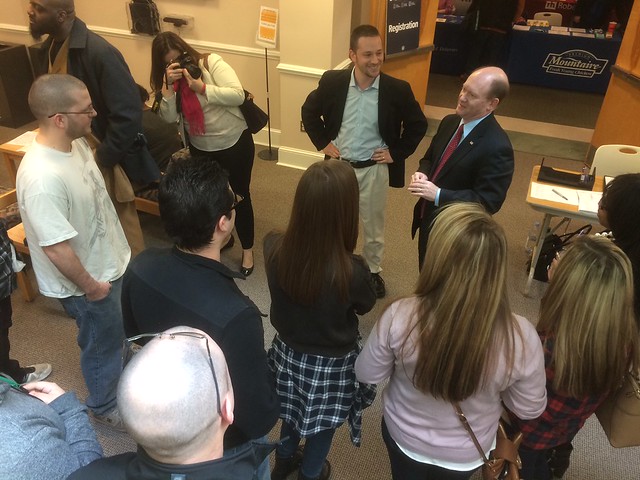
DOVER, Del. – U.S. Senators Tom Carper and Chris Coons and U.S. Representative John Carney hosted their first job fair of the season at Wilmington University’s Dover Campus Monday matching more than 400 job seekers with nearly 30 business looking to fill full and part-time employment positions. This was the first of three job fairs to be hosted by the delegation this year.

Upcoming job fairs will be held at Delaware Technical Community College’s Stanton campus on Friday, April 10 from 12 to 4 p.m. and at the Rehoboth Beach Convention Center on Monday, May 4 from 10 a.m. to 2 p.m.

In addition to networking and interviewing with companies, job seekers attend job hunting workshops with the Brandywine Counseling & Community Services, where they polished their resumes and picked up interview techniques. This was the third straight year that the Kent County job fair has been partnered with the Brandywine Counseling & Community Services to provide these workshops for attendees. Guests also attended a lecture by life coach Joe White.

Since 2011, the Congressional Delegation has hosted 24 job fairs in Delaware, including five specifically for veterans. For more information on how to participate as an employer or job seeker, please call Senator Coons’ office at 302-573-6345, or email workshop@coons.senate.gov. Preregistration for job seekers is not required.

Carper, Coons, Carney to host job fair in Dover this Monday

Dover, Del. – Working to connect individuals searching for jobs and companies looking to fill full and part-time positions, U.S. Senators Tom Carper and Chris Coons, and U.S. Representative John Carney will host the first of three spring jobs fairs this Monday at Wilmington University’s Dover campus (3282 North DuPont Highway) from 10 a.m. to 2 p.m. 

The fair will feature more than 30 companies looking to fill more than 300 full and part-time slots. Some of the companies include AAA Mid-Atlantic, Aflac, BayadaHome Healthcare, DART, Energizer Personal Care, J & J Staffing Resources, Kate Spade NY, Lacoste, Lowe’s, Mountaire Farms, Navient, New Castle County Police Department, New York Life, North Dover Chick-Fil-A, PNC Bank, Robert Half Office Team, Under Armour, USDA Food Safety and Inspection Service, Westside Family Healthcare, Wilmington Police, Wilmington University, and WSFS Bank.

The Dover job fair organizers will also welcome guest speaker and life coach Joe White. Mr. White was named New Castle County Chamber of Commerce’s 2012 Entrepreneur of the Year.

The delegation is also seeking interested companies looking to fill positions for the remaining two job fairs in New Castle and Sussex Counties. Those who are looking to hire can contact Senator Coons’ office at 302-573-6345 or via email atworkshop@coons.senate.gov.

Senator Coons praises USTR action against Indonesian trade restrictions

WASHINGTON – U.S. Senator Chris Coons (D-Del.), co-chair of the bipartisan Senate Chicken Caucus and a member of the Senate Foreign Relations Committee, issued the following statement Wednesday on the decision by U.S. Trade Representative Michael Froman to request the World Trade Organization (WTO) establish a dispute settlement panel to examine Indonesia’s wide-ranging import restrictions on fruits and vegetables (such as apples, grapes, and potatoes), animal products (such as beef and poultry), and other agricultural products.

“The economic health of America’s agricultural sector is directly tied to its access to foreign markets,” Senator Coons said. “That makes it critical that the United States fight the unfair protectionist policies of some of the world’s biggest markets. Indonesia is the fourth largest country in the world, and its ban on the import of U.S. poultry is both unwarranted and — it seems — illegal. If Indonesia wants the trade protections afforded by the WTO, it needs to itself live up to the standards enforced by the WTO. Ambassador Froman is continuing what has been an aggressive and appreciated effort by the Obama Administration to level the playing field for American farmers, and protect the jobs they support.”

Delaware’s poultry industry supports more than 14,000 jobs and contributes more than $4.6 billion to the state’s economy, according to the National Chicken Council.

In October, the WTO sided with the United States with a ruling that India had illegally blocked imports of U.S. poultry based on unfounded claims about avian influenza. Senator Coons praised the ruling, noting India’s baseless claims were being used to justify its ban on U.S. poultry and were hurting Delaware chicken-growers.

Senator Coons is actively working with Senator Isakson to get South Africa to drop its illegal anti-dumping duties on U.S. poultry, warning that if South Africa’s duties are not dropped before the Senate considers the reauthorization of the African Growth and Opportunity Act (AGOA) this spring, they will work to prevent South Africa from continuing to enjoy the significant trade benefits afforded by the law.

###

Senator Coons statement on patent reform

WASHINGTON – Today, U.S. Senator Chris Coons (D-Del.) released the following statement as the Senate Judiciary and Small Business Committees hold hearings this week to discuss patent reform.

Earlier this year, Senator Coons introduced the STRONG Patents Act. More information on his bill can be found here: https://www.coons.senate.gov/issues/intellectual-property/strong-patents-act

“Our economy depends on American innovators to turn their ideas into new companies and new jobs.  Patents protect those jobs, but almost everyone agrees that America’s patent system needs to be updated to stop abuse from patent trolls and help job-creating inventors.  The problem is that too many advocates for patent reform believe the only way to stop those abusing the system is to weaken protections for inventors,” said Senator Coons. “Weakening patents means weakening investments in research and making it harder for inventors to find the investment capital they need. America’s patent system needs to work for all inventors, and it shouldn’t be carved up to benefit certain industries over others. Instead, we need a patent system that works for everyone, so Congress should have a real debate over the best way to fight against patent trolls while protecting the inventors our economy relies on. The reforms contained in the STRONG Patents Act strike the right balance and would improve the climate for America’s inventors. I look forward to working with my colleagues to get it passed into law.”

###

Bipartisan coalition introduces bill to designate ‘Manufacturing Universities’

WASHINGTON – Today, U.S. Senators Chris Coons (D-Del.), who leads the Manufacturing Jobs for America campaign, Lindsey Graham (R-S.C.), Kirsten Gillibrand (D-N.Y.), Kelly Ayotte (R-N.H.), and Tammy Baldwin (D-Wis.) introduced bipartisan legislation to help schools strengthen their engineering programs and meet the growing demands of 21st century manufacturing. The bill would designate 25 universities as ‘Manufacturing Universities’ and provide incentives to better align educational offerings with the needs of modern manufacturers. The incentives would be used to bolster universities’ efforts to focus on manufacturing engineering and curricula specifically related to targeted industries.

The Manufacturing Universities Act of 2015 would establish a program within the Commerce Department’s National Institute of Standards and Technology (NIST) charged with designating 25 schools as ‘Manufacturing Universities.’ Designated schools would receive $5 million per year for four years to meet specific goals, including focusing engineering programs on manufacturing, building new partnerships with manufacturing firms, growing training opportunities, and fostering manufacturing entrepreneurship. The program would be run by the Director of the NIST, in coordination with the Secretaries of Defense and Energy, and the Director of the National Science Foundation, among others.

“It’s critical that our schools and universities equip students for success in manufacturing and contribute to the research and development that drives advanced manufacturing,” said Senator Coons. “Although our economy has created more than 800,000 manufacturing jobs over the last five years, hundreds of thousands of jobs remain unfilled because we don’t have enough trained workers. We need our engineers to fill the growing demand for manufacturing workers and accelerate manufacturing’s growth. This bipartisan bill would help us meet that challenge. By helping schools focus their engineering programs on advanced manufacturing skills, we can equip our next generation of engineers with the skills they need to thrive in the 21st century.”

“This is an incredibly important issue for our states’ institutions of higher education and manufacturing industries,” said Senator Graham. “I look forward to working with this bipartisan group of senators to explore additional innovative ways to ensure our manufacturing sector thrives.”

“If we want businesses to expand and grow our economy, we need to make sure our workforce has the skills and training to match,” said Senator Gillibrand. “No job should go unfilled and no company’s expansion should ever be inhibited because there aren’t enough trained workers. This legislation will equip more students with the advanced manufacturing skills and experience necessary to meet growing demand and ensure our manufacturing remains innovative and globally competitive.”

“This legislation will help our students acquire the skills they need to meet the demand for the high-paying, manufacturing job opportunities in New Hampshire, while giving our universities more tools to spur innovation and use cutting-edge technology to grow this vibrant sector of our economy,” said Senator Ayotte

“As the demand for a highly skilled workforce continues to grow, I’m proud to support bipartisan legislation that ensures our universities offer courses that will help prepare students for our 21st century Made in Wisconsin manufacturing economy,” said Senator Baldwin. “In Wisconsin, we can create stronger economic growth and shared prosperity for our state if we make investments in higher education and advanced manufacturing. This bipartisan legislation will give students the ability to carry on our Wisconsin tradition of making things and help us build a stronger middle class in Wisconsin and America.”

Companion legislation will be introduced in the House of Representatives today by U.S. Representatives Elizabeth Esty (D-Conn.), Chris Collins (R-N.Y.), Paul Tonko (D-N.Y.), Rodney Davis (R-Ill.), Patrick Meehan (R-Pa.), and Mike Thompson (D-Calif.).

This bipartisan legislation has been endorsed by Association of American Universities, the Association of Public and Land-grant Universities, The Information Technology and Innovation Foundation, the Precision Metalforming Association, the National Tooling & Machining Association, the University of Delaware, Delaware State University, Clemson University, University of South Carolina, University of Pennsylvania, Temple University, Drexel University, the University of Missouri System, the University of Illinois, the University of California, Davis, the University of California, Irvine, Boston University, the University of Rochester, the Rochester Institute of Technology, the State University of New York (SUNY) System, Kent State University, the University of Wisconsin, the University of Connecticut, Rensselaer Polytechnic Institute, Clarkson University, Dow, DuPont, and Siemens.

Senator Coons statement on the 50th anniversary of the Voting Rights Act introduction

WASHINGTON – U.S. Senator Chris Coons (D-Del.) today released the following statement on the 50th anniversary of the original introduction of the Voting Rights Act.

“Two weeks ago, I gathered with colleagues, civil rights leaders, and Americans from across the country in Selma, Alabama to honor Dr. Martin Luther King, Jr., Congressman John Lewis, and so many other brave men and women who marched over the Edmund Pettus Bridge 50 years ago. Many of those Americans were beaten, humiliated, and arrested simply because they dared to demand equal voting rights, and a half century later, we celebrated their sacrifices and their accomplishments.  

“Today, we mark another 50 year anniversary to remember the day when the Voting Rights Act was first introduced in Congress. This landmark legislation, first proposed by President Lyndon Johnson, sought to fulfill the promise of the Fifteenth Amendment and ensure that no person would be denied the right to vote because of the color of his or her skin. Since its passage, the Voting Rights Act has accomplished much, but with the Supreme Court’s 2013 decision to gut a key part of that law that protects against new laws and ongoing efforts, particularly at the state level, to deny millions of Americans their right to vote, President Obama is right to say that ‘our march is not yet finished.’

“Today’s America is not the America of 50 years ago, just as today’s hurdles to the ballot box are not Jim Crow. But in too many cities and towns, states and counties, new roadblocks are being built to make it more difficult for some Americans to vote.

“Just as Republicans and Democrats came together in 1965 after President Johnson spoke for ‘the dignity of man and the destiny of democracy,’ it is my sincere hope that we too will come together to meet the new challenges our democracy faces. In the coming weeks, I will join my colleague, Senator Patrick Leahy of Vermont, in introducing the Voting Rights Amendment Act to restore and improve the original law, and I will personally lobby all of my colleagues, Republicans and Democrats, to join us.

“Today, 50 years after Congress first took those historic steps to give all Americans access to the ballot, we should pledge that our freedoms will not fall victim to division, but will instead be strengthened by our union.”

Senator Coons says U.S. cannot “write another blank check for war”

In December, Coons introduced an amendment to ensure U.S. pays for war against ISIS

Coons pledges to once again introduce amendments to ensure U.S. pays for combat operations

WASHINGTON – U.S. Senator Chris Coons (D-Del.) pressed Secretary of Defense Ash Carter on the Administration’s position on paying for combat operations against ISIS at a Senate Foreign Relations Committee hearing on the Obama Administration’s draft Authorization for Use of Military Force (AUMF) on Wednesday.

At the hearing, Coons also pledged to introduce amendments to the federal budget and any AUMFs considered during this Congress to ensure the United States pays for the fight against ISIS.

“The two post-9/11 engagements added literally trillions of dollars to our nation’s debt, so I think we cannot write another blank check for war. We have to pay for it. It’s not just fiscally responsible, it’s morally responsible,” said Senator Coons.

“In the last Congress I introduced an amendment to the AUMF that was debated and considered, and I will do so in this debate and consideration and also in the upcoming budget process,” Coons added.

In December, Coons introduced an amendment to a separate AUMF draft, which was then under consideration by the Senate Foreign Relations Committee, that said “any funds made available for activities authorized by this joint resolution should be fully offset through reduced spending, increased revenue, or both.” 

A full transcript of Senator Coons’ exchange with Secretary Carter is below:

Senator Coons: “Thank you, Chairman Corker. I want start by thanking General Dempsey and Secretary Carter and Secretary Kerry for your service, for your testimony and for your engagement with us today.

“We recently heard the tragic news of 11 service members – four soldiers, seven marines – currently missing, and I believe presumed lost in a training accident at Eglin Air Force Base.

“I just think it’s worth a moment of prayerful reflection for the enormous sacrifice that they have made – and their families – the loss they’re facing. Dover Air Force Base will be the place to which those families now go and their remains return.  I think all of us who are contemplating the undertaking we’re about to authorize, that I pray we’re about to authorize, is one that will involve a great deal of sacrifice across many countries and many years.

“A question I wanted to raise is about who bears the cost. In addition to the men and women of the armed forces and their families, I think we need to be putting on the table in our conversation about authorizing the conflict against ISIS the financial cost. General Dempsey was right to raise concerns about DOD’s budget for maintenance of effort across many different fields.

“The need to pay for this war is, for me, a central concern.

“Going back to 1961, President Eisenhower said that America ‘could choke itself to death piling up military expenditures just as surely as it can defeat itself by not paying enough for protection.’ We have used a combination of either spending cuts or increased revenue to pay for every conflict before the 2003 Iraq War and the two post-9/11 engagements added literally trillions of dollars to our nation’s debt, so I think we cannot write another blank check for war. We have to pay for it. I think it’s also not just fiscally responsible but morally responsible.  It engages every American in bearing the cost of the conflict.  I’m aware this is not directly in the purview of this committee, but I think it’s the responsibility of all of Congress. 

“I am intending to renew this conversation. In the last Congress, I introduced an amendment to the AUMF that was debated and considered and I will do so in this debate and consideration and also in the upcoming budget process. 

“I wondered if any of you cared to comment on behalf of the Administration on an amendment that would call for a temporary war surtax that raises revenues, or one that is a mix of raising revenues and cutting spending, to off-set to cost of the conflict against ISIL. Secretary Carter, I’ll start with you.

Secretary Carter: “You’re raising a very important question. My own view is that that question is not best associated with the Authorization for the Use of Military Force, although it’s a very important question. The AUMF principally covers the kind of campaign required, and the support and authority of the President to engage in that.

“With respect to the expenditures, we are in a situation – and Chairman Dempsey referred to this, and I believe the State Department is also, in terms of its own budget – of one in which we’ve had year after year of turmoil, which is disruptive, which is wasteful, which causes all of us – and I think this is probably true in the State Department budget and any of my other colleagues – to have a very difficult time managing appropriately and efficiently. So that’s a very important problem and I appreciate your attention to it and agree with what you said.  This is now, I’m offering a view off the top of the head here, I think that that is best dealt with and needs to be dealt with, but best dealt with in another way than by incorporating the funding situation into the AUMF. 

Senator Coons: “Thank you, Mr. Secretary. The point I’m simply trying to raise, is that at the same time that the Chairman of the Joint Chiefs raises appropriately, enduring budget concerns. As a former member of the Budget Committee myself, I feel uncomfortable that we continue to use OCO contingency funding for more and more reach and more and more functions and I’d like to see us take on, perhaps in other committees, the responsibility of clearly shouldering the responsibility of paying for this, and not just asking for sacrifice from those who wear the uniform.”

Senators Coons, Collins, Reed, Shaheen re-introduce bill to enhance and extend landmark energy efficiency programs

WASHINGTON – U.S. Senators Chris Coons (D-Del.), Susan Collins (R-Maine), Jack Reed (D-R.I.), and Jeanne Shaheen (D-N.H.) on Wednesday re-introduced their legislation to strengthen and reauthorize the heart of the federal government’s energy efficiency strategy — the Weatherization Assistance Program — and to reauthorize the vital work of the State Energy Program. S.703, the Weatherization Enhancement and Local Energy Efficiency Investment and Accountability Act would extend both programs for five more years.

“Saving energy is the first step to reducing our energy costs and increasing our nation’s energy security,” Senator Coons said. “The Weatherization Assistance Program and State Energy Program have made it possible for millions of Americans to reap the benefits of a wide range of energy-efficient technologies and practices. Our bill will not only ensure that both landmark programs can continue to help make American homes safer, healthier, and more energy efficient, it also further enhances the Weatherization Assistance Program with a complementary, competitive grant program, and requires that the DOE establish strong, achievable standards for qualifying entities. This will ensure that even more families can benefit. This is common-sense, bipartisan legislation that I hope will once again earn strong support in the Senate.”

“Weatherization provides grants to permanently lower home energy costs for low-income families, seniors, and individuals with disabilities,” Senator Collins said. “This is particularly important for a state like Maine with some of the oldest housing stock in the nation and a high dependence on home heating oil. The State Energy Program is also supporting important state energy efficiency and renewable energy projects.  Programs such as these have a significant return on investment and help meet our national goals of saving energy, lowering costs, and energy independence.”

“Being smarter about how we use energy helps to strengthen our economy, improve our energy security, and protect the environment,” Senator Reed said. “This bipartisan legislation to reauthorize the Weatherization Assistance Program and State Energy Program will help more Rhode Island families and businesses save on their energy bills.  On a national level, investing in a cleaner, more efficient energy system is a cost-effective strategy to help increase our global competitiveness, support job growth, and reduce our dependence on fossil fuels.”

“Weatherization projects are among the most effective ways to conserve energy, create jobs, and lower costs for New Hampshire families,” Senator Shaheen said. “The Weatherization Assistance Program has helped low-income families, seniors and individuals with disabilities make lasting and cost-effective energy efficiency improvements to their homes, while the State Energy Program has a history of success working across all sectors of the economy to support cost-effective energy efficiency improvements in New Hampshire and across the country. They’re proven programs, and we ought to act on our bipartisan proposal to reauthorize them immediately.”

For 39 years, the Weatherization Assistance Program has assisted low-income families that lack the resources to make their homes more energy efficient. It is responsible for energy efficiency upgrades — including the installation of attic insulation and dense pack sidewall insulation, as well as air sealing, heating system repairs and, when necessary, replacements, duct sealing and insulation, and base load measures — in more than 7.4 million homes across the country, including more than 1 million homes in just the last four years. For every dollar invested by the Weatherization Assistance Program, participating American homeowners have saved more than $2.50 on their energy costs.

The 40-year-old State Energy Program leverages federal investment with state and local funds to encourage strategic and programmatic energy-related activities to increase energy efficiency, develop alternative energy sources, promote energy development, and reduce energy dependency.  For every dollar invested by the State Energy Program, more than $7 in energy-cost savings have been realized.

The Congressional authorization for both programs expired in September 2012.

The Weatherization Enhancement, and Local Energy Efficiency Investment and Accountability Act would:

  • Reauthorize and extend the WAP and SEP through 2020;
  • Develop a competitive, leveraged grant program for non-profits that have a track record of success to access the WAP; and
  • Require minimum professional standards for WAP contractors and workers, and require an independent quality assurance program.

The legislation has been endorsed by more than 20 organizations, including the National Association of State Energy Officials, Habitat for Humanity International, Natural Resources Defense Council, Alliance to Save Energy, American Council for an Energy Efficient Economy, Energy Future Coalition, National Association for State Community Services Programs, and Rebuilding Together.  A complete list is available at http://www.coons.senate.gov/weatherization.

“Once again, these Senators recognize the value of continuing these important programs,” National Association of State Energy Officials Executive Director David Terry said. “These programs work cooperatively between the Federal government and the states, and help support private sector efforts to improve our nation’s use of energy.  We look forward to swift action supporting this important authorizing legislation.”

“The Alliance to Save Energy applauds Senators Chris Coons, Susan Collins, Jack Reed and Jeanne Shaheen, for introducing bi-partisan legislation that will increase the affordability and comfort of housing for our most vulnerable American families while also helping communities by creating local jobs and stabilizing low income housing markets,” Alliance to Save Energy President Kateri Callahan said. “The Weatherization Enhancement and Local Energy Efficiency Investment and Accountability Act reauthorizes programs that are proven to leverage non-federal dollars and to return $7 for every $1 of federal funding spent. Congress should pass this important bill post haste.”

“In addition to creating health and environmental benefits, increasing and modernizing weatherization techniques will lower energy costs for individual families and create financial opportunities throughout communities in the U.S.,” Habitat for Humanity Chief Executive Officer Jonathan Reckford said. “Every dollar that families save on energy usage can go toward other necessities. Habitat for Humanity strongly supports this legislation that will help families make residential energy efficient upgrades while creating an innovative and competitive grant program that enables nonprofits to help solve the ongoing energy efficiency challenges facing lower-income families.”

“The National Association for State Community Services Programs (NASCSP) thanks Senators Coons, Collins, Reed, and Shaheen for their diligent work to reauthorize the Weatherization Assistance Program and the State Energy Program,” NASCSP Executive Director Jenae C. Bjelland said. “These senators continue to demonstrate their leadership and commitment to proven cost-effective energy efficiency projects with a positive impact in communities throughout the nation. NASCSP urges support of the senators’ efforts for reauthorizing these valuable and effective programs.”

A PDF of the legislation can be downloaded here:
http://coons.senate.gov/download/weatherization-legislation