Related Issues

Related Issues

[VIDEO] Sen. Coons: “President Trump’s objective here is to put in place an attorney general who will fire Bob Mueller.”

WASHINGTON – U.S. Senator Chris Coons (D-Del.), a member of the Senate Judiciary Committee, joined Morning Joe to discuss President Trump’s recent comments about Attorney General Jeff Sessions.

“I think there’s going to be widespread opposition to an abrupt firing of Attorney General Jeff Sessions,” said Senator Coons. “Attorneys general pledged their loyalty to the United States Constitution, not to an individual president, and President Trump doesn’t seem to understand that. His repeated harassment of Jeff Sessions based on his recusal suggests he just doesn’t understand that.”

“During the Obama administration, Republicans then in the minority in the Senate for much of it refused to recess, so every three days we would have what’s called a pro forma session, that’s what I think will block, so there is a confirmation hearing at which I would expect Republicans and Democrats would raise tough questions about this ongoing Russia investigation, about whether the next attorney general would agree to fire Bob Mueller, because I think that’s what’s really President Trump’s objective here is to put in place an attorney general who will fire Bob Mueller,” said Senator Coons. 

Full audio and video available here.

Excerpts from the interview:

Senator Coons on Attorney General Jeff Sessions: First, I think the Senate will take action to make sure the president can’t make a recess appointment, that once we leave for our August recess or what’s left of it, that the president doesn’t have the opportunity to appoint someone as attorney general without the appropriate review and consent by the United States Senate. Second, I think there’s going to be widespread opposition to an abrupt firing of Attorney General Jeff Sessions. Attorneys general pledged their loyalty to the United States Constitution, not to an individual president, and President Trump doesn’t seem to understand that. His repeated harassment of Jeff Sessions based on his recusal suggests he just doesn’t understand that. So I think we would see strong and bipartisan resistance to the firing of Jeff Sessions, and I think the president would have great difficulty getting a successor attorney general confirmed in the Senate without confirmation hearings and those confirmation hearings would focus on the importance of the independence of the attorney general which is exactly the topic the president seems to want to avoid. 

More on Sessions: No, let me be clear. We’ll try to block a recess appointment so the president can appoint someone without a confirmation hearing or a vote by the Senate during a full recess. During the Obama administration, Republicans then in the minority in the Senate for much of it refused to recess, so every three days we would have what’s called a pro forma session, that’s what I think will block so there is a confirmation hearing at which I would expect Republicans and Democrats would raise tough questions about this ongoing Russia investigation, about whether the next attorney general would agree to fire Bob Mueller, because I think that’s what’s really President Trump’s objective here is to put in place an attorney general who will fire Bob Mueller. 

Senator Coons on whether President Trump can fire Bob Mueller: That’s correct, he cannot fire him, himself. That has to be done through the Department of Justice since the attorney general recused himself from oversight of the investigation, it would have to be Rod Rosenstein, the deputy attorney general. If the deputy attorney general refused to do so it would go to his deputy and so forth, just as happened in 1974 when a series of folks resigned. 

More on Sessions and Mueller: What am I drawing on to reach the conclusion that the president can’t directly fire the special counsel? Well, I haven’t reread the statute this morning, but it’s my impression that the special counsel serves at the pleasure of the attorney general and that there are certain standards for his removal and that his removal is only at the pleasure of the attorney general. I may be wrong about that. I’m happy to review the statute. 

More on Sessions and President Trump’s tweet on Murkowski: No. One of the things about this moment where the president is harassing Attorney General Sessions that is relevant here is that loyalty is an important value in politics. Senator Sessions really stuck his neck out for President Trump, really campaigned hard for him, and gave him credibility in the conservative movement in the United States and the idea that the president would personally attack the senator from Alaska who is widely respected for her independent streak will frankly only help her I think in her home state of Alaska which has a long tradition of charting their own path and of not necessarily following any particular president or his leadership. There were lots of legitimate questions on the floor last night, not least of which what Senator McCain said in his speech about where they’re going. There were 50 Republican senators who voted to get on the bill but then the bill that was taken up wasn’t passed. Nine Republican senators voted against it. It’s unclear where they’re going, and I think Senator Murkowski’s vote against going on the bill was because there’s no clear path forward. 

###
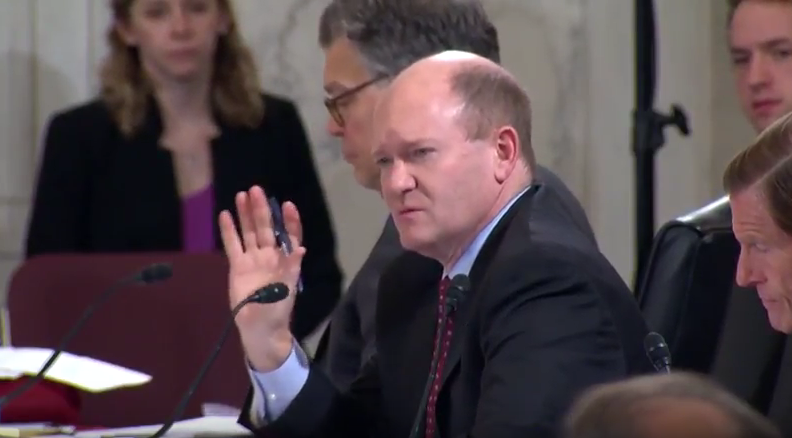
[VIDEO] Sen. Coons: “There is a disturbing trend across the Trump Administration…of nominating people whose main qualifications are personal or political loyalty, and who seem to have troubling or sometimes undisclosed ties with Russia”

WASHINGTON – U.S. Senator Chris Coons (D-Del.), a member of the Senate Judiciary Committee, questioned Brian Benczkowski, nominee to be an Assistant Attorney General in the Criminal Division of the Department of Justice. Also being questioned today were Ralph R. Erickson, nominated to be the United States Circuit Judge for the Eighth Circuit, Dabney Langhorne Friedrich, nominated to be the United States District Judge for the District of Columbia, and Stephen S. Schwartz, nominated to be a Judge of the United States Court of Federal Claims.

“There is a disturbing trend across the Trump Administration, across several agencies, of nominating people whose main qualifications are personal or political loyalty, and who seem to have troubling or sometimes undisclosed ties with Russia, and I am struggling with the timing of [Mr. Benczkowski’s] representation,” said Senator Coons.

“Mr. Benczkowski, what do you make of the President’s recent public statements expressing a lack of confidence in the Attorney General?” said Senator Coons. “He’s described him as beleaguered, he’s questioned his prosecutorial priorities, he’s continued to, in my view, harass the Attorney General- does that raise concerns for you about the ability of the Department to operate independent of political interference?”

Full audio and video available here.

Senator Coons’ remarks and Q&A, as delivered, are below:

Senator Coons, opening remarks: Thank you Chairman Grassley and I’d like to thank you at the outset for the way you’ve conducted this hearing and many other proceedings in this committee. In this particularly difficult time, and when other committees are struggling to function in a partisan way, I respect the way you’ve provided opportunities to question and the opportunity to investigate thoroughly the troubling representation of Alfa Bank by one of the nominees today, which I’ll get to in moment. I just want to welcome all three nominees. Thank you and your families for your public service previously and going forward, and while I wish I had time to question all three of your thoroughly, I will mostly focus on the matter that’s occupied many of my colleagues. If I might, Mr. Benczkowski, I have concerns that the Attorney General has been violating the scope of his recusal; I have questions about it, as I referenced in our private meeting. If you were confirmed, what would you do to ensure that no one in the criminal division communicated with your former boss, Senator Sessions, now Attorney General Sessions, regarding the ongoing Russia investigation?

Mr. Benczkowski: I think I would make it clear on day one, Senator, that any such communications with the Fifth Floor and the Office of the Attorney General would be forbidden. That said, I don’t know, as I said here today, under what circumstances I might, or the Office might learn of anything that was going on in Special Prosecutor Mueller’s investigation, but I would make it clear from day one that no such communications with the Office on the Fifth Floor of the Justice Department, including with the Attorney General, should occur.

Senator Coons: Ms. Friedrich, you served in the White House Counsel’s Office during another politically charged time, and I’m concerned about the independence of the Justice Department and its ability to operate free from political interference. Could you just briefly comment on how important that independence is institutionally over a long period of time?

Ms. Friedrich: It is critically important that the Department of Justice function independently from the White House, and as Mr. Benczkowski discussed, there are very clear rules about communications between the White House and the Department of Justice, and this happens only at the very high levels, and that’s in order to protect the Department of Justice and its independence.

Senator Coons: Thank you.  I see it as essentially important too. Mr. Benczkowski, what do you make of the President’s recent public statements expressing a lack of confidence in the Attorney General? He’s described him as beleaguered, he’s questioned his prosecutorial priorities, he’s continued to, in my view, harass the Attorney General- does that raise concerns for you about the ability of the Department to operate independent of political interference?

Mr. Benczkowski: Senator, as you know from my service to this committee and with Jeff Session, I’ve known him for quite some time, believe him to be a man of integrity, who cares deeply about the institutional independence of the Department. I think he goes to work every day doing his dead level best to protect that independence and those sorts of comments are painful and difficult for me to hear.

Senator Coons: Well, I too am concerned about what it indicates about the President’s state of mind and his intentions with regard to the Department. We talked about your previous experience at senior levels at the Department, about your lack of criminal prosecutorial experience your lack of any experience in prosecuting criminal trials, and you said you recognize that it creates a blind spot for you. How do you plan to oversee the prosecution of the most important criminal matters in our country having rarely appeared in the court room and never as a criminal prosecutor?

Mr. Benczkowski: Senator, thank you for that. The Criminal Division is a big place, 700 lawyers, thousands of support staff, and investigators. Seventeen sections. Being the Head of the Criminal Division in the first instance is principally a management and leadership job, and as I said previously, this would be my sixth such job at the Department. One of the things I’ve learned in the course of those previous positions is how important it is to consult, and listen to the career lawyers in the Department-

Senator Coons: I hope you will consult with them, forgive me, I’ve got just a minute left. My larger concern as a number of folks have said, you’ve got senior experience in the agency, you’ve got professional experience, but there is a disturbing trend across the Trump Administration, across several agencies, of nominating people whose main qualifications are personal or political loyalty, and who seem to have troubling or sometimes undisclosed ties with Russia, and I am struggling with the timing of your representation. I appreciate the opportunity we had to talk about the details of it, but I remain hung up on it. So let me ask a last question: you mentioned that attorneys from your team and Stroz Friedberg met with the FBI regarding the investigation and Alfa Bank but you didn’t participate out of an abundance of caution. What were you concerned about, and who did you consult? Did you consult the Ethics Committee at your firm, the general counsel of your firm, or consult the model rules of conduct? What were you concerned abut and how did you act on that?

Mr. Benczkowski: I was concerned at that point that my participation in that meeting, should I be nominated ultimately to head the Criminal Division, could somehow be seen as there being a conflict. And I didn’t think that for the client, again as a lawyer in private practice, my concern was for the client, and what that would mean for the client. So I stepped away. This was in part a concern about appearance down the road, but it was really out a concern that the communications between the client, its representatives, its lawyers, lawyers at Stroz Friedberg and the government be seen as pristine at that point.

Senator Coons, closing remarks: I appreciate that answer. I hope you can appreciate that the timing of your very senior role on the transition team, your representation of Alfa Bank and some of these unresolved question, have raised a great deal of concern for many of us, despite your previous experience here, and your long record for public service in other roles, and I think we have unresolved questions which I’ll submit for the record as well. Thank you to all three of the nominees today.

###

Sen. Coons on sanctions against Russia for interference in the 2016 election

WASHINGTON – U.S. Senator Chris Coons (D-Del.), a member of the Senate Foreign Relations Committee, released the following statement urging members of the U.S. House of Representatives to pass sanctions against Russia for their interference in our 2016 presidential election and urging President Trump to quickly sign those sanctions into law:

“The intelligence community’s declassified report on Russia’s intervention in the 2016 presidential election assesses with high confidence that Russian President Vladimir Putin ordered a large-scale campaign to influence our election and undermine the American public’s faith in our democratic process. Russia must pay a price for its actions, and that starts by enacting sanctions against the Russian government for its meddling in our election. The Senate voted to pass sanctions on Russia with overwhelming bipartisan support, and members of the House of Representatives should also ensure that Russia is held accountable.

“The sooner the House passes sanctions against Russia, the sooner both chambers of Congress can agree on a final text and send the bill to President Trump. I strongly urge the President to sign these sanctions into law immediately, and send a clear and forceful message that the United States will not tolerate future interference.

“We have no quarrel with the Russian people. However, we will not stand for Russian government actions that undermine our democracy. Our electoral process is fundamental to our democracy, and we must defend the integrity of that process. The 2018 United States mid-term elections are quickly approaching, and we must ensure that Russia does not successfully interfere again. It is crucial that the House, the Senate, and the White House enact this bill quickly and protect our democracy moving forward.

###

Carper, Coons join Senate Dems to challenge Trump administration over move to slash teen pregnancy prevention; Dems say action “short-sighted,” will make it harder to prevent unintended pregnancies

WASHINGTON – U.S. Senators Tom Carper and Chris Coons (both D-Del.) sent a letter on Friday with 35 of their Senate colleagues to Department of Health and Human Services (HHS) Secretary Tom Price questioning plans by HHS to unilaterally shorten the duration of grant agreements for the Teen Pregnancy Prevention (TPP) Program. Since 2015, the TPP Program has served nearly 1.2 million youth in 40 states and territories, supporting teens in adopting sexual health behaviors that help them avoid unintended pregnancy.

In their letter, Senators say the decision by the Trump Administration to gut the TPP Program will put at risk women and our most vulnerable youth, as well as undermine bipartisan goals on evidence-based policymaking.

“This action is short-sighted and puts at risk the health and well-being of women and our most vulnerable youth who depend on the evidenced-based work that TPP Program grantees are doing across the nation,” wrote the Senators. “The TPP Program is making a vital contribution to building a body of knowledge of what works to prevent teen pregnancy… Yet, the Department’s notification to grantees suggests that HHS no longer prioritizes high quality evidence-based interventions.”

Full list of Senators joining the letter: Patty Murray (D-WA), Tammy Baldwin (D-WI), Cory Booker (D-NJ), Richard Blumenthal (D-CT), Sherrod Brown (D-OH), Bernie Sanders (I-VT), Patrick Leahy (D-VT), Richard Durbin (D-IL), Tom Carper (D-DE), Tammy Duckworth (D-IL), Maggie Hassan (D-NH), Chris Coons (DE), Ron Wyden (D-OR), Tom Udall (D-NM), Jack Reed (D-RI), Chris Van Hollen (D-MD), Ben Cardin (MD), Mazie K. Hirono (D-HI), Bob Casey (D-PA), Martin Heinrich (D-NM), Al Franken (D-MN), Claire McCaskill (D-MO), Elizabeth Warren (D-MA), Amy Klobuchar (D-MN), Kamala Harris (D-CA), Bill Nelson (D-FL), Dianne Feinstein (D-CA), Michael Bennet (D-CO), Jeanne Shaheen (D-NH), Robert Menendez (D-NJ), Christopher Murphy (D-CT), Sheldon Whitehouse (D-RI), Catherine Cortez Masto (D-NV), Kirsten Gillibrand (D-NY), Maria Cantwell (D-WA), and Brian Schatz (D-HI).

Full text of the letter below and PDF HERE:

July 21, 2017

The Honorable Thomas E. Price, M.D.

Secretary of Health and Human Services

U.S. Department of Health and Human Services

200 Independence Avenue, SW

Washington, DC 20201

Dear Secretary Price:

We write in response to the Department of Health and Human Services (HHS or the Department) indicating it plans to unilaterally shorten the duration of grant agreements for the Teen Pregnancy Prevention (TPP) Program.  The Office of Adolescent Health (OAH) has notified all 81 grantees that their five-year projects (originally awarded for FY 2015 through FY 2019) will end on June 30, 2018, after only three years. OAH has also notified the five National Capacity-Building Assistance Providers that their grants will end immediately, without the FY 2017 funding they were expecting and which Congress has already appropriated. These notices of shortened project periods are highly unusual, especially given that Congress has yet to act on FY 2018 appropriations. This action is short-sighted and puts at risk the health and well-being of women and our most vulnerable youth who depend on the evidenced-based work that TPP Program grantees are doing across the nation.

The annual appropriations bill that funds your Department sets out not only the funding amount for the TPP Program, but also directs the program’s parameters. Grants must be medically accurate, age appropriate, and replicate programs that have been proven effective through rigorous evaluation. As such, the TPP Program is a pioneering example of evidence-based policymaking. Congressional leadership on both sides of the aisle as well as independent experts have called for increasing the use of data to build government programs that are supported by evidence, as indicated by the support for the bipartisan Commission on Evidence-Based Policymaking established by the Evidence-Based Policymaking Commission Act of 2016 (P.L. 114-140). 

The TPP Program is making a vital contribution to building a body of knowledge of what works to prevent teen pregnancy. Since the start of the grant projects and prior to the recent notification of early termination, OAH has ensured the program includes high quality implementation, rigorous evaluation, innovation, and learning from results. The pace of progress has accelerated dramatically since the federal investments in evidence-based teen pregnancy prevention began. Since 2010, pregnancy rates among 15–19 year olds has declined by 41 percent nationwide—more than double the decline in any other six year period since rates peaked in 1991—and is at a historic low. Seventy-five percent of pregnancies among this population remain unintended. The TPP Program has been proven to support young people in delaying sexual initiation and adopting sexual health behaviors that help them avoid unintended pregnancy.

Yet, the Department’s notification to grantees suggests that HHS no longer prioritizes high quality evidence-based interventions serving some of the most at-risk youth and communities around the country. TPP Program grantees served half a million youth from FY 2010-FY 2014, and were well on their way to serving an additional 1.2 million youth in 40 states and territories during the FY 2015-FY 2019 project period.  Despite these successes, HHS has apparently elected to eliminate the final two years of TPP Program grants without cause or a rationale for the termination.

In light of these actions by HHS, we would appreciate a written response to the following questions by August 4, 2017:

1.      Who made the decision to shorten the 81 TPP Program grant agreements by two years, and what role did those individuals hold in HHS or the White House when the decision was made?

2.      What was the justification behind this decision?

3.      Why was the notification to end grants made in advance of Congressional action on FY 2018 appropriations?

4.      What is the justification for immediately terminating the five grants for the National Capacity-Building Assistance Providers, and what are your plans for the $2.9 million in already appropriated FY 2017 funds that were part of the TPP Program’s support funding?

5.      If Congress appropriates TPP Program funding for FY 2018, will the Department deny current TPP Program grantees funding for continuing their projects? If so, what would the Department plan to do with FY 2018 funding, given the directives Congress has provided?

6.      Please share information or documents on any plans to change the responsibilities, grant programs or scope of work for the Office of Adolescent Health.

Thank you for your prompt attention to this urgent matter. If you have any questions, please contact Laurel Sakai with Senator Murray’s HELP Committee staff or Lisa Bernhardt with Senator Murray’s LHHS Appropriations Subcommittee staff at (202) 224-0767.

Sincerely,

###

[VIDEO]: Sen. Coons: “My concern is President Trump is playing checkers, or isn’t even on the same board” as Putin, Lavrov

WASHINGTON – U.S. Senator Chris Coons (D-Del.), a member of the Senate Foreign Relations Committee, today joined Morning Joe to discuss recent news regarding Russia.

“I think it’s important for us to remember that Vladimir Putin and Sergey Lavrov are very experienced, very cagey players on the world stage,”said Senator Coons. “This is the fourth American president with which they’ve had the opportunity to work, and Vladimir Putin, a skilled former KGB agent, has all the tools at his disposal that Russia has used to play chess with us. And my concern is President Trump is playing checkers, or isn’t even on the same board.”

“We’re not talking about North Korea. We’re not talking about finding ways to move China toward reigning in North Korea’s nuclear program,”said Senator Coons. “Instead, we’re talking about how we’re on the retreat in the face of Russian assertion or aggressiveness, whether it’s on the eastern edge of NATO or in the Middle East in Syria.”

Full audio and video available here.

Excerpts from the interview:

Senator Coons on Vladimir Putin’s political influence: I think it’s important for us to remember that Vladimir Putin and Sergey Lavrov are very experienced, very cagey players on the world stage. This is the fourth American president with which they’ve had the opportunity to work, and Vladimir Putin, a skilled former KGB agent, has all the tools at his disposal that Russia has used to play chess with us. And my concern is President Trump is playing checkers, or isn’t even on the same board.

Senator Coons on Russia and Tehran’s power in the Middle East: Well, that’s got significant strategic consequences for us and our close allies. Michael Gerson wrote what I thought was a compelling column in the Washington Post yesterday entitled “Trump’s Breathtaking Surrender to Russia,” that points out some of the consequences of unilaterally walking away from the Syrian opposition that’s been trained and equipped by the CIA over recent years, and the idea that we would make a number of concessions to Russia without getting anything in return, and how that weakness will affect our role in the Middle East, in Western Europe and throughout the world. As Richard Haass just pointed out, we’ve got significant challenges around the world. We’re not talking about North Korea. We’re not talking about finding ways to move China toward reigning in North Korea’s nuclear program. Instead, we’re talking about how we’re on the retreat in the face of Russian assertion or aggressiveness, whether it’s on the eastern edge of NATO or in the Middle East in Syria. To your question, I think Iran is poised to take advantage of the opening that’s being created here, and to spread their brand of extremism even more broadly throughout the Middle East.

Senator Coons on Paul Manafort and Donald Trump Jr. being invited to testify before the Judiciary Committee: Well, both the Chair of the Committee, Senator Grassley, and Ranking Member Feinstein have publicly said they’ll use the subpoena power if they don’t come willingly. I expect we’ll see them Wednesday. I think this is an important next step in better understanding what happened. I’ll remind you that the meeting that they had, that Donald Trump Jr. had and Jared Kushner and Paul Manafort had, was supposedly about adoptions, something that President Trump referenced as well. The adoptions issue is tied to the Magnitsky Act, a set of sanctions on Russian human rights abusers- folks folks who were involved in murdering Sergei Magnitsky back in 2009. This is something Senator Ben Cardin and Senator John McCain have really championed as part of our long history of standing up to Russian abuses of human rights.

###

Senator Coons’ agriculture, rural development, water infrastructure, and science priorities included in annual appropriations bills

WASHINGTON, D.C. — U.S. Senator Chris Coons (D-Del.), the first Delaware Senator in more than four decades to serve on the critical Appropriations Committee, joined his colleagues on the committee to approve annual appropriations bills for Agriculture, Rural Development, Food and Drug Administration, and Related Agencies as well as Energy and Water Development. These two bills passed out of the Appropriations Committee unanimously and are now ready for consideration by the full Senate.

Sessions hearing

“Defending funding for our farmers and rural communities is a priority for me. I’m thrilled the Agriculture bill contains strong funding for animal and plant health, farm conservation programs, rural water, and rural housing. These funds will help maintain the health of our poultry industry, ensure produce imported at the Port of Wilmington is disease-free, support farmers in protecting Delaware’s land and waterways, strengthen our rural communities, and much more,” said Senator Coons. “Further, the strong funding for the Army Corps of Engineers in the Energy and Water Development bill means we will be able to make continued investments in harbor maintenance and shore protection. I also strongly support the investments made by the Department of Energy important for basic science, energy innovation, and advanced manufacturing. All of these investments mean jobs, economic opportunity, and a cleaner environment for Delaware.”

A list of Senator Coons’ priorities that are included in appropriations bills are below:

U.S. Department of Agriculture
Support for animal and plant health
Senator Coons fought for $953.2 million for the Animal and Plant Health Inspection Service (APHIS), $143.2 million above the budget request and $7 million above the FY2017 enacted level. This funding will help continue programs to control or eradicate plant and animal pests and diseases that threaten U.S. agriculture production, including poultry through the $55.3 million for Avian Health programs.

Support for Farm Bill conservation programs
Senator Coons fought to protect Farm Bill-authorized levels of funding for conservation programs. This includes over $5 billion for programs such as the Conservation Reserve Program, Agricultural Conservation Easement Program, Conservation Stewardship Program, Environmental Quality Incentives Program, and Regional Conservation Partnership Program.

Support for rural communities
Senator Coons fought for $550 million for rural water and waste disposal, $18 million for the Circuit Rider program, and $6.5 million for Grassroots Source Water Protection. These programs help ensure that rural communities have clean, safe, and affordable drinking water and sewer service. He also fought for $1 billion for the direct loan program, which provides low-income rural families with home loan assistance, and $1.345 billion for rental assistance for affordable rental housing for low-income families and the elderly in rural communities.

Support for agriculture research
Senator Coons fought for $1.369 billion for the National Institute of Food and Agriculture and $375 million for the Agriculture and Food Research Initiative (AFRI). This supports research, education, and extension grants to improve rural economies, increase food production, mitigate the impacts of climate variability, ensure food safety and security, and train the next generation of our agricultural workforce.

Army Corps of Engineers
Support for water infrastructure programs
Senator Coons fought for strong utilization of the Harbor Maintenance Trust Fund ($1.34 billion), which supports maintenance of our ports and shipping channels, ensuring maritime commerce can proceed smoothly. He also fought for $50 million to maintain coastal protections.

Department of Energy
Support for science, energy research and advanced manufacturing
Senator Coons fought for funding for continuing investments in basic science, energy research, and innovative manufacturing programs. Funding within the Department of Energy includes $330 million for ARPA-E as well as $5.5 billion for the Office of Science, including $110 million for the Energy Frontier Research Centers. Additionally, $70 million was provided for the Manufacturing USA Institutes. The University of Delaware has been awarded funding through these important programs for a number of years. Further, Delaware will continue to receive funding through the Weatherization Assistance Program and State Energy Program which focus on energy efficiency improvements for low income households and energy activities respectively. These and other programs were slated for elimination under the Trump budget request which were rejected by the Senate.

Senator Coons’ statement on Senator John McCain

WILMINGTON, Del. – Senator Chris Coons (D-Del.) issued the following statement on Senator John McCain:

“John McCain is a fighter, and I am hopeful he will once again beat the odds. During his naval service, John survived a terrible fire on board the USS Forrestal, he survived being shot down and he survived five and a half hard years of captivity. I have had the honor of serving with him and traveling with him repeatedly over the past seven years and he is a true leader and an American hero. I am praying for his full recovery and for the return of his forceful voice to the Senate.

“Last month, I had the honor of traveling again with John McCain, this time to Vietnam and Singapore. We visited the site where his plane was shot down and the prison where he was a POW. Throughout our visit, I saw his humor and grace in recounting this very hard history, and in many meetings with senior Vietnamese officials, I saw the very high regard in which he is held throughout the country for his amazing work over 22 visits to Vietnam to reconcile our countries. We also visited the USS John McCain, named for his father and grandfather, in Cam Ranh Bay, where he spoke to the crew and presided over an inspiring re-enlistment and promotion ceremony. Finally, we visited Singapore for a regional security conference, where I heard across many meetings the deep respect for his leadership by many allies and adversaries alike across the region.

“Overall, this trip was a chance to be reminded of Senator McCain’s experience and leadership at a time when we need both in the Senate. I truly hope he will return soon to continue his service in the Senate.”

###

Senator Coons’ statement on the nomination of Sam Clovis for USDA Undersecretary

WASHINGTON – U.S. Senator Chris Coons (D-Del.) released the following statement in response to the announcement of Mr. Sam Clovis as the nominee for the position of USDA Undersecretary for Research, Education, and Economics:

“I am extremely concerned about the nomination of Sam Clovis for the position of USDA Undersecretary for Research, Education, and Economics. The person who serves as the USDA’s top scientist is required to actually be a scientist. This is not just my opinion, but also a statutory requirement. Mr. Clovis is a former Trump campaign adviser and conservative radio talk show host with no background in the hard sciences, nor expertise in agriculture policy.  Additionally, he is an outspoken climate denier, claiming that climate science is ‘junk science’ and ‘not proven’ and stating that the Trump administration would not prioritize climate science in its agriculture policy. I believe that science, not baseless opinion, should underpin our decisions when it comes to our nation’s agriculture policy.

“Given the serious challenges facing America’s farmers and our food system, from pollinator declines to deteriorating soil health to a changing climate, USDA’s science mission is extremely important. The USDA is critical in helping provide our farmers with the information they need to improve plant and animal resilience, be more effective stewards of their land, and adopt new technology and practices on their farms. This could all be at risk if the agency’s head of science has no relevant scientific training and rejects current scientific thinking.”

###

TRAVEL BAN: Sen. Coons, Rep. Lofgren file bicameral amici brief opposing Trump administration guidance blocking admission of grandparents and refugees

WASHINGTON – U.S. Senator Chris Coons (D-Del.) and Representative Zoe Lofgren (D-Calif.) filed an amici curae brief asking the Supreme Court to uphold the decision of U.S. District Judge Derrick Watson (District of Hawaii), which enjoined portions of the guidance the Trump administration put in place after the Supreme Court’s decision about which parts of the travel ban should be permitted to go into effect pending a decision on the merits.  The Trump administration’s guidance interpreting “bona fide relationship” excluded many family members and refugees working with resettlement agencies.  Per the district court’s decision, a broader category of family members (including grandparents) and refugees already vetted and approved by resettlement agencies would be able to enter the country pending the Supreme Court’s decision on the merits of the travel ban.  

“Arbitrarily preventing grandparents from visiting their families and blocking refugees that agencies are working to resettle is cruel and contrary to the Supreme Court’s order,” said Senator Coons.

“This Administration has misinterpreted the Supreme Court’s order, and misconstrued the law with regard to what constitutes a bona fide relationship with a U.S. person or entity. We are urging the Supreme Court today to fix these egregious errors. And, by the way, as a new Grandmother I know very well that “grandparent” is a close familial relationship,” said Rep. Lofgren.

The amici brief makes the following arguments:

·       The administration’s guidance on what familial relations are sufficiently “close” to be covered by the preliminary injunctions is at odds with the Supreme Court’s order.

·       The Government erroneously relied on the Immigration and Nationality Act’s immigrant visa provisions in interpreting the scope of the Supreme Court’s order.

·       The Government’s exclusion of refugees with a formal assurance from a U.S. resettlement agency is also at odds with the Supreme Court’s order.

On March 6, 2017, President Trump signed an Executive Order suspending entry into the U.S. of foreign nationals from six Muslim-majority countries.  Two Courts of Appeals affirmed preliminary injunctions barring enforcement of a number of the EO’s provisions.  On June 26, 2017, the Supreme Court held that those injunctions should remain in place as to “respondents and those similarly situated.” See Trump v. Int’l Refugee Assistance Project, 137 S. Ct. 2080, 2087 (2017) (per curiam).  It granted the Government’s request for a stay only “to the extent the injunctions prevent enforcement . . . with respect to foreign nationals who lack any bona fide relationship with a person or entity in the United States.”  Id.  The Supreme Court explained that, for entry into the United States based on family connections, a “bona fide relationship with a person” requires “the sort of relationship” enjoyed by Respondents – that is, “a close familial relationship.” Id. at 2088.

Following the Supreme Court’s order, the administration issued guidance that interpreted “close familial relationship” to bar grandparents, grandchildren, brothers-in-law, sisters-in-law, aunts, uncles, nieces, nephews, and cousins of persons in the U.S.  The administration’s new guidance also excluded refugees who have a formal assurance from a refugee resettlement agency.  

The Respondents sought an injunction to block the administration’s improper interpretation of the Supreme Court’s order.  On Monday, July 10, Judge Watson ordered the government to allow in refugees formally working with a resettlement agency in the U.S.  His order also expanded the list of U.S. family relationships that refugees and visitors from six Muslim-majority countries can use to get into the country, including grandparents and grandchildren.  On Friday, July 14, the Trump administration went to the Supreme Court to try again to block these family members and women and children fleeing violence.

###

VIDEO: Senator Coons’ statement on a path forward for health care

WASHINGTON – U.S. Senator Chris Coons (D-Del.) released the following statement in response to the recent announcement that Senate Republicans do not have the votes to pass their bill to repeal the Affordable Care Act. 

Watch the video of the statement here.

“Now that the Senate Republicans clearly cannot pass their Affordable Care Act repeal and replace bill, my hope is that we will begin to work across the aisle. The Affordable Care Act—or Obamacare as it has come to be known—has done some great things. It has made it possible for more than 150 million Americans to get higher quality health insurance through their employers, and for tens of millions of Americans to get health insurance for the first time.

“But, as I’ve heard from Delawareans, it has also provided health insurance that has become too expensive for some, and for some small businesses, it has made it less affordable for them to provide health insurance to their employees. So, my hope is that the Republican majority will abandon their efforts to cut hundreds of billions of dollars out of Medicaid in order to give a big tax cut to the wealthiest Americans and will instead focus on working together across the aisle to address some of the challenges with the Affordable Care Act.”

###