Related Issues

Related Issues

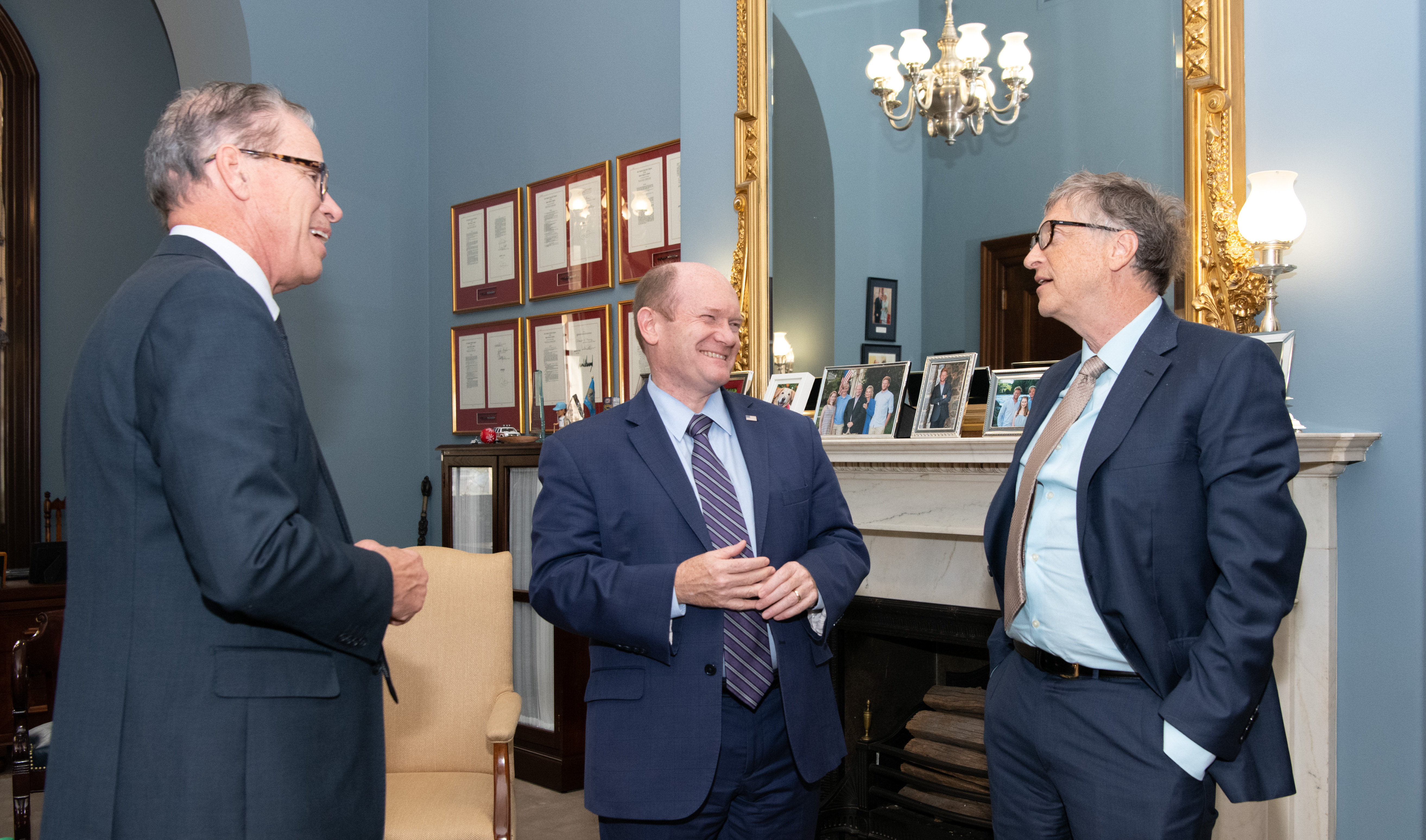
Bipartisan Senate Climate Solutions Caucus co-chairs meet with Bill Gates

WILMINGTON, Del. – U.S. Senators Chris Coons (D-Del.) and Mike Braun (R-Ind.) today met with Bill Gates to discuss climate change and ways to address the challenge, including investing in technology and the role that agriculture and reforestation can play in reducing emissions.

Photos of the meeting are available here.


Bipartisan Senate Climate Solutions Caucus adds new members, hosts first meeting with CEOs

WASHINGTON, D.C. – U.S. Senators Chris Coons (D-Del.) and Mike Braun (R-Ind.) today announced that six additional members will join the newly-formed bipartisan Senate Climate Solutions Caucus: Senators Lisa Murkowski (R-Alaska), Jeanne Shaheen (D-N.H.), Mitt Romney (R-Utah), Angus King (I-Maine), Lindsey Graham (R-S.C.), and Michael Bennet (D-Colo.). The caucus is bringing together an equal number of Republicans and Democrats to craft and advance bipartisan solutions to address climate change.

“If we are to make meaningful, sustainable progress toward combatting climate change, both Republicans and Democrats have to be at the table,” said Senator Coons. “I’m proud to join my colleagues in launching this important effort to take the politics out of this discussion and work toward real solutions. We look forward to continuing to hear from business leaders, workers, farmers, and a range of experts about their priorities and ideas for how we can best address climate change and strengthen American competitiveness.”

“As a life-long conservationist, I am proud to launch the bipartisan Climate Solutions Caucus with Senators Coons, Shaheen, King, Bennet, Murkowski, Romney, and Graham,” said Senator Braun. “For too long, Washington has been paralyzed by partisan gamesmanship, unable to have productive conversations about our changing climate. Through this caucus we can have real conversations about protecting our environment, securing America’s energy future and protecting American manufacturing jobs.”

“I thank Senator Braun and Senator Coons for forming the Senate’s Climate Solutions Caucus and am pleased to be part of it. I welcome the bipartisan, consensus-based approach this group has committed to and believe it will support and expand on the important work we are undertaking on the Energy and Natural Resources Committee,” Senator Murkowski said. “Through constructive dialogue and by working together, we can advance timely, pragmatic policies that will help lower our greenhouse gas emissions and address the threatening reality of climate change.”

“We’re already seeing more extreme storms, rising temperatures and polluted air that are having a dangerous impact on our well-being,” said Senator Shaheen. “Congress has been dragging its feet on climate change for too long – wherever there’s common ground, we need to seize it. It’s time to cross party lines and take this threat seriously. I hope that through this Caucus, we can put our heads together and have meaningful, constructive conversations that lead to common-sense steps forward to address the direct threats posed by climate change.”

“Addressing climate change is going to require significant private sector investments and a major global breakthrough in innovation and technology. To that end, Congress should explore ways to incentivize the research, development, and deployment of clean technologies,” said Senator Romney. “This caucus will serve as a starting point for a productive bipartisan dialogue so we can begin to come up with solutions for addressing climate change.”

“The threats of climate change don’t end at party lines, and our work to mitigate these effects can’t either,” said Senator King. “The impacts of this crisis are already being felt in Maine; the Gulf of Maine, which plays a vital role in both our economy and our culture, is warming faster than 99% of the world’s oceans. This is the most serious global challenge of our time, and we have areas of bipartisan agreement where we can start working together to make much-needed progress. I’m ready to join with any of my colleagues – from any political party and any corner of the country – to take meaningful steps that will protect the planet for our children and grandchildren.”

“I believe climate change is real. I also believe that we as Americans have the ability to come up with climate change solutions that can benefit our economy and our way of life,” said Senator Graham.  “The United States has long been a leader in innovation.  Addressing climate change is an opportunity to put our knowledge and can-do spirit to work to protect the environment for our benefit today and for future generations.”

“To effectively address the climate crisis we need enduring solutions – ones that won’t whipsaw back and forth with changing political winds,” said Senator Bennet. “We need to build the same broad consensus in Washington to address the climate crisis that exists across the country. This bipartisan caucus is a step closer to achieving that goal, and I’m honored to join Senators Coons and Braun and my colleagues in this effort.”

The caucus held its first meeting Tuesday with CEOs who came to Capitol Hill as part of the CEO Climate Dialogue, a collection of 20 companies with $1.3 trillion in combined annual revenue and four leading environmental nonprofit organizations that have come together to advocate for federal climate policy. The group discussed their support for the bipartisan development of legislation that will significantly reduce greenhouse gas emissions using market-based approaches that are durable, equitable, and supportive of the American economy. 

Carper, Coons Join Colleagues in Push to Renew Funding for DSU and HBCUs Across the Country

WASHINGTON, D.C. – Today, U.S. Senators Tom Carper and Chris Coons (both D-Del.) joined Senators Doug Jones (D-Ala.) and Jon Tester (D-Mont.) and 34 of their colleagues in a new push to pass funding for Historically Black Colleges and Universities (HBCUs) and other minority-serving institutions (MSIs). In a letter to Senate Majority Leader Mitch McConnell (R-Ky.) and Minority Leader Chuck Schumer (D-N.Y.), the senators called for the immediate passage of Senator Jones’ bipartisan FUTURE Act legislation, which would reauthorize $255 million per year in mandatory federal funding – which expired on September 30, 2019 – for an additional two years. The House of Representatives approved the legislation unanimously in September.
At Delaware State University, this federal funding helps to support, among others things, science, technology, engineering and math (STEM) and teacher education programs at both the undergraduate and graduate levels.
“HBCUs, TCUs, and MSIs are an essential component of America’s higher education and workforce development system,” the senators wrote.“Given the importance of this funding to hundreds of institutions and millions of students, we request that the Senate delay no longer and take up the bipartisan FUTURE Act  immediately to avoid permanent damage to our nation’s historic colleges.”
The FUTURE Act would ensure that DSU would continue to receive approximately $890,000 annually, which funds the following main programs:
·        $270,000 for the Revitalizing Excellence and Expectations in Math and Science Program
·        $264,000 for the Teacher Education Program Enhancement Program
·        $174,000 for the Improving Library Services and Research Support Program
·        $73,000 for Campus-Wide Classroom/Laboratories Facilities and Technology Upgrade Budget
Senators Carper, Coons, Jones and Tester were joined in sending the letter by Patty Murray (D-Wash.), Chris Van Hollen (D-Md.), Kamala Harris (D-Calif.), Michael Bennet (D-Colo.), Tom Udall (D-N.M.), Dick Durbin (D-Ill.), Elizabeth Warren (D-Mass.), Cory Booker (D-N.J.), Sherrod Brown (D-Ohio), Catherine Cortez Masto (D-Nev.), Dianne Feinstein (D-Calif.), Jacky Rosen (D-Nev.), Tina Smith (D-Minn.), Tammy Baldwin (D-Wisc.), Kyrsten Sinema (D-Ariz.), Bob Casey (D-Pa.), Mark Warner (D-Va.), Ben Cardin (D-Md.), Amy Klobuchar (D-Minn.), Tim Kaine (D-Va.), Chris Murphy (D-Conn.), Brian Schatz (D-Hawaii), Joe Manchin (D-W.V.), Tammy Duckworth (D-Ill.), Kirsten Gillibrand (D-N.Y.), Bernie Sanders (I-Vt.), Mazie Hirono (D-Hawaii), Gary Peters (D-Mich.), Maria Cantwell (D-Wash.), Richard Blumenthal (D-Conn.), Martin Heinrich (D-N.M.), Ed Markey (D-Mass.), Robert Menendez (D-N.J.), and Debbie Stabenow (D-Mich.).  
Full text of the letter can be found here and below:
November 4, 2019
Dear Leader McConnell and Leader Schumer:
We write today to respectfully request immediate Senate consideration of the Fostering Undergraduate Talent by Unlocking Resources for Education (FUTURE) Act. This important bipartisan legislation would reauthorize funding for Title III, Part F of the Higher Education Act of 1965, which provides mandatory funds for Historically Black Colleges and Universities (HBCUs), Tribal Colleges and Universities (TCUs), Hispanic-Serving Institutions (HSIs), and other minority serving-institutions (MSIs). Mandatory funding benefiting these institutions lapsed on September 30, 2019.
HBCUs, TCUs, and MSIs are an essential component of America’s higher education and workforce development system. MSIs serve nearly 6 million students, accounting for more than one-quarter of all undergraduates across the nation. These institutions enroll a significant share of all students of color. For example, HSIs account for nearly 15 percent of all non-profit colleges and universities, but enroll two-thirds of all Hispanic students. Also, while HBCUs only comprise 8.5 percent of all four-year institutions, they enroll, on average, 24 percent of all black undergraduates pursuing a bachelor’s degree, graduate 26 percent of all black bachelor’s degrees, and graduate 32 percent of STEM degrees earned by black students. The student population across all TCUs is 78 percent American Indian and Alaska Native. Similarly, these schools disproportionately enroll low-income students – more than 75 percent of students at HBCUs and 90 percent of students at TCUs receive Pell Grants, compared to only 32 percent of all students.
Title III, Part F funding is critical to ensuring these institutions are able to best serve their students. This funding is used for an array of purposes across campuses. Many schools use these funds to improve student services and academic programs like counseling, tutoring, mentoring, and STEM and career training programs. Numerous institutions use the funding to perform technology maintenance and expansion in order to provide students with up-to-date technology and vital learning opportunities such as computer labs, research institutes, and educational experiences. Others put the investment toward capital improvements like constructing affordable housing, renovating facilities, and creating learning spaces for students. All told, the Title III, Part F funding is a lifeline for these institutions to strengthen their academic, administrative, and fiscal capacities.
The bipartisan FUTURE Act will allow HBCUs, TCUs, and MSIs across the country to keep their doors open and continue to generate more opportunities for their students, disproportionate percentages of whom are for the low-income students and students of color. This funding stream plays a vital role in increasing institutional capacity at MSIs and in generating more opportunities for students of color to attain degrees in STEM fields and secure good-paying jobs, generating a strong economic impact. HBCUs, for example, have created over 134,000 jobs and have produced over $10 billion in gross regional product and a total annual economic impact of nearly $15 billion.  
Unfortunately, funding for this program lapsed due to Senate inaction last month. The House of Representatives passed the FUTURE Act by a voice vote last month. Given the importance of this funding to hundreds of institutions and millions of students, we request that the Senate delay no longer and take up the bipartisan FUTURE Act immediately to avoid permanent damage to our nation’s historic colleges.
Sincerely,

Sen. Coons secures tens of millions in funding for Delaware priorities in key federal spending bills

Sen. Coons secures funding to support Delaware law enforcement, Amtrak, the Delaware River and the Chesapeake Bay, research grants for Delaware universities, the manufacturing institute based in Newark, and more. 

Congress and the White House must approve spending bills by November 21 to avoid a government shutdown.

WASHINGTON, D.C. – Today, U.S. Senator Chris Coons (D-Del.), the first Delaware Senator in more than 40 years to serve on the powerful Appropriations Committee, secured funding for key Delaware priorities in the first package of Fiscal Year (FY) 2020 spending bills to pass the Senate. Congress and the White House must approve a spending package by November 21 to avoid a government shutdown.

The bipartisan package, which passed on a 84-9 vote, includes funding for Amtrak, housing and economic development programs like the HOME Investment Partnerships Program and Community Development Block Grants that communities in Delaware rely on, investments in the preservation of the Delaware River and the Chesapeake Bay, programs that support Delaware law enforcement, research grants for Delaware universities, and the premier national biopharmaceutical manufacturing institute based in Newark.

“Delawareans deserve a government that’s able to fulfill its most basic responsibilities, and that starts with keeping the government open and supporting the programs that make a difference in our communities,” said Senator Coons. “These bipartisan spending bills will provide more bulletproof vests for police officers in Delaware, expand initiatives to combat drug addiction, preserve clean air and water in our state, and much more. There’s more work to do in the weeks ahead to ensure our government stays open and all of our key agencies and programs remain funded, but this is an important start.”

The bipartisan package passed today includes provisions that will benefit Delaware:

The Commerce, Justice, Science, and Related Agencies bill provides critical funding for law enforcement, economic development, advanced manufacturing, scientific research, cybersecurity, the 2020 Census, and more.

  • Law Enforcement. The bill includes a $16.5 million increase in funding for the Community Oriented Policing Services (COPS) Hiring program, which will place approximately 1,300 more police officers on streets in Delaware and across the country. The legislation includes a $5 million increase to the Department of Justice (DOJ) Bulletproof Vest Partnerships Program, which saved the lives of two police officers in Delaware in 2013. DOJ has calculated that the lives of more than 3,000 officers over the last two decades have likewise been saved by this program. The bill also provides a total of $208.3 million in DOJ grant programs to address gun violence and keep Delaware communities safe, including funding to improve the quality of criminal and mental health records so interstate background checks are more effective and funding to improve officer safety though POLICE Act grants and VALOR grants.
  • Combatting Gun Violence. This spending bill provides a total of nearly $1.3 billion to fight gun violence and help keep our schools and neighborhoods safe. This includes $131 million to the FBI, an increase of $24.9 million above FY 2019, to run instant background checks so legal buyers can exercise their Second Amendment rights while keeping guns away from known criminals. It also provides the Bureau of Alcohol, Tobacco, Firearms and Explosives (ATF) a total of $913 million, an increase of $21.3 million more than the FY 2019 level to enforce gun laws, trace firearms connected to crime scenes, and keep illegal guns away from traffickers and criminals. 
  • Economic Development. The bill provides an increase of over $40 million for the Commerce Department’s Economic Development Administration (EDA). EDA awards infrastructure and planning grants to all 50 states. The $319.5 million provided for EDA will support over 20,000 American jobs and leverage an additional $4.5 billion in investment. The bill also includes language secured by Senator Coons to encourage EDA to establish a STEM Apprenticeship program to develop our country’s workforce.
  • Addressing Addiction and Substance Abuse. The bill provides Delaware communities, including first responders, $505 million in grant program funding to fight substance abuse, including opioids. This includes $378 million for Comprehensive Addiction and Recovery Act and $12 million for anti-methamphetamine task force program. 
  • Preventing Violence Against Women and Children. The bill provides $500 million, the highest funding level ever, for grants provided by the Office on Violence Against Women. It also provides a $5 million increase in funding to implement the Victims of Child Abuse Act.
  • Manufacturing. The bill provides for the growth of the Manufacturing USA program, including funding for competitive grants to seed new future institutes, which are critical to keep the United States competitive in advanced manufacturing. The legislation also provides funding for NIIMBL, the nation’s premier biopharmaceutical manufacturing institute based in Newark, DE. The bill rejected the President’s attempts to defund the Manufacturing Extension Partnership program, and has increased its funding so it can carry out its important mission and further support small manufacturers with new cybersecurity and digitalization challenges. For every one dollar of federal investment, MEP generates over $27 in new sales growth for manufacturers. 
  • Census. The bill provides $7.6 billion for the Census Bureau, an increase of $3.7 billion above the FY 2019 enacted amount and $1.4 billion above the President’s proposal. The bill included Senator Coons’ amendment that will put pressure on the Census Bureau to step up its outreach and engagement with hard-to-count communities, often disenfranchised minority communities, for the 2020 Census.
  • Science and Research. The bill rejects the administration’s request to cut funding for climate, weather, and oceans research at the National Oceanic and Atmospheric Administration (NOAA) by 41 percent. Additionally, the bill provides strong funding for the National Science Foundation (NSF), including the Established Program to Stimulate Competitive Research (EPSCoR), which bolsters investment in groundbreaking research in Delaware and across the country. The bill also includes other priorities of universities across Delaware, including the NOAA Sea Grant program, NASA Space Grant program, and strong funding for NASA heliophysics research and Wide Field Infrared Survey Telescope development. 
  • Conservation. The bill funds several NOAA programs that help Delaware promote coastal security and climate resilience, including Coastal Zone Management Grants, the National Oceans and Coastal Security Fund, and the National Estuarine Research Reserve System. The bill also directs the DOJ to provide dedicated resources for investigating and prosecuting wildlife trafficking and calls for funding for an important horseshoe crab trawl survey.
  • Safe Navigation. The bill provides $7.5 million for the NOAA Physical Oceanographic Real Time Systems (PORTS) program, an increase above the FY 2019 enacted amount. This program supports real-time data that helps vessels safely navigate the Delaware River.

The Interior, Environment, and Related Agencies bill provides key funding for the Department of the Interior, the Environmental Protection Agency (EPA), and other agencies to protect Delaware’s air and water, help preserve land and wildlife habitat, and support cultural and recreational opportunities.

  • Delaware River Basin Restoration Program. The bill includes $6.5 million for the Delaware River Basin Restoration Program. The basin is home to more than 8 million people in five states and provides clean drinking water for more than 15 million people. This funding is vitally important for ensuring the health of the Delaware River watershed and the agriculture, recreation, and other economic benefits that come from it.
  • Chesapeake Bay. The bill includes $76 million for the EPA Chesapeake Bay Program and $3 million for the National Park Service Chesapeake Bay Gateways and Watertrails Network. These programs help protect water quality in the Chesapeake Bay and provide recreational opportunities throughout the region.
  • Conservation. The bill includes $29.8 million for the National Estuary Program, which will help support Delaware’s two national estuaries – the Partnership for the Delaware Estuary and the Delaware Center for the Inland Bays. The bill also provides funding for key conservation programs, such as the North American Wetlands Conservation Act and the Land and Water Conservation Fund, both programs that help protect open space and wildlife habitat in Delaware.
  • Protecting Drinking Water. The bill continues steady funding for the Clean Water and Drinking Water State Revolving Funds, including $1.13 billion for Drinking Water and $1.64 billion for Clean Water. The bill also provides $29 million for lead contamination testing at schools and child care centers, $20 million for lead reduction projects in rural areas, and $26 million for water projects in communities working to improve Safe Drinking Water Act compliance. 
  • Arts & Culture Programs. The bill provides $157 million each to the National Endowments for the Arts and Humanities, an increase of $2 million for each endowment than the FY 2019 enacted level, rejecting the Administration’s proposal to end these programs.

The Agriculture, Rural Development, Food and Drug Administration, and Related Agencies bill supports rural areas in Delaware and provides funding for the Department of Agriculture and the Food and Drug Administration to continue their work on food safety, product safety, research, and nutrition programs.

  • U.S. Department of Agriculture (USDA). The spending package maintains funding for important USDA programs, including $87 million for the Economic Research Service (ERS), $1.5 billion for the National Institute of Food and Agriculture (NIFA), $425 million for the Agricultural and Food Research Initiative (AFRI), and $64 million for the Animal and Plant Health Inspection Service (APHIS), which play vital roles in enhancing agricultural production, research, sustainability, and safety. The bill also provides $63 million for USDA’s Avian Health program, which is critically important to Delaware’s chicken industry.
  • Conservation. This bill also builds on the successes of the farm bill passed last year by maintaining support for agricultural conservation programs such as the Conservation Stewardship Program (CSP), Environmental Quality Incentive Program (EQIP), and the Regional Conservation Partnership Program (RCPP). These programs offer crucial tools to help farmers in Delaware and around the country protect water quality, preserve land, and enhance wildlife habitats. 
  • Rural Development. The bill rejects the Administration’s ill-conceived proposal to eliminate many of USDA’s rural housing programs. It provides robust funding for Rural Health Insurance Loans, including $1 billion for Direct Loans, $30 million for self-help housing, $40 million for Rental Housing Loans, and $27.5 million for Farm Labor Housing Loans. The bill also provides $950 million in Business and Industry loans that promote job creation and income generation in rural areas. The bill also sustains funding to continue to develop rural broadband.
  • Nutrition. This bill funds programs that are an important safety net for some of the most vulnerable Americans, including Supplemental Nutrition Assistance Program (SNAP). The bill also provides a more than $400 million increase for the National School Lunch Program.

The Transportation, Housing and Urban Development, and Related Agencies bill addresses the housing affordability crisis in America and sustains funding to invest in our nation’s infrastructure.

  • Amtrak and Transportation. The legislation includes a modest increase in funding for Amtrak to $2 billion, including $680 million for the Northeast Corridor. The bill rejects the President’s proposed $3.58 billion cut to Department of Transportation programs, allowing for the strong sustainment of investments in transportation projects that address congestion and improve the overall safety and infrastructure of our nation’s roads, bridges, and railways.
  • Housing and Community Development. This bill rejects the President’s budget proposal to cut $11.96 billion in important housing programs at a time when Americans are experiencing sky rocketing rents, wage stagnation, and a shortage of affordable housing. This bill instead provides strong funding for the Department of Housing and Urban Development’s (HUD) affordable housing and economic development programs, including $1.25 billion for the HOME Investment Partnerships Program, $3.325 billion for the Community Development Block Grant program, and rental assistance programs that communities in Delaware rely on. This bill provides $100 million for the HUD Choice Neighborhood grants, which benefit the Wilmington Housing Authority and REACH Riverside.
  • Infrastructure. The bill provides $1 billion for national infrastructure investments through the BUILD program.

Coons, Gardner Praise Senate Passage of TAIPEI Act

WASHINGTON, D.C. – The U.S. Senate unanimously passed the Taiwan Allies International Protection and Enhancement Initiative (TAIPEI) Act, authored by Senator Chris Coons (D-Del.) and Senator Cory Gardner (R-Colo.). This bipartisan legislation is intended to strengthen Taiwan’s standing around the world and comes in response to increased Chinese pressure to restrict Taiwan’s international space and global diplomatic recognition. 

“Taiwan’s commitment to democracy is inspiring and deserves to be celebrated,” said Senator Coons. “The Senate’s approval of this important legislation will help to preserve Taiwan’s international space and safeguard their democracy and free market economy.”

“The United States should use every tool to support Taiwan’s standing on the international stage,” said Senator Gardner. “This bipartisan legislation demands a whole-of-government approach to ramp up our support for Taiwan, and will send a strong message to nations that there will be consequences for supporting Chinese actions that undermine Taiwan. I applaud the U.S. Senate for unanimously advancing this critical bipartisan legislation, and I will continue to advocate on behalf of Taiwan and the Taiwanese people, as guided by United States law.”

The TAIPEI Act requires a U.S. strategy to engage with governments around the world to support Taiwan’s diplomatic recognition or to strengthen unofficial ties with Taiwan, calls on the State Department to exercise a range of diplomatic and assistance options with regard to any government that takes adverse actions with regard to Taiwan, and articulates a clear U.S. policy to support Taiwan’s participation in appropriate international organizations. The bill also calls on the Administration to immediately begin negotiations on a U.S.–Taiwan Free Trade Agreement.

Coons, Cortez Masto, Hawley, Blunt introduce new bill to help reduce police officer suicides

WASHINGTON, D.C. – U.S. Senators Chris Coons (D-Del.), Catherine Cortez Masto (D-Nev.), Josh Hawley (R-Mo.), and Roy Blunt (R-Mo.) today introduced a bill to track law enforcement suicides. The Law Enforcement Suicide Data Collection Act requires the FBI to collect voluntary, anonymous data on police suicides and attempted suicides from local, state and federal law enforcement agencies. Collecting this data will help inform policy solutions so that law enforcement suicides can be prevented. 

“Tragically, according to the Department of Justice, more police officers have died by suicide recently than were fatally shot in the line of duty,” said Senator Coons. “We must do more to protect the officers who put their lives on the line every day to keep our communities safe, and that includes providing them with the mental health care they deserve. I’m proud to work with a bipartisan group of colleagues to introduce the Law Enforcement Suicide Data Collection Act here in the Senate. This bill will provide valuable data that can help inform and target a suicide-prevention initiative within the law enforcement community.”

“America’s law enforcement officers risk their own lives to protect others, and in the process they see some of the most traumatic scenes imaginable,” said Senator Cortez Masto. “These burdens can haunt them and lead to PTSD, depression and other mental health issues that put them at greater risk for suicidal thoughts. They deserve all the support we can give them, and the data this bill will make available is a crucial part of that support. I’ll keep fighting in the United States Senate to make sure that our first responders get the critical assistance they need to do their jobs protecting the public.”

“Every day law enforcement officers walk into the line of fire to protect our communities. But the trauma they experience can take a heavy toll on those brave men and women who keep us safe,” said Senator Hawley. “This bill takes positive steps toward getting our men and women in blue the support they deserve in order to heal and recover.”

“Law enforcement officers face stressful and dangerous situations every day,” said Senator Blunt. “That can take a tremendous toll on their mental health and, in too many cases, lead them to take their own lives. The data collected by the FBI will play a vital role in developing policies to help prevent future tragedies. As a mental health advocate and co-chair of the Senate Law Enforcement Caucus, I hope my colleagues will join us in this effort to better support the brave men and women who keep our communities safe.”

“We are no longer able to hide from the stigma that is associated with suicides and attempted suicides within our law enforcement ranks,” said Richard McCann, Executive Director of the Nevada Association of Public Safety Officers. “We need a full-scale national data collection effort to help us learn from and address this growing mental health problem. Therefore, NAPSO fully endorses Senator Cortez Masto’s proposed Law Enforcement Suicide Data Collection Act as a measure that will support law enforcement officers throughout their careers and increase the availability of mental health resources for these heroes who serve our communities.”   

In addition to Senators Coons, Cortez Masto, Hawley, and Blunt, Senators Chuck Grassley (R-Iowa) and Dick Durbin (D-Ill.) also cosponsored the Act. In the House of Representatives, companion legislation was introduced by Representatives Mike Quigley (D-Ill.-5), Greg Steube (R-Fla.-17) and Madeleine Dean (D-Pa.-4).

BACKGROUND:

2018 was the third straight year in which police suicides outnumbered line-of-duty deaths. Law enforcement agencies across the country lost at least 167 officers to suicide in 2018. Currently, there is no comprehensive government effort to track suicides and attempted suicides in law enforcement like there is for line-of-duty deaths.

The Law Enforcement Suicide Data Collection Act requires the FBI to open a voluntary data collection program to track suicides and attempted suicides within local, tribal, state and federal law enforcement. Information collected and maintained by the FBI will not include any personally identifiable information. 

Participating law enforcement agencies will report information on suicides within their agency to the FBI, including:

  • Circumstances and events that occurred before each suicide or attempted suicide;
  • Location of each suicide or attempted suicide;
  • Demographic information of each law enforcement officer who dies by suicide or attempts suicide;
  • Occupational category for each law enforcement officer who dies by suicide or attempts suicide; and
  • Method used in each suicide or attempted suicide.

This bill also directs the FBI Director to submit an annual report on the data to Congress and publish the report on the FBI website.

This program would serve as the principal data collection tool on suicides and attempted suicides within law enforcement across the country. By providing accurate and detailed information on these suicides and attempted suicides, more effective prevention programs could be implemented to save lives.

###

[VIDEO] Sen. Coons on the Senate floor: “An impeachment trial of a President would be a true test of the integrity and capabilities of the Senate”

WASHINGTON, D.C. – U.S. Senator Chris Coons (D-Del.), a member of the Senate Judiciary Committee, spoke on the Senate floor regarding the ongoing impeachment inquiry, and the role of the Senate in the event that the House of Representatives votes to impeach President Trump. Video and audio are available here.

“If we are called to serve as jurors in an impeachment trial, all of us must show our nation and the world that this body – that this institution – has not been completely overtaken by the divisive political era in which we live. Nothing less than the Senate’s very legitimacy will be at stake,” said Senator Coons. 

Senator Coons’ remarks, as delivered, are below:

Madam President, I come to the floor today as a proud member of this chamber, of the United States Senate, and as someone who believes earnestly in our role in our country’s constitutional order. I’m here on the floor because a real and significant challenge to this body and each of our members is potentially in the very near future. 

Right now, the House of Representatives is holding an impeachment inquiry focused on grave and significant charges against our President related to the very threats to our democracy of foreign interference that our Founders feared the most. 

I am not here, Madam President, to argue over whether President Trump’s actions deserve impeachment or perhaps even removal from office. It is I think inappropriate to reach that point. Instead, I am here today as the inquiry proceeds in the House to urge my colleagues here in the Senate — Republicans, Independents, and Democrats – to take seriously the moment we’re in and the tests we may have soon ahead as a Senate, when we will need to uphold and defend the role of this institution.

I’m on the floor today to issue a challenge to all of my colleagues. 

If an impeachment trial does take place here in the Senate – all of us must decide to approach it as Americans, less as people representing any parochial or partisan or particular interest, less as Republicans or Democrats or Independents, and instead as Senators.

If we are called to serve as jurors in an impeachment trial, all of us must show our nation and the world that this body – that this institution – has not been completely overtaken by the divisive political era in which we live. Nothing less than the Senate’s very legitimacy will be at stake.

Our Founders warned about the challenge of this moment, they warned specifically that foreign powers improperly influencing our American government were, in the words of Alexander Hamilton, the “most deadly adversaries of republican government.”

This is why our Constitution entrusts Congress with the enormous power of potential removal through impeachment.

James Madison called impeachment “indispensable . . . for defending the Community [against] the incapacity, negligence or perfidy of the chief Magistrate,” a reference to the President.

Alexander Hamilton argued that the Senate was the proper body to hold an impeachment trial.  The Founders entrusted us to protect our country from “the misconduct of public men” and “the abuse or violation of some public trust.”

George Mason put forward the precise language that appears in our Constitution, the language of “high crimes and misdemeanors” and urged that impeachment must be a remedy to remove even a President, asking, “Shall any man be above Justice?”

Our Founders insisted that no one, no one in our nation, in our constitutional order, not even our President, is above the law. This fundamental principle remains the very linchpin of our government.

Based on what we know today from press reports about the President’s actions and from notes of a conversation, I believe it is critical that the House conduct a thorough impeachment inquiry. If the House does vote impeachment articles, members of the Senate will have to live up to the responsibilities which the Framers of our nation entrusted to us. The eyes of history will be upon us.

So, Madam President, let me be clear: I am not saying here today that if the House should vote articles of impeachment, it will be the Senate’s duty to vote to remove him. It will be instead the responsibility of every single Senator to carry out their duty to serve as impartial jurors with their principle focus their oath to uphold and defend the Constitution – and nothing else – informing our decisions.

This is a challenge to all of my colleagues. Both Republicans and Democrats must appreciate the gravity of this process as we call on our colleagues to do the same. Democrats equally with Republicans must not allow our vigorous disagreements with this President and our colleagues to influence our judgment and cloud it. We have to understand that this process, this likely future moment, are far more important than our own individual political fortunes. 

An impeachment trial of a President would be a true test of the integrity and capabilities of the Senate – our commitment to follow the facts, to consider the evidence, and to apply the rule of law. It will be a test that we as a body cannot afford to fail.

So, Madam President, it is important to begin the process of establishing what that process might look like as soon as there are impeachment articles if that is the direction the House takes.

The basic rules are clear: As stated in the Constitution, the House is given the “sole Power of Impeachment,” and the Senate “the sole Power to try [as jury] all Impeachments.” If the House votes to impeach, the Senate must conduct a trial and either convict by two-thirds or acquit on whatever counts are presented.

At that trial, the Chief Justice of the United States Supreme Court would preside. The House managers would present the case, the President’s counsel present his defense, and the Senators serve as the jury.

The manner in which our leaders – Leader McConnell and Leader Schumer – direct the Senate in the event of a trial will be the most important test in a generation of whether our Senate remains capable of enforcing the law, living up to the Constitution, and upholding the responsibilities our Founders bestowed upon us.

I’ll remind you that the opening vote in the Senate of the impeachment trial of President Clinton, the vote that set the rules under which that trial would proceed, was unanimous. It was 100 to zero.

An impeachment trial, should it come in the near future here, must not be gamed or politicized or subjected to brinksmanship, and any trial should be governed by rules that are passed on a broad and bipartisan basis, animated by justice over partisanship.

In many ways, an impeachment trial would mean that our institution of the Senate would itself also be on trial.  We, as a body, need to show the American people and the world that we are more than just 100 elected politicians brought here by partisan whim or by a bare majority of our states, but instead, a body whose sum is much more than its individual parts.  Together, we must act as stewards for our democracy.

History is watching us – all of us: Democrats, Independents, Republicans. How we respond will shape and impact our Senate and our nation for years to come.

So, in the days, weeks, or months to come, I hope my colleagues will rise to the challenges we face, deliberate with an eye towards history and an ear towards our constituents, and a heart focused on our Constitution, and prove that, in this body, we answer to the Constitution, not any particular or partisan loyalty to our President or any other elected official. The health of our very institutions and democracy itself is at stake.

###
Coons, Toomey push for gun safety amendment in federal spending bill

WASHINGTON – U.S. Senators Chris Coons (D-Del.) and Pat Toomey (R-Pa.) filed their bipartisan NICS Denial Notification Act as an amendment to the federal spending bill that is currently pending on the Senate floor. This legislation would provide states with critical information to help them enforce existing laws that prevent prohibited individuals from purchasing firearms. Under this measure, federal authorities would now be required to alert state law enforcement within 24 hours when individuals “lie and try” to purchase firearms, which can be a warning sign of additional criminal behavior.

“We have seen too many tragic instances when an individual who should not have been able to obtain a gun used one to commit horrible crimes,” said Senator Coons. “The American people have called on Congress to act, and the NICS Denial Notification Act is one commonsense step we should take. By ensuring that federal and state law enforcement can work together to prevent those who shouldn’t be able to buy a gun from getting one, we can make our communities safer. This is exactly the sort of bipartisan step Congress should be able to support.”

“It’s a serious crime for a person who is prohibited from having a gun, such as a convicted felon, to lie about his background in an attempt to buy a gun. That is, in itself, a federal felony and it goes almost entirely unpunished now. It can also be a warning sign of future criminal behavior,” said Senator Toomey. “My amendment with Senator Coons will better enforce existing gun laws and strengthen public safety by requiring the FBI to notify state law enforcement within 24 hours if a prohibited person ‘lies and tries’ to buy a gun.”

Federal officials are notified when individuals who are legally prohibited from purchasing a firearm (such as convicted felons, fugitives, and domestic abusers) try to buy a gun but fail a National Instant Criminal Background Check System (NICS) background check. These attempted purchases often violate federal and state laws. Unfortunately, the federal government rarely prosecutes any of these individuals.

In the 13 states that run their own background checks using the FBI’s NICS system, state authorities are aware when prohibited persons fail background checks and can have state law enforcement investigate these cases. However, in the 37 states and the District of Columbia that rely on the FBI to run some or all of their background checks, state authorities generally are not aware when prohibited persons fail background checks run by the FBI. Individuals who are willing to “lie and try” to buy a gun may be dangerous and willing to obtain guns through other means. As a result, these states and D.C. lack critical law enforcement intelligence that they could use to try to keep their communities safe.

###

Sens. Coons & Blunt, Reps. Fitzpatrick & Castro introduce Global Child Thrive Act

WASHINGTON – Today, U.S. Senators Chris Coons (D-Del.) and Roy Blunt (R-Mo.), along with U.S. Representatives Brian Fitzpatrick (R-Pa.) and Joaquin Castro (D-Texas), introduced the Global Child Thrive Act. The bipartisan legislation strengthens the implementation of policies that advance early childhood development internationally, which includes learning and physical, cognitive, social, and emotional development for children younger than eight years old.

“With nearly 250 million children in low- and middle-income countries suffering from poor development due to poverty and stunting alone, it’s critical that we do everything possible to support children in meeting their developmental milestones,” said Coons. “I’m proud to introduce the Global Child Thrive Act with Senator Blunt, a leader on the Senate Appropriations Committee. Together, we understand the value of investing in the reduction of preventable child deaths worldwide and ensuring the healthy development of future generations.”

“Many children around the world aren’t growing up in an environment that supports their developmental needs,” said Blunt. “This bill will improve efforts by the U.S. to advance early childhood development policies across the world. I urge my colleagues to support this bipartisan, bicameral bill that will make a huge difference in the lives of countless children.”

“As public servants, we have no higher responsibility than to protect our children and to ensure that children have a strong foundation for success,” said Fitzpatrick. “This bipartisan and bicameral legislation is a step in the right direction helping children across the globe. Every child deserves the opportunity to grow, learn, and thrive in a safe and healthy environment. As federal legislators, we owe a duty to support federal policies that keep this goal in mind.” 

“We’ve seen the impact that investment in early childhood development has back home,” said Castro. “To help all kids succeed, it’s never been more important that we show that same commitment on a global scale. The bipartisan, bicameral Global Child Thrive Act responds to difficult conditions abroad, advances effective initiatives, and empowers the world’s children.”

“We have seen how early childhood development interventions allow children to reach their God-given potential and are heartened to see the U.S. Congress take this important step on their behalf,” said Bill O’Keefe, Vice President of Mission and Mobilization at Catholic Relief Services.

The Assistance for Orphans and Other Vulnerable Children in Developing Countries Act of 2005 created the U.S. Government Special Advisor on Children in Adversity, who is tasked with coordinating all U.S. assistance to orphans and other vulnerable children among U.S. departments and agencies, among other responsibilities. The Global Child Thrive Act builds upon that foundation by strengthening the implementation of policies that advance early childhood development internationally.

The bill expands the number of agencies over which the Special Advisor has explicit authority to coordinate early childhood development policies. It also directs the U.S. Agency for International Development to engage relevant executive agencies to incorporate early childhood development into current programming over the next five years.

To incorporate early childhood development into current programming, the agencies would:

•  build on the evidence and priorities outlined in ‘Advancing Protection and Care for Children in Adversity: A U.S. Government Strategy for International Assistance 2019-2023’;

•  identify evidence-based strategic priorities, indicators, outcomes, and targets to support inclusive early childhood development;

•  support the design, implementation, and evaluation of pilot projects in partner countries, with the goal of taking them to scale;

• support bureaus, working groups, and task forces implementing relevant sector strategies and public laws; and

•  focus on improving coordination with foreign governments and international and regional organizations with respect to official country policies and plans for early childhood development.

The Global Child Thrive Act is endorsed by Catholic Relief Services and the LEGO Foundation.

###


Senator Coons to 400+ Delawareans in Wilmington today: American diplomacy, foreign assistance crucial to strengthen U.S. leadership around the world

WILMINGTON, Del. – U.S. Senator Chris Coons (D-Del.), a member of the Senate Foreign Relations Committee and the Appropriations Subcommittee that funds foreign assistance, today hosted a forum in Wilmington with the U.S. Global Leadership Coalition (USGLC) to discuss the importance of investing in America’s civilian tools overseas to strengthen U.S. national security, create new opportunities for Delaware businesses, and reinforce America’s role as a global leader. Senator Coons was joined at the event by CNN’s Dana Bash, former Congressman Ed Royce (R-Calif.), Nobel Prize winning economist Dr. Michael Kremer, and more than 400 political, business, and community leaders.

Watch the full video here

“U.S. diplomacy and development programs address the root causes of the world’s toughest challenges, from poverty to pandemics to climate change, while helping to advance American values abroad,” said Senator Chris Coons. “I’m proud to have worked with the Administration and a bipartisan group of colleagues to pass legislation to make foreign assistance more effective and efficient and help Delaware businesses stay competitive overseas. As a member of the Senate Foreign Relations Committee, I will continue to work across the aisle to protect our critical investments in the State Department and USAID and ensure that the U.S. maintains its position as a world leader.”

Coons and Royce have been long-time champions of the global development agenda and protected funding for America’s International Affairs Budget.

“Throughout the quarter century that I served in Congress, I saw countless threats to our country prevented because of America’s unique combination of civilian and military tools,” said Ed Royce, former Chairman of the House Foreign Affairs Committee. “Development and diplomacy, alongside a strong national defense, are critical to keeping us safe and ensuring America maintains its status as the leader of the free world. America has to lead.” 

With over 108,000 jobs in Delaware tied to international trade, and Delaware exports to foreign markets totaling more than $4.7 billion a year, America’s global leadership isn’t just a matter of national security. It’s also a strategic economic issue for the First State.

“It’s not just a matter of research, it is not the government just spending taxpayer dollars, it’s finding out the most efficient way to do [development], not necessarily with government money,” said Nobel Prize winning economist Dr. Michael Kremer. “This approach has such bipartisan support, because this is very focused on evidence. It’s very focused on cost effectiveness… I think there are a lot of people out there who care deeply about [development] issues and want to do the right thing.”

“Fragility can destabilize entire regions, leading to the type of conflict and violence that can pose great threats to America’s national security,” said Lt. Gen Kip Ward, USA (ret.). “By investing in our diplomats and development activities, we can prevent crises that could impact our safety and security – from our men and women in uniform on the frontlines to our communities and families back home.”

The forum also brought together leaders from the private sector alongside the veteran, NGO, faith, and diaspora communities. Through panels and breakout sessions, the forum provided insights on a diverse array of foreign policy topics from climate change and conservation to global health and food security.

“Innovations in health care and medicine have completely changed how we respond to some of the world’s most pressing public health challenges,“ said Carmen Villar, Vice President of Social Business Innovation, Merck. “And America is leading the charge when it comes to many of these advances. Working alongside the U.S. government, Merck and others are sharing the latest breakthroughs in medical technology in order to respond to life-threatening diseases like Ebola and HIV/AIDS in parts of the world that have very little access to health care.”

Today’s event marks the third annual mid-Atlantic summit hosted by the U.S. Global Leadership Coalition in Delaware, building on the past success of Senator Coons’ Opportunity: Africa summit over the last decade. 

“Days like today are what the USGLC is all about,” said Liz Schrayer, President & CEO of the U.S. Global Leadership Coalition. “Where policy makers are coming together with veterans, students, community leaders from businesses and NGOs to talk about why American global leadership matters right here in Delaware. It’s impressive to see—year after year— Senator Coons leading the way by engaging his constituents on the importance of U.S. development and diplomacy, especially with the next generation.”

Also participating in today’s forum was the Honorable Mike Castle, former Delaware governor and U.S. representative; Dana Bash, Chief Political Correspondent, CNN; Jennifer Billings, Agriculture Development Leader, Corteva; Collin O’Mara, President & CEO, National Wildlife Federation; Suzanne Ehlers, President & CEO, PAI; Angeli Achrekar, Principal Deputy Coordinator, PDAS, Office of the U.S. Global AIDS Coordinator and Global Health Diplomacy, U.S. Department of State; Ari Johnson, Co-founder & CEO, Muso; Adrian Thomas, Vice President, Global Public Health & Access, Johnson & Johnson; Jahaan Johnson, Senior Vice President, Citi; Ezrah Aharone, Professor of Practice, Founder and Director, Center for Global Africa (CGA); Kristin Johnson, Senior Vice President, IREX; Carrie Hessler-Radelet, President & CEO, PCI; Savannah Fox, Regional Advocacy Coordinator, Policy & Advocacy Department, CARE; Margaret Tran, Regional Organizer, Bread for the World; and Matt Meyer, New Castle County Executive.