Related Issues

Related Issues

Bipartisan group of senators highlight extreme food insecurity on World Food Day 2020

WASHINGTON – Today, U.S. Senators Chris Coons (D-Del.), Jerry Moran (R-Kan.), Patrick Leahy (D-Vt.), and John Boozman (R-Ark.) celebrate World Food Day and recommit to fighting hunger in the face of unprecedented levels of hunger as a result of the COVID-19 pandemic. The senators are the sponsors of Senate Resolution 365, which designated October 16, 2020 as World Food Day and passed the Senate unanimously last year.

The COVID-19 pandemic has exacerbated the global hunger crisis, with the United Nations estimating that rising food costs and widespread unemployment could push an additional 130 million people into chronic hunger by 2020. Even before the pandemic, nearly 700 million people suffered from hunger. 

“At home and abroad, we’ve seen a sharp rise in food insecurity during the pandemic. I’m grateful for the work of so many in Delaware – from our farmers, to school lunch workers, to folks working in food pantries and nonprofits – who are helping provide food to families who need it most,” said Senator Coons. “I will continue fighting for resources for the programs that are providing emergency assistance to our world’s most vulnerable populations, and that support resiliency in our food and agricultural systems.”  

“The call to feed the world has been answered by so many Kansans, who are taught at a young age that it is our duty to help those in need,” said Senator Moran. “Today on World Food Day 2020, we are reminded of our responsibility to help those in need in our own communities and in towns, cities and villages all around the world. As the co-chair of the Senate Hunger Caucus, I believe that fighting hunger is not only the morally right thing to do; it is also the smart thing to do both for Kansas producers and for global security.”

“As co-chair of the Senate Hunger Caucus, I am proud to have joined my colleagues in support of this resolution. Observing this day raises awareness of America’s important efforts to stamp out world hunger. Eliminating hunger at home and abroad takes U.S. leadership. That is why the Senate Hunger Caucus not only seeks to find vehicles to bring focus to the plight of those suffering from food insecurity, but solutions that bring upon meaningful change as well. There is a great deal of work to be done, but the theme of this year’s World Food Day serves as a guide as we work to achieve that goal,” Senator Boozman said.


Each year, the United States joins 150 other countries and the Food and Agriculture Organization of the United Nations (FAO) in celebrating World Food Day to promote global awareness and action for all who suffer from malnutrition. This year also commemorates the 75th anniversary of the FAO, established in Hot Springs, Virginia on October 16, 1945.

To learn more about what actions you can take to promote better resilient food systems and healthy diets for all, please visit http://www.fao.org/world-food-day.

The full text of the resolution can be found here.


###

[VIDEO] Sen. Coons: ‘Judge Barrett as Justice Barrett may well cast the deciding vote to overturn the Affordable Care Act’

WASHINGTON — Today, U.S. Senator Chris Coons (D-Del.), a member of the Senate Judiciary Committee, spoke about his concerns regarding the nomination of Judge Amy Coney Barrett on the final day of her Supreme Court confirmation hearings.

On the Affordable Care Act, Senator Coons said, “Judge Barrett as Justice Barrett may well cast the deciding vote to overturn the Affordable Care Act, with potentially disastrous consequences for a majority of Americans. Meanwhile, the Trump Justice Department has joined a challenge to the ACA that is back in front of the Supreme Court to be argued just a few weeks from now before the Supreme Court on November 10th.” 

On the timing and context of Amy Coney Barrett’s nomination, Sen. Coons said, “This is an unprecedented context and with unprecedented speed. You don’t convene a Supreme Court confirmation hearing in the middle of a pandemic while the Senate is on recess, while voting has already started in a presidential election in a majority of states, because we are simply concerned about abstract ideas or the neutral application of law.”

On Barrett’s refusal to commit to recuse herself given a disputed election, Sen. Coons said, “I thought nothing was stopping Judge Barrett from making a commitment to recuse herself given what President Trump has said and was gravely concerned she did not.”

On pandemic relief concerns, Senator Coons said, “My hope is that we will get back to the work of trying to deliver the relief –  small businesses, Americans, those unemployed, those infected – desperately need. I’ve worked hard to bring the voices of real Delawareans into this discussion because it is easy to miss in the seemingly abstract conversations about things that really matter to lawyers.”

Sen. Coons concluded, “I will not be voting to confirm Judge Barrett to the Supreme Court but I frankly think we should not be taking this vote, we should not be proceeding today. We should instead be turning to the urgent business of protecting the American people and ensuring the safety and security of our election and keeping our word.”

Full video is available here. A transcript is provided below. 

Sen. Coons: Thank you, Mr. Chairman. Today my constituents from Delaware are asking the same thing they’ve been asking for weeks. In this particular context, the question is, and I got one just while we were sitting here: why is the Senate Judiciary Committee meeting to race through your process and this confirmation when the Senate itself isn’t in session? I was delayed a few minutes this morning because I went and got tested for COVID by the Senate physician so that I can return with some confidence to my family this evening that I haven’t picked it up while here. 

The Senate of the United States is not in session because we have an outbreak amongst senators and I’m not confident we’ve provided for senators, for staff, for the White House, frankly for the American people. My whole state is just 900,000 people, and how many people filed new unemployment claims [nationally] last week? Almost exactly 900,000 people.

My hope is that we will get back to the work of trying to deliver the relief –  small businesses, Americans, those unemployed, those infected – desperately need. I’ve worked hard to bring the voices of real Delawareans into this discussion because it is easy to miss in the seemingly abstract conversations about things that really matter to lawyers, like the Dormant Commerce Clause, and I look forward to our long delayed debate on that, Senator Lee. Conversations about originalism, precedent, stare decisis, about what is or isn’t, the precedent either for this committee, for confirmations, or for the Supreme Court, can lead to millions of Americans struggling in the middle of this pandemic and the recession that I would argue is made worse by the bungled mishandling of this pandemic by our president, a little cold. I am gravely concerned, Mr. Chairman, that you and the majority are standing on the edge of a precipice of pushing through a nominee in a way you yourself said was unthinkable two years ago in the last days of the last quarter of this presidency. We are 19 days from the presidential election. A majority of states are voting. People stood outside for 10 hours in Georgia yesterday. That’s the good news. I think they are that determined to vote. We heard repeatedly from the nominee that she has no agenda. But I’ll tell you the agenda of President Trump in choosing her and the agenda of the Republican majority in racing forward with this confirmation. That is clear. My colleague from Illinois said that this process has turned into something that your average American has real trouble discerning what’s going on. We keep asking earnest questions and the nominee keeps declining to answer them in any substantive or meaningful way and we do have to ask ourselves: is there any path towards getting a confirmation process in this body back onto a real and a rational footing? We are about to have a vote in this committee, and that’s why I will support my colleague from Connecticut’s motion where we haven’t even heard from the last panel of witnesses today. 

We haven’t even heard responses to the questions for the record. This is an unprecedented context and with unprecedented speed. You don’t convene a Supreme Court confirmation hearing in the middle of a pandemic while the Senate is on recess, while voting has already started in a presidential election in a majority of states, because we are simply concerned about abstract ideas or the neutral application of law. And you don’t mangle and mishandle my predecessor and attribute to him some rule and then restate that rule as the McConnell rule and then ignore it and then state up and down and down is up when nothing could be further from the truth. This is not on the level. You don’t go against your own promise after you’ve already claimed as a matter of high principle, justices shouldn’t be confirmed in [an] election and after you’ve already blockaded a centrist, competent, highly qualified nominee for exactly that reason because you solely care about methodology. This is about the president’s disastrous response to a pandemic and a decade-long unfilled pledge embodied in one party’s platform to overturn protections for a majority of Americans in the middle of a pandemic. As my Democratic colleagues and I have been working, laboring to lay out, there will soon be, if Judge Barrett is confirmed, a hard turn to the right on the Supreme Court. A change in methodology, a change in approach, a change in principle that will have practical, pragmatic and lasting consequences for the majority of Americans. 

After studying Judge Barrett’s record, I’m convinced she would come to the Supreme Court with a deeply conservative originalist philosophy and a judicial activism with regards to precedent that would put numerous longstanding rights the American people have come to rely on and hold dear in nearly every aspect of modern life at risk. Simply put, I believe she will open a new chapter of conservative judicial activism unlike anything we’ve seen in decades. First Judge Barrett as Justice Barrett may well cast the deciding vote to overturn the Affordable Care Act, with potentially disastrous consequences for a majority of Americans. Everyone watching at home has heard my colleagues say that for the last ten years, their top priority has been repealing the ACA and every single Republican senator on this committee has talked publicly, repeatedly about their desire to get rid of that law at some point previously. So, too, has President Trump. Despite their best efforts, they have so far failed to do so here and in my view, have failed to advance a credible alternative plan for how to deal with pre-existing conditions and give them lasting protection. So now I think the last-best shot for accomplishing this goal is at the Supreme Court. That’s where Judge Barrett comes in. As she conceded during our questioning, our exchange, Judge Barrett has written in no uncertain terms she thinks Chief Justice Roberts got it wrong in his ruling upholding the law against the constitutional challenge. She wrote that article in early 2017 and months later found herself on President Trump’s shortlist for the Court. Meanwhile, the Trump Justice Department has joined a challenge to the ACA that is back in front of the Supreme Court to be argued just a few weeks from now before the Supreme Court on November 10th. President Trump and his administration are arguing in no uncertain terms the Court must tear down the entire law. Now my colleagues have said this is fear mongering, this is baseless political theater. But to anyone who thinks this challenge is farfetched, just read the brief, just read the brief filed by the solicitor general of the United States or the one filed and co-signed by 18 Republican attorneys general. 

Most importantly, consider what our president himself has said about what he expects from his judicial nominees. He lashed out at Chief Justice Roberts over and over for his decision upholding the Affordable Care Act and pledged as a candidate, his nominees would do the right thing and overturn the law. It isn’t just the ACA that’s on President Trump’s agenda for the Court. He’s made clear he wants to overturn the ACA, he wants to overturn Roe v. Wade, and most concerning to me, he has repeatedly made statements that expect his nominee to hand him the election if there is a dispute in the courts. As I made clear in my exchange with Judge Barrett, I am not suggesting that she is engaged in any inappropriate conversations or commitments with the president. That’s not at all what I’m saying. It was the president’s conduct himself that has put this issue in front of the American people. His repeated undermining of the credibility, safety, and security of our election should be alarming to all of us. His refusal to commit to a peaceful transfer of power and to respect the results of the election should give all of us concern, those who pledged to uphold and defend the Constitution under all circumstances. 

Judge Barrett also steadfastly refused to answer whether she believed Scalia was correct in his criticism of Griswold v. Connecticut, a case decided when I was just 2 years old that protects the right to use contraceptives in the privacy of one’s home and is an important landmark case because it is the anchor as we all recognize the line of substantive due process jurisprudence. Chief Justice Roberts, Justices Alito and Kavanaugh, were willing to say Griswold was right, so it left me concerned and as I laid out yesterday, what truly concerns me more is her approach to precedent. Precedent has been called the foundation stone of American law and gives predictability, stability to it. 

And as I walked through yesterday, I’ve concluded that Judge Barrett is even more willing than Justice Scalia to overturn precedents with which she disagrees and made clear that justices should feel free to overturn cases that they believe were wrongly decided, which if she deeply holds the originalist philosophy she’s espoused may mean that dozens and dozens, in fact as I detailed in a chart yesterday, more than 120 cases long settled in many cases may be at risk of reconsideration. And they will cover, yes, healthcare, yes, privacy, but education, consumer protection, marriage equality, criminal justice, a range of cases a majority of Americans believe are long settled. 

Last, as to President Trump’s most critical expectation or expressed wish, I was concerned that Judge Barrett would not specifically commit to recusal in the event there is something arising from this imminent presidential election. I think nothing could be more challenging to the role of the Supreme Court and our national life and I urge my colleagues first to consider seriously the Senator from Connecticut’s motion and to delay the final stages of this process until after this election. But equally, if not more importantly, to think about the moment we are on. 

Because if this election in some way is interfered with, does not go appropriately, I think our democracy itself is at risk. So at the very least, to be clear, I thought nothing was stopping Judge Barrett from making a commitment to recuse herself given what President Trump has said and was gravely concerned she did not. So Mr. Chairman, I will conclude. I will not be voting to confirm Judge Barrett to the Supreme Court, but I frankly think we should not be taking this vote. We should not be proceeding today. We should instead be turning to the urgent business of protecting the American people and ensuring the safety and security of our election and keeping our word. 

###
[VIDEO] Sen. Coons: Barrett confirmation ‘may launch a new chapter of conservative judicial activism unlike anything we’ve seen in decades’

WASHINGTON — Today, U.S. Senator Chris Coons (D-Del.), a member of the Senate Judiciary Committee, questioned Judge Amy Coney Barrett, President Trump’s nominee to the Supreme Court, on her views on upholding legal precedent. Senator Coons announced that he will vote against Judge Barrett’s confirmation to the Supreme Court.

Sen. Coons said, “My core concern here, Your Honor, is that your confirmation may launch a new chapter of conservative judicial activism – unlike anything we’ve seen in decades. The point of the chart was to show we’ve mostly been talking about the Affordable Care Act and privacy-related cases, but if that’s true, it could touch virtually every aspect of modern American life. I pray that I’m wrong. I hope that I am. But, in my reading of your work, nothing has alleviated my grave concerns that rather than building on Justice Ginsburg’s legacy of advancing privacy, equality, and justice, I’m concerned – in fact – that you will take the Court in a very different direction. So with all due respect, I will be voting against your confirmation, Your Honor.”

See Senator Coons’ chart presentation here. PDF available here.

Audio and video is available here. Additional excerpts are provided below.

On Judge Barrett’s nomination, Sen. Coons said, “President Trump did not nominate you to carry on Justice Ginsburg’s legacy. He nominated you because he wants to undermine or change or shift that legacy, and he’s been very clear repeatedly before you were chosen about his intent to nominate justices in the mold of Justice Scalia.”

On previous Supreme Court cases, Sen. Coons asked, “If Justice Scalia had had his way, we’d be in a very different country with regards to gender discrimination. In one of Justice Ginsburg’s most celebrated decisions in 1996 in the case involving Virginia Military Institute, she struck down their male-only admissions policy. Decades later, VMI honored Justice Ginsburg in recognition of the contributions its female alumni have made. Justice Scalia was the sole dissenter in that case and even accused the Court of destroying VMI which remains standing and strong to this day. I’m just getting at how closely you would ally yourself with Justice Scalia’s jurisprudence. Would you agree with Justice Scalia that Justice Ginsburg’s decision in VMI was wrong?”

On Judge Barrett’s views on judicial restraint, Sen. Coons asked, “In the 2017 article in the University of Minnesota in Constitutional Commentary ­– that’s been referenced before – you said, and I’m quoting, about modern originalists, ‘that they have abandoned the claim one should be an originalist because originalism produces more restrained judges.’ Do you stand by that characterization?”

On court precedents, Sen. Coons said, “[T]he larger challenge here is not what you have said about your views on cases, but what the president who has nominated you has said about his goals and his objectives for your service on the Court. And frankly, my concern about originalism and an activist willingness to reconsider precedent is that in combination, Justice Scalia’s views often expressed in sharply worded – memorable, memorable – dissents may make for great academic reading, but I think most Americans don’t expect them to become the law of the land. And in a long line of cases, they would overturn well-settled precedent that I think we have all come to expect.”

###

ICYMI: Delaware Tech highlights Marcus Wright, Dover-based outreach coordinator for Senator Coons

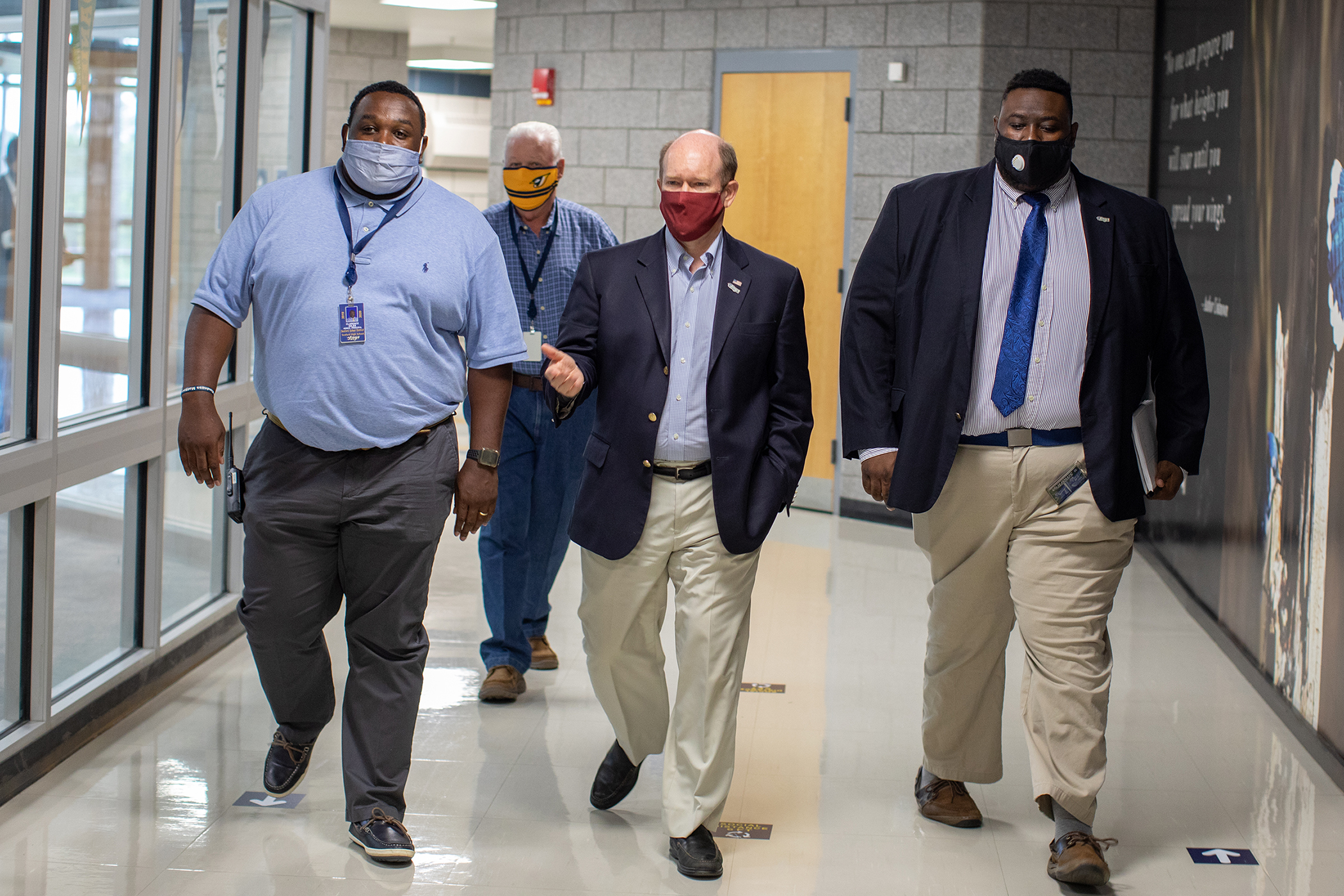
U.S. Sen. Chris Coons (D-Del.) walks with associate principal Mr. Clarence Giles (left) and outreach coordinator Mr. Marcus Wright at Seaford High School in Seaford, Del., Sept. 14, 2020. (Photo by Office of U.S. Sen. Chris Coons/Released). For additional photos, visit bit.ly/3nORmV3.

DOVER, Del. – Mr. Marcus Wright, the Dover-based outreach coordinator for U.S. Sen. Chris Coons (D-Del.), was recently chronicled by Delaware Technical Community College’s online news magazine. The Seaford native, an alumnus of Delaware Tech and Delaware State University, joined the senator’s team two years ago, serving as a college intern (2018) and then as a staff assistant (2019) in Washington, D.C.

Earlier this year, Coons promoted Wright to the position of outreach coordinator to assist educational groups, faith-based organizations, non-profits, and lead on minority outreach initiatives in Kent and Sussex. Based in the Dover office, he is reachable at marcus_wright@coons.senate.gov or 302-736-5601.

Read Delaware Tech’s story below or online at www.dtcc.edu/about/news/2020/07/08/mr-wright-goes-washington. For more about Team Coons, visit coons-staging.creativengine.com/contact/staff-directory.

Mr. Wright Goes to Washington
*Note: This story was written before the COVID-19 pandemic* 

Marcus Wright came to Delaware Tech in pursuit of a career as a counselor. Through career guidance and internships, he learned how to turn his passion for public policy into his profession.

“I’ve spent the better part of my life searching out ways to make an impact in someone else’s life,” Wright said. “While at Delaware Tech, Dr. Deneice Berry told me the best way to find my purpose was to figure out where my passion aligns with my skillset. So, I aligned my affinity for politics with my desire to help, and now I’m working on Capitol Hill.”

Wright is the staff assistant for the Washington, D.C., office of Delaware Senator Chris Coons. In his role, Wright manages all office operations, facilitates White House and Capitol tour requests, processes flag requests, supervises the D.C. intern program, and assists with the office’s appropriations work. According to Wright, Sen. Coons refers to his staff as the “directors of first impressions.”

“We have an open phone line with the American people,” Wright said. “We field calls from all across the country, and it is interesting to hear the concerns of the general public. I hear from people that disagree with Sen. Coons on several issues, people that call and just want to say thank you, and everyone in between.”

Wright graduated from Delaware Tech in 2016 with a degree in human services. From there, he earned his bachelor’s degree in social work from Delaware State University and started on his journey to Washington, D.C. He completed two summers as a legislative intern for Lieutenant Governor Bethany Hall-Long and additional internships in D.C. with Sen. Coons and with U.S. Representative Robert C. Scott, chairman of the House Committee on Education and Labor. He also worked for Children and Families First as a youth advocate and as a special schools paraeducator for the Seaford School District.

Over the past four years, Wright has leaned on the skills and knowledge he gained while attending Delaware Tech. He served as vice president of the campus activity board, was a student ambassador, and became a member of AmeriCorps, a voluntary civil society program supported by the U.S. federal government. He also learned the importance of networking and having a support system, in large part because of the culture the faculty and staff created. 

“Delaware Tech is where I grew up, where I learned to become a professional, and where I learned to manage my time and prioritize my responsibilities,” Wright said. “This is especially important now because Sen. Coons is involved in so much, sits on some very high-profile committees, and chairs many active caucuses. This means that time is at a premium, and we can’t afford to waste it.”

[VIDEO] Sen. Coons to Judge Barrett: ‘I am gravely concerned by what I see’

WASHINGTON — Today, U.S. Senator Chris Coons (D-Del.), a member of the Senate Judiciary Committee, questioned Judge Amy Coney Barrett, President Trump’s nominee to the Supreme Court, on her views on the Affordable Care Act and potential 2020 elections cases.

Sen. Coons pressed Judge Barrett on her previous criticism of the Supreme Court’s pivotal 5-4 decision in NFIB v. Sebelius upholding the Affordable Care Act, “As I read this, [Judge Barrett], you are saying to Chief Justice Roberts, you are no textualist, you have overreached, you have delivered an implausible conclusion, and frankly, I disagree with your upholding the constitutionality of this statue. That seems to me […] a plain reading of your own writing.” Judge Barrett admitted she disagrees with the ruling in the case.

She tried but failed to show that this new challenge to the Affordable Care Act is different from NFIB v. Sebelius which, in 2012, upheld the Affordable Care Act. Barrett said, “I think severability is one of the most important issues in the case […] NFIB v. Sebelius also is interpreting a different provision [from California v. Texas]. It was [an individual mandate] that wasn’t zeroed out, that actually had money attached to it.”

Sen. Coons said to Judge Barrett, “I am gravely concerned by what I see. Your Honor, I believe your views are sincere, but I also think you genuinely think the Affordable Care Act is unconstitutional […] Bluntly, if our president and the majority are able to swing the Court out of balance by replacing Justice Ginsburg by someone whose views may be significantly to the right, the health of a majority of Americans may well be in peril.”

Additionally, Judge Barrett declined to say she’ll recuse herself from SCOTUS decisions on the 2020 election results, despite previous comments by President Trump about the Court deciding the election: 

Sen. Coons: Given what President Trump said, given the rushed context of this confirmation, will you commit to recusing yourself from any case arising from a dispute in the presidential election results three weeks from now?

Barrett: I promise you that, if I were confirmed and if an election dispute arises – you know both of which are ifs – that I would very seriously undertake that process and I would consider every relevant factor. I can’t commit to you right now for the reasons that we talked about before, but I do assure you of my integrity and I do assure you that I would take that question very seriously.

 Full audio and video available here.

###

[VIDEO] Sen. Coons: ‘[T]rump promised to choose a nominee who would overturn the ACA’

WASHINGTON – U.S. Senator Chris Coons (D-Del.) joined Alisyn Camerota on CNN to discuss this week’s confirmation hearings for Judge Amy Coney Barrett.

On Judge Barrett’s record, Sen. Coons said, “[S]he repeatedly wrote over and over in opinion and law review article after article what she would do, not just with the Affordable Care Act, but with precedent more broadly. That’s a fancy way of saying she’s to the right of Justice Scalia. She has made it clear that she would join Justice Thomas and others in reaching back and overturning long settled cases from 20 or 30 years ago.”

On the Affordable Care Act, Sen. Coons said, “I will be asking her about her statements, a recent written statement in an article she wrote just in 2017, criticizing Chief Justice Roberts and his decision upholding the ACA on very similar grounds as those that the Trump Administration is arguing in the Supreme Court should justify taking away these critical health care protections from a majority of Americans.”

Full video is available here. A transcript is provided below.

Q: Joining us now is Democratic Senator Chris Coons. He’s a member of the Senate Judiciary Committee who will be questioning Judge Amy Coney Barrett today. Okay, let’s talk about what’s going to happen today. Give us a preview. What’s your top question for Judge Barrett? 

Sen. Coons: What I’m hearing from Delawareans, Alisyn, is concern about health care, about the Supreme Court case that’s going to be heard a week after the election, and the key question: Why? Why are we doing this hearing now in the middle of a pandemic when the Senate is shut down because there’s three senators infected? There’s been an outbreak at the White House that’s infected more than 35 people, so why this rush? I think the answer is hiding in plain sight. President Trump promised he would only choose a nominee who would overturn the Affordable Care Act, taking away health care protections from a majority of Americans. I will remind you, Alisyn, Justice Ginsburg, whose seat we are having this hearing to fill, dedicated her life to gender equality, and one of the key provisions of the ACA protects women against discrimination by insurance companies just for being women. Insurance companies used to treat pregnancy as a pre-existing condition, and there’s 130 million Americans who have other pre-existing conditions. I will be asking her about her statements – a recent written statement in an article she wrote just in 2017, criticizing Chief Justice Roberts and his decision upholding the ACA on very similar grounds as those that the Trump Administration is arguing in the Supreme Court should justify taking away these critical health care protections from a majority of Americans. 

Q: Is there anything that she could say that would win you over with that answer? 

Sen. Coons: She could say, “that’s absolutely untrue, here is what I meant, and here is what I would do.” But I don’t expect her to do that. She signaled loud and clear what she will do in this case – that’s why President Trump chose her. Now, to be clear, I’m not accusing her – I’m not suggesting that she had some private conversation with the president where they cut some deal. That would be inappropriate and she specifically said she had no conversation about this case or any other individual case. But as an academic, she repeatedly wrote over and over in opinion and law review article after article what she would do, not just with the Affordable Care Act, but with precedent more broadly. That’s a fancy way of saying she’s to the right of Justice Scalia. She has made it clear that she would join Justice Thomas and others in reaching back and overturning long settled cases from 20 or 30 years ago. She is at one end of the spectrum in terms of her expressed willingness to overturn precedent. Even Justice Scalia at times hesitated to do that because of what’s called reliance interest. So there’s millions and millions of Americans who have ordered their lives based on an expectation that the Affordable Care Act is law. It was settled eight years ago. That’s the sort of thing that Justice Scalia in his earlier years might have said,  “okay, we shouldn’t move ahead even if I disagree with this law.” Judge Barrett has made it clear things that were decided 20, 30, even 50 years ago, she may well go back and revisit. That’s conservative judicial activism. 

Q: As a side issue, Senator Mike Lee was in the chamber yesterday.  

Sen. Coons: Yes.

Q: And he was mask-less for much of it. He tested – he was diagnosed with Coronavirus, I think, ten days ago. Did he give an explanation to you, fellow committee members, of why he was there in person instead of remotely? 

Sen. Coons: Not to me, not that I remember. I’m certainly happy to go back and check, but I was surprised he was present. Senator Tillis has also tested positive. He questioned remotely yesterday. Frankly, Alisyn, I was more alarmed last Thursday when Mike Lee was also in the chamber with us here in the Kennedy Caucus Room, unmasked for a long period of time and gave about ten minutes of remarks at a very high level of agitation. I went home and got tested the next morning – I tested negative. I’m getting tested shortly here. I think every senator should be getting tested every day and should have to prove that they’ve tested negative on a reliable test in order to participate. That’s the standard all of us Democrats on the Judiciary Committee had suggested, was that you should only participate in person if you test negative. It frankly, Alisyn, points to the broader question: why are we doing that at all in the middle of a pandemic instead of focusing on delivering a round of pandemic relief to millions of Americans who are unemployed, whose kids can’t safely go to school, whose parents might be in skilled nursing facilities, who they’re worried about? Why aren’t we doing our jobs? Instead we’re rushing through this, racing through, with this partisan nominee. 

Q: Senator Chris Coons, thank you very much for giving us your perspective on all of these things.

Sen. Coons: Thank you, Alisyn. 

###

[VIDEO] Sen. Coons: Judge Barrett’s views are ‘so extreme as to make her unqualified to serve on the Supreme Court’

WASHINGTON — Today, U.S. Senator Chris Coons (D-Del.), a member of the Senate Judiciary Committee, joined MSNBC Live to discuss the judicial philosophy of Judge Amy Coney Barrett and the impact of her confirmation on the American people. 

“As I’ll lay out in detail, she has broadcast clearly that her views on respecting precedent – which is a fancy way of saying going back and overturning long-settled cases – are more in line with Justice Thomas, putting her at the absolute far right end of the Supreme Court, more conservative even than Justice Scalia.

“This doesn’t just affect the Affordable Care Act – although that’s important in the middle of a pandemic. This may affect reproductive rights, it may affect individual liberties, it may affect immigration law and long settled issues in criminal law and criminal justice that your average American doesn’t think is at stake in this confirmation hearing. I understand that for millions of Americans, they have more pressing concerns than listening to this confirmation hearing, but I think they should pay attention to the ways in which Judge Barrett has views so extreme as to make her unqualified to serve on the Supreme Court.”

Full audio and video available here.

###

[VIDEO] Sen. Coons highlights Delawareans, impacts of Supreme Court overturning Affordable Care Act

WASHINGTON — Today, U.S. Senator Chris Coons (D-Del.), a member of the Senate Judiciary Committee, discussed the impact of the Affordable Care Act (ACA) potentially being struck down in the Supreme Court in his opening remarks at the confirmation hearings for Judge Amy Coney Barrett. Senator Coons highlighted the story of Carrie from Middletown, Delaware, a constituent who depends on the protections of the ACA. 

“Listen to the voice of Carrie who’s behind me to my right. Carrie from Middletown, Delaware used to pay $800 a month for ‘junk insurance’ as she called it – coverage so skimpy, she had to live in fear of going to the doctor’s office or needing medication. Because of the ACA, she was able to get better coverage to pay what she can afford based on her income,” said Senator Coons. “She has diabetes, she has high blood pressure, but thanks to the ACA, she can’t be denied care or coverage. She told me when we spoke, ‘This takes the stress and the worry out of it,’ and then asked me: ‘How is this even at issue? Wasn’t that settled years ago?’”

“Carrie’s right. She should have the peace of mind that you can care for yourself and your family if you get sick,” Senator Coons concluded.

On November 10, oral arguments will be presented before the Supreme Court in California v. Texas, a case which could result in the ACA being struck down. Tomorrow, Senator Coons will highlight the devastating effects of the Supreme Court overturning the ACA in the midst of a global pandemic. Overturning the ACA would rip health coverage away from 20 million Americans and eliminate protections for the 130 million Americans with pre-existing conditions.

In Delaware, if the U.S. Supreme Court overturns the ACA, it would mean:

Discrimination against those with pre-existing conditions—including COVID-19 survivors.

  • The 393,200 Delawareans with pre-existing conditions could face higher costs, fewer benefits, and could have trouble finding coverage.
  • Individual market insurers could deny coverage altogether for the 160,000 Delawareans who have pre-existing conditions that are considered “uninsurable.”
  • The 21,363 Delawareans who have been diagnosed with COVID-19 so far could face higher premiums and more meager coverage that puts health care out of reach.

Women pay more but get less.

  • Insurers could charge women higher premiums than men (i.e., “gender rate”) and offer fewer benefits for the 17,400 Delaware women under 65 covered through individual market plans.
  • Together, gender rating, reduced benefits, and the ability of insurers to deny coverage altogether could increase costs, bar access to care, and put coverage out of reach for 197,000 women under 65 and girls in Delaware with pre-existing conditions.
  • Insurers would no longer be required to cover essential health benefits—making it harder for the 199,200 Delaware women covered by private insurance in the individual and group markets to find coverage for maternity care, contraception, and cost-free screenings for breast cancer, cervical cancer, and bone density.

Higher costs for older Delawareans

  • Before the ACA, Delaware had no rating restrictions. Insurers could charge an “age tax” to small businesses or people buying coverage on their own.
  • If the ACA were overturned, insurers could again raise premiums or deny coverage or benefits for the 7,377 enrollees in Delaware’s marketplace between the ages of 55-64 and the thousands more purchasing coverage off marketplace and in the small group market.
  • Striking down the ACA would re-open the Medicare prescription drug “donut hole”—exposing 23,485 seniors to potentially thousands of dollars in out of pocket costs.

More Delawareans losing coverage during a global pandemic

  • 62,500 Delawareans enrolled through the Medicaid expansion could lose coverage.
  • Without Medicaid expansion and tax subsidies to help purchase Marketplace plans, even more Delawareans who have lost their job-based coverage could stay uninsured.

Judge Barrett’s record: 

Judge Amy Coney Barrett has already indicated she would vote to strike down the Affordable Care Act. Barrett has said she and Justice Antonin Scalia have the same judicial philosophy. Justice Scalia twice voted to overturn the Affordable Care Act. He wrote the dissenting opinions in NFIB v. Sebelius and King v. Burwell. 

Barrett criticized Chief Justice John Roberts for upholding the law, saying in 2017: “[Chief Justice John] Roberts pushed the Affordable Care Act beyond its plausible meaning to save the statute.” Barrett also expressed disagreement with the Supreme Court’s majority opinion in King v. Burwell, where the court upheld a key component of the law, saying the dissent had “the better of the legal argument.”

Full audio and video available here. A transcript is provided below.

“Today, because of the Affordable Care Act, insurance companies cannot discriminate against women for being women. They cannot charge more. They cannot treat pregnancy as a pre-existing condition. I cannot think of a sharper irony as we consider the legacy of Justice Ginsburg who dedicated her life to fighting for gender equality.

“It also prevents insurance companies from charging any with pre-existing conditions more, so Americans no longer have to worry about going bankrupt because of an unexpected illness or accident.

“Don’t take my word for it. Listen to the voice of Carrie who’s behind me to my right. Carrie from Middletown, Delaware used to pay $800 a month for ‘junk insurance’ as she called it – coverage so skimpy, she had to live in fear of going to the doctor’s office or needing medication. Because of the ACA, she was able to get better coverage to pay what she can afford based on her income. She has diabetes, she has high blood pressure, but thanks to the ACA, she can’t be denied care or coverage. She told me when we spoke, ‘This takes the stress and the worry out of it,’ and then asked me: ‘How is this even at issue? Wasn’t that settled years ago?’

“Carrie’s right. She should have the peace of mind that you can care for yourself and your family if you get sick.

“I’ve heard so many more stories from Delaware. Just over my shoulder here is Debbie from New Castle, a self-employed small business owner who receives her health insurance through the marketplace.  Her pre-existing condition requires her to attend physical therapy and doctors’ appointments multiple times each month.  Without the ACA, insurance companies would have charged her more because of her condition, and she would not be able to afford her medical bills and support her small business.

“There’s Barb Slater from Newark, Delaware who was diagnosed with Scleroderma four years ago. After losing her employer-sponsored health insurance, she was able to find new coverage in the marketplace thanks to the Affordable Care Act. 

“My inbox and the inbox of all my colleagues are filled with stories like Carrie’s, Debbie’s, Barb’s and they highlight the breadth of what the ACA means to the American people: the ability of young people to stay on their family’s insurance, lower out-of-pocket costs for seniors’ prescriptions, the elimination of lifetime caps. These protections are on the line – on the docket of the Supreme Court.”

###

[VIDEO] Sen. Coons: ‘Republicans in the Senate and President Trump keep trying to overturn’ Affordable Care Act

WILMINGTON, Del. — Today, U.S. Senator Chris Coons (D-Del.), a member of the Senate Judiciary Committee, joined Chris Wallace on Fox News to discuss the upcoming Supreme Court confirmation hearings for Judge Amy Coney Barrett.

“I’m going to be laying out the ways in which Judge Barrett’s views, her views on reaching back and reconsidering and overturning long settled precedent are not just extreme, they’re disqualifying. She has taught at a well-regarded law school, she clerked for Justice Scalia, but she has views that make her not qualified to serve on the Supreme Court. President Trump has said he would only nominate someone who would overturn the Affordable Care Act taking away health care protections for more than 100 million Americans in the middle of the pandemic and members of the majority on this committee have said they would only vote for a nominee who would overturn Roe v. Wade,” said Senator Coons.

Senator Coons added, “When I spoke with a constituent here in Delaware last week, someone with a pre-existing condition, she said I thought this was settled, I thought years ago that the Supreme Court upheld the Affordable Care Act. I said that’s right, but Republicans in the Senate and President Trump keep trying to overturn it, this is their last desperate measure to jam someone on the Court to accomplish that goal by Supreme Court decision what they could not accomplish by legislative action in the Congress.”

Full audio and video available here. A transcript is provided below.

Q: Senator Coons, your caucus just plain does not have the votes at this point to block Judge Barrett’s nomination to the Court, so what is your strategy for the hearings this week?

Sen. Coons: Well, I’m going to be laying out the ways in which Judge Barrett’s views, her views on reaching back and reconsidering and overturning long settled precedent are not just extreme, they’re disqualifying. She has taught at a well-regarded law school, she clerked for Justice Scalia, but she has views that make her not qualified to serve on the Supreme Court. President Trump has said he would only nominate someone who would overturn the Affordable Care Act taking away health care protections for more than 100 million Americans in the middle of the pandemic and both President Trump and members of the majority on this committee have said they would only vote for a nominee who would overturn Roe v. Wade. As I will lay out in my questioning this week, we should not be having this hearing with two members of the committee infected with Covid. It is rushed, it constitutes court packing, and her views are too extreme to qualify her to serve on this Court. 

Q: Let me point out there’s been a number of hearings since Covid began that had virtual membership participation by some of the senators. So this is nothing new in this period of time. I want to get back to your main point. Based on her writings and even some of her votes as a judge in the Seventh Circuit, do you have any doubt that a Justice Barrett would vote to overturn Obamacare and would vote to either overturn or restrict a woman’s right to abortion?

Sen. Coons: I think she’s made that very clear in recent writings. Frankly, don’t just believe me, believe President Trump. He said publicly I would only nominate someone who will overturn the Affordable Care Act. Judge Barrett directly criticized Chief Justice Roberts just three years ago saying that his decision eight years ago upholding the Affordable Care Act stretched the plausible limits of the text and criticized him for not being a proper textualist. This is hard for your average American to follow, I think. When I spoke with a constituent here in Delaware last week, someone with a pre-existing condition, she said I thought this was settled, I thought years ago that the Supreme Court upheld the Affordable Care Act. I said that’s right, but Republicans in the Senate and President Trump keep trying to overturn it, this is their last desperate measure to jam someone on the Court to accomplish that goal by Supreme Court decision what they could not accomplish by legislative action in the Congress. 

###

Sen. Coons’ statement on World Food Programme’s Nobel Peace Prize

WILMINGTON, Del. — U.S. Senator Chris Coons (D-Del.), a member of the Senate Foreign Relations Committee, released the following statement after the Nobel Committee awarded the 2020 Nobel Peace Prize to the United Nations World Food Programme (WFP):

“In the midst of the worst ongoing refugee and displacement crisis since the Second World War, the World Food Programme continues to lead vital work around the world to combat hunger and starvation and build peace. I’m thrilled that the Nobel Committee has awarded the Peace Prize to the WFP, Executive Director David Beasley, and all of the men and women who carry out the WFP’s mission around the world.

“I often hear from Governor Beasley as he works in challenging environments across the world, and he brings to his work an energy and dedication rooted in faith and optimism. I cannot think of a more deserving organization or individual. The WFP’s work is a reminder of how U.S. partnership with the United Nations can do so much good in the world, saving lives and stabilizing war-torn countries.”

On Friday morning, the Nobel Committee announced the award to the World Food Programme “for its efforts to combat hunger, for its contribution to bettering conditions for peace in conflict-affected areas and for acting as a driving force in efforts to prevent the use of hunger as a weapon of war and conflict.”

###