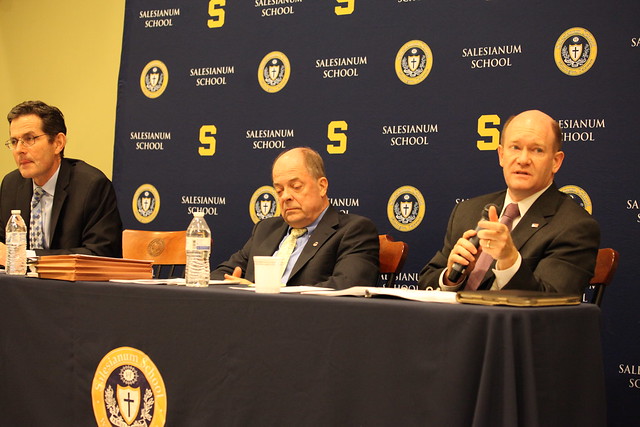
WILMINGTON, Del. – On Monday, Senator Coons sat down with other leaders and reformers in the field of criminal justice at Salesianum High School’s Centenary Hall for “Incarceration Nation,” the latest in the Salesianum Breakfast Speaker Series. Panelists participated in a lively discussion about mass incarceration in the United States and then fielded questions from an audience of community members, professionals, and Salesianum students.
“The United States is home to 5% of the world’s population, but nearly a quarter of the world’s prisoners,” said Salesianum’s President Brendan P. Kennealey in his opening remarks. The goal of the discussion was to consider the impacts, both social and economic, of America’s mass incarceration epidemic.
Senator Coons was joined by two other panelists in the field of criminal justice. The Honorable John Gleeson, a federal judge from the Eastern District of New York, has recently made news for his efforts to raise awareness about the controversial effects of mandatory minimum sentencing. Also on the panel was United States Attorney for the District of Delaware Charles Oberly III. Prior to taking that position, Mr. Oberly was the longest-serving state Attorney General in Delaware’s history, serving three four-year terms. Chief Justice Leo E. Strine of the Delaware Supreme Court moderated the discussion.
Panelists zeroed in on mandatory minimum sentencing and the efficacy of electing federal judges to the bench as potential contributing factors to the trend towards mass incarceration. This question of the effectiveness of imprisonment on reducing crime rates is particularly timely as Wilmington is suffers from an epidemic of violent crime.
“What we need is an attitude of humility in the face of the vast human suffering that is really at the core of the criminal justice system,” Senator Coons said in his closing remarks, “for victims and for those who commit crimes and for those who put themselves at risk investigating and prosecuting crimes. An attitude of humility is what I try to encourage in my colleagues in the Senate as we examine this issue and try to find a bipartisan path forward.”