Related Issues

Related Issues

A bipartisan appeal for comprehensive deficit reduction

In order to get our fiscal house in order, both parties need to come together to pass a budget that deals comprehensively with our growing deficit. This was the message Senator Coons and sixty-two other senators from both sides of the aisle sent to the President today in a letter that can be read here in full.

Chris and his colleagues are urging the President to lead a more comprehensive approach to deficit reduction based in part on the recommendations of the bipartisan National Commission on Fiscal Responsibility and Reform. These include tax reform, entitlement spending changes, and cuts to discretionary spending.

“While we may not agree with every aspect of the Commission’s recommendations,” the bipartisan group of senators wrote, “we believe that its work represents an important foundation to achieve meaningful progress on our debt.” This is a message Chris has been repeating since taking office – that our challenges are interrelated, and we will need to approach the budget comprehensively in order to achieve real bipartisan solutions.

In his maiden speech to the Senate in January, Chris similarly spoke of the need to address our greatest national challenges, such as unemployment, energy security, economic growth, and education access, comprehensively. “Our problems are interrelated,” he told his colleagues, “and the solutions must be as well.”

Chris is committed to working with leaders of both parties to reach the necessary compromises that will get our budget in order, promote economic growth and job creation, and set our country on a path toward greater competitiveness.
Chris cosponsors bill to repeal DOMA

After announcing two weeks ago his strong support for a repeal of the Defense of Marriage Act, Senator Coons on Wednesday joined Senator Dianne Feinstein (D-Calif.) and 17 of his Senate colleagues in introducing a bill that would not only repeal DOMA, but would actively prevent the federal government from discriminating against same-sex couples.

The bill doesn’t require states to allow same-sex marriage, but it does require the federal government to recognize the marriages performed by states that do.


“There are thousands of same-sex couples legally married in several states but whose marriages have been deemed invalid or unworthy by the federal government,” Senator Coons said in a statement released Wednesday.  “The Respect for Marriage Act not only reverses this discriminatory provision but ensures LGBT families will be afforded the same federal rights as every other American. I am proud to be an original cosponsor of this bill.”  

“There are too many young people growing up in Delaware and throughout the United States who think the world is against them because they are gay,” Senator Coons said. “Repealing DOMA is one way we can tell a whole generation of young LGBT Americans that they should not give up and that their country respects them enough to treat them as equal to every other American.”

Small business innovation and job growth

Senator Coons took to the Senate floor today in support of S. 493, legislation to reauthorize and expand the Small Business Innovation Research and Small Business Technology Transfer programs. These programs directly help small businesses scale up and create jobs, and they have a history of job creation in Delaware. 

Established in 1982, the Small Business Innovation Research (SBIR) program sets aside a small part of the research and development budget from a number of federal agencies to be used as grants for small businesses. The Small Business Technology Transfer (STTR) program, created in 1992, helps scientists and innovators at research institutions take their discoveries and commercialize them through small business start-ups. Together, both of these programs have invested over $28 billion in helping American small businesses transform into medium and big businesses through innovation and the commercialization of cutting-edge products.

Unfortunately, both SBIR and STTR have faced expiration year after year as Congress delayed a long-term reauthorization. “For too long,” Chris said in his floor speech, “the Senate has kicked the can down the road by passing temporary extensions month after month, year after year, for these two vital programs. This week, at long last, we have the chance to pass real long-term reauthorization.”

In Delaware, local companies are benefitting. Since 1983, nearly 400 Delaware businesses have received $400 million in SBIR grants. One, Elcriton in Newark, started with only two employees and is now scaling up and creating jobs. Elcriton is working on commercializing a process that uses bacteria to turn algae into butanol fuel. Butanol works with our existing petroleum infrastructure, which makes it better than ethanol for wide use in cars and trucks.

Another company Chris featured in his remarks is ANP Technologies, which is developing a lightweight biological agent detection system for troops in the field and first-responders. Compact Membrane Systems of Newport is also putting an SBIR grant to work developing a holly fiber filter that can separate hydraulic fluid from water, extending the life of wind turbines and expanding their workforce from three to twenty-four employees.

In his statement, Chris highlighted the importance of passing S. 493 and its effect on American competitiveness. He said: 

“We cannot afford to let this critical job-creating program expire. According to one report, small businesses backed by SBIR grants have been responsible for almost a quarter of our nation’s most important innovations over the past decade, and they account for almost forty percent of our nation’s patents. The applications range from the military to medicine, from education to emergency services.

“Congress must have a smart approach to budget reform that balances budget cuts with strategic long-term investments that create growth and job-creation for our communities, a great example of exactly what it is that the SBIR and STTR programs do.”

Chris is continuing to fight for a budget that puts job creation first and invests in long-term growth for Delaware and for all Americans.

Defense of Marriage Act repeal to be introduced Wednesday

Senator Coons will join Senators Dianne Feinstein (D-CA), Patrick Leahy (D-VT), Kirsten Gillibrand (D-NY) and Richard Blumenthal (D-CT) at a press conference on Wednesday to announce legislation to repeal the Defense of Marriage Act.

In a statement after President Obama instructed the Justice Department to longer defend DOMA in court, Chris said, “it is time to repeal DOMA and make clear that it is not the policy of the government of the United States of America to discriminate against its citizens on the basis of their sexual orientation.”

“The Defense of Marriage Act enshrined the discriminatory treatment of American citizens based on sexual orientation, which simply should not be a factor in a person’s access to equality in this country,” Chris said. “Rather than defend an unconstitutional statue, the President today demonstrated his commitment to defending the Constitution and its prohibition on arbitrary discrimination.” 

Senator Coons to co-chair Malaria Working Group

Today, Senator Coons announced that he will co-chair the bipartisan Senate Working Group on Malaria with Senator Roger Wicker of Mississippi. The goal of the Working Group is to raise awareness in Congress of global efforts to combat the spread and effects of malaria, in particular U.S. government efforts through agencies like the Centers for Disease Control and Prevention.

Malaria is an infectious disease of the blood that is mostly spread through mosquitos. It is most prevalent in the developing world, with nine out of ten malaria deaths occurring in Africa. Chris was named Chair of the African Affairs Foreign Relations Subcommittee in February.

“During my time studying and working in Africa,” Chris said, “I witnessed first-hand the havoc that malaria has on villages, especially on women, children, and those most in need and susceptible. Three million people die yearly from this preventable disease. The best way to improve life expectancy and engage in effective prevention efforts is to empower communities and governments with the tools and resources they need to save the lives of their people.”

Click here to learn more about malaria and ways you can help.

Senator Coons talks about faith and poverty

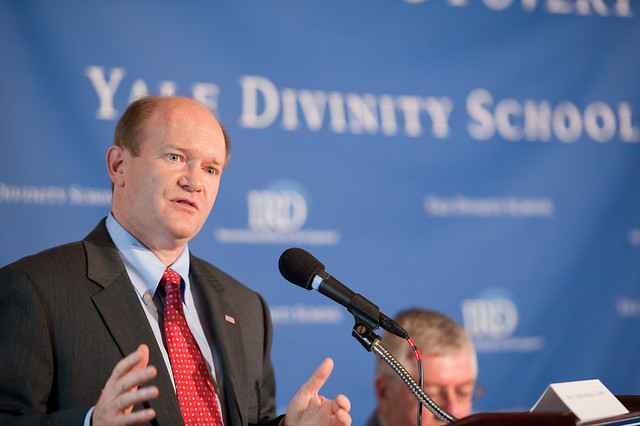
Chris Coons speaks about faith and poverty at the National Press ClubAt a gathering of global aid activists, scholars, and clergy this evening, Senator Coons spoke about his travels in Africa as a youth and how the depth of poverty he witnessed on that continent affected him as a person of faith. The event was hosted by International Relief and Development and the Yale Divinity School, of which Chris is an alumnus, having earned his degree in ethics there in 1992.

Timed to coincide with the beginning of Lent, the event featured Chris discussing how faith can be a powerful catalyst for action to ease the suffering of others.  He drew on his own religious background as an ordained Presbyterian elder as well as lessons from other faith traditions, including Islam and Judaism, to explore the meaning of our connections to one another as people sharing this world.  Faith, he told those in attendance, has the power to motivate us to act – as individuals, as communities, and as a nation – to help feed the hungry, heal the sick, and shelter the homeless. 

Chris recalled some of his early experiences in Kenya, Uganda, and Tanzania as a student in college:

I’ll never forget walking through Nairobi’s Mathare Valley for the first time.  Its seemingly-endless slum fills the narrow space between the hills, a mess of corrugated metal, dirt roads, animals, and people.  It is difficult to imagine unless you have actually been there. 

While there is difficult poverty in every nation, including our own, the depth of poverty in the slums of the developing world is unmatched. 

Mathare today is home to nearly half a million Kenyans, and they live without running water, sewers, and access to basic health care, education, and adequate food.  Homes are constructed from garbage, and the stench of the slum is just unbearable to those who were not forced to grow up inside it.

…I saw something else in Mathare and in all the slums I visited that stood in striking contrast to their poverty.  I once attended a church service lasting over four hours, and the faith and hope and joy that overflowed from the worshippers was incredible. 

These people, so poor in wealth, were so abundant in their love for God and hope for the future.  Several of us who were there working on relief visited the home of a family who slaughtered their last goat in order to serve their guests an adequate meal.  We were as the three strangers arriving at Abraham’s tent. 

After returning to the United States, Chris worked with the South African Council of Churches against apartheid and later worked with the Coalition for the Homeless in five states. He noted how striking it was that, twenty-five years after that first experience in Nairobi, he has just recently been selected to chair the Senate Foreign Relations Subcommittee on African Affairs. 

In his leadership of the Subcommittee, Chris looks forward to working with his colleagues, with the Administration, with our allies, and with aid groups – including faith-based organizations – to help Africans escape the painful cycles of poverty and work toward political freedom and economic developme

Delaware can benefit from Florida’s folly on high-speed rail

With the Administration’s continued focus on high-speed rail development, states have been benefiting from infusions of federal investment to upgrade their rail networks. Unfortunately for their states’ residents, some governors have put the brakes on high speed rail projects. Fortunately for Delaware, Senator Coons and Senator Carper have been urging the federal Department of Transportation to redirect funding from states that refuse it to those that embrace it. 

For well over a century, Delaware has relied on rail transportation to bring its goods to market and transport people in and out of the state. The Wilmington train station, housed in a historic building from the early twentieth century, served over 696,000 travelers last year, making it the 12th busiest in the Amtrak system. As Delaware continues to develop a vibrant innovation-based and advanced manufacturing economy, rail will continue to be important as commuters move throughout the Delaware Valley and new products are exported out of state.

In February, Florida’s Republican Governor, Rick Scott, astoundingly rejected $2.4 billion that in federal funding had been allocated for high speed rail in his state. In response, Chris joined Senator Carper and other senators from Maryland, Pennsylvania, New Jersey, New York, Connecticut, and Massachusetts to ask Transportation Secretary Ray LaHood to send those funds to Amtrak’s Northeast Corridor instead.

“In addition to reducing congestion on our roads,” Chris said, “high-speed rail makes the cities and states it serves more appealing to businesses looking to open new facilities and put more people to work. If Florida isn’t interested in this funding, I’m certain that it can be put to good use up here in Delaware.”

In a statement to the press on March 4, after the Florida Supreme Court upheld Governor Scott’s decision to decline federal rail funding, Chris explained how redirecting this money could benefit Delaware:

“There are a number of important projects in the Northeast Corridor and right here in Delaware that could benefit millions of Americans. Projects like the construction of a new train station in Newark, or a third track connecting Wilmington and Newark to extend SEPTA’s reach and ease congestion for Amtrak. We would welcome this funding and could quickly and effectively put it to good use expanding and improving our high-speed rail service. Not only would this create good paying jobs, but it would help ease congestion on our already crowded roads and highways, and reduce harmful air pollution.”

To learn more about the Administration’s plans for national high-speed rail development and how Delaware is already ahead of the game, click here.

A big step forward for American innovation, entrepreneurship, and competitiveness

After years of being stalled in Congress, major patent reform legislation passed the Senate today.  Senator Coons was proud to cosponsor the America Invents Act of 2011, which secured a strong, bipartisan 95-5 vote for passage. 

As a member of the Senate Judiciary Committee, Chris is committed to strengthening our intellectual property laws and helping American inventors and entrepreneurs transform their ideas into products.  America has always been the world’s idea factory, and our new products and technologies have transformed the world several times over.  The America Invents Act is an important step forward in this area. 

“The America Invents Act,” Chris said after passage, “will create jobs in Delaware and throughout the United States by removing some of the administrative roadblocks that currently prevent inventors from becoming successful entrepreneurs.  This bill will improve the speed, quality and reliability of the Patent and Trademark Office and it will ensure that America retains its place in the world as the leader of invention and innovative thinking.” 

The U.S. Patent and Trademark Office (PTO) currently has a backlog of patent applications, and the average time from submission to approval is almost three years.  This bill allows the PTO to set its own fees and ends the practice of patent application fees paid to the PTO being reallocated to other agencies.  As a result, the PTO can hire more reviewers, streamline operations, and approve more patents in less time.  

Chris spoke on the Senate floor this afternoon before the vote to press his colleagues to support the bill.  In his remarks, he noted that, essentially, this is a job-creating bill.  He hailed the bipartisan nature of the bill and also stated his hope that it will help ensure America’s continued global leadership in innovation.  

Senator Coons calls for cuts to Congressional office budgets

Senator Coons today sent a letter to Senators Ben Nelson and John Hoeven urging them to cut the budgets for all Congressional offices for the remainder of 2011. Senators Nelson and Hoeven serve as the Chair and Ranking Member, respectively, of the Senate’s Appropriations Subcommittee on the Legislative Branch, which oversees Congress’s annual operating budget.

When Chris was New Castle County Executive, and the county budget felt the economic squeeze, he cut his own pay first and asked county officers to cut theirs too. That measure saved the county $130 million and helped achieve a balanced budget. Chris believes that Congress should share the sacrifice of making cuts to reduce our deficit, and that is why he is calling on Senators Nelson and Hoeven to reduce the amount spent on congressional offices and staff. 

In his letter, Chris explained the importance of asking members of Congress and their staffs to share the burden of deficit reduction measures. He wrote:

“While we work to bolster our economic recovery, we also have a responsibility to reduce deficits and take steps to lower our national debt. This will require spending restraint across government and, regrettably, painful cuts to important programs. We in Congress must do our part, too, by accepting cuts to our administrative budgets. Though the savings from these cuts will not solve our fiscal problems, it is important for Congress to lead by example and share in the sacrifices we will ask families in Delaware and across the country to make.”

Understanding the important work performed by hardworking congressional staff and their commitment to public service, Chris stated his believe that they will certainly accept that, during these difficult economic times, everyone has to pitch in and do what is necessary to get our fiscal house in order.

Delawareans with pre-existing conditions have new insurance options

This morning, Senator Coons visited Wilmington’s Henrietta Johnson Medical Center to talk with patients and their families about one of the helpful benefits of the new health reform law. For too long, those with pre-existing conditions have faced expensive insurance premiums and were routinely denied coverage by providers. Thankfully, with the passage of the Patient Protection and Affordable Care Act last year, Americans with pre-existing medical conditions have a new option for affordable health insurance. 

For Delawareans who have been denied coverage as a result of chronic or pre-existing conditions, affordable insurance is now a reality. In his visit to the Henrietta Johnson Medical Center today, Chris outlined the new Pre-Existing Condition Insurance Program that can cover adults through 2014, when provisions of the Affordable Care Act prohibiting denial of coverage for pre-existing conditions come into effect. The Affordable Care Act has already been extending this right to children with pre-existing conditions since last year.

Speaking to doctors, patients, and hospital visitors, Chris said, “Delawareans who have been denied coverage for a pre-existing condition like cancer, diabetes, asthma, or high-blood pressure need to know that there is now an option available to them.” The Affordable Care Act has already enabled young people under the age of 26 to be covered under their parents’ plan, and it promises to lower health insurance costs and enable more Americans to purchase affordable insurance as additional provisions come into effect over the next few years.

Delaware’s Pre-Existing Care Insurance Program, which is administered by the federal government, covers a range of benefits. These include primary and specialty care, doctor visits, hospital stays, and prescription drugs. Moreover, there are no waiting periods for coverage of pre-existing conditions. It also features a number of plan options and does not base eligibility on income.

If you have a pre-existing condition, and can prove that you have been denied coverage as a result (or been told you do not qualify for coverage), this plan may be a good option for you. Depending your age and what type of coverage you select, your premiums could be as low as $181 a month. 

If you are interested in more information about the Pre-Existing Coverage Insurance Plan, including full qualifications, you should visit www.pcip.gov and www.healthcare.gov to learn more.