Related Issues

Related Issues

Senator Coons congratulates Dover AFB reserves on national award
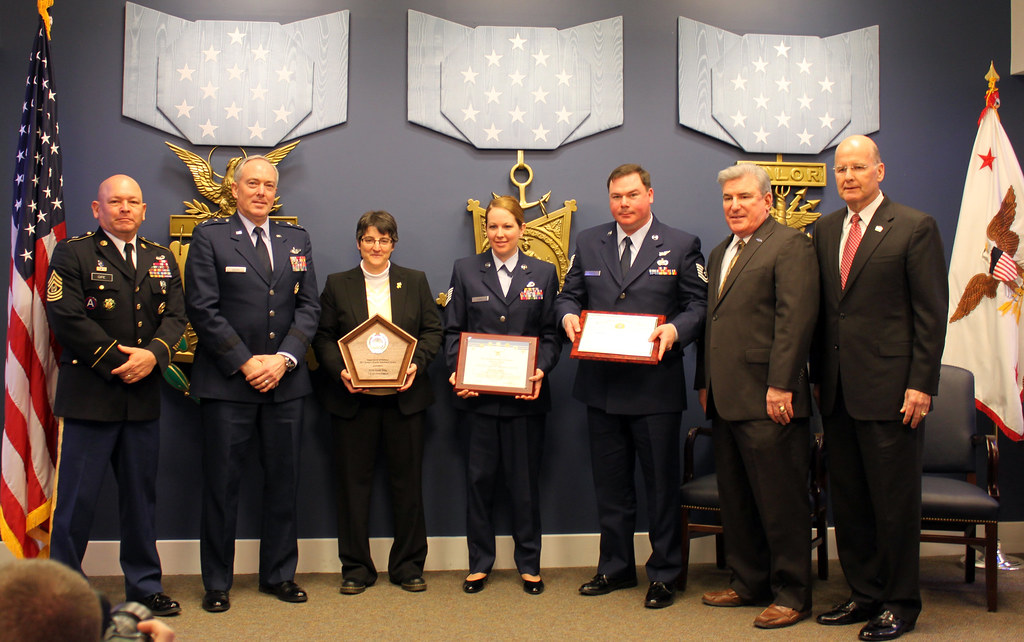
honorsThis morning, Dover’s own 512th Airman and Family Readiness of the 512th Airlift Wing at Dover Air Force Base was honored with the 2011 Reserve Family Readiness Award for the U.S. Air Force Reserves. Every year, the award goes to the best unit in each reserve component that prepares airmen and their families for deployment, sustains them throughout, and supports them in their reintegration when they return. The award-winning 512th A&FR supports more than 1,800 airmen and their families connected to Dover Air Force Base, who are spread over 29 states.

The 512th A&FR’s director, Master Sergeant Laura Coseglia, accepted the award on behalf of her team from Acting Assistant Secretary of Defense for Reserve Affairs David McGinnis at a ceremony held at the Pentagon. Senator Coons was presiding over the Senate at the time of the ceremony, but a member of his staff was present, as was wing commander Colonel Randal L. Bright.

Master Sgt. Coseglia’s team has earned best in the nation honors because of their community-based approach to support for airmen and their families. Rather than focus on a top-down, directive based approach to meeting the needs of men and women who serve, the 512th A&FR reaches out to our Delaware community, partnering with over 175 different military, non-profit, business, education, and veteran groups. In today’s austere environments, when needs seem to always outstrip resources, this broad community-based approach opens up creative possibilities for meeting needs.

Senator Coons believes that the community-based approach to serving needs in Delaware that the 512th A&FR does the best in the nation provides the flexibility and responsiveness that is too often lagging in support for our nation’s service members and veterans. He will join with Wilmington University on April 21 for Operation Success, a job fair and outreach event for service members, veterans, and their families, which is bolstered by the Delaware service members support community, including the 512th A&FR.

Senator Coons earns perfect rating on civil, human rights policy

The Leadership Conference on Civil and Human Rights released its annual Congressional Voting Record on Tuesday, highlighting the position of members of Congress on civil and human rights issues.

In historical terms, the session was one of the least productive on record with little to no work on the advancement of civil rights. Senator Coons, however, has remained an ardent supporter of advancing civil rights and received a perfect score on the Leadership Conference on Civil and Human Rights’ voting record.

The scorecard, which covers the first session of the 112th Congress, outlines how U.S. senators and representatives voted and whether they co-sponsored legislation on priority issues affecting education, economic security, and civil rights. Chris is one of 38 senators to receive a perfect 100 percent rating for the first half of the 112th Congress. 

The Leadership Conference on Civil and Human Rights is a coalition charged by its diverse membership of more than 200 national organizations to promote and protect the civil and human rights of all persons in the United States. Through advocacy and outreach to targeted constituencies, The Leadership Conference works toward the goal of a more open and just society – an America as good as its ideals.

Founded in 1950, The Leadership Conference works to effect meaningful legislation, policies, and executive branch appointments, and to ensure the proper enforcement of civil rights laws to unite us as a nation true to its promise of equal justice, equal opportunity, and mutual respect.

Click here to learn more about Chris’ work for to improve civil rights.

What We’re Reading: Factory output jumps in January

Flag for What We're Reading

The Associated Press reported Monday that the overall output of American factories for the months of December and January were the best the sector has seen in five years.

Job creation, with a particular focus on manufacturing jobs, has been Senator Coons’ top priority since joining the Senate. He is a member of the Senate Manufacturing Caucus, devoted his maiden speech to the importance of America manufacturing, and unveiled his “Blueprint for American Jobs,” which contains measures to boost growth in the manufacturing sector.

The Federal Reserve said Wednesday that manufacturing production increased 0.7% in January. And output soared 1.5% in December, according to an upward revision. That was the biggest gain since December 2006.

Factory output has risen 16.7% from its low point during the recession, in June 2009. It is still 7.1% below its December 2007 peak.

Two strong months of manufacturing growth are among the encouraging signs that show the economy could grow at a steady pace this year. The pickup in manufacturing coincides with five straight months of solid job growth, which has lowered the unemployment rate to 8.3%.

Click here to read the full article on USA Today’s website.

Click here to learn more about Senator Coons’ work to improve the economy and create jobs.  

Senator Coons hails new international cooperation on climate change and clean air

This morning, Secretary of State Hillary Clinton announced a new climate change and clean air initiative at the State Department. This initiative will bring together a coalition of countries including Sweden, Mexico, Canada, Bangladesh, and Ghana to fight some of the biggest contributions to global climate change.

The Climate and Clean Air Coalition, in cooperation with the U.N. Environment Programme, will target so-called short-lived “climate forcers.” Those substances like methane, black carbon and hydrofluorocarbons (HFCs) remain in the atmosphere only days or weeks, unlike carbon dioxide, which lasts generations.  Collectively, they account for 30-40% of current global warming. The initiative will look to find ways to reduce these pollutants that have the potential for reducing average global temperatures by ½ degree Celsius. This could be a significant reduction in light of the recent pledge reduce average global temperatures by 2 degrees Celsius at last year’s international conference on climate change.

Senator Coons is a strong supporter of cooperative, international approaches to fighting climate change and improve clean air. Prior to last year’s international conference on climate change in Durban, South Africa, he joined 15 of his Senate colleagues in signing a letter urging coordinated international efforts as we transition to a clean energy economy.

Chris was also glad to hear that additional countries, including many in Europe and Latin America, are expected to join the coalition next year. All reductions are voluntary and the programs are low cost or even cost neutral.

U.S. Environmental Protection Agency head Lisa Jackson joined Secretary Clinton for this morning’s announcement, highlighting the health benefits of the initiative. Her agency estimates these programs could save over 2.5 million lives and prevent some of the 30-50 million tons of agricultural losses each year due to these pollutants.

Budget Analysis: Clean energy and innovation

Legislative AnalysisAs a member of the Senate Energy and Natural Resources Committee, Senator Coons has been leading the fight for solutions to promote clean, affordable energy technologies. His analysis of President Obama’s budget proposal included a close review of clean energy programs.

The budget request for clean energy and environmental programs is on track with last year’s request, although it includes notable increases for certain energy and advanced manufacturing programs.  The blueprint also highlights the need for Congress to extend clean energy tax incentives, something Chris strongly supports.

Clean energy programs are divided among several agencies, including:

Department of Energy Programs

  • Energy efficiency and renewable energy programs receive a request for $2.3 billion, an increase of $527 million from FY12.  Notable increases include biomass R&D, wind (including offshore wind), vehicles, advanced manufacturing, and buildings programs.   
  • The request triples funding for groundbreaking research in the transportation sector, which helps reduce our dependence on foreign oil.  The focus will be on sustainable biofuels, vehicle electrification, and manufacturing advancements.     
  • The budget requests $6 billion for the HOME STAR program, an initiative at the Department of Energy designed to create jobs in existing industries by providing short-term incentives for energy efficiency improvements in residential buildings.

U.S. Department of Agriculture Energy Programs

  • The budget proposes $6.1 billion in loans to rural electric cooperatives and utilities for clean-energy generation, transmission, and distribution sites in rural communities.
  • The budget also proposes $19 million for Rural Energy for America Program (REAP) and over $200 million for the development of advanced biofuels.

Department of the Interior Energy Programs

  • The budget proposal includes $86 million for permitting new renewable energy projects on federal lands and waters, with the goal of permitting 11,000 megawatts on DOI-managed areas by the end of 2013.

Energy Tax Extenders 

  • The budget request supports the extension of the 1603 Treasury grant program and the Production Tax Credit (PTC) for wind power.
  • The administration also proposes spending $5 million to extend the 48c manufacturing tax credit which expired in December 2010.
  • The budget includes tax credits mirrored Senator Coons’ Job Creation Through Innovation Act
  • The budget seeks to eliminate $4 million in fossil fuel subsidies, mostly from oil and gas companies.

Budget Analysis: Promoting trade

Legislative AnalysisIn today’s global economy, it is critical for American businesses to be able to sell their goods and services to customers overseas. Senator Coons has been working to ensure Delaware businesses have access to the more than 95 percent of the world’s consumers who live outside the United States.

At his first Opportunity: Africa conference held this year in Wilmington, Senator Coons worked to connect Delawareans with some of the nation’s leading authorities on sustainable development and trade with Africa to help open new markets for Delaware businesses.  

President Obama’s budget proposal contains several important programs that can help meet that goal. For example:

  • Export promotion. The budget provides an increase of $19 million, for a total of $432 million, to strengthen efforts at five international trade-related agencies to promote and enforce international trade, and meet the goals of the National Export Initiative. The funding will be divided among the Export-Import Bank, the U.S. Trade and Development Agency, the office of the U.S. Trade Representative, the U.S. International Trade Commission and the Overseas Private Investment Corporation.   
  • Economic Diplomacy. Included in the State Department budget is funds for economic diplomacy and export promotion with the goal of increasing the number of “market-oriented economic and commercial policy activities and accomplishments” by 15 percent by September 2013.

Budget Analysis: Protecting innovation

Legislative AnalysisSenator Coons has been hard at work on the complex issue of protecting American intellectual property from theft by foreign criminals. After hearing from local businesses, both large and small, about the importance of this issue, Chris recently said “protecting American innovation is an economic imperative, and whether that innovation comes in the form of an idea, a design, or a product.”

President Obama’s budget proposal also recognizes the imperative of protecting innovation and through that, American jobs. It includes several solutions, such as: 

  • Improve the Patent System and Protect Intellectual Property. The budget proposes to give the U.S. Patent and Trademark Office (USP­TO) full access to its fee collections and strength­en USPTO’s efforts to improve the speed and quality of patent examinations through reforms authorized by the America Invents Act. This will provide the USPTO with more than $2.9 billion in resources in 2013.
  • Strengthen Enforcement. The budget supports strengthened intellectual property enforcement domestically and overseas as set out in the Intel­lectual Property Enforcement Coordinator’s Joint Strategic Plan required by Prioritizing Resources and Organization for Intellectual Property Act of 2008 (Pro-IP).
  • Promotes Innovation by Protecting Intel­lectual Property Rights. The Administration proposes de­voting nearly $40 million to identify and defeat intellectual property criminals, an increase of $5 million over 2012. The Administration’s efforts have already resulted in shutting down 350 web­sites engaged in the illegal sale and distribution of counterfeit goods and copyrighted works. Addi­tionally, international partnerships and joint ini­tiatives have enabled experts to train or educate in IP protection more than 2,500 foreign judges, prosecutors, investigators, and other officials from over 30 countries.

Budget Analysis: College access and completion

Legislative AnalysisIt was fitting that President Obama unveiled his budget at a community college, because his plan focuses heavily on ensuring the next generation of American workers have access to an affordable higher education. 

This is a top priority for Senator Coons, who said “if we are to compete and succeed in the global economy, we have to invest now in the training and education required for highly skilled, good quality jobs. If we have the right workforce, we can revitalize American manufacturing so products are made in America and manufactured in Delaware.” 

In analyzing the President’s budget request, there are a several key programs related to college access, including:

  • Race to the Top: College Affordability and Completion.  The budget proposes a $1 billion investment in a new Race to the Top challenge for states to spur higher education reform that will help improve affordability, quality, productivity, and degree completion.
  • First in the World Fund.  The budget proposes a new $55 million First in the World Fund that introduces an evidence-based framework to test, validate, and scale up effective strategies to improve higher education.
  • Community College to Career Fund.  Co-administered by the Department of Labor and the Department of Education, this fund will help forge partnerships between community colleges and businesses to train workers for good-paying jobs in high-growth and high-demand industries, such as health care, transportation, and advanced manufacturing.

Budget Analysis: Manufacturing and competitiveness

Legislative AnalsysisIn reviewing President Obama’s budget proposal, Senator Coons was especially interested in programs to create good-quality jobs and help Delaware and America compete and win in a global economy.

To achieve these goals, Chris has actively supported manufacturing programs, as well investments in research and development, in previous legislation.  President Obama zeroed in on some of these same solutions in his budget. Highlights include:

  • Manufacturing Tax Incentives.  The budget plan includes tax incentives for manufacturers who create jobs here and doubles the deduction for advanced manufacturing.  It also ends tax deductions for shipping jobs overseas and creates a Manufacturing Communities Tax Credit to encourage investment in communities affected by job loss.
  • Innovation Corps.  The Administration proposes $19 million for a new public-private “Innovation Corps” program aimed at bringing together the technological, entrepreneurial, and business know-how necessary to bring discoveries ripe for innovation out of the university lab.
  • Research and Development. The budget blueprint makes the R&D tax credit permanent, an idea Senator Coons strongly supports and has introduced as legislation because of its importance to economic competitiveness. The budget proposal includes an overall number of $140.8 billion for R&D and increases the level of investment in non-defense R&D by 5 percent from the 2012 level as well as provides $2.2 billion for advanced manufacturing R&D, a 19% increase over 2012.
  • International Trade Administration.  Proposed funding for this program, which promotes exports and trade enforcement, is increased by $60 million, or 14%.

Budget Analysis: Deficit reduction

Legislative AnalsysisPresident Obama’s budget proposal for the upcoming fiscal year (FY13) hit Capitol Hill this week, hot off the presses. Senator Coons reviewed the blueprint and praised it for responsibly reducing our country’s dangerous deficits while still investing in America’s long-term competitiveness.

After digesting the budget proposal’s many charts and numbers, our team has identified a few key highlights for Delaware, starting with responsible deficit reduction.

President Obama’s budget plan would save more than $4 trillion over 10 years, stabilizing public debt at 76.5% of GDP by 2022, with deficits declining to an average of 3% of GDP per year. 

This blueprint reduces the deficit in four primary ways:

  • Winding down the wars in Iraq and Afghanistan. Nearly $850 billion is saved in the Overseas Contingency Operations accounts, which primarily relates to war funding.
  • Returning to Clinton-era tax levels on the wealthiest Americans.  Some $206 billion is saved by ending the George W. Bush-era tax cuts for families making over $250,000 a year.
  • Reforming entitlement programs. The budget includes close to $600 billion in savings on health and other mandatory spending programs.
  • Staying within Congressional budget limits. The President continues the savings plan established by Congress in the Budget Control Act, passed last year, which saves over $1 trillion through caps on discretionary spending.