Related Issues

Related Issues

The Senator’s week ahead schedule: June 4 to June 10

The Week Ahead

Monday, June 4 at 12:00 p.m. — The Senator will speak at the Laborers’ International Union of North America (LIUNA) Legislative and Political Captains Conference in Washington. LIUNA’s annual conference focuses on the past, present and future of organized labor, including legislative priorities, such as the surface transportation bill and other job-creating measures. Washington Court Hotel, Atrium, 525 New Jersey Ave NW, Washington D.C.

 Wednesday, June 6 at 9:00 a.m. — The Senator will attend a Democratic Steering and Outreach Committee meeting on college affordability. Higher education experts and advocates, including Delaware State University President Dr. Harry Williams, will participate in the meeting. S-207, U.S. Capitol, Washington, D.C. – Closed to press.

Wednesday, June 6 at 10:00 a.m. — The Senator will attend a Senate Judiciary Committee hearing entitled, “Ensuring that Federal Prosecutors Meet Discovery Obligations.” Senator Coons will chair the hearing’s final panel. 226 Dirksen Senate Office Building, Washington, D.C. – Open to Press.

Thursday, June 7 at 10:00 a.m. – The Senator will attend a Senate Judiciary Committee business meeting.  226 Dirksen Senate Office Building, Washington, D.C. – Open to press.

Thursday, June 7 at 4:00 p.m. The Senator will preside over the Senate until 5:00 p.m.  Senate Chamber, U.S. Capitol, Washington, D.C. – Open to press who wish to sit in the Senate Gallery.

Friday, June 8 at 3:00 p.m. — The Senator will speak to Leadership Delaware.  Senator Coons will address the 2012 class of Leadership Delaware fellows. Bank of America, 1100 North King Street, Wilmington, DE – Closed to press.

Friday, June 8 at 7:00 p.m. – The Senator will be the keynote speaker at the Newark Charter School’s Graduation Ceremony. Newark Charter, 2001 Patriot Way, Newark, DE – Open to Press. 

Saturday, June 9 at 11:00 a.m. – The Senator will attend the Separation Day Parade in Historic New Castle. Delaware Street, New Castle, DE — Open to Press.

Saturday, June 9 at 6:30 p.m. – The Senator will attend and speak at the Delaware Democratic Party’s Jefferson-Jackson Dinner. Dover Downs, Dover, DE – Open to Press.

Note: Schedule is subject to change.

###

What We’re Reading: Highly educated immigrants and American jobs

Flag for What We're Reading

Bloomberg View noted this week that America’s competitors in the global economy are welcoming highly skilled, highly educated immigrants with open arms, and warned that if the United States doesn’t do the same, we will lose out on job creating potential.

To see the results of self-defeating U.S. immigration policies, you need only open your browser to www.canadavisa.com. There, you’ll see a shrewd neighbor fishing for talent at U.S. expense.

At the top of the website, in large print, is the question: “Currently on an H1B Visa or otherwise working or studying in the United States?” There is nothing subtle about the appeal. Canada is seeking skilled foreigners who’ve grown frustrated with the U.S. visa gantlet, which can take a decade for the lucky few who manage even to begin it.

The Bloomberg editorial mentions the Startup Act 2.0, legislation Senator Coons introduced with Senators Mark Warner, Jerry Moran and Marco Rubio. To help create jobs, this legislation would create a new visa for immigrants who graduate from U.S. universities with an advanced degree in science, technology, engineering or math fields. It would also create an entrepreneur’s visa to help immigrants with capital start businesses and create jobs in the United States.

In addition, earlier this year, Senator Coons introduced the bipartisan SMART Jobs Act with Senator Lamar Alexander of Tennessee. This legislation offers another solution to the problem of America losing highly skilled immigrants – and their job creating potential – to our foreign competitors by creating a clear path forward for foreign-born, American-educated holders of advanced degrees in key fields to remain in the United States.

Studies have shown that immigrants are nearly twice as likely as U.S.-born individuals to start new businesses. Immigrant-founded startup companies created 450,000 jobs in less than a decade, and collectively they have generated over $50 billion in sales in a single year. More than 40 percent of Fortune 500 companies were founded by immigrants or their children, but arbitrary and limiting per-country visa caps are sending nearly 20,000 foreign-born, American-educated degree-holders out of the country each year.

Law of the Sea treaty vital to U.S. interests

One hundred and sixty-two countries have ratified the United Nations Convention on the Law of the Sea — a treaty designed to provide international guidelines for use of the world’s oceans — but in the 30 years since it was first negotiated, the United States has refused, putting the country’s long-term national and economic security at risk.

That was the focus of a hearing of the Senate Foreign Relations Committee hearing last week, which featured testimony from Chairman of the Joint Chiefs Gen. Martin Dempsey Secretary of State Hillary Clinton, and Secretary of Defense Leon Panetta. 

“When I was brand-new to the Senate,” Senator Coons said at the hearing, “one of the earlier meetings I took with was with the then outgoing Chief of Naval Operations, Admiral Gary Roughead.  And when I asked him, what is the single most important thing we can do to help the Navy over the next decade, he said, without hesitation, ratify the Law of the Sea treaty.” 

Chris also addressed some of the resistance to the Convention’s passage, noting the debate is largely dated.

“I understand some of the concerns raised by members of this committee,” he said. “There were some flaws and some issues in this treaty when first negotiated in ’82.  Many of them were hammered out, resolved by ’94, by amendments, certainly by the time this was previously considered several times by this committee during your service here, Senator, now Secretary.” 

“I believe it is well past the time when the questions and concerns raised here today were compelling.”

Asked by Senator Coons about the potential risk assumed by the U.S. by refusing to ratify the Convention, General Dempsey said that the “failure to ratify puts us at some greater risk of conflict.”

Secretary Panetta also agreed that failure to ratify the Convention could pose an increased risk of confrontation.

“The risk is this,” Panetta explained. “If we face a situation that involves navigational rights, if we are not a party to this treaty and can’t deal with it at the table, then we have to deal with it at sea with our naval power.  And once that happens, we clearly increase the risk of confrontation.”

Panetta added that so many U.S. allies have already signed on to the convention and they cannot understand why the U.S. has not yet ratified the convention. 

“Sure, they know we are a strong naval power,” Panetta said. “They know that we can exert ourselves military wherever we want to.  But they also know that, in today’s world, they are dealing at the table trying to negotiate resolutions to conflicts in a rules-based manner.  That is the way to deal with issues like that.”

Finally, Chris asked Secretary Clinton how failing to ratify the convention would pose challenges to the State Department in their efforts to protect vital U.S. interests in the Arctic’s Northwest Passage.

Clinton noted that “one of the reasons there has been such strong bipartisan support coming from Alaska over the last decades is because they are truly on the front lines.”

“We know there are natural resources that are likely to be exploitable if we have the opportunity to do so,” Clinton said.

“Being able to demarcate our continental shelf and our extended continental shelf is seen in Alaska as a missed opportunity and a strategic disadvantage that is increasingly going to make us vulnerable as the waters and the weather warms,” Clinton said.

“There are going to be ships from all over the world exploring, exploiting, fishing, taking advantage of what rightly should be American sovereign territory.”

The United States is currently the only Arctic nation that has not ratified the convention.

ICYMI: Startup Act 2.0 endorsed by News Journal

The News Journal: In a Sunday editorial, the News Journal wrote about the importance of the Startup Act 2.0. Introduced last week by U.S. Senators Chris Coons (D-Del.), Marco Rubio (R-Fla.), Mark R. Warner (D-Va.), and Jerry Moran (R-Kan.), this legislation will  help  jumpstart the economy through the creation and growth of new businesses and jobs.

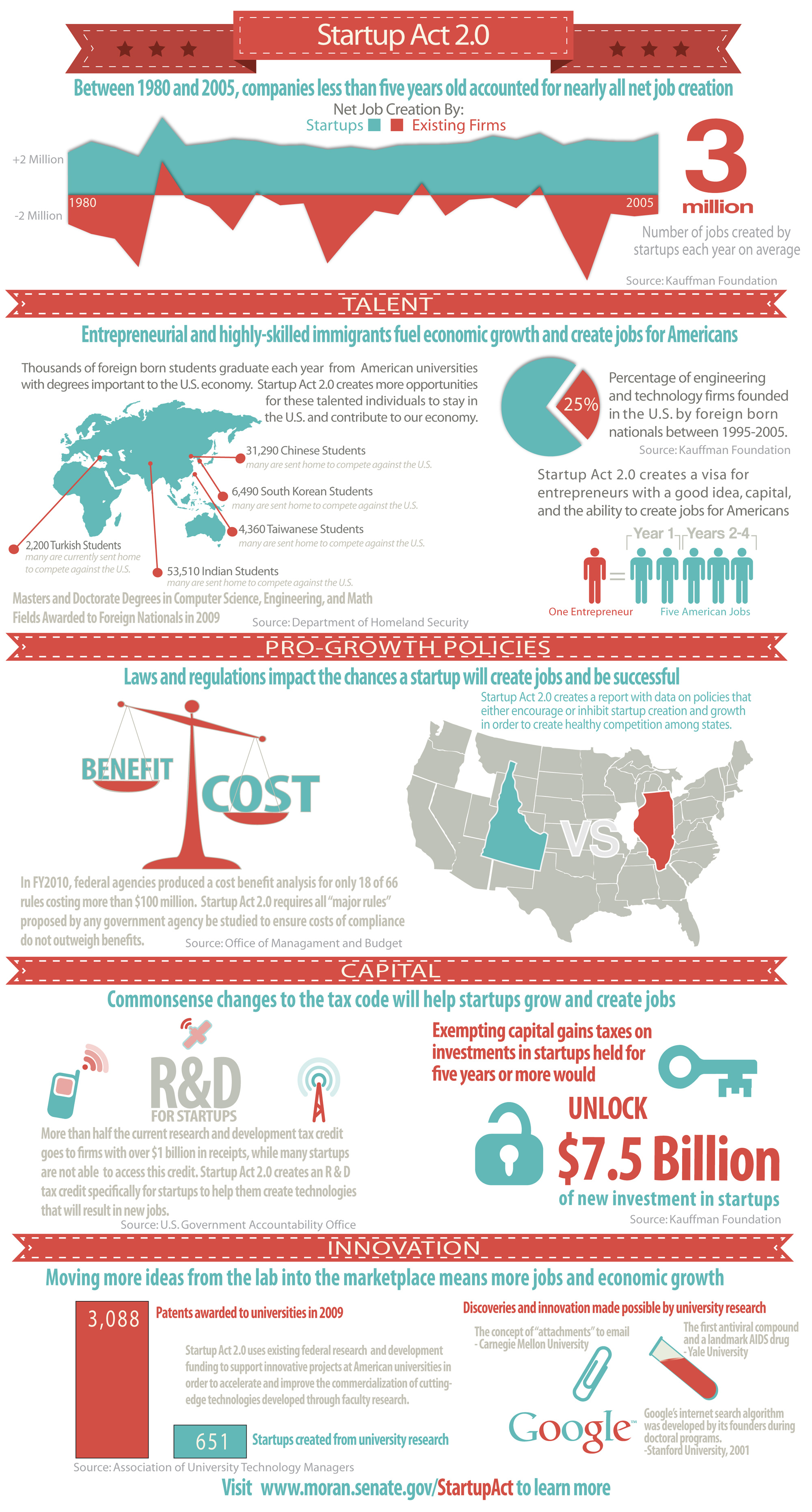
It is based upon research showing that for close to three decades, companies less than five years old have created almost all of the net new jobs in America, averaging about three million new jobs each year.

Sen. Chris Coons of Delaware was joined by fellow Democrat Mark Warner of Virginia and Republicans Jerry Moran of Kansas and Marco Rubio of Florida in proposing “Startup Act 2.0.” The “2.0” means it’s an updated version of an earlier Moran-Warner proposal.

Startup 2.0 would do several important and smart things. First, it would create “STEM visas” for foreign students to come here to earn graduate degrees in science and math. It also would create “entrepreneur visas” for legal immigrants who start businesses.

Click here to learn more about the bill.

ICYMI: News Journal editorializes in support of Senator Coons’ bill on bankruptcy judges

The News Journal: On Saturday, the News Journal editorialized on the importance of the Temporary Bankruptcy Judgeship Extension Act, which was introduced by Senator Chris Coons in November and signed into law by President Obama on Friday. The law reauthorizes 29 temporary bankruptcy judgeships, including five in Delaware, ensuring that the judgeships are not lost due to the retirement, resignation, death or removal of the judge.

There’s no way for this country to get beyond the economic malaise of the last three to four years without sufficient bankruptcy judges on the bench.

On Friday President Obama affirmed this reality with his signature on the Temporary Bankruptcy Judgeship Extension Act.

“This law will stave off a grave shortage of bankruptcy judges in many districts around this country, which could have impaired the abilities of courts in those districts to do just that,” said Sen. Chris Coons, who introduced the legislation back in November.

Click here to learn more about the bill.  

Click here to read the full text of the bill Senator Coons introduced in November.

ICYMI: Sens. Coons, Rubio, Warner, and Moran’s op-ed on Startup Act 2.0

Politico: Senator Chris Coons joined his colleagues Senators Marco Rubio, Mark Warner, and Jerry Moran in penning an op-ed on Tuesday that corresponds with the rollout of their bipartisan legislation to help jumpstart the economy through the creation and growth of new businesses and jobs.  The Startup Act 2.0 is based upon research showing that for close to three decades, companies less than five years old have created almost all of the net new jobs in America, averaging about three million new jobs each year.

Inside the Beltway, conventional wisdom says that Congress does little during an election year. But Americans are eager to see Congress address our country’s challenges — most important, the economy and job creation.

We are introducing bipartisan legislation, Startup Act 2.0 on Tuesday — to help jump-start the economy through the creation and growth of new businesses. We want to prove the critics wrong: Congress can get something done in an election year when we work together to strengthen the economy and create jobs.

Companies less than five years old have created nearly all net new U.S. jobs for almost three decades, according to Kauffman Foundation research, averaging roughly 3 million each year. Passing the JOBS Act in March was good news for the young companies now creating jobs. But entrepreneurs face additional challenges beyond access to capital. Startup Act 2.0 picks up where the JOBS Act left off — by helping entrepreneurs to succeed.

Click here to read the full op-ed on Politico’s website.

Click here to learn more about Chris’ work to create jobs.

Delaware ranks in the top ten of bicycle-friendly states

For the first time since the League of American Bicyclists started its annual national ranking of bicycle-friendly states in 2008, Delaware is ranked in the top ten. Delaware has continued to become more bicycle-friendly over the years with a significant leap from last year when Delaware was ranked 18th, and in 2008 when the state was ranked 31st.

Delaware’s number 10 ranking was based on a number of key indicators, including infrastructure and funding that provide on-the-ground bicycle facilities; education and programs that promote cycling; and passage of bicycle-friendly laws, such as the 3-foot passing law championed by the Delaware Bicycle Council, which increases safety for bicyclists of all ages.

Delaware’s jump to the 10th slot is due to support from officials at the local, state, and national level who are leading the way by creating a multi-modal transportation system. Senator Coons has worked hard with other members of the Delaware Congressional Delegation and Governor Markell to utilize federal funding originally secured by former Congressman Castle, as well as state resources for the construction of a recreational trail on the banks of the Chesapeake and Delaware Canal.

Click here to learn more about Chris’ work to promote transportation development.

Click here to learn more about Chris’ work to help develop the C&D Canal.

What We’re Reading: Millennials more likely to start businesses

Flag for What We're Reading

USA Today reported Sunday that young Americas are more inclined to launch their own start-up businesses, despite the current tough economic climate. Several factors play into Millennials’ tendency to be more open to entrepreneurship in the early stages of their careers. 

“Generation Y is the most entrepreneurial generation ever,” said Jeff Cornwall, director of the Center for Entrepreneurship at Belmont University in Nashville. “Parents raised their children to be independent,” Cornwall said.

When Cornwall wanted to start an entrepreneurial program at Belmont in the 1980s, “There were only about a dozen universities with this type of program — now, there are over 2,000,” he said. Belmont University touts a success rate of having 36.8% of entrepreneur majors and minors operating their own businesses post-graduation.

According to a 2012 report by the Kauffman Foundation, the largest entrepreneurial foundation in the U.S., 29.4% of entrepreneurs were 20 to 34 years old, and roughly 160,000 start-ups a month were led by Millennials in 2011.

Senator Chris Coons has been an advocate for helping startup businesses expand and create jobs. In November, Chris introduced the AGREE Act with Republican Senator Marco Rubio, which stems from areas of common agreement between the President’s jobs plan, recommendations from the President’s Council on Jobs and Competitiveness, and plans put forward by both parties in Congress. On Tuesday, the AGREE Act expanded with the introduction of the Startup Act 2.0, which takes elements from both the AGREE Act and Senators Warner and Moran’s Startup Act.

Click here to read the full article on USA Today’s website.

Click here to learn more about Chris’ work on create jobs in Delaware.  

Video: Rollout of the Startup Act 2.0

U.S. Senators Chris Coons, Marco Rubio, Mark R. Warner, and Jerry Moran introduced bipartisan legislation, Startup Act 2.0, on May 22, 2012 to help jumpstart the economy through the creation and growth of new businesses and jobs. Many of the principles included in Startup Act 2.0 are endorsed by the President’s Council on Jobs and Competitiveness, which was represented at today’s announcement by Steve Case, a co-founder of AOL.

Infographic: Startup Act 2.0 by the numbers

Senator Coons is teaming up with Senators Marco Rubio (R-Fla.), Jerry Moran (R-Ka.), and Mark Warner (D-Va.) to introduce the Startup Act 2.0 — a bill that builds upon the bipartisan AGREE Act and the bipartisan Startup Act to help entrepreneurs create jobs in the U.S. Check out this infographic below for  why Congress should pass the Startup Act 2.0. Click on the image to see it bigger.

Infographic on Startup Act 2.0