Related Issues

Related Issues

The Senator’s week ahead schedule: July 30 to August 5

The Week Ahead

Monday, July 30 at 9:30 a.m. — The Senator will attend a news conference with Senator Carper, Governor Markell and DNREC Secretary Collin O’Mara to mark the completion and naming of the Cedar Creek boat ramp facility in Milford.  This state-of-the-art facility includes eight 16-foot wide concrete launch lanes, five floating boarding docks and one floating courtesy dock.  Funding for the project was made up of 75% federal Sport Fish Restoration funds allocated by the U.S. Fish & Wildlife Service, and 25% state matching funds from fishing and boating license fees. Cedar Creek Boat Ramp, Lighthouse Road, Slaughter Beach near Milford, DE. Open to press. 

Monday, July 30 at 11:30 a.m. – The Senator will join Senator Carper, state officials and Seaford cattle farm owners Carlton and Jody Jones to highlight USDA’s Natural Resources Conservation Service accomplishments in the Chesapeake Bay Watershed. NRCS has achieved historic levels of conservation implementation in the Chesapeake Bay watershed during the past two fiscal years, leading to water quality improvements, wildlife habitat enhancement and support of rural economies.  3174 Woodland Ferry Road, Seaford, DE. Open to press.

Monday, July 30 at 1:15 p.m. – The Senator will visit the Davis Farm in Georgetown with Senator Carper and USDA Undersecretary for Farm and Foreign Agricultural Services Michael Scuse to view the effects of the current drought and high temperatures on farmers.  Farmer Mark Davis will show the devastation to both irrigated and “dry land” corn. On the Georgetown farm of Mark Davis. Turn north on Piglet Lane from Route 404 for approximately 0.7 mile. You will see a mowed area in the cornfield on your left. (Piglet Lane is about 1.5 miles west of Route 113 and Del Tech.) Open to press.

Tuesday, July 31 at 10:00 a.m. — The Senator will preside over the Senate until 11:00 a.m. Senate Chamber, U.S. Capitol, Washington, D.C. – Open to press who wish to sit in the Senate Gallery.

Thursday, August 2 at 10:00 a.m. — The Senator will attend a Senate Judiciary Committee business meeting. 226 Dirksen Senate Office Building, Washington, D.C. Open to Press.

Thursday, August 2 at 4:00 p.m. — The Senator will preside over the Senate until 5:00 p.m. Senate Chamber, U.S. Capitol, Washington, D.C. – Open to press who wish to sit in the Senate Gallery.

Friday, August 3 at 9:30 a.m. — The Senator will preside over the Senate if the Senate is in session. Senate Chamber, U.S. Capitol, Washington, D.C. – Open to press who wish to sit in the Senate Gallery.

Saturday, August 4 at 8:45 a.m. — The Senator will attend the 2012 Wyoming Peach Festival. The 27th annual Peach Festival will be kicked off by a parade that will begin at Fifer Middle School, traveling west Camden/Wyoming Avenue, crossing the tracks, making a right on Railroad Avenue, and breaking up at Railroad Avenue and Third Street.  After the parade, downtown Wyoming will be lined with craft and food vendors. Wyoming, DE. Open to press.

Note: Schedule is subject to change.

###
Senator Coons introduces amendment to sunset key provisions of Cybersecurity Act

Two hours after the Senate voted 84-11 on Thursday to proceed to the Cybersecurity Act of 2012 — a bill Senator Coons worked aggressively to shape — the Senator introduced an amendment to add a “sunset” to the legislation that would cause provisions that allow expanded systems monitoring and information sharing to expire five years after the legislation is enacted.

Sunsets are written into often written into new legislation to ensure that Congress revisits the issue and deliberately reauthorizes the law. This gives Congress an explicit opportunity to update the law to take into account lessons learned and best practices, ultimately making the law better. While House-passed cybersecurity legislation includes a five-year sunset of the expanded systems-monitoring and information-sharing provisions of the legislation, the Senate’s Cybersecurity Act does not.

Senator Coons’ amendment was cosponsored by Senators Ron Wyden (D-Ore.), Daniel Akaka (D-Hawaii), Al Franken (D-Minn.), Bernie Sanders (I-Vt.), and Tom Udall (D-N.M.). The full text is below.

Senator Coons congratulates Delaware Boys & Girls Nation Participants

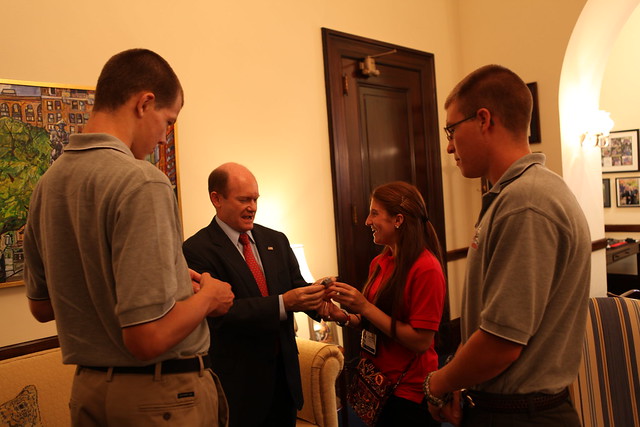
Senator Coons with studentsSenator Coons congratulated four Delaware American Legion Auxiliary Boys and Girls Nation leaders Thursday in Washington. The young leaders from the First State are Lael Houston, Rachel Defroda, Donald Wiegner and Christopher Clifton.


“I am always excited to meet our nation’s future leaders, and programs like Boys Nation and Girls Nation are terrific ways for the next generation to learn about our government,” Chris said. “These young men and women will develop essential leadership skills and cultivate strong bonds. This experience puts them on the road to success in their future endeavors.”

Lael Houston, of Dover High School, and Rachel Defroda, of Delaware Military Academy, were the two Delawarean women ‘Senators’ elected out of the 49 Girls State participants. Donald Wiegner, of Delaware Military Academy, and Christopher Clifton, of Sussex Technical High School JROTC, were elected out of 98 Boys State participants. 

The week-long immersion program held in the nation’s capital teaches ambitious young men and women about how the federal government works. Two participants per state, known as “Senators,” are chosen from the Boys and Girls State program. The men and women create a mock legislature where they run for office and elect a mock U.S. Boys or Girls Nation President. The students campaign for the passage of bills, participate in Senate sessions, and more. The highlight of the week includes field trips to monuments, meetings with state senators and representatives, and a visit to the White House.

Supporting innovation to fuel job creation

Senator Coons' Monthly column

The most important responsibility I have as your senator is to support job creation. Our economy is starting to recover, but there are still far too many Delawareans out of work. That is why we are continuing to host job fairs across the state, connecting job seekers with employers ready to hire, and working to help Delaware businesses access the capital they need to grow and create new jobs.

One of the keys to fueling American economic growth and ensuring we remain competitive in the global economy is putting in place policies that support and sustain innovation. American ingenuity has always been at the core of our economic success. From inventing the light bulb to perfecting the search engine, we have never lacked good ideas. The challenges of the global economy may be new, but America’s advantage – our entrepreneurs and innovators – remains the same. We just have to support their work so they can continue to grow and create jobs.

Over the last few months, I’ve partnered with Republicans and Democrats alike to introduce legislation that will support our most innovative companies – the ones with the highest job-creation potential.

Watching cable news, it would be easy to think the Senate is stuck in partisan gridlock, and to an extent, that is true. Yet there are also decent people of both parties who want to get things done, especially when it comes to our economy. To those of us in Delaware, that is the rule, rather than the exception, but unfortunately, Washington doesn’t always work the same way.

That is why I was so glad to find partners like Senator Marco Rubio from Florida and Senator Jerry Moran from Kansas. They are both conservative Republicans, but I’ve worked with them and Senator Mark Warner, a Democrat from Virginia, on a series of job-creation proposals we bundled together in a bill called the Startup Act 2.0.

The Startup Act 2.0 is designed to promote innovation and jumpstart the economy through the creation and growth of new businesses and jobs. It is based on research showing that for almost 30 years, companies less than five years old have created almost all the net new jobs in America – at an average of about three million new jobs a year. So we pulled together ideas that help bring university research from the lab to the marketplace, ideas that encourage investments in new startup companies and more in the hopes of creating an environment where entrepreneurs can succeed.

Our bill contains an array of job-creating measures for small businesses, such as exempting capital gains taxes on investments in startups, which the independent Kauffman Foundation tells us would unlock $7.5 billion of new investment. It also supports innovative small businesses with an expanded research and development tax credit, an idea Senator Rubio and I introduced together last fall as part of our bipartisan AGREE Act and something I will continue fighting to pass because it is critical for Delaware small business.

With the right resources, American products can be manufactured in Delaware and remain competitive in the global marketplace. It is happening every day across our state, at companies of all sizes, including Miller Metal in Bridgeville, a local shop that is going head-to-head with Chinese metal fabricators – and winning.

We have to continue to support this kind of entrepreneurship and innovation in all sectors of our economy, including in the energy sector. There is going to be a clean energy economy in the years ahead, the only question is whether American businesses, families and workers will be at the center or the periphery. If we want to stay competitive in the race for homegrown, affordable, renewable sources of energy, we have to make sure our financial innovation keeps up with our technological innovation.

That is why this spring, I introduced bipartisan legislation to level the playing field and make a tax credit that has long supported oil and gas projects available to renewable energy projects like wind, solar and biofuels. The bill I wrote with Senator Moran, the Master Limited Partnership Parity Act, could bring significant capital off the sidelines to give clean energy innovators and projects the critical private sector support they need to get their product to the marketplace.

The bottom line is that America’s researchers, business leaders, innovators and entrepreneurs are already working to help create jobs and ensure American competitiveness in the global economy. We just have to support and sustain their hard work, and we cannot take the rest of the year off just because there’s an election coming up. Even in this difficult, partisan atmosphere, we have to find ways to work together and get things done. Innovation will drive American economic competitiveness for generations to come, and our job is to help our innovators and entrepreneurs do their jobs.

What We’re Reading: Delaware swimmer goes to London

Flag for What We're Reading

The News Journal published an article on Tuesday about Andrew Gemmell, the 21-year-old Wilmington native who will represent the USA swim team in the 2012 London Olympics. Andrew, who is the sole Delaware native represented in the 2012 Olympics, will compete in the 1,500 freestyle qualifying heats on August 3. The top eight swimmers will comprise the field in the finals on August 4 at the London Aquatics Centre.

Delaware has not won an Olympic swimming gold since Dave Johnson earned two at Mexico City in 1968.

The Olympics promise to be the culmination of a life-long love affair with the water for the long-distance swimmer.

“I’ve been taking [swimming] lessons since I was 1 or 2,” he said. “My dad was a swimmer and he was sort-of coaching some and he just took me into lessons and I’ve been doing it ever since. He probably started coaching me as my primary coach at around 8 to 10, somewhere in that range.”

Nowadays, those training sessions include 20 hours per week in the water and four to five hours of weight training out of the pool. In all, Gemmell swims 8,000 meters/yards a day, six days a week.

That much training takes dedication and often also takes a team – and Gemmell has found that with his family.

Click here to read the full article on The News Journal’s website.

Video: Senator Coons calls for a balanced approach to deficit reduction

U.S. Senator Chris Coons (D-Del.) took to the Senate floor on July 25, 2012 to urge his Senate colleagues to stand together to vote for a tax proposal that will help create fairness in our nation’s tax code by extending the so-called “Bush tax cuts” and other tax breaks for the middle class and low-income families, while allowing income tax, dividend, and capital gains rates to rise on earnings greater than $250,000.

Come see us at the State Fair

If you go to the State Fair in Harrington before it wraps up on Saturday, we hope you’ll stop by the Delaware Building to see us!

Photo of Senator Coons greeting a constituent

Here are Grace and Megan, staff assistants in our Washington office, meeting a baby goat in the Kent Building at the Fair on Sunday!

Coons staffers with a goat at the State Fair

Senator Coons urges students to use new financial aid tools

The U.S. Department of Education announced on Friday a new streamlined website and social media tools that will make it easier for students and families to navigate the financial aid process and make informed decisions about paying for college. Senator Coons encouraged Delaware students and families to take advantage of these new tools, which are designed to be fully accessible on tablets and smartphones.

Included on the new website is an interactive tool to help borrowers who have fallen behind on their federal or private student loan payments. The tool provides tips to borrowers with private student loans on how to negotiate with debt collectors.

Students now have more online options to learn about financial aid, including on Facebook, YouTube and Twitter.

Chris has been a longtime advocate for college accessibility. Earlier this year, he introduced the American Dream Accounts Act to help increase the number of low-income students able to access and complete a college education. The bill would authorize the Department of Education to award three-year competitive grants to support innovative and comprehensive partnerships that support low-income students in preparation for a college education.

Click here to learn more about Chris’ work on improving America’s education system. 

Senator Coons calls for research on pancreatic cancer

As a strong advocate for science-based research, Senator Coons this week joined a bipartisan group of 56 Senators – more than half the Senate – to urge quick action on legislation to combat pancreatic cancer.  The group came together to sign a letter urging their colleagues to move forward on the Pancreatic Cancer Research & Education Act, which would require the National Institutes of Health to lead a strategic plan to address this disease.

Pancreatic cancer is the fourth leading cause of cancer death in the United States and will strike 43,000 Americans this year, 74 percent of whom will die within a year of diagnosis.

The letter, addressed to the Chairman and Ranking Member of the Health, Education, Labor, and Pensions Committee, stated that pancreatic cancer is “unique biologically and requires focused research. Because pancreatic cancer is one of the most scientifically-complicate cancers, the advances we make in understanding the disease may have spillover effects in understanding treatments and cures for other cancers.”

The proposed pancreatic cancer legislation follows in the footsteps of other legislative actions to eradicate other pernicious diseases, such as Alzheimer’s, breast cancer, autism, diabetes, and HIV/AIDS. The legislation would “provide a critical tool for making progress in this terrible disease,” but the strategic plan would not compel the NIH, Centers for Disease Control (CDC), or National Cancer Institute (NCI) to allocate taxpayer dollars for disease specific research. Rather, funds would be allocated “on a peer-reviewed basis.”

During a Democratic Steering Committee meeting this week, Chris engaged leaders of the biomedical research community, including NIH Director Francis Collins, in a dialogue on biotech research and what Congressional action would best facilitate academic research. The panel of experts, which included two Delawareans, unanimously agreed that greater government funding will spur economic growth. Dr. Collins also pointed out that every dollar of NIH funding yields a return of $2.25 in the first year alone.