Related Issues

Related Issues

Carper, Coons vote in favor of bipartisan emergency security funding bill

WASHINGTON – Today, U.S. Senators Tom Carper and Chris Coons (both D-Del.) voted to advance bipartisan emergency security funding to address the impacts of the January 6th insurrection and the COVID-19 pandemic. The bill will also support the hundreds of Delaware National Guard members who traveled to protect the Capitol in the wake of the January 6th attack, and reimburse Delaware law enforcement for costs incurred protecting the president-elect prior to Inauguration Day. 

“On January 6th, our Capitol was attacked and desecrated in one of the darkest days in our nation’s history. In the wake of the assault on our democracy, we in Congress have a moral obligation to take care of the brave men and women who serve in our Capitol Police force,” said Senator Carper. “I’m proud that the Senate could come together today to pass this critical legislation that helps ensure the Capitol Police can safely continue to do their jobs and supports the extraordinary members of the Delaware National Guard who courageously protected our Capitol and our democracy.”

“We owe the brave men and women of the Capitol Police and National Guard, including many Delawareans, a debt of gratitude for their efforts to keep us safe following the events of January 6. I’m pleased that, in a bipartisan vote, the Senate has advanced critical funding for security in the Capitol complex, as well as money to help the National Guard and the Capitol Police recoup costs for their important work,” said Senator Coons. “I was also pleased to work with my colleagues on the Senate Appropriations Committee to ensure that Delaware law enforcement receive reimbursement for their costs to protect the President during the transition period. I’m proud to support these much-needed investments, and I look forward to this legislation being signed into law.”

The $2.1 billion supplemental includes:

·       $521 million to reimburse the National Guard;

·       $1.1 million to reimburse Delaware law enforcement for security services provided to then President-elect Biden between the election and inauguration;

·       $70.7 million for Capitol Police to support overtime, more officers, hazard pay, and retention bonuses for the Capitol Police;

·       $35.4 for the Capitol Police for mutual aid agreements with local, state, and federal law enforcement for securing the Capitol;

·       $300 million to secure the Capitol complex;

·       $42.1 million to respond to the COVID pandemic on the Capitol complex;

·       $1.125 billion for Afghan refugee assistance; and

·       8,000 new Afghan Special Immigrant Visas with new reforms to improve program efficiency.

A summary of the bill can be found here.

###


Sen. Coons votes to advance bipartisan infrastructure deal

WASHINGTON — Yesterday, U.S. Senator Chris Coons (D-Del.), a member of the group of 22 senators that has been negotiating bipartisan infrastructure legislation, announced that a deal has been reached among key Republican and Democratic lawmakers on a $550 billion infrastructure package. Senator Coons voted to advance the proposal last night, which will start the formal process of debating the bill.

Senator Coons issued the following joint statement with Senators Richard Burr (R-N.C.), Bill Cassidy (R-La.), Susan Collins (R-Maine), Dick Durbin (D-Ill.), Lindsey Graham (R-S.C.), Maggie Hassan (D-N.H.), John Hickenlooper (D-Colo.), Mark Kelly (D-Ariz.), Angus King (I-Maine), Joe Manchin (D-W.Va.), Lisa Murkowski (R-Alaska), Rob Portman (R-Ohio), Mitt Romney (R-Utah), Jacky Rosen (D-Nev.), Mike Rounds (R-S.D.), Jeanne Shaheen (D-N.H.), Kyrsten Sinema (D-Ariz.), Jon Tester (D-Mont.), Thom Tillis (R-N.C.), and Mark Warner (D-Va.): 

“We are proud to announce we have reached a bipartisan agreement on our proposal to make the strongest investment in America’s critical infrastructure in a generation. Our plan will create good-paying jobs in communities across our country without raising taxes. Reaching this agreement was no easy task—but our constituents expect us to put in the hard work and show that two parties can still work together to address the needs of the American people. We appreciate our colleagues on both sides of the aisle, and the administration, working with us to get this done and we look forward to earning broad, bipartisan support among our Senate colleagues for this historic legislation.”

The bipartisan infrastructure package will support high-paying jobs, vital projects, and connectivity in Delaware and across the country. Major investments include:

  • Roads and Bridges: The bill invests $110 billion of new funds for roads, bridges, and major projects. This investment will repair and rebuild our roads and bridges with a focus on climate change mitigation, resilience, equity, and safety for all users, including cyclists and pedestrians.
  • Rail: The bill makes the largest investment in passenger rail since Amtrak’s creation. $22 million would be provided as grants to Amtrak, $24 billion as federal-state partnership grants for Northeast Corridor (NEC) modernization, $12 billion for partnership grants for intercity rail service, $5 billion for rail improvement and safety grants, and $3 billion for grade crossing safety improvements. This funding will allow service providers on the NEC, including Amtrak, to make necessary capital investments. The NEC is one of the busiest and most complex rail lines in the world and runs through Wilmington, Delaware. The state-of-good-repair backlog in the NEC has climbed to over $40 billion, and Amtrak and other infrastructure owners lack the long-term funding to address it. Senator Coons has been leading an effort in the Senate to address this issue.
  • Ferries: The bill includes $2.5 billion for ferries, of which $1.25 billion is for the Federal Transit Administration’s Passenger Ferry Grant program and $250 million is for a new electric and hybrid ferry pilot program to reduce emissions. Delaware’s ferry system, run by the Delaware River Bay Authority, connects Lewes to Cape May, New Jersey.
  • Transit: The bill provides more than $39 billion to modernize our nation’s transit system and make public transportation more accessible.
  • Clean Energy: The bill invests $73 billion in our nation’s energy infrastructure, including modernizations to our electric grid and Senators Coons’ and Cassidy’s Storing CO2 And Lowering Emissions (SCALE) Act to support the buildout of CO2 transport and storage infrastructure. As the nation’s first comprehensive CO2 infrastructure bill, it would drive deployment of carbon capture, utilization, and storage (CCUS) technology and create thousands of jobs.
  • Clean water and pollution remediation: The bill directs $55 billion for clean drinking water, including significant funding to address PFAS and lead contamination. The bill also includes $21 billion for environmental remediation, including funds to clean up Superfund and Brownfield sites. 
  • Climate resilience: The bill invests $46 billion for environmental resilience, including $26 million for the Delaware River Basin Restoration Program, $238 million for the EPA Chesapeake Bay Program, and $200 million for the NOAA Marine Debris Program.
  • Broadband: The bill makes an historic investment of $65 billion to connect every American, including those in rural areas of Delaware, to high-speed internet.
  • Ports and airports: The bill includes $17 billion for port infrastructure and $25 billion for airports to reduce congestion and emissions and address maintenance backlogs
  • School buses: The bill delivers $5 billion for electric and low-carbon school buses, to reduce exposure to emissions for students in Delaware and around the country.
  • Reconnecting communities: The bill provides $1 billion for a new program to reconnect communities divided by the interstate highway system and other transportation infrastructure, as called for in the Reconnecting Communities Act, which Senator Coons cosponsored. This would help fund projects like a highway cap on I-95 in Wilmington.

###

Sens. Coons, Young introduce JUDGES Act to authorize new district court judgeships

WASHINGTON – U.S. Senators Chris Coons (D-Del.) and Todd Young (R-Ind.) introduced legislation this week to address the shortage of judicial resources in districts across the United States. Federal courts across the country are experiencing significant case backlogs as the result of a lack of federal judges. In March, the Judicial Conference of the United States, a nonpartisan policy-making body for federal courts, recommended that Congress create 77 new district court judgeships to help alleviate this access-to-justice crisis. The Judicial Understaffing Delays Getting Emergencies Solved (JUDGES) Act would act on this report and increase the number of federal district judges in the most overworked regions of the country.

“Lower courts across the country, including in Delaware, are struggling to keep up with growing caseloads,” said Senator Coons. “Congress has a constitutional responsibility to ensure that the federal judiciary is able to give every litigant their day in court and that the justice system is accessible to all. For too long, Congress has failed to act to enable the proper functioning of our courts, and I am proud to work in a bipartisan fashion to address this access-to-justice crisis.”

“The current judicial emergency is hindering Hoosiers’ opportunity to have their day in court due to an overload of cases and a shortage of judges. This is a serious problem that has only escalated throughout the pandemic,” said Senator Young. “My bipartisan bill will help ensure all Americans can receive a timely day in federal court in the overworked regions of the country.”

The last comprehensive authorization of new judgeships occurred in 1990, which established 11 additional circuit court judgeships and 74 district court judgeships across America. Since then, smaller legislative proposals were enacted between 1999 and 2003 that created 34 additional district court judgeships. However, it has been nearly 20 years since Congress last authorized additional district judgeships, the longest time the Congress has gone without creating a new district court judgeship since 1789.

“Countless Americans seeking their day in court badly need Congress to authorize more judgeships to handle burgeoning caseloads. But for decades, lawmakers have either ignored this access-to-justice crisis or offered bills that would plainly benefit one party over another,” said Gabe Roth, Executive Director of Fix the Court. “Thankfully, today’s legislation from Sens. Coons and Young demonstrates that leaders in both parties can find a solution that will dramatically improve access to the courtroom and help to address judicial emergencies across the country.”

Bill text is available here

###

Coons, Cornyn, Durbin, Tillis introduce commonsense, bipartisan bill to expand federal expungement

WASHINGTON – Today, U.S. Senators Chris Coons (D-Del.), John Cornyn (R-Texas), Dick Durbin (D-Ill.), and Thom Tillis (R-N.C.) introduced bipartisan legislation to expand the eligibility for expungement of a first-time simple federal drug possession offense. Under 18 U.S.C. § 3607, expungement is currently available to first-time drug users meeting certain requirements, but only if the individual is under the age of 21. The Kenneth P. Thompson Begin Again Act would remove this age requirement, allowing judges to give more low-level drug offenders a second chance. Criminal records create significant barriers to finding work, housing and access to education, which are key for individuals to make a new start and avoid subsequent criminal activity. Companion legislation was introduced in the U.S. House by Representatives Hakeem Jeffries (D-N.Y.) and Van Taylor (R-Texas).

“No one should be defined by a single one of their mistakes. No matter their age, first-time drug offenders deserve a second chance to pursue a productive life without the burden of a criminal record,” said Senator Coons. “I’m proud to introduce this legislation that will provide a path forward for Americans across the country to turn their lives around and give back to their communities, and I’m grateful to my colleagues on both sides of the aisle for their support.”

“Part of criminal justice reform is ensuring that rehabilitated individuals are able to move on with their lives and get a second chance,” said Senator Cornyn. “Those who successfully complete court-imposed probation for low-level possession should be able to have their records cleared, and this legislation would do just that.”

“When we saddle low-level, first-time drug offenders with a criminal record, our criminal justice system feeds the cycle of recidivism and distress that harms our communities. Formerly incarcerated individuals should have an opportunity to learn from their mistakes and turn toward a brighter,” said Senator Durbin. “Kenneth Thompson was a district attorney who saw the value in a second chance. I’m proud to join my colleagues in continuing that legacy by helping returning citizens begin again.”

“First-time, non-violent drug possession offenses should not impede the ability for individuals who have reformed themselves to find jobs, housing, and education their whole lives,” said Senator Tillis. “I am proud to co-introduce the bipartisan legislation that would remove the age restriction for expungement so we can give non-violent, productive members of our community a second chance at a successful life.”

“Prosecutors across the country continue to support reasonable approaches to criminal justice reform that build trust between law enforcement and the communities they serve. Meaningful second chances are vital to the successful reentry of individuals into communities and the bipartisan Kenneth P. Thompson Begin Again Act strikes the right balance between public safety and expanding common sense expungement measures,” said Nelson Bunn, the Executive Director of the National District Attorneys Association.

“Under current law, an individual can have a federal simple possession offense expunged from their record if they meet stringent criteria and were 21 or younger at the time of the offense. However, when looking at the criteria as a whole, it becomes clear that this age limit is an arbitrary cutoff. The Begin Again Act will address this shortcoming by removing the age requirement currently in statute. The MCCA thanks Sen. Cornyn and Sen. Coons for their continued dedication to making our criminal justice system fairer and more equitable,” said Chief Art Acevedo, Chief of the Miami Police Department and President of the Major Cities Chiefs Association.

“NACDL proudly supports the Kenneth P. Thompson Begin Again Act,” said Martín Antonio Sabelli, President of the National Association of Criminal Defense Lawyers. “Individuals and families should not have their lives destroyed by nonviolent, low-level, first-time, simple possession offenses especially after successful completion of court probation. Offering a chance for a clean slate makes sense and will keep families together, allow people to contribute to society, and strengthen communities, many of which have been overpoliced.”

“For far too many Americans and their families, a first-time, non-violent drug offense creates irrevocable barriers that are nearly impossible to overcome—making it hard to find and hold down a job, put a roof over their heads, or become an active community member. The Begin Again Act is an important step toward overcoming those barriers and providing deserving individuals with a second chance at life. Americans for Prosperity applauds Senators Coons and Cornyn for carrying forth Representatives Jeffries and Van Taylor’s Begin Again Act into the Senate. Our activists across the country look forward to encouraging their Senators to support this meaningful step toward real second chances,” said Mark Holden, Board Chairman of Americans for Prosperity.

The text of the bill is available here. The Kenneth P. Thompson Begin Again Act is supported by the American Civil Liberties Union, Americans for Prosperity, Association of Prosecuting Attorneys, Due Process Institute, Fair and Just Prosecution, National District Attorneys Association, Major Cities Chiefs Association, FreedomWorks, Justice Action Network, Law Enforcement Action Partnership, Law Enforcement Leaders to Reduce Crime & Incarceration, National Association of Criminal Defense Lawyers, Prison Fellowship, and the Safer Foundation.

###

Senate unanimously passes Coons resolution supporting Team USA at 2020 Tokyo Olympics

WASHINGTON – The Senate unanimously passed a resolution introduced by U.S. Senators Chris Coons (D-Del.), Mitt Romney (R-Utah), Michael Bennet (D-Colo.), Bill Hagerty (R-Tenn.), and Amy Klobuchar (D-Minn.) commemorating the past success of the United States Olympic and Paralympic teams and showing support for Team USA in the 2020 Olympic Games and Paralympic Games in Tokyo, Japan. The 2020 Summer Games were delayed for a year because of the coronavirus pandemic. 

“For over a century, the Olympic Movement has strengthened the ties of the international community by bringing athletes from all over the world together to showcase their talents and forge lasting bonds,” said Senator Coons. “I applaud the Japanese government for its perseverance in committing tremendous resources to build a safe and secure environment despite the immense challenges of the COVID-19 pandemic. I look forward to cheering our exceptional athletes from Delaware and all of Team USA on to victory!”

Delaware will be well-represented at the 2020 Tokyo Olympic and Paralympic Games.  The roster of Delawareans heading to Tokyo for the games includes:

  • Justin Best, Newport Rowing Club and Drexel University alumnus – U.S. Olympic Rowing Team
  • Marquis Dendy, Middletown High School and University of Florida alumnus – U.S. Olympic Track & Field Team
  • Valerie Allman, Newark native and Stanford University alumna – U.S. Olympic Track & Field Team
  • Kieran Tuntivate, Charter School of Wilmington and Harvard University alumnus – Thailand Olympic Track & Field Team
  • Michaela Meyer, University of Delaware alumna – alternate for U.S. Olympic Track & Field Team
  • Maggie Giddens, Tower Hill School and Michigan State University alumna, 2001 Delaware Field Hockey Player of the Year – referee for Olympic Field Hockey

The full text of the resolution can be found here and below:

Whereas, for 125 years, the Olympic Movement has worked to build a better and more peaceful world by educating young people through amateur athletics, bringing together athletes from many countries in friendly competition, and forging new relationships bound by friendship, solidarity, and fair play;  

Whereas the 2020 Olympic Games will take place in Tokyo, Japan, from July 23, 2021, to August 8, 2021, and the 2020 Paralympic Games will take place in Tokyo, Japan, from August 24, 2021, to September 5, 2021;

Whereas, at the 2020 Olympic Games, 206 countries will compete in more than 330 events in nearly 40 disciplines, and at the 2020 Paralympic Games, more than 165 countries will compete in events in 22 disciplines;

Whereas the United States Olympic and Paralympic Teams have won 1,974 gold medals, 1,685 silver medals, and 1,536 bronze medals, totaling 5,195 medals, during the past Olympic and Paralympic Games;

Whereas the United States plans to send 613 athletes to participate in the 2020 Olympic and Paralympic Games, including a record 329 women;

Whereas the people of the United States stand united in respect for and admiration of the members of the United States Olympic and Paralympic Teams and the athletic accomplishments, sportsmanship, and dedication to excellence of the United States Olympic and Paralympic Teams;

Whereas the many accomplishments of the United States Olympic and Paralympic Teams would not have been possible without the hard work and dedication of many others, including individuals on the United States Olympic and Paralympic Committee and the National Governing Bodies of Sport and the many administrators, coaches, and family members who provided critical support to the athletes;

Whereas the United States Government is grateful to Japan for hosting the 2020 Olympic and Paralympic Games;

Whereas Japan successfully hosted the 1964 Tokyo Olympics, the first ever Olympic Games to be held in Asia, as a symbol of Japanese postwar reconstruction and a catalyst for economic growth and technological development;

Whereas Japan successfully hosted the 1972 Winter Olympics in Sapporo and the 1998 Winter Olympics in Nagano;

Whereas the people of the United States take great pride in the qualities of commitment to excellence, grace under pressure, and goodwill toward competitors exhibited by the athletes of the United States Olympic and Paralympic Teams; 

and

Whereas the Olympic Movement celebrates competition, fair play, and the pursuit of glory, elevating the eternal qualities of the human spirit to the world stage:  

Now, therefore, be it

Resolved, That the Senate –     

(1) supports proceeding with the 2020 Olympic and Paralympic Games in a safe and secure environment;

(2) commends the Government of Japan and the Tokyo Metropolitan Government in their efforts to commit tremendous resources to provide a safe and secure environment for the athletes competing in the 2020 Olympic and Paralympic Games;

(3) applauds the athletes and coaches of the United States Olympic and Paralympic Teams and their families who support them;

(4) supports the athletes of the United States Olympic and Paralympic Teams in their endeavors at the 2020 Olympic and Paralympic Games held in Tokyo, Japan; and

(5) supports the goals and ideals of the Olympic Games and Paralympic Games.

###

Sen. Coons, Rep. Kilmer introduce legislation to spur economic growth & create jobs

WASHINGTON – Today, U.S. Senator Chris Coons (D-Del.) and U.S. Representatives Derek Kilmer (D-Wash.) and Jaime Herrera Beutler (R-Wash.), along with Senators Amy Klobuchar (D-Minn.), Michael Bennet (D-Colo.), and Jacky Rosen (D-Nev.), introduced the bipartisan Rebuilding Economies and Creating Opportunities for More People Everywhere to Excel Act (RECOMPETE Act). The RECOMPETE Act would establish a new federal grant program at the Economic Development Agency (EDA) that would empower persistently distressed communities to develop, implement, and carry out 10-year economic development strategies and create jobs.

Distressed communities, as identified by the W. E. Upjohn Institute for Employment Research, are home to almost one-sixth of the U.S. population and have an employment rate among workers ages 25 to 54 that is significantly below the national average. The Upjohn Institute’s analysis suggests that these communities have largely been left out of the investment, wealth, innovation, and opportunity that has instead been concentrated in a handful of major metro areas in recent decades. 

The RECOMPETE Act would provide eligible local labor markets, local communities, and Tribal governments with flexible 10-year RECOMPETE Grants from the EDA in an effort to meet a variety of local economic development needs. Grants could be used for infrastructure investments, brownfield redevelopment, workforce development, small business assistance, resources to connect residents to opportunities, and other investments to help communities rebuild.

“Time and again, economic crises in America have highlighted inequities across our communities. In order to successfully rebuild after the COVID-19 pandemic, we should address the root causes of economic distress,” said Senator Coons. “I’m proud to partner with Representative Kilmer in introducing this ambitious legislation that will target the most distressed communities with job opportunities, business investment, and resources for long-term economic growth. I look forward to working with my colleagues in the House and Senate to move this legislation forward, so that our recovery lifts up every American regardless of where they live.”

“I grew up in Port Angeles and was in high school right around the time the timber industry took it on the chin. I saw a lot of my friends’ parents lose their jobs. It had a big impact on me – and I’ve spent most of my adult life trying to figure out how to make sure we are doing a better job of protecting workers and communities so that no one gets left behind in our society and economy,” said Representative Kilmer. “That’s why I’ve worked with Senator Coons and Rep. Herrera Beutler to introduce the bipartisan RECOMPETE Act – a bold proposal to provide flexible, long-term grant assistance to create jobs and lay the foundation for long-term economic growth and opportunity. This is about ensuring people have economic opportunity – regardless of what zip code they live in.”

“The COVID-19 crisis has only exacerbated existing economic inequities and opportunity gaps in our country,” said Senator Bennet. “Our RECOMPETE Act will give communities that were already hurting prior to the pandemic – due to industry loss or other factors – access to flexible funds to recover, rebuild, and rectify long-standing inequities. Washington should empower local leaders to make decisions about how to invest in their communities because they know them best.”

“As we round the corner of this pandemic, we must help communities boost their local economies,” said Senator Klobuchar. “This legislation will do just that by providing key resources to create jobs and support businesses and entrepreneurship. By meeting the needs of communities hit hardest by the coronavirus, we aren’t only investing in pandemic recovery – we’re investing in future generations.”

The RECOMPETE Act is endorsed by the National League of Cities, the Information Technology and Innovation Foundation, Third Way, the Progressive Policy Institute, and the Federal Issues Committee of the Washington State Association of Counties.

“Through the Economic Development Agency, the RECOMPETE Act would give municipalities access to flexible grants to meet economic development needs, create good jobs, invest in their workforce, and connect residents to opportunities within persistently distressed communities,” said Clarence Anthony, CEO & Executive Director of the National League of Cities (NLC) in a letter supporting the RECOMPETE Act. “This bill recognizes the overall need to invest in America’s workforce and the differing needs within each community. By maintaining flexibility and local control, city leaders in persistently distressed communities can tailor workforce investments to properly prepare their residents to work in critical industries within the local economy. NLC is committed to realizing equitable solutions, and the RECOMPETE Act prioritizes investment where it is needed most.”

“Over the last 40 years, federal support to help lagging regions and communities rebound has been declining. Moreover, current efforts are often too little, too late to make a real difference for communities. The RECOMPETE Act would address these shortcomings by providing flexible long-term assistance to help persistently distressed labor markets, and the workers there, get back on their feet,” said Robert D. Atkinson, Ph. D., President of the Information Technology and Innovation Foundation. “The United States can no longer afford to write off whole communities. The RECOMPETE Act is an important step in reversing this trend.”

“As America builds back from COVID, we need a bold agenda that focuses on creating jobs in every zip code in the country. And we must make sure those jobs lead to prosperity and a good life,” said Gabe Horwitz, Senior Vice President for the Economic Program at Third Way. “Rep. Derek Kilmer’s leadership on these issues and his latest legislation should be applauded. His new federal block grant program would truly help persistently distressed communities—giving them flexible tools to invest in job growth, workers, and economic opportunity. We hope policymakers join his effort and this innovative idea becomes law.”

“The Washington State Association of Counties’ Federal Issues Committee agreed unanimously to support this innovative legislation. The block grant approach would empower historically distressed communities to craft targeted solutions to address the unique economic challenges within their communities. This legislation would move past the usual one-sized-fits-all approach that doesn’t reflect the uniqueness of our respective economies,” said Robert Gelder, Kitsap County Commissioner and federal issues committee chair for the Washington State Association of Counties.

A summary of the bill can be found here.

Bill text can be found here.

###

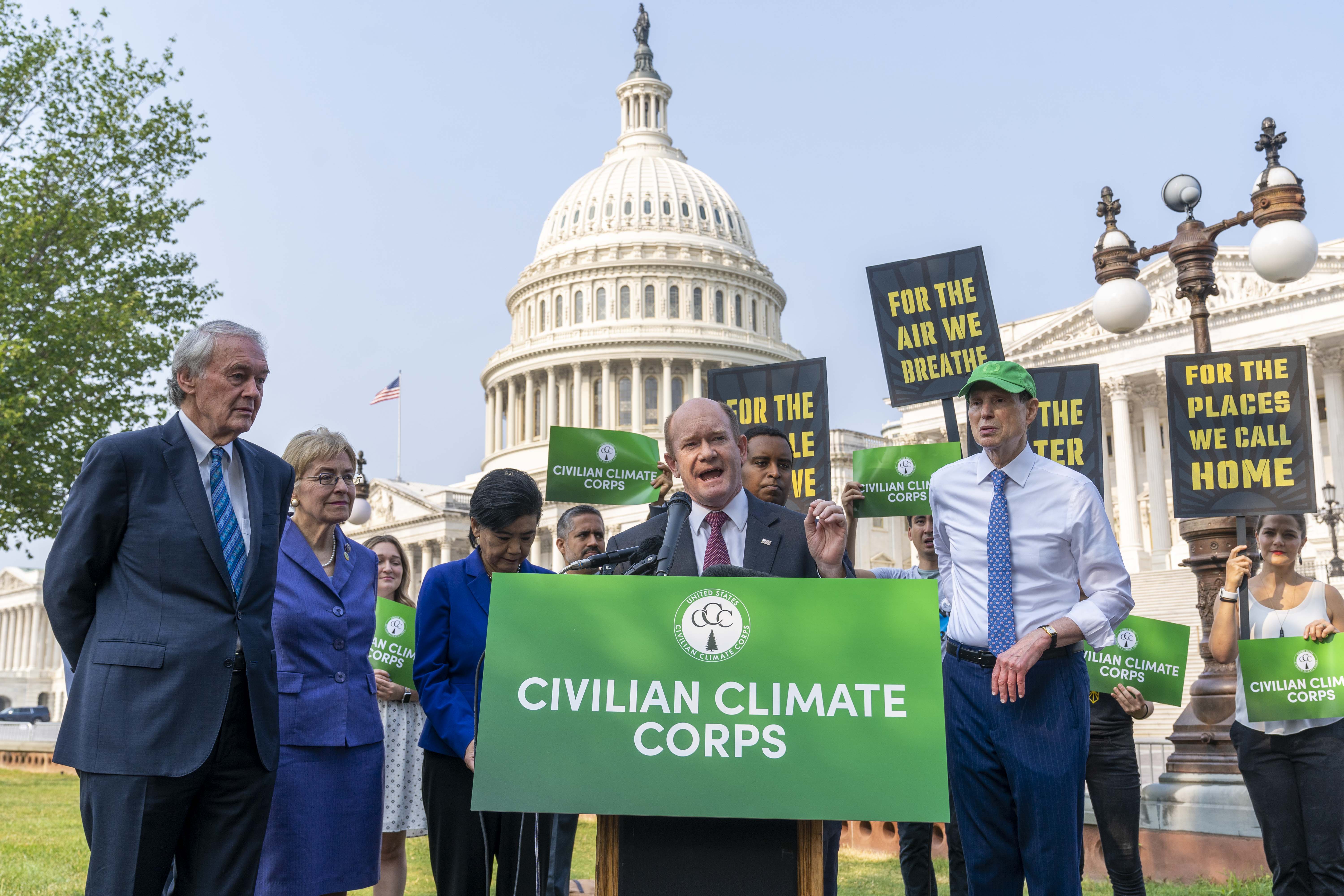
[PHOTOS | VIDEO] Senator Coons, colleagues urge inclusion of Civilian Climate Corps in jobs package

Photo_18

U.S. Senator Chris Coons (D-Del.), co-chair of the bipartisan Senate Climate Solutions Caucus, speaks at a press conference with bicameral leaders about the importance of including a CCC in the reconciliation package in Washington, D.C., July 20, 2021. (Photo courtesy of Senate Democratic Media Center/released). Download photos and video here.

WASHINGTON – U.S. Senator Chris Coons (D-Del.), co-chair of the bipartisan Senate Climate Solutions Caucus, joined bicameral leaders yesterday to urge the inclusion of a Civilian Climate Corps in the final budget reconciliation package being considered in the Senate.

Senator Coons spoke alongside Senators Ron Wyden (D-Ore.) and Ed Markey (D-Mass.) and Representatives Joe Neguse (D-Colo.), Judy Chu (D-Calif.), Alexandria Ocasio-Cortez (D-N.Y.), and Marcy Kaptur (D-Ohio) to outline their unified vision to create a Civilian Climate Corps that puts people to work on the most important issues facing our nation today. AmeriCorps, which already has a robust existing network across the country and experience tackling the full range of climate challenges – from conservation and mitigation to disaster response, would play a central role in its implementation. 

“This is a tried, true, and tested model that helped our country get out of the Great Depression married up with a program that has helped us over the last 25 years bring Americans together in service to our country,” Senator Coons said during his speech.

“When we harness that to the generational challenge of combating climate change,” he continued, “we can make a truly transformational difference for a generation of Americans, and for our country, and for our future. I am so excited to work with my colleagues on bringing this vision into reality.”

In a letter to House and Senate leadership, Senator Coons and his colleagues asked for several key components to be included in the Civilian Climate Corps (CCC), including its implementation through programs including AmeriCorps, which Senator Coons has long championed.

To download video, photos, and a transcript of the senator’s remarks, click this link.

###

Coons, Hagerty resolution marking 10 years since the earthquake and tsunami in Japan passes Senate

WASHINGTON — A resolution authored by U.S. Senators Bill Hagerty (R-Tenn.), former U.S. Ambassador to Japan, and Chris Coons (D-Del.), both members of the Senate Foreign Relations Committee, that marks 10-years since the March 11, 2011 earthquake and tsunami in Japan has passed the Senate unanimously. 

The resolution mourns the loss of life, sends condolences to the families of the victims, expresses commitment to the survivors, and commends the Japanese government’s ongoing revitalization efforts.

Full text of the resolution can be found here and below.

Expressing the sense of the Senate relating to the 10th anniversary of the March 11, 2011, earthquake and tsunami in Japan. 

Whereas, at 2:46 p.m. on March 11, 2011, an earthquake initially reported as measuring 8.9 on the Richter scale, the strongest recorded in more than 100 years in Japan, occurred near the Tohoku region of Northeast Japan, 81 miles off the coast from Sendai City;  

Whereas intense shaking could be felt from Tokyo to Kamaishi, an arc of roughly 360 miles;

Whereas the earthquake generated a massive tsunami that caused widespread damage to a swath of the northeast Japanese coastline and traveled across the Pacific Ocean, causing damage to coastal communities as far away as the States of Hawaii, Oregon, and California; 

Whereas authorities in Japan confirm at least 15,899 deaths from the earthquake and resulting tsunami;

Whereas, within minutes of the earthquake, the National Oceanic and Atmospheric Administration alerted emergency workers in the States of Hawaii, California, Oregon, Washington, and Alaska that a potentially catastrophic tsunami was heading toward those States and mobilized the Tsunami Warning System in the Pacific; 

Whereas the earthquake forced the emergency shutdown of 4 nuclear power facilities in Japan, representing a significant loss of electric generation capacity for Japan and necessitating rolling blackouts in portions of Tokyo; 

Whereas the earthquake and the resulting tsunami severely damaged the Fukushima Daiichi nuclear power station, precipitating a loss of power for cooling systems at that facility and necessitating emergency measures to prevent serious radiation leakages; 

Whereas international response to the disaster was swift, with search and rescue teams arriving from the United States, the United Kingdom, Australia, New Zealand, France, and China, among other countries; 

Whereas the USS Ronald Reagan aircraft carrier and its support vessels were deployed to the earthquake region to participate in search and rescue and relief operations;

Whereas elements of the III Marine Expeditionary Force (MEF), a United States Agency for International Development Disaster Assistance Response Team (DART), and other United States military and civilian personnel were deployed to Japan to render aid and help coordinate United States relief efforts;

Whereas the United States-Japan alliance is based upon shared values, democratic ideals, free markets, and a mutual respect for human rights, individual liberties, and the rule of law, and is central to the security and prosperity of the entire Indo-Pacific region; 

Whereas the Self-Defense Forces of Japan have contributed broadly to global security missions, including relief operations following the tsunami in Indonesia in 2005, reconstruction in Iraq from 2004 to 2006, and relief assistance following the earthquake in Haiti in 2010; 

Whereas Japan is among the most generous donor nations, providing billions of dollars of foreign assistance, including disaster relief, annually to developing countries; 

Whereas, since 2011, Japan has committed tremendous resources and effort to decommission the Fukushima Daiichi nuclear power station by taking measures on contaminated water and extracting fuel; 

Whereas, since 2011, Japan has committed tremendous resources and effort to restore the environment in Fukushima Prefecture, in collaboration with the International Atomic Energy Agency, to ensure that citizens can live with peace of mind with safe water and food; and  

Whereas, 10 years after the earthquake and resulting tsunami, Japan is seeking to host a successful Olympics in Tokyo where the best athletes from across the world can showcase their talents amidst the ongoing global COVID– 19 pandemic: Now, therefore, be it 

Resolved, That the Senate—  

(1) mourns the loss of life resulting from the earthquake and tsunami in Japan on March 11, 2011;

(2) expresses its deepest condolences to the families of the victims of the tragedy;

(3) expresses its sympathies to the survivors who are still suffering in the aftermath of the natural disaster;

(4) commends the Government of Japan for its courageous and professional response to the natural disaster; and

(5) supports the efforts already underway by the United States Government, relief agencies, and private citizens to assist the Government and people of Japan with the revitalization efforts in Fukushima Prefectures.

###

80+ Senate and House Democrats urge inclusion of Civilian Climate Corps in final reconciliation deal

WASHINGTON — Today, U.S. Senators Chris Coons (D-Del.), Ron Wyden (D-Ore.), and Ed Markey (D-Mass.), and U.S. Representatives Joe Neguse (D-Colo.), Alexandria-Ocasio Cortez (D-N.Y.), Judy Chu (D-Calif.), Marcy Kaptur (D-Ohio), Bobby Rush (D-Ill.) led a letter signed by over 80 lawmakers urging inclusion of the Civilian Climate Corps in the final budget reconciliation deal. Initial reporting of the Senate’s framework for a deal notes general support for the concept, but the final funding and details will be agreed upon in the coming weeks.

The group of bicameral leaders, who have been advocating for creation of a Civilian Climate Corps for several months and years, laid out their joint vision on goals, labor standards and structure of the program in a letter to House and Senate leadership today. While each of the legislators have previously introduced their own bills outlining a vision for the Civilian Climate Corps, this is the first time the coalition is coming together to agree upon their priorities.

Coons and the bicameral group held a press conference this morning at the U.S. Capitol. Click here for full video. 

The letter asks that the Civilian Climate Corps: 

  • Prioritize projects that invest in natural climate solutions, clean energy, and climate resilience, and which address environmental justice; 
  • Sets ambitious labor standards, including by providing a living wage, robust education awards, full healthcare coverage and support for childcare, housing, transportation and education; 
  • Invests in equitable and diverse Corps membership by recruiting from frontline environmental justice communities and offering opportunities for DACA recipients, DED and TPS holders, refugees and asylees and veterans; 
  • Is implemented through AmeriCorps and other national, state and local service organizations to build on and scale up existing infrastructure;
  • Includes robust funding for the many programs and activities in which Corps members will engage including at the Departments of Interior, Agriculture, Commerce, and others, to provide the needed workforce for federal programs to fulfill their full potential to mitigate climate impacts; and
  • Follows the lead of local communities. 

“Establishing a Civilian Climate Corps will advance equity and environmental justice while putting people to work on the most important issues facing our nation today,” said Senator Coons. “I’m glad my colleagues in this bicameral group have worked with me to prioritize the inclusion of a Civilian Climate Corps in the final reconciliation bill. The unified vision we have laid out here will pave the way for making national service, job creation, and climate resilience key components of the jobs package moving forward.”

“Right now, my state has the sad honor of having the largest wildfire currently burning nationwide. I’m tired of watching my state burn. I’m tired of Oregonians losing everything in one devastating wildfire season after another,” said Senator Wyden. “A Civilian Climate Corps is urgently needed to get ahead of the very real and immediate impacts of the climate crisis hitting communities in Oregon and across the country. We all agree: let’s create good-paying jobs with good benefits and put people to work to make our communities safer and more climate resilient.”  

“It’s time for us to pass a bold and equitable Civilian Climate Corps to reinvent, reimagine, and rebuild America. With a robust investment in wages, worker benefits, and climate-smart projects, we can center jobs and justice within the vision of a safer, healthier future and put a diverse group of well-paid workers on the pathway to life-long careers in the clean energy economy,” said Senator Markey. 

“In the face of multiple challenges that our communities in Colorado are facing: unemployment, catastrophic wildfires and climate change, creation of a Civilian Climate Corps will bring in essential resources to put Coloradans back to work, restore our lands and our communities,” said Representative Neguse. “As Chair of the Subcommittee on National Parks, Forests and Public Lands, I’m excited to bring this innovative proposal before my Subcommittee today. We have a historic opportunity to make bold investments in our public lands, clean energy and climate resiliency, all while creating good-paying jobs, building a diverse workforce and strengthening career pathways. The urgency of this moment recalls past chapters of national mobilization, and in standing up the Civilian Climate Corps, we will build on that legacy and existing infrastructure to meet the challenges of today.”

The full text of the letter is available here.

The letter is signed by Senators Chris Coons, Ron Wyden, Ed Markey, Michael Bennet, Richard Blumenthal, Cory Booker, Ben Cardin, Bob Casey, Richard Durbin, Dianne Feinstein, Kirsten Gillibrand, Martin Heinrich, Mazie Hirono, Patrick Leahy, Ben Ray Luján, Jeff Merkley, Alex Padilla, Chris Van Hollen, and Elizabeth Warren, and Representatives Joe Neguse, Judy Chu, Alexandria Ocasio-Cortez, Marcy Kaptur, Bobby Rush, Nanette Barragán, Earl Blumenauer, Lisa Blunt Rochester, Jamaal Bowman, Brendan Boyle, Julia Brownley, André Carson, Troy Carter, Kathy Castor, Yvette Clarke, Emanuel Cleaver, Steve Cohen, Gerald Connolly, Madeleine Dean, Peter DeFazio, Diana DeGette, Mark DeSaulnier, Lloyd Doggett, Michael Doyle, Veronica Escobar, Ruben Gallego, Jesús García, Raúl Grijalva, Jared Huffman, Pramila Jayapal, Mondaire Jones, Kaiali’i Kahele, Ro Khanna, John Larson, Barbara Lee, Teresa Leger Fernandez, Ted Lieu, Alan Lowenthal, Tom Malinowski, Carolyn Maloney, Betty McCollum, Grace Meng, Marie Newman, Eleanor Norton, Jimmy Panetta, Mark Pocan, Katie Porter, Ayanna Pressley, Mike Quigley, Jamie Raskin, John Sarbanes, Janice Schakowsky, Darren Soto, Melanie Stansbury, Thomas Suozzi, Mark Takano, Mike Thompson, Dina Titus, Rashida Tlaib, Paul Tonko, Debbie Wasserman Schultz, Peter Welch, Nikema Williams, Frederica Wilson. 

The letter is endorsed by over 45 local, state and national organizations, including Environmental Defense Fund, Rocky Mountain Conservancy, Defend Our Future, League of Conservation Voters, The Wilderness Society, Sunrise Movement, Earthjustice, The Corps Network, Service Year Alliance, America’s Service Commissions, States for Service Coalition, Outdoor Afro, The Nature Conservancy, Conservation Lands Foundation, Continental Divide Trail Coalition , Conservation Colorado, Sierra Club, National Parks Conservation Association, National Recreation and Park Association, American Forests, SkyDay, Choose Outdoors, SOS Outreach, National League of Cities, Courage California, Student Conservation Association, Continental Divide Trail Coalition, Protect Our Winters, Inclusion Outdoors, Better Wyoming, The Educator, Collective for Environmental Justice, Defiende Nuestra Tierra, 10 Billion Strong, Natural Resources Defense Council, Association for Environmental & Outdoor Education, Friends of, Organ Mountains-Desert Peaks, Rising Routes, Children & Nature Network, Sierra Club, Outdoors Alliance for Kids, Outdoor Afro, Connecticut Forest & Park Association, REI Co-op, The Trust for Public Land, Pacific Crest Trail Association, Washington Trails Association, North American Association for Environmental Education.

Quotes of support are available here.

###
Sen. Coons, Rep. Peters introduce legislation to support U.S. workers and international climate cooperation

WASHINGTON — Today, U.S. Senator Chris Coons (D-Del.), co-chair of the bipartisan Senate Climate Solutions Caucus and a member of the Senate Foreign Relations Committee, and U.S. Representative Scott Peters (D-Calif.), a member of the House Energy and Commerce Committee, unveiled new legislation to establish a border carbon adjustment (BCA) on polluting imports. Imposing a BCA will protect U.S. jobs, reduce global emissions, and drive resilience in frontline communities.

A BCA is a trade tool that levels the field for domestic manufacturers by imposing a fee on carbon-intensive products when they reach the border. This will incentivize investments in cleaner technologies and account for the cost of complying with U.S. laws and regulations on greenhouse gas emissions. The BCA will also provide a flexible framework for more ambitious climate policy to come.

“International cooperation will be critical to reaching net-zero emissions, and I applaud the Biden administration’s reengagement with our partners around the world to address climate change,” said Senator Coons. “We have an historic opportunity to demonstrate that climate policy goes hand in hand with providing economic opportunities as U.S. innovators develop and scale clean energy technologies. The FAIR Transition and Competition Act will complement our efforts to reduce emissions at home, ensure the United States is at the table for reframing trade around climate, and provide resources to support vulnerable communities and energy innovation as we build back better.”  

“I reject the idea that we should weaken our environmental standards to compete with other nations. The U.S. will remain a global economic leader by raising our ambition to meet the historic moment—to address climate change, to create millions of good-paying jobs, and to reduce economic inequality—not by lowering our standards and defying our responsibility to be a leader in providing safe, clean, and reliable energy,” said Representative Peters. “The FAIR Transition and Competition Act will facilitate a race to the top among U.S. companies to produce the next generation of clean energy and technology. The move would ensure we remain a key player in international cooperation on climate action and show the world that the U.S. is fully committed to addressing the climate crisis at home and abroad.”

“To ensure that our clean energy future is Made in America, we need a level playing field for American manufacturers who operate some of the least polluting facilities in the world,” said Collin O’Mara, President and CEO of the National Wildlife Federation. “Senator Coons and Representative Peters’ visionary legislation will recognize the climate leadership of American companies, while holding foreign polluters accountable, which is essential to creating good paying manufacturing jobs at home and tackling the 20% of emissions from the industrial sector around the globe.”

“Climate change is a global issue, and policies that create a level global playing field—and ensure that emissions reductions in one country aren’t erased by increases elsewhere—are critical.  On a level playing field an economy-wide price on carbon could seize an opportunity to harness market forces to unleash American innovation to reduce emissions, create clean energy jobs and usher in a new, prosperous economic era. We commend Sen. Coons and Rep. Peters for advancing the discussion on a key component of a carbon pricing framework, and look forward to evaluating this and other proposals as part of an effort to establish a comprehensive, market-based, economy-wide approach for emissions reductions,” said members of the CEO Climate Dialogue—a broad-based coalition of 27 leading businesses and institutions representing sectors across the U.S. economy — oil and gas, utilities, agriculture and food, automotive, chemicals, manufacturing, financial services, and environmental advocacy — united in their recognition of the economic, health, and environmental risks posed by climate change.

“The members of the American Sustainable Business Council are leaders when it comes to taking action on climate change.  As we move towards complete decarbonization of our economy, their efforts should be rewarded not penalized. The FAIR Transition and Competition Act guarantees that American businesses are not undercut by polluting industries beyond our borders,” said David Levine, Co-founder and President of ASBC. “By leveling the playing field, we will be able to invest back into communities that have historically carried the burden of environmental injustice with new workforce development programs and innovation breakthroughs. By working with the international community and our private sector, we will be able to rise to the moment and tackle the climate crisis.” 

“Global problems require global solutions. This is why Citizens’ Climate Lobby is excited to see the introduction of the Fair, Affordable, Innovative, and Resilient Transition and Competition Act introduced by Senator Coons and Representative Peters,” said Dr. Danny Richter, Vice President for Government Affairs at the Citizens’ Climate Lobby. “The introduction of this bill speeds up the global discussion about accountability for polluters regardless of where they are located. Polluters should pay, but they should not have to pay twice for the same pollution. This bill is particularly well timed with the release of details to the EU’s carbon border adjustment mechanism. The prospect of the two largest economies in the world demanding accountability for carbon pollution at the same time should be a cause of celebration for climate advocates everywhere. Important details with respect to the WTO still need to be resolved, but there can be no doubt that this is a positive contribution to the climate discussion.”

“State and local governments need investments to increase community resilience to climate coastal hazards. In coastal communities, sea level rise and increased coastal storm intensity and related storm surge are causing coastal flooding and inundation and exacerbating erosion,” said Derek Brockbank, Executive Director of the Coastal States Organization. “Additionally, underserved and disadvantaged communities are particularly hard hit by these increasing climate induced coastal hazards. The Resilient Communities Grant Program would provide coastal communities with critical resources necessary to prepare for, and adapt to, increasing climate induced hazards.”

“As countries advance increasingly ambitious climate policies, they invariably hit a stumbling block: the risk that domestic manufacturing will relocate to countries with weaker or no climate policies,” said Dr. Michael Mehling, Deputy Director of the Center for Energy and Environmental Policy Research (CEEPR) at the Massachusetts Institute of Technology (MIT). “The FAIR Transition and Competition Act can help preempt such concerns by introducing a border carbon adjustment that ensures emissions will not simply be outsourced and occur elsewhere.”

The FAIR Transition and Competition Act of 2021 will protect U.S. jobs, reduce reliance on foreign energy sources, and drive climate innovation and community resilience domestically by:

  • Recognizing the costs incurred by U.S. companies in producing cleaner products due to emissions-related laws and regulations;
  • Accounting for those costs by levying a fee on imports in carbon-intensive, trade-exposed sectors;
  • Supporting international climate cooperation and the reframing of trade around climate;
  • Directing revenue to the development and commercialization of high-impact emissions reductions technologies; and
  • Creating a new Resilient Communities Grant Program for states to support climate adaptation, transition assistance, and the communities facing the most severe impacts of climate change and historic pollution.

Bill text is available here. A one-pager is available here.

###