Related Issues

Related Issues

Senator Coons hosts Senate Agriculture Committee Ranking Member Boozman for Farm Bill tour of Delaware

DOVER, Del. – On Friday, U.S. Senator Chris Coons (D-Del.) hosted U.S. Senator John Boozman (R-Ark.), Ranking Member of the Senate Agriculture, Nutrition & Forestry Committee, for a listening tour of several agricultural sites in Delaware and a pair of roundtable discussions with farming and conservation stakeholders as discussions over the Farm Bill reauthorization continue.

While Senator Boozman has been holding similar Farm Bill listening tours throughout the country, Senator Coons is the first Senate Democrat not on the Senate Agriculture Committee to host Senator Boozman for such a tour. Throughout the day, the pair joined Delaware Secretary of Agriculture Michael T. Scuse for stops at the Puglisi Egg Laying Facility Farm in Middletown, the Delaware Agriculture Museum in Dover, and Bombay Hook National Wildlife Refuge in Smyrna. They listened to farmers, conservationists, and environmental stakeholders at roundtable discussions in both Dover and Smyrna.

The goal of the visit was to promote and receive feedback on the upcoming Farm Bill, legislation Senator Boozman is helping to negotiate alongside Senate Agriculture Committee Chair Debbie Stabenow (D-Mich.). The bill sets agriculture, nutrition, conservation, and forestry policy every five years and is up for reauthorization in 2023.

The tour also provided an opportunity for Senator Coons to discuss his Healthy Poultry Assistance and Indemnification Act with Senator Boozman. The bill will expand the safety net and compensation program for poultry growers and layers whose flocks are hit with highly pathogenic avian influenza  (HPAI) to all poultry growers and layer operations within an HPAI control area. Senator Coons hopes to include the legislation as an amendment to the upcoming Farm Bill. Senator Coons is co-Chair and Senator Boozman is a member of the bipartisan Senate Chicken Caucus.

“From our broiler chicken and egg farms to specialty crops like lima beans and watermelons, agriculture is the First State’s number one industry, and we have a long history of conserving our resources for future generations,” said Senator Coons. “Thank you, Senator Boozman, for coming to meet Delaware farmers and growers, and for your leadership with Senator Stabenow in crafting a new Farm Bill that will benefit our states and our nation.”

“I appreciate the invitation from Senator Coons to visit with stakeholders in Delaware and hear from them directly about what we need to include in the Farm Bill. Senator Coons and I have a history of working closely together on these issues as senior members of the Appropriations Committee and through other ag-related entities like the Senate Chicken Caucus. I know firsthand what a committed advocate he is for Delaware’s farmers, growers, and conservationists,” said Senator Boozman. “Senator Coons brought an excellent group of stakeholders together to help us learn how their experiences can help shape this critical legislation in a bipartisan fashion. We left with valuable input to consider as we work to better support the agriculture community.”

“We are privileged to have the ranking member of the United States Senate Agriculture Committee visit Delaware and to listen to what those in the agricultural sector had to say about current programs in the Farm Bill and the need for additional assistance in the next Farm Bill going forward,” said Secretary Scuse. “I want to thank Senator Coons for making this happen and having Senator Boozman visit us because it is due to his efforts that this was made possible.”

“As a private non-profit organization representing Delmarva’s largest and most important industry, it is appropriate that the Delaware Agricultural Museum be the setting for a conversation between legislators and farmers on the proposed Farm Bill,” said Carolyn Claypoole, Executive Director of the Delaware Agricultural Museum. “This conversation is unique in today’s world, representing bipartisan support for multi-year trillion-dollar legislation that recognizes the fact that a vibrant agricultural industry benefits all Americans.”


farm tour boozmanimage002

Click here for photos from the day’s eventsFor additional photos, click here to visit the Delaware Department of Agriculture’s Flickr page.
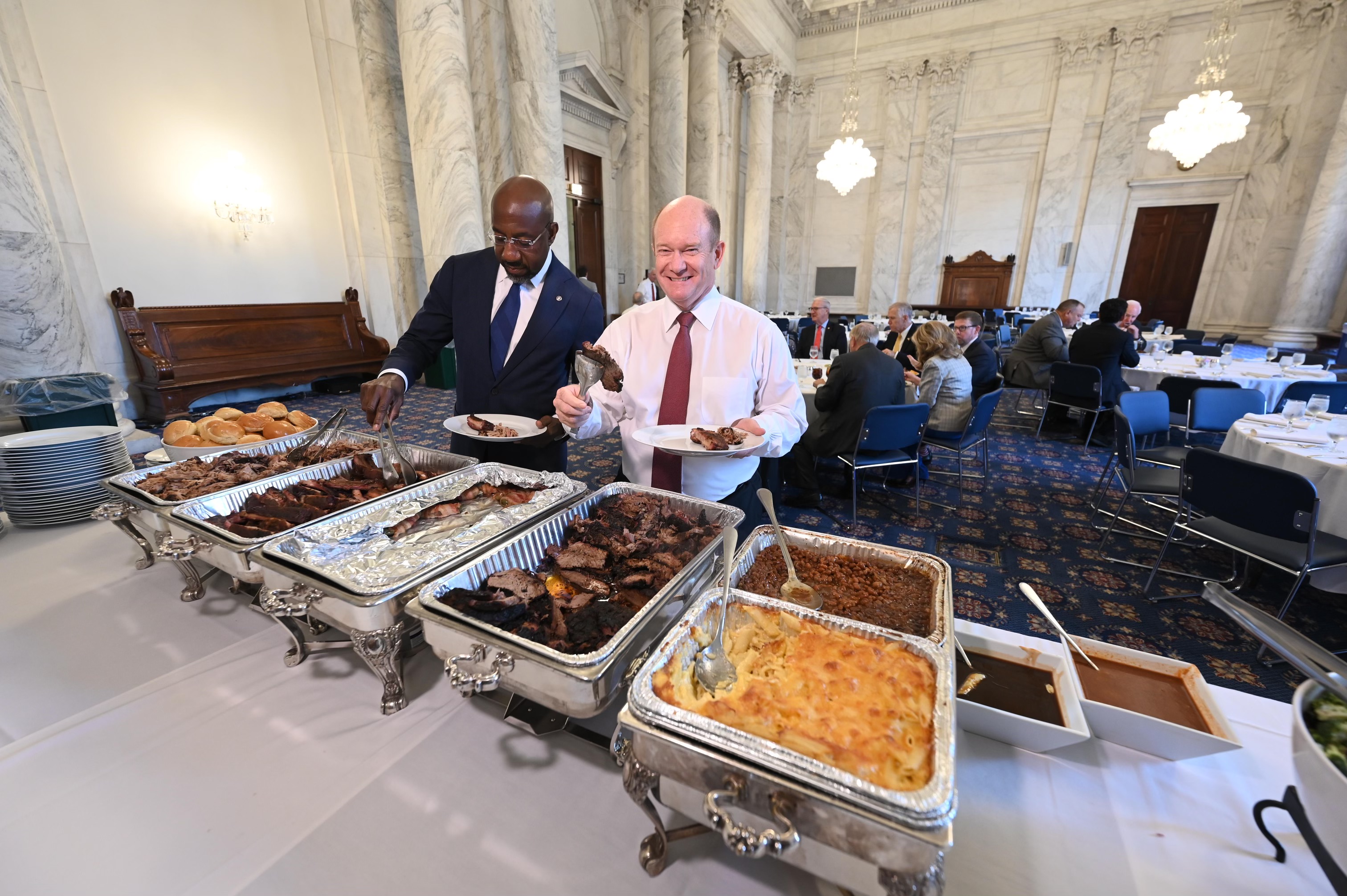
Senators Coons, Graham, Warnock, Tillis continue tradition of bipartisan Senate BBQ

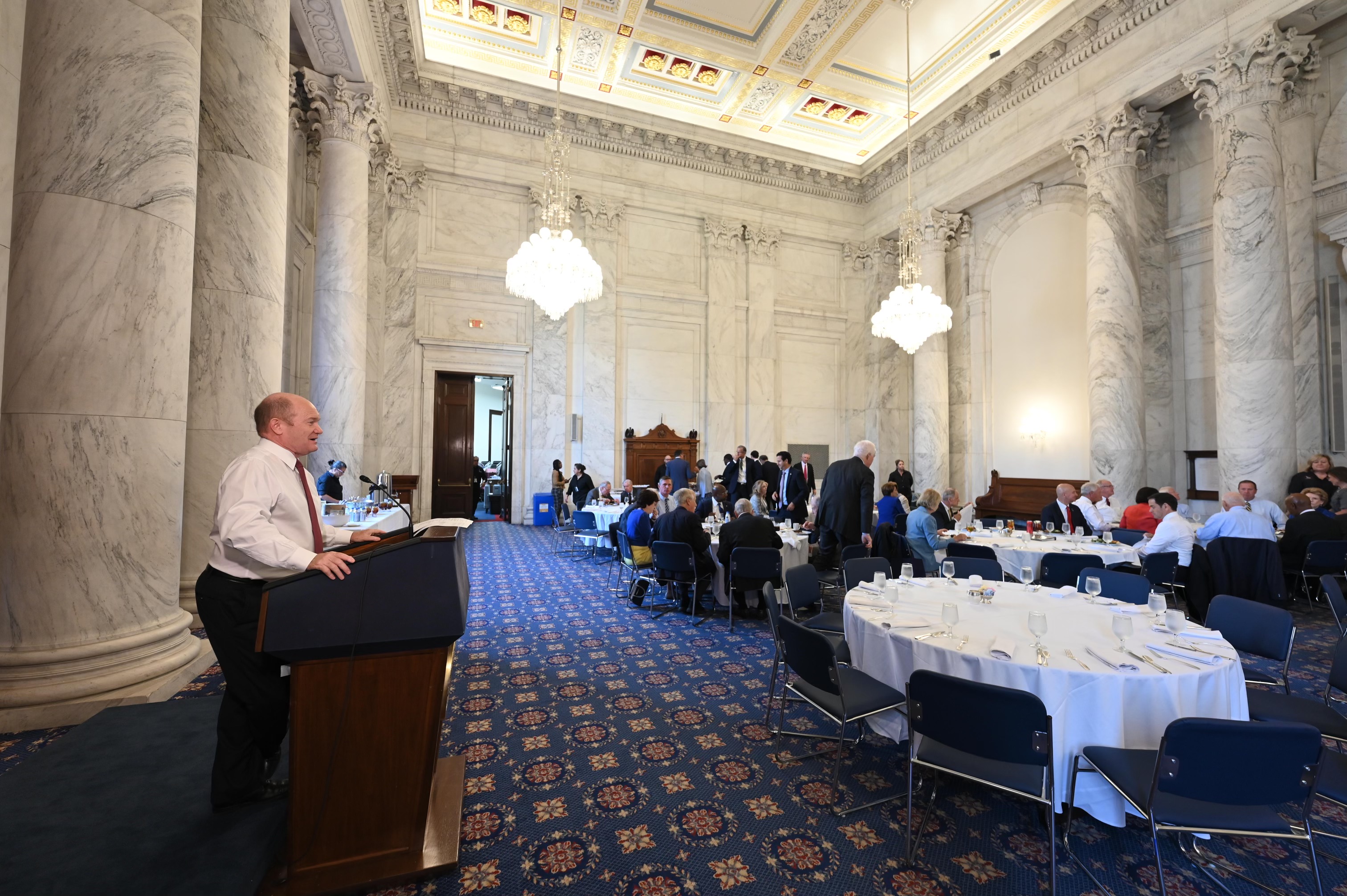
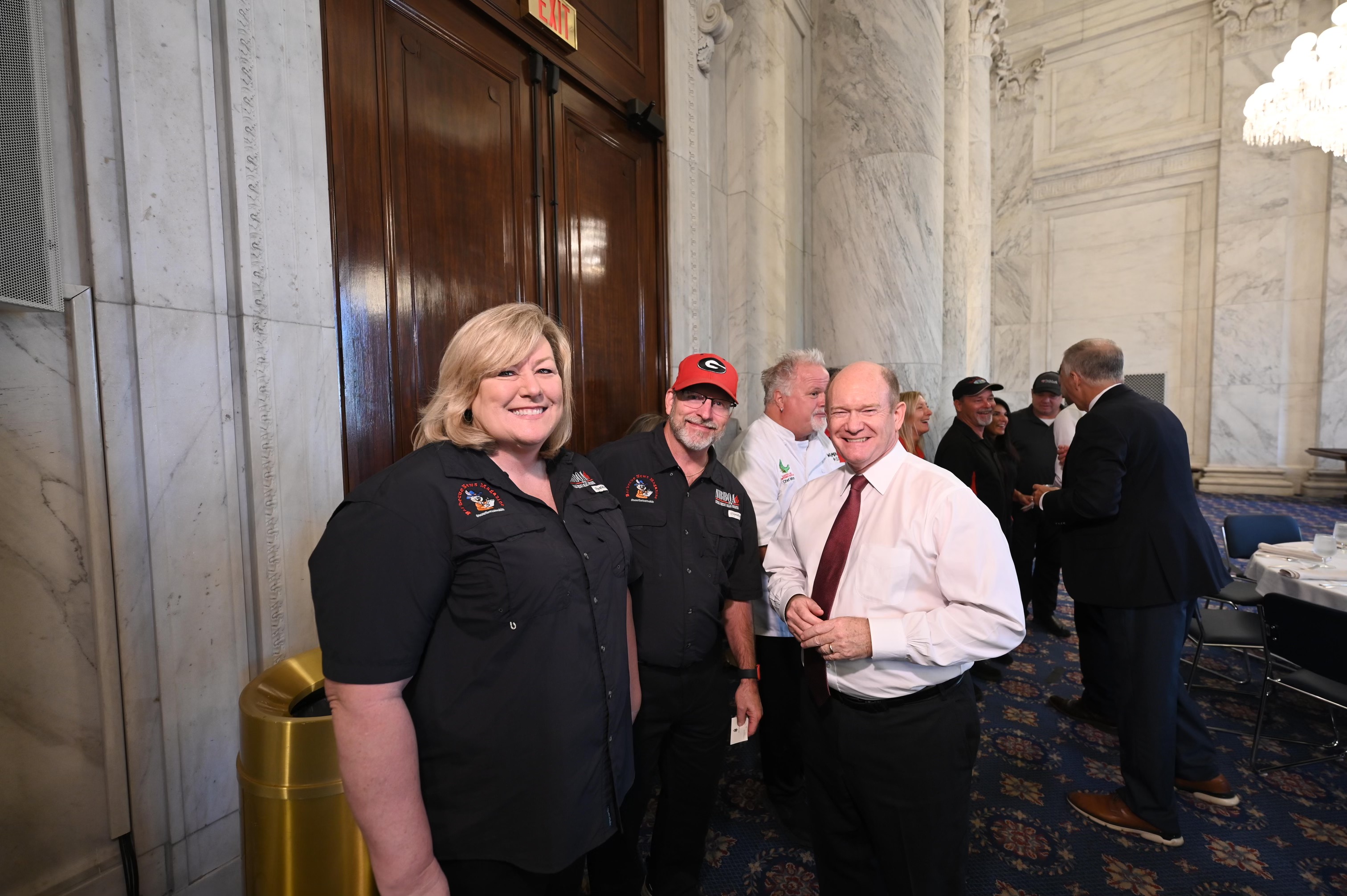
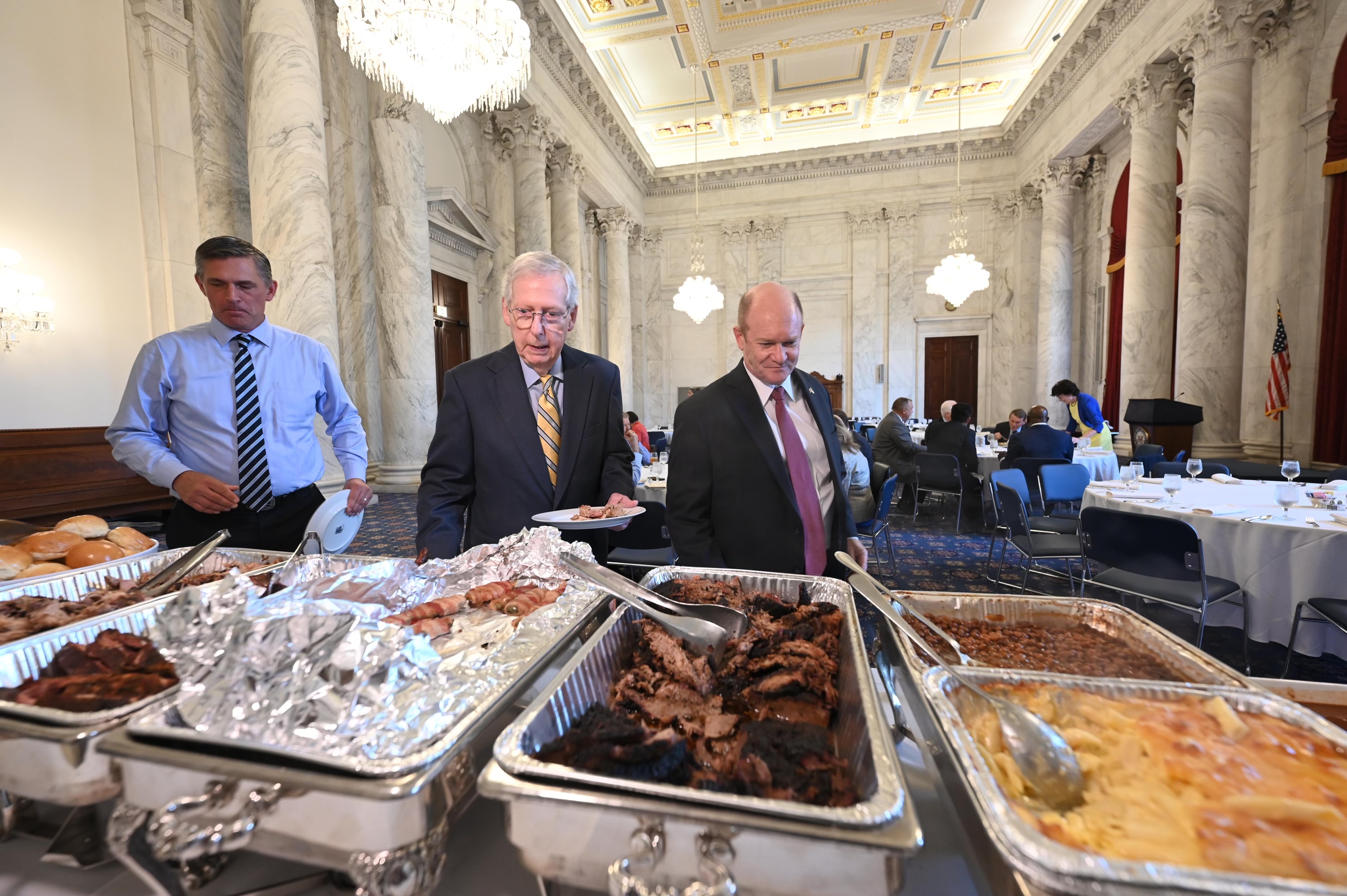
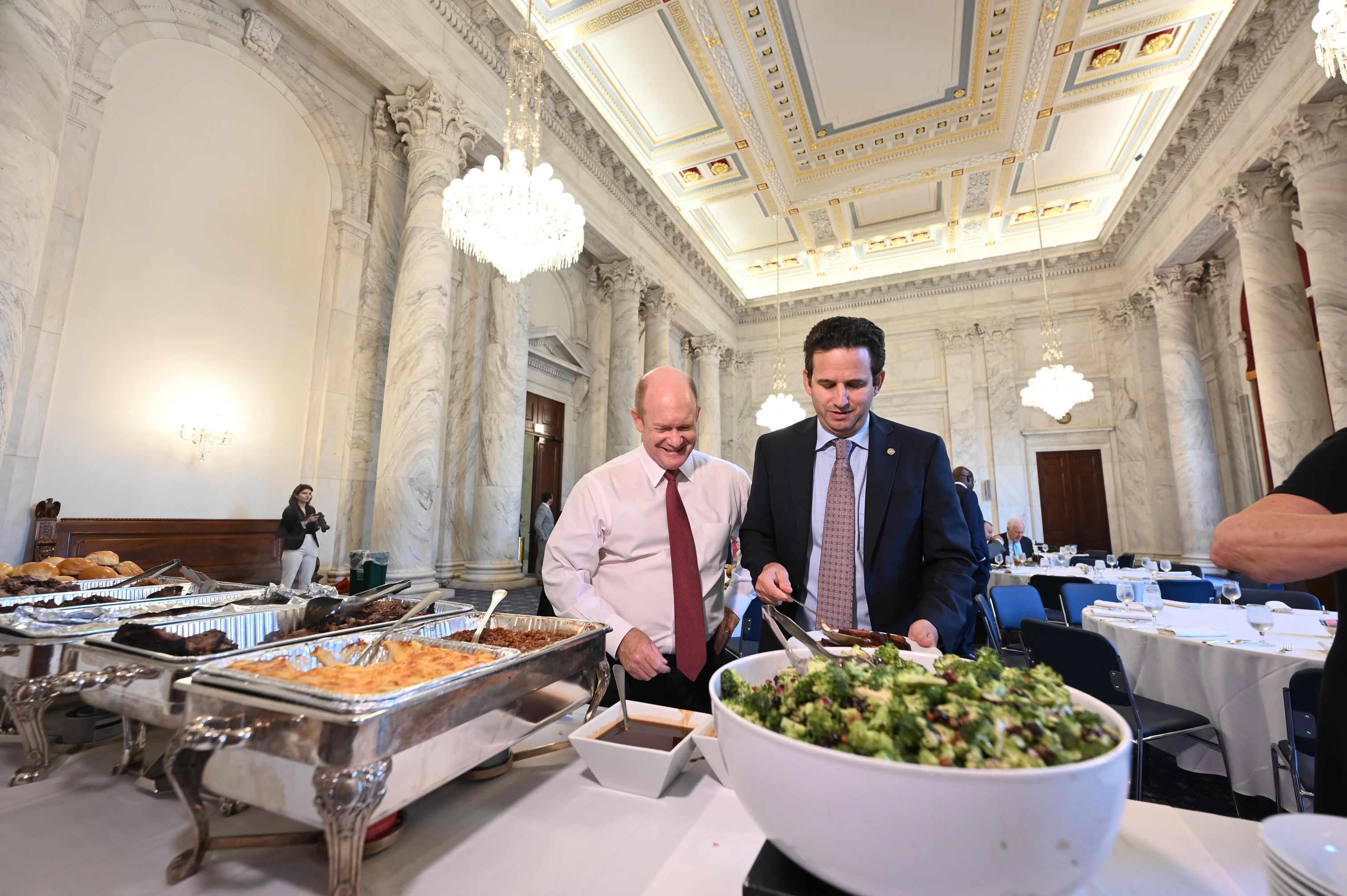
WASHINGTON — U.S. Senators Chris Coons (D-Del.), Lindsey Graham (R-S.C.), Raphael Warnock (D-Ga.), and Thom Tillis (R-N.C.) cohosted the 14th annual bipartisan Senate Barbecue luncheon this afternoon, a lunch that brings together senators from both parties to break bread together and spark bipartisan conversations.

Once per year—in place of the regularly scheduled Democratic and Republican caucus lunches—Senator Johnny Isakson (R-Ga.), who served in the Senate from 2005 to 2019, brought together Democrats and Republicans to enjoy barbecue from his home state. Today, the meal is the only lunch each year where senators of both parties are scheduled to eat together. Today’s event represents a continuation of this tradition with barbecue provided by pitmasters from South 40 Smokehouse in Marietta, Georgia, Bub-Ba-Q in Woodstock and Jasper, Georgia, the Salty Mule in Canton, Georgia, and Wegman’s Bayou Louisiana Kitchen in Roswell, Georgia.

“Senator Isakson was a dear friend and mentor of mine who helped instill the value of building relationships with colleagues from across the aisle,” said Senator Coons. “He had a simple goal in mind when he started this lunch—to encourage senators to break bread with someone they didn’t know and to have a conversation they hadn’t had before. I’m proud to partner with Senators Warnock, Graham, and Tillis this year to follow in Johnny’s footsteps and help my colleagues realize that if they agree on barbecue, they may agree on some of the issues facing our nation, too.”

“I am thrilled to join Senator Coons and my colleagues across the aisle in continuing this bipartisan tradition uplifting the legacy of the late Senator Johnny Isakson,” said Senator Warnock. “Johnny represented the best of Georgia, and I was honored to call him a friend. It is in his spirit of servitude that I will continue to break bread with my colleagues and renew our efforts to work together to better Georgia and our nation. And it never hurts doing so over some good old fashioned southern barbecue.”

“I’m excited to continue the Johnny Isakson tradition of having a bipartisan barbeque with Senators Coons, Warnock, and Tillis,” said Senator Graham. “Our country is very divided, and Congress is no different. However, being from the great state of South Carolina, I understand the magic of BBQ is unlimited. This is a start to helping heal a fractured Congress and honoring the legacy of our great colleague, Senator Isakson.”

“I’m proud to help continue Senator Isakson’s legacy of bipartisanship by co-hosting this year’s annual bipartisan lunch,” said Senator Tillis. “It’s important for the success of our nation for our elected leaders to be able to set aside their political differences and come together, even if it’s to share a good meal. I look forward to continuing this great tradition and fostering conversation and friendship with my fellow senators.”

JS6_7620

JS6_7706

JS6_7722

JS6_7657

JS6_7601


More pictures of the event are available here.

Senators Coons, Moran and Reps. Pingree, Lawler unveil NO TIME TO Waste Act to combat American food loss and waste

WASHINGTON – U.S. Senators Chris Coons (D-Del.) and Jerry Moran (R-Kan.) and Representatives Chellie Pingree (D-Maine) and Mike Lawler (R-N.Y.) today introduced the New Opportunities for Technological Innovation, Mitigation, and Education To Overcome Waste or NO TIME TO Waste Act, a bipartisan, bicameral bill that would reduce food loss and waste in the United States. Cutting down on food waste will increase food security, foster productivity, promote resource and energy conservation, and address climate change.

“Food waste and hunger harm more than 34 million Americans and disproportionately impact rural communities in Delaware and across our nation,” said Senator Coons. “My bipartisan NO TIME TO Waste Act strengthens collaborative efforts between federal agencies, supports public-private partnerships, and raises public awareness about the impact of food loss. By addressing food loss and waste, we can improve children’s health, fight malnutrition, and even protect our environment without putting more strain on family farms across the country.”

“Kansas is the breadbasket of the country, helping feed the nation and the world,” said Senator Moran. “However, nearly 40 percent of food produced in the U.S. goes to waste while millions of Americans suffer from hunger. This legislation would require collaboration between agencies to help cut food waste and support partnerships to feed those in need.” 

“It’s estimated that 30-40 percent of the entire United States food supply is discarded every year. This is bad for the environment, extremely costly, and is a lost opportunity to help feed the millions of Americans who are food insecure,” said Representative Pingree. “To combat food waste and hunger, we need whole-of-government action. The NO TIME TO Waste Act would strengthen the federal government’s approach to food loss by tackling waste in every step of our food system—from prevention research and education to composting and donation programs.”

“Each year, around 40 percent of all food produced in the United States is lost or wasted despite the fact that more than 34 million Americans, including 9 million children, go hungry. When it comes to combating hunger, there is no time to waste. That’s why I’m proud to join Congresswoman Pingree and Senators Coons and Moran in introducing the bicameral, bipartisan NO TIME TO Waste Act. This commonsense legislation will help cut food loss and waste through federal coordination, research, innovation, and education. This bill is an important step to eliminating food waste and hunger, goals that we all share, regardless of politics,”said Representative Lawler.

Every year, around 40 percent of all food produced in the United States is lost or wasted – a total of 119 billion pounds of food. Meanwhile, more than 34 million Americans, including 9 million children, are food insecure, often in rural communities that struggle to cope with widespread hunger. In the United States, food is the single largest category of material placed in municipal landfills, generating methane gas as it decomposes, a greenhouse gas approximately twenty-five percent more potent than carbon dioxide. As a result, the United States committed in the 2018 Farm Bill to cut food loss and waste (FLW) in half by the year 2030 through the U.S. 2030 Food Loss and Waste Reduction Goal, the first-ever domestic goal to reduce FLW.

The NO TIME TO Waste Act would: 

  • Strengthen federal agency coordination: The bill authorizes the existence of collaboration between the USDA, EPA, and FDA to reduce FLWby 50 percent by 2030.
  • Establish an Office of Food Loss and Waste at USDA: The Office will support the role of the Food Loss and Waste Liaison, strengthen research on FLW and new technologies, and quantify the impact of current FLW policies on greenhouse gas emissions.
  • Foster a FLW prevention and reduction environment in the United States: The bill supports public-private partnerships that commit to reducing FLW, strengthens current USDA research programs to include FLW as part of their priorities, and provides support to states to assist local food recovery infrastructure and coordination efforts.
  • Start a public awareness and education campaign in the United States: USDA would start a campaign focused on how much food goes to waste in households, the impacts of FLW, methods for preserving and storing foods, tips for identifying whether food is still safe and edible, and developing educational materials.

This legislation has received the endorsement of the Zero Food Waste Coalition(which includes the Natural Resources Defense Council, Harvard Food Law and Policy Clinic, World Wildlife Fund, ReFED), Bread for the World, Upcycled Food Association, National Sustainable Agriculture Coalition, Global Cold Chain Alliance, Plastic Free Delaware/Zero Waste First State, and Health Care Without Harm.

“The NO TIME TO Waste Act acknowledges the critical role that food loss and waste prevention efforts can play in addressing both the climate crisis and food insecurity,” said Emily Broad Leib, Faculty Director, Harvard Law School Food Law and Policy Clinic. “Better coordination amongst government agencies, support for infrastructure and organizational policies to support food waste reduction and food recovery efforts, and consumer education and awareness campaigns are meaningful steps toward a future with a more sustainable food system. We are thrilled to support this bill, which is aligned with the recommendations in our report on Opportunities to Reduce Food Waste in the 2023 Farm Bill. We thank Senator Coons and Senator Moran for their leadership on the effort.” 

“Up to 40% of food going to waste in this country is a big problem, and big problems require big solutions,” said Yvette Cabrera, Director of Food Waste, NRDC, member of the Zero Food Waste Coalition. “This bill offers that up by creating an office within USDA dedicated to food loss and waste, supporting more robust research, educating consumers, and providing more critical funding and collaboration. With these new systems and processes, the nation is better positioned to reach its goal of 50% reduction in food waste by 2030.” 

“It is estimated that nearly 40 percent of our food supply in the United States is going to waste,” said Pete Pearson, Senior Director, Food Waste, World Wildlife Fund, member of the Zero Food Waste Coalition. “Along with this waste comes the squandering of the underlying land, water, and energy resources associated with food production and significant greenhouse gas emissions when food decomposes in landfills. The bipartisan NO TIME TO Waste Act provides commonsense solutions to address the issue of food waste and deliver environmental, social, and economic benefits.”

“The National Sustainable Agriculture Coalition is excited to see a concrete, bipartisan plan for greenhouse gas reductions from food waste that invests in community and regional coordination around efficient food recovery efforts to distribute healthy and safe upcycled food products,” said Hannah Quigley, Local and Regional Food Policy Specialist, and Cathy Day, Climate Policy Coordinator. “These provisions provide an effective, easily adoptable set of pathways for municipalities nationwide to move towards substantial emissions reductions, especially from methane.” 

“Food waste is a systemwide problem that requires systemwide action to solve. Government policy plays a critical role in driving that action forward – through coordination and collaboration, research and education, funding, and more,” saidDana Gunders, Executive Director, ReFED, member of the Zero Food Waste Coalition. “The NO TIME TO Waste Act will provide important resources to support the food system’s efforts to reduce food waste and will help make sure that food goes to its highest and best use of feeding people.”

“Plastic Free Delaware (aka Zero Waste First State) applauds our Delaware Senator Coons, and Senator Moran, for pursuing the goals inherent in the NO TIME TO Waste Act,” said Dee Durham, Plastic Free Delaware/Zero Waste First State. “The Act would bolster our efforts on the ground in Delaware to reduce food loss and divert organics from Delaware’s landfills, saving Delawareans money, conserving resources, and reducing factors which lead to climate change.”

A one-pager is available HERE. Bill text is available HERE.

Senators Carper, Coons, colleagues introduce resolution to recognize September as National Voting Rights Month

WASHINGTON – U.S. Senators Tom Carper and Chris Coons (both D-Del.) introduced a resolution recognizing September as National Voting Rights Month. The resolution will encourage voter registration in the month of September and push Congress to preserve the right to vote by restoring the Voting Rights Act of 1965. September 19, 2023, was National Voter Registration Day.

“Voting is the most sacred right we have as Americans, and it hasn’t been won easily,” said Senator Carper. “In fact, one of the first times I visited the U.S. Capitol, I attended the hearings that led to the passage of the Voting Rights Act of 1965. I witnessed firsthand the hard work that went into this monumental effort and now, all these years later, I’m proud to cosponsor this resolution to recognize September as National Voting Rights Month. It is critical that we celebrate the generations of work that went into securing voting rights for all Americans, and renew our efforts in Congress to make it easier, not harder, to vote all across the country.”

“In order to live up to its highest ideals, democracy requires every eligible American to participate,” said Senator Coons. “That is why I’m proud to introduce this resolution to encourage Delawareans to vote in our free, fair, and secure elections. National Voting Rights Month provides us an opportunity to honor the sacrifices of those who fought for equal access to the ballot, and I urge all citizens to make their voices heard at the ballot box in the next election.”

In addition to Senators Carper and Coons, the resolution is cosponsored by Senators Ron Wyden (D-Ore.), Dianne Feinstein (D-Calif.), Ed Markey (D-Mass.), Maria Cantwell (D-Wash.), Amy Klobuchar (D-Minn.), Alex Padilla (D-Calif.), Chris Van Hollen (D-Md.), Tim Kaine (D-Va.), Debbie Stabenow (D-Mich.), Bob Casey (D-Pa.), Sheldon Whitehouse (D-R.I.), Tina Smith (D-Minn.), Ben Ray Luján (D-N.M.), Peter Welch (D-Vt.), Mazie Hirono (D-Hawaii), Tammy Baldwin (D-Wis.), Richard Blumenthal (D-Conn.), Cory Booker (D-N.J.), Bernie Sanders (I-Vt.), Bob Menendez (D-N.J.), Angus King (I-Maine), John Fetterman (D-Pa.), Dick Durbin (D-Ill.), Jack Reed (D-R.I.), Jeff Merkley (D-Ore.), Mark Warner (D-Va.), Sherrod Brown (D-Ohio), Tammy Duckworth (D-Ill.), and Ben Cardin (D-Md.).

Senators Coons, Tillis statement on anniversary of Mahsa Amini’s death

WASHINGTON – U.S. Senators Chris Coons (D-Del.) and Thom Tillis (R-N.C.) issued the following statement on the anniversary of Mahsa Amini’s death:

“Tomorrow marks one year since the killing of Mahsa Amini by Iran’s ‘morality police’ for purportedly wearing a hijab improperly. Mahsa’s brutal and unjust killing sparked the largest wave of protests in Iran in years, in which tens of thousands of brave Iranians called on the government to end its systematic persecution of women and improve basic human rights.

“As Co-Chairs of the Senate Human Rights Caucus, we continue to stand behind the rights of peaceful protesters and prisoners of conscience in Iran and reaffirm our commitment to supporting human rights, women’s rights, and democratic freedoms as cornerstones of our nation’s foreign policy.”

Senators Coons and Tillis are Co-Chairs of the Senate Human Rights Caucus. Senator Coons is a member of the Senate Foreign Relations Committee and Chair of the Senate State, Foreign Operations, and Related Programs (SFOPS) Appropriations Subcommittee.

Senator Coons, colleagues introduce bill to create African Diaspora Heritage Month

WASHINGTON – U.S. Senator Chris Coons (D-Del.) introduced a bill authorizing the formal designation of an African Diaspora Heritage Month recognizing and reaffirming the significant contributions of the African diaspora to the growth and prosperity of the United States. African diaspora communities typically celebrate the month in September.

“Delaware and our nation are thankful for the indelible contributions of the African diaspora,” said Senator Coons. “I am proud to have worked with my colleagues to introduce a resolution to designate an African Diaspora Heritage Month and to recognize the cultural, social, and economic impact of the global African diaspora on Delaware and America.”

In addition to Senator Coons, the bill is cosponsored by Senators Tim Kaine (D-Va.), Mark R. Warner (D-Va.), Cory Booker (D-N.J.), Alex Padilla (D-Calif.), Ben Cardin (D-Md.), Chris Van Hollen (D-Md.), and Jeff Merkley (D-Ore.).

Senator Coons is a member of the Senate Foreign Relations Committee.

Senator Coons, colleagues introduce bipartisan legislation to ban use of materially deceptive AI-generated content in elections

WASHINGTON – U.S. Senators Chris Coons (D-Del.), Josh Hawley (R-Mo.), Amy Klobuchar (D-Minn.), and Susan Collins (R-Maine) yesterday introduced the Protect Elections from Deceptive AI Act, which would ban the use of artificial intelligence (AI) to generate deceptive content falsely depicting federal candidates in political ads with the intent of influencing federal elections. 

“American democracy faces novel threats from deceptive content generated by artificial intelligence, and we must take action to defend our system of free and fair elections. That is why I’m proud to have worked across the aisle to introduce legislation to safeguard federal elections by restricting the use of AI-generated content. I urge my Senate colleagues to swiftly pass this bill and to protect our electoral system from the risks posed by unregulated AI,” said Senator Coons.

The Protect Elections from Deceptive AI Act would amend the Federal Election Campaign Act of 1971 to prohibit the distribution of deceptive AI-generated audio, images, or video relating to federal candidates in political ads or certain issue ads. The bill would allow federal candidates targeted by materiallydeceptive content to have that content taken down and enables them to seek damages in federal court. This ban extends to a person, political committee, or other entity that distributes materially deceptive content intended to influence an election or raise money fraudulently. Consistent with the First Amendment, the bill has exceptions for parody, satire, and the use of AI-generated content in news broadcasts.

As Chair of the Judiciary Committee’s Intellectual Property Subcommittee, Senator Coons has held a series of hearings focused on exploring the impact of AI, proposing regulation frameworks, and ensuring U.S. leadership on AI policies.

ICYMI: Senator Coons talks about leading Chicken Caucus, importance of protecting poultry growers on Odd Lots podcast

WASHINGTON – In case you missed it, U.S. Senator Chris Coons (D-Del.) joined the Odd Lots podcast on Bloomberg today to highlight his leadership of the bipartisan Senate Chicken Caucus as well as the Healthy Poultry Assistance and Indemnification (HPAI) Act, his bipartisan bill to expand the safety net and compensation program to all poultry growers and layer operations within a highly pathogenic avian influenza control area.

As Co-Chair of the bipartisan Senate Chicken Caucus, Senator Coons has prioritized legislation to support farmers’ vital role in feeding America’s families. As part of that, Senators Coons and Roger Wicker (R-Miss.) introduced the HPAI Act in June 2023, which would expand the compensation from the U.S. Department of Agriculture Animal and Plant Inspection Services (USDA-APHIS) to all poultry farmers in an avian flu control area and simplify the calculation of the payments to farmers to prevent a cash shortfall and be more transparent.

Under current APHIS policies, all poultry farms located within a 10-kilometer radius of an avian flu case are disallowed from placing flocks until the virus is contained. Afterward, all growers who have positive tests in their flocks receive compensation from the USDA, but not those within the 10-kilometer control area whose flocks don’t contract HPAI. As a result, while these growers undergo many of the same financial struggles as those whose flocks contract the virus, they aren’t compensated for their compliance with efforts to help contain HPAI. This bill would rectify that so all growers in the control area are duly compensated. 

Last year, the American poultry industry was hit with its worst-ever HPAI outbreak. The outbreak affected 47 states and caused hundreds of millions of dollars in losses to poultry growers and layer operations, raising the price of Americans’ most cost-effective animal protein source. 

Bloomberg: Senator Chris Coons on How to Fix Our Response to Avian Flu

As a country, we’re very good at identifying Highly Pathogenic Avian Influenza outbreaks, or HPAI outbreaks, and what happens, frankly, is that the farmer whose flock is infected promptly gets a control order, has to depopulate, has to destroy his entire flock, and he’s then compensated by USDA for that. However, under current policy, all the other poultry farms in a six-mile radius or a 10-kilometer radius around that HPAI case are not allowed to bring new flocks in until the virus is deemed fully contained.

My sense is that growers undergo significant financial struggles, but there is a real gap between those who have a positive HPAI case and those who aren’t compensated in the same area. I am optimistic that working with my friend and partner, Senator Wicker, and the other 15 members from across the country of our bipartisan Senate Chicken Caucus, that we’re going to be successful in adding additional compensation through the farm bill this year.

The Chicken Caucus recognizes that chicken is a really important agricultural product for all of the United States. It’s critical to my home state of Delaware, but across the country, [there are] 300,000 people who work in the poultry industry. It generates about $45 billion a year and [there are] major operations in about 30 states, but instead of having a common and cohesive voice in the Senate when I got here 13 years ago, there really wasn’t that. So, with my dear friend and late colleague, Senator Johnny Isakson [R] of Georgia, Johnny and I launched the Chicken Caucus in 2013. Part of this is just good old home-state interests for me. Delaware has 200 times more chickens than people. It generates about $7 billion a year in economic activity for my state. It really defines agriculture in Delaware.

Listen to the entire podcast episode here.

Senators Coons, Young introduce JUDGES Act to expand federal judiciary capacity

WASHINGTON – U.S. Senators Chris Coons (D-Del.), Todd Young (R-Ind.), James Lankford (R-Okla.), and Alex Padilla (D-Calif.) reintroduced bipartisan legislation to address the emergency judicial shortages occurring in district courts across America. The Judicial Understaffing Delays Getting Emergencies Solved (JUDGES) Act would address these judicial shortages by increasing the number of federal district judges in the most overworked regions of the country, including Delaware.

“Congress has a responsibility to ensure that the federal judiciary is able to give every litigant their day in court and that the justice system is accessible to all. In Delaware and across the country, however, district courts face a crisis of judicial resources and overburdened dockets. That is why I’m working across the aisle on my JUDGES Act, which would create two new judgeships in Delaware and bolster our federal judiciary in the most overburdened districts across America,” said Senator Coons.

“Too many Americans are being denied access to our justice system due to an overload of cases and a shortage of judges,” said Senator Young. “These judicial emergencies are affecting Indiana and a number of other states across the country. Our bipartisan bill will help address this shortage and ensure all Americans have the opportunity to have their day in court.”

Courts across the country are overburdened and facing a shortage of federal judges. As of March 31, 2023, there were 686,797 pending cases in federal district courts across the country, averaging 491 filings per judgeship over a 12-month period. Earlier this year, the Judicial Conference of the United States, a nonpartisan policymaking body for federal courts, recommended that Congress create 66 new district court judgeships to help alleviate this crisis. 

This bipartisan bill would act on the findings in the 2023 Judicial Conference of the United States report by creating the 66 recommended judgeships after future presidential elections – half on January 21, 2025, and half on January 21, 2029.

Congress bears the constitutional responsibility of establishing judgeships in the district courts of the United States. However, the last comprehensive authorization of new judgeships, which established 11 additional circuit court judgeships and 74 district court judgeships across America, occurred in 1990. Since then, targeted legislation enacted between 1999 and 2003 created 34 additional district court judgeships. It has now been two decades since Congress last authorized additional district judgeships.


Full legislative text can be found here.

Carper, Coons, Blunt Rochester announce $5 million federal grant to protect Wilmington families from lead

WASHINGTON – U.S. Senators Tom Carper and Chris Coons and Congresswoman Lisa Blunt Rochester (all D-Del.) announced a $5 million grant to the Wilmington Housing Authority in New Castle County from the U.S. Department of Housing and Urban Development (HUD)’s Capital Fund Lead-Based Paint Program. The Capital Fund Lead-Based Paint Program is a competitive grant program that provides funding to identify and eliminate lead-based paint hazards in public housing.

“We have a responsibility to ensure that no Delawareans live in an environment that puts them at risk of lead poisoning,” said Senator Carper. “I’m proud to announce that this Department of Housing and Urban Development funding will improve health outcomes and ensure that every Wilmington family, especially low-income families, is safe from lead poisoning.”

“Children and families up and down Delaware deserve safe and healthy homes, and that starts by eliminating the risk of lead poisoning in and around the house,” said Senator Coons. “Since day one, the Biden administration has fulfilled its commitment to protect Americans from lead exposure that may affect physical and mental development or lead to lifelong sickness or death. I am proud to celebrate this federal grant that will make homes safer and healthier for low-income families and communities of color in Delaware that are disproportionately affected.”

“Every Delawarean deserves to have peace of mind that they are safe in their homes – from the air they breathe to the water they drink,” said Congresswoman Blunt Rochester. “With this federal grant, the Wilmington Housing Authority will be able to tackle the lead-based paint impacting public housing throughout Wilmington head-on. I applaud the Biden administration for their commitment to helping Delawareans get back that peace of mind, and I am proud to be a partner in creating healthier and safer housing in the First State.”

“The Wilmington Housing Authority is grateful to have the opportunity to receive this grant and make improvements to infrastructure that support some of our most vulnerable children and families. The grant will give the Wilmington Housing Authority the ability to expedite identifying and eliminating lead-based paint hazards much faster than we were previously able and will enhance our efforts to provide affordable and safe housing to the people we serve,” said Wilmington Housing Authority Executive Director Ray Fitzgerald.

“American families deserve a safe and healthy place to call home. However, in many older homes, lead-based paint can be a serious threat to the health and well-being of children,” said HUD Secretary Marcia Fudge. “This funding effort will help us identify homes where occupants are at risk of lead exposure and other health hazards, and build on our promise of a healthier, stronger country.”

HUD announced over $157 million in grants that went to 27 state and local government agencies to protect children and families from lead-based paint hazards and additional home health hazards. Included in that funding was $5 million that will go to Wilmington through the Lead-Based Paint Hazard Control Grant Program.