Related Issues

Related Issues

Senators Coons, Moran, Stabenow, Boozman reaffirm U.S. commitment to fighting food insecurity on World Food Day

WASHINGTON – U.S. Senators Chris Coons (D-Del.), Jerry Moran (R-Kan.), Debbie Stabenow (D-Mich.), and John Boozman (R-Ark.) introduced a resolution designating World Food Day on October 16 in 2023 and 2024 and recommitting to fighting hunger in the face of rising food insecurity around the world. U.S. Representatives Chellie Pingree (D-Maine), María Elvira Salazar (R-Fla.), and Jim McGovern (D-Mass.) introduced a companion resolution in the House of Representatives.

In 2022, an estimated 783 million people across the world experienced hunger. Of that 783 million, 2.3 million were severely food insecure Americans. The World Food Day resolution recognizes the important role that the United States plays in combating hunger worldwide and promotes further action to help people suffering from hunger and malnutrition. In the 117th Congress, the World Food Day resolution passed unanimously by voice vote on October 7, 2021.

“At a time when climate change, conflict, and economic volatility affect food systems globally, it is crucial that the United States reaffirms our commitment to fighting food insecurity,” said Senator Coons. “In addition to providing lifesaving food assistance, we must also work to build a more resilient, sustainable, and inclusive global agri-food system that protects vulnerable people at home and abroad.”

“The most fundamental human need we can meet is providing food for the hungry,” said Senator Moran. “The war in Ukraine highlighted the ongoing global hunger crisis and reinvigorated our responsibility to provide greater food security both at home and around the world. The call to feed the world has been answered by many Kansans, who are taught at a young age that it is our duty to help those in need. As the Co-Chair of the Senate Hunger Caucus, I believe that combating hunger is not only the morally right thing to do; it is also the smart thing to do both for Kansas producers and for global security.”

“It is unacceptable that anyone should experience hunger,” said Senator Stabenow. “The climate crisis, armed conflicts, and the residual economic effects of the COVID-19 pandemic have increased the urgency to address the hunger crisis that has touched so many families worldwide. Now more than ever, it is imperative that we continue to invest in resilient and sustainable food systems.”

“Malnutrition and food insecurity impact millions in the United States and around the world, representing not only a threat to individuals but also to global stability when weaponized, as Russian President Vladimir Putin has amid an unjustified, brutal war against Ukraine,” said Senator Boozman. “America’s farmers and ranchers, as well as countless humanitarian organizations, work incredibly hard to close the gap and make our international leadership in combating hunger possible. World Food Day serves as a reminder to us and our allies that we must be united in this cause and double down on efforts to make our food supply more resilient and robust.”

“For far too many families in Maine, across the country, and across the world, simply putting enough food on the table is a challenge. With hunger and malnutrition rates on the rise, World Food Day gives us an opportunity to raise awareness to this global issue and inspire action for the future of our planet and food system,” said Congresswoman Pingree. “I’m proud to once again introduce this bipartisan resolution to designate October 16 as World Food Day and reaffirm our commitment to increasing access to healthy food, reducing food waste, and acknowledging the scale of the hunger crisis. The United States has a critical role in the global fight against hunger and I hope this resolution will inspire my colleagues in Congress to support programs and policies that strengthen food security around the globe.”

“No one should go hungry in today’s world,” said Congresswoman Salazar. “Unfortunately, hundreds of millions of people suffer from food insecurity and malnutrition. The ability to feed one’s family is essential to human dignity, and hunger increases the chance of conflict if it is not addressed. I am proud to co-lead the World Food Day resolution to advance the fight against global hunger.”

“This resolution reaffirms that America must lead the world in the struggle against hunger and malnutrition,” said Congressman McGovern. “We live in a world of plenty, where it is possible for us to grow enough healthy food for everyone. Yet close to a billion people around the world are impacted by hunger. Programs like the McGovern-Dole International Food for Education and Child Nutrition program, Feed the Future, Food for Peace, the Maternal and Child Nutrition Program, Food for Progress, and our own hunger safety net here at home are key to ending hunger. Now is the time to redouble our efforts to find new, innovative ways to solve this problem. Food is a fundamental human right for all people, and we have a moral obligation to act.”

Each year, the United States joins more than 130 countries and the Food and Agriculture Organization of the United Nations (FAO) in celebrating World Food Day to promote global awareness and action for all who suffer from malnutrition. This year’s World Food Day theme is “Water is Life, Water is Food. Leave No One Behind.” World Food Day also commemorates the founding of the FAO, established in Hot Springs, Virginia, on October 16, 1945.

To learn more about what actions you can take to promote better resilient food systems and healthy diets for all, please visit http://www.fao.org/world-food-day.

The full text of the resolution can be found here

ICYMI: Senators Coons, Blackburn, Klobuchar, Tillis announce draft of bill to protect voice and likeness of actors, singers, performers, and individuals from AI-generated replicas

WASHINGTON – In case you missed it, U.S. Senators Chris Coons (D-Del.), Marsha Blackburn (R-Tenn.), Amy Klobuchar (D-Minn.), and Thom Tillis (R-N.C.) released a discussion draft of legislation to protect the voice and likeness of creators and individuals from the proliferation of AI-generated replicas without their consent. 

See coverage of the discussion draft below: 

Los Angeles Times: “The draft legislation — called the Nurture Originals, Foster Art, and Keep Entertainment Safe Act, or NO FAKES — would give both celebrities and ordinary people a legal recourse for the unauthorized AI replication of their likeness, per a discussion draft of the act.”

Rolling Stone: “AI has been a hot-button topic across the music, film, and television industries. Songs featuring voice-cloned vocals of artists like Drake, [T]he Weeknd, and Bad Bunny have gone viral this year — albeit, to the concern of record companies like Universal Music Group, which have called for streaming services to take down music that features their artists’ voices without permission. Still, the industry has looked on with cautious optimism that other AI tools that help generate melodies and beats or mix records could help with the creation process.”

Politico: “Sens. Chris Coons (D-Del.), Marsha Blackburn (R-Tenn.), Amy Klobuchar (D-Minn.), and Thom Tillis (R-N.C.) released a draft of the ‘NO FAKES Act’ this morning, which would establish clearer legal guidelines and liability for the creation of unauthorized digital likenesses, such as this year’s fake Drake single or a Tom Hanks dental ad.”

The Verge: “The Recording Industry Association of America (RIAA), which recently called on the US government to include AI voice cloning websites as part of its list of online piracy markets, said it welcomes the bill. ‘Our industry has long embraced technology and innovation, including AI, but many of the recent generative AI models infringe on rights — essentially instruments of theft rather than constructive tools aiding human creativity,’ the RIAA said in an emailed statement to reporters.”

Gizmodo: “In a statement on the SAG-AFTRA site, President Fran Drescher responded: ‘A performer’s voice and their appearance are all part of their unique essence, and it’s not ok when those are used without their permission. Consent is key, and I’m grateful that Sens. Coons, Blackburn, Klobuchar and Tillis are working to give performers recourse and providing tools to remove harmful material.’”

Deadline: “Coons is Chair of the Senate Judiciary Committee’s Intellectual Property Subcommittee. ‘Creators around the nation are calling on Congress to lay out clear policies regulating the use and impact of generative AI,’ he said, ‘and Congress must strike the right balance to defend individual rights, abide by the First Amendment, and foster AI innovation and creativity.’

“The Motion Picture Association (MPA) also weighed in on the NO FAKES Act: ‘Today, Sens. Coons, Blackburn, Klobuchar, and Tillis released a discussion draft of a bill creating a new federal digital-replica right. We look forward to working with them, their staff, other members of Congress, and other stakeholders to ensure any eventual legislation establishes adequate protections against harmful uses of digital replicas without infringing on the First Amendment rights and creative freedoms upon which our industry depends.’”


Law360: “Coons, who heads the Senate intellectual property subcommittee, said generative AI poses unique challenges that make it easier for artists to have their likeness stolen.

‘Creators around the nation are calling on Congress to lay out clear policies regulating the use and impact of generative AI, and Congress must strike the right balance to defend individual rights, abide by the First Amendment, and foster AI innovation and creativity,’Coons said.”

Bloomberg Law: “Companies and users of generative artificial intelligence would be held legally responsible for producing content that replicates the voices, images, and visual likenesses of artists without their consent, according to a bipartisan US Senate proposal announced Thursday.”

Washington Examiner: “A bipartisan group of senators circulated draft legislation that would prevent unauthorized artificial intelligence replicas of personal images or likenesses, a policy that could offer protections to creative workers such as artists and actors.”

Carper, Coons, Blunt Rochester Announce Mid-Atlantic Hydrogen Hub Proposal Awarded by Energy Department for Future Clean Hydrogen Research and Development

WASHINGTON, DC – Today, U.S. Senators Tom Carper, Chris Coons, and Congresswoman Lisa Blunt Rochester (all D-Del.) announced the U.S. Department of Energy (DOE) has chosen the Mid-Atlantic Clean Hydrogen Hub, a public-private partnership between Delaware, Southeastern Pennsylvania, and Southern New Jersey, as one of 7 regional clean hydrogen hubs. The award will provide up to $750 million in federal funding with a total project cost of nearly $3 billion including private sector funding. The Mid-Atlantic Clean Hydrogen Hub will support the development of hydrogen production facilities from renewables and nuclear electricity, as well as the adoption of hydrogen in heavy transportation, manufacturing, and combined heat and power applications, and the expansion of hydrogen storage and distribution infrastructure. More than $9 billion in funding for clean hydrogen research and development was made possible by the Bipartisan Infrastructure Law, the largest long-term investment in our infrastructure and economy in our Nation’s history championed by Carper, Coons and Blunt Rochester, and signed into law by President Biden in 2021.

The Mid-Atlantic Clean Hydrogen Hub’s proposal was submitted to the Department of Energy in April 2023, and will produce, distribute and use clean hydrogen to power our vehicles, airplanes, industries and more. The proposal was chosen due to Delaware and our surrounding region’s highly trained, unionized workforce combined with a strong manufacturing, chemical, and bioscience presence and existing infrastructure that can transport and store hydrogen.

“I am proud of our work to support an all-of-the-above approach to powering our economy, and that includes clean hydrogen,” said Sen. Carper, Chairman of the Senate Environment and Public Works Committee. “The Mid-Atlantic Clean Hydrogen Hub combines Delaware and our region’s first-class labor workforce, strong existing infrastructure, large hydrogen production capacity, and diverse demand across many industries to make this an ideal location for a hydrogen hub. Supporting good-paying union jobs while fighting climate change with clean hydrogen – which has the capability to reduce emissions in heavy industry and transportation – is a win-win!”

“Today is a monumental day for Delaware and its role in the future of our nation’s clean energy economy. Delaware possesses the resources, infrastructure, and workforce that make it an ideal location for one of the country’s first hydrogen hubs, and I’m glad the Department of Energy has recognized these strengths by selecting the Mid-Atlantic Clean Hydrogen Hub (MACH2),” said Sen. Coons, Co-Chair of the Bipartisan Senate Climate Solutions Caucus. “MACH2 will create a new generation of good-paying jobs for Delawareans, support new industries that can work hand-in-hand with our universities and leading businesses, and ensure that the First State plays a leading role in reducing our nation’s carbon footprint. I am proud to have advocated tirelessly for this proposal and can’t wait to see these projects come to fruition.”

“Today’s award of the Mid-Atlantic Hydrogen Hub is a touchstone moment as we build a clean energy economy across our nation,” said Rep. Blunt Rochester, member of the House Energy & Commerce Committee. “That the Mid-Atlantic Hub has been named as one of the regional hubs is testament to the remarkable workforce and resources throughout Delaware and our neighboring states. I’m immensely proud of the work of all of the partners who came together to make our proposal possible and am even more excited at the prospect of working with these remarkable stakeholders as we build a Hub that creates good-paying union jobs, clean energy, and helps power our economy.”

Senators Coons, Blackburn, Klobuchar, Tillis announce draft of bill to protect voice and likeness of actors, singers, performers, and individuals from AI-generated replicas

U.S. Senator and Chair of the Senate Judiciary Subcommittee on Intellectual Property Chris Coons (D-Del.) and Senators Marsha Blackburn (R-Tenn.), Amy Klobuchar (D-Minn.), and Thom Tillis (R-N.C.) announced they have released a discussion draft of their Nurture Originals, Foster Art, and Keep Entertainment Safe (NO FAKES) Act today to protect the voice and visual likenesses of individuals from unfair use through generative artificial intelligence (AI).

“Generative AI has opened doors to exciting new artistic possibilities, but it also presents unique challenges that make it easier than ever to use someone’s voice, image, or likeness without their consent,” said Senator Coons. “Creators around the nation are calling on Congress to lay out clear policies regulating the use and impact of generative AI, and Congress must strike the right balance to defend individual rights, abide by the First Amendment, and foster AI innovation and creativity. I am thankful for the bipartisan partnership of Senators Blackburn, Klobuchar, and Tillis as we work to protect all individuals from unauthorized replication and ensure that the United States sets clear rules governing the intersection of AI and intellectual property.”

“Songwriters, actors, and our incredibly talented creative community deserve the right to own their name, image, and likeness (NIL). This legislation is a good first step in protecting our creative community, preventing AI models from stealing someone’s NIL, and ensuring that those rights are given primary consideration under the law. I look forward to joining Senator Coons and my colleagues in the Senate and House to develop strong bipartisan legislation we can pass into law,” said Senator Blackburn.

“More and more, we’re seeing AI used to replicate someone’s likeness and voice in ads, images, and videos without consent or compensation. Our laws need to keep up with this quickly evolving technology,” said Senator Klobuchar. “We must put in place rules of the road to protect people from having their voice and likeness replicated through AI without their permission.”

“While AI presents extraordinary opportunities for technological advancement, it also poses some new problems, including the voice and likeness of artists being replicated to create unauthorized works,” said Senator Tillis. “We must protect against such misuse, and I’m proud to co-introduce this draft legislation to create safeguards from AI and protect the authentic work of these artists.”

The NO FAKES Act would prevent a person from producing or distributing an unauthorized AI-generated replica of an individual to perform in an audiovisual or sound recording without the consent of the individual being replicated. The person creating or sharing the unauthorized replication would be liable for the damages caused by the AI-generated fake. Exclusions are provided for the representation of an individual in works that are protected by the First Amendment, such as sports broadcasts, documentaries, biographical works, or for purposes of comment, criticism, or parody, among others.

With the rapid advance of generative AI, creators have already begun to see their voices and likenesses used without their consent in videos and songs. Notably, the song “Heart on my Sleeve,” which used AI-generated likenesses of the voices of pop stars Drake and The Weeknd, accumulated hundreds of thousands of listens on YouTube, Spotify, and other streaming sites within days and was poised to appear on streaming charts before it was removed by streaming services.

As Chair of the Senate Judiciary Committee’s Intellectual Property Subcommittee, Senator Coons has long advocated for protecting U.S. intellectual property rights and making U.S. intellectual property law more reliable, effective, and predictable. Senator Coons has held a series of hearings focused on exploring the impact of AI, proposing regulation frameworks, and ensuring U.S. leadership on AI policies.

The text of the discussion draft is available here. A one-pager is available here.

Senators Coons, Kennedy introduce resolution celebrating National Wildlife Refuge Week

WASHINGTON – U.S. Senators Chris Coons (D-Del.) and John Kennedy (R-La.) introduced a resolution today designating the week of October 8-14, 2023 as National Wildlife Refuge Week. The resolution celebrates the diverse ecosystems and wildlife found in our National Wildlife Refuges and the many recreational activities that they support, including hunting, fishing, and wildlife observation. Since 1903, the National Wildlife Refuge System has served a critical role in wildlife conservation, and it generates billions of dollars for local economies across the country each year.

“The National Wildlife Refuge System is vital to the protection of the wildlife and recreation found up and down Delaware and across America,” said Senator Coons. “In Delaware, Bombay Hook and Prime Hook National Wildlife Refuges provide essential habitats for our wildlife and recreational opportunities for Delawareans and visitors from around the world. I am proud to lead this resolution in the commemoration of National Wildlife Refuge Week, and I look forward to continuing to support our rich and diverse ecosystems.”

“As a sportsman, I’m thankful for the role national refuges play in conserving Louisiana’s vibrant wildlife. Louisianians are natural stewards of the environment because we know how important our wetlands are for protecting our fish, waterfowl, and other species. National Wildlife Refuge Week gives everyone a chance to highlight America’s natural beauty and how we can preserve it together,” said Senator Kennedy.

With more than 568 refuges and 38 wetland management districts — located in every state and territory of the United States — the National Wildlife Refuge System contributes more than $3.2 billion to local economies annually and supports more than 41,000 jobs. 

In addition to Senators Coons and Kennedy, the resolution is cosponsored by Senators Tom Carper (D-Del.), Mazie Hirono (D-Hawaii), Jack Reed (D-R.I.), Sheldon Whitehouse (D-R.I.), Joe Manchin (D-W.Va.), Angus King (I-Maine), and Ben Cardin (D-Md.).

The text of the resolution is available here.  

VIDEO: Senator Coons chairs Judiciary IP Subcommittee hearing on protecting families and shoppers from counterfeit goods sold online

WASHINGTON – U.S. Senator and Chair of the Senate Judiciary Subcommittee on Intellectual Property Chris Coons (D-Del.) chaired a hearing yesterday to highlight the rise of harmful counterfeits sold online. 

The hearing, entitled “Back to School with the SHOP SAFE Act: Protecting Our Families from Unsafe Online Counterfeits,” explored legislation that would combat counterfeit goods sold on e-commerce platforms and protect shoppers and consumers. Senator Coons and Subcommittee Ranking Member Thom Tillis (R-N.C.) introduced the Stopping Harmful Offers on Platforms by Screening Against Fakes in E-Commerce (SHOP SAFE) Act to protect consumers from harmful counterfeit products that are sold online. The SHOP SAFE Act would reduce the availability of harmful counterfeit products online by incentivizing platforms to engage in best practices for vetting sellers and goods and stopping repeat counterfeit sellers.

As Chair of the Senate Judiciary Committee’s Intellectual Property Subcommittee, Senator Coons has long advocated for protecting U.S. intellectual property rights and the American consumer from counterfeit goods and making U.S. IP law more reliable, effective, and predictable. In July, Senators Coons and Chuck Grassley (R-Iowa) introduced a bipartisan resolution recognizing the month of August as National Anti-Counterfeiting and Consumer Education and Awareness Month and highlighting the importance of the roles of trademarks in the American economy and in protecting consumer safety. In the same month, Senator Coons held a hearing on oversight of the U.S. Patent and Trademark Office (USPTO) to ensure U.S. intellectual property laws are being enforced predictably and effectively by, among other things, exploring the actions the USPTO is taking to combat sales of counterfeit goods.

A video and transcript of Senator Coons’ opening remarks are available below.


100323-RB6-237-4


WATCH HERE:

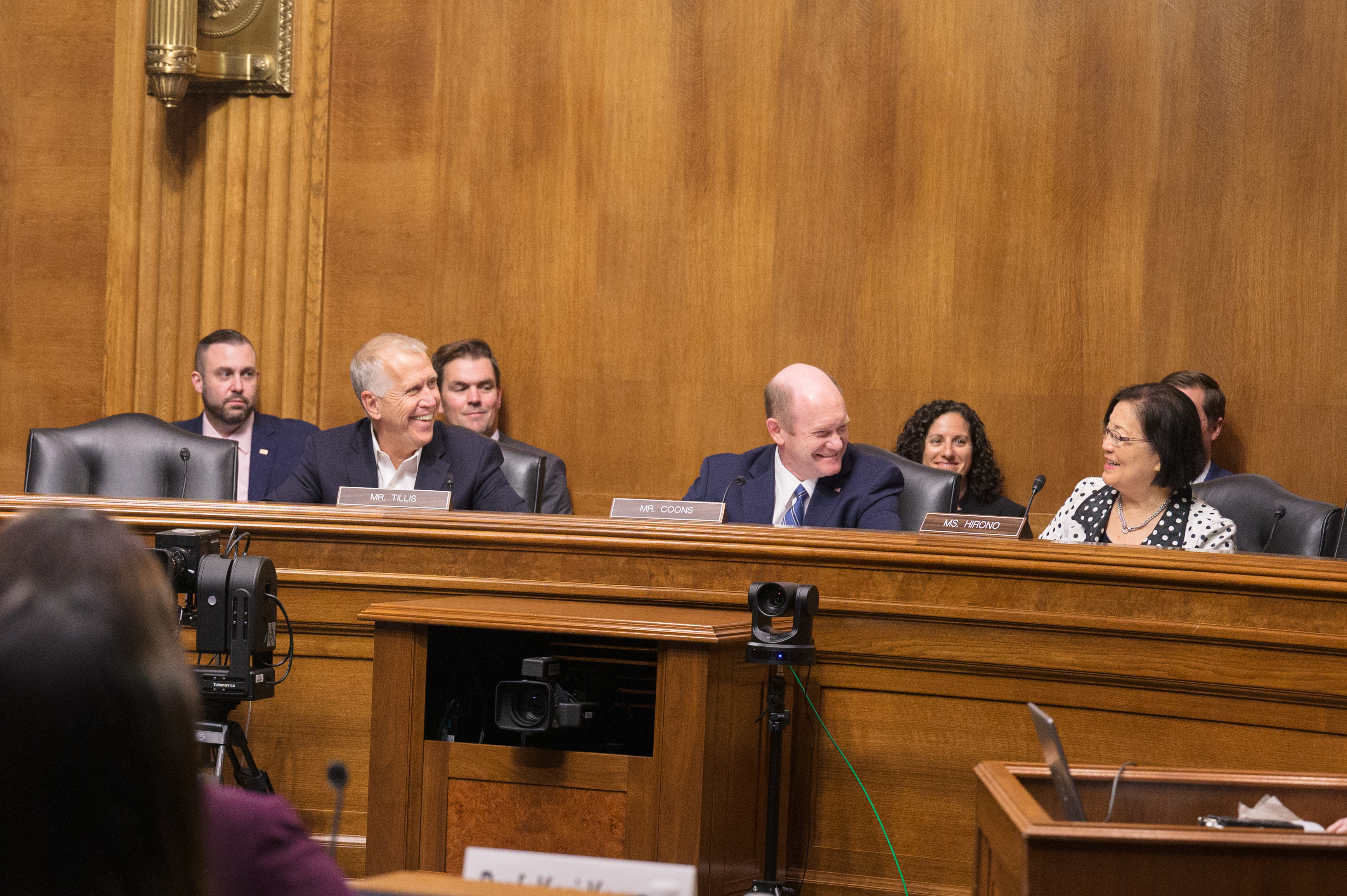
Senator Chris Coons: This hearing will come to order. I’d like to thank our witnesses for participating today. I’d also like to thank Ranking Member [Thom] Tillis [R-N.C.] and his staff for working in a collaborative way to put this hearing together, and I’d like to welcome Senator [Mazie] Hirono [D-Hawaii]. This is our fifth hearing of the IP Subcommittee of this year, and Senator Tillis, you and your team continue to be great partners in moving forward.

Just to set the stage more broadly on the focus of this hearing: Online shopping has expanded dramatically — has exploded in recent years. Last year, U.S. e-commerce sales exceeded a trillion dollars for the first time, as millions and millions of Americans turned to online platforms, from eBay to Amazon, to find the brands they trusted at prices they could afford. Counterfeiters, unfortunately, have moved online right alongside American consumers, and their tools are becoming far more sophisticated. Counterfeiters are no longer selling fake handbags or watches on a street corner or a flea market. New, modern, online counterfeiting delivers products that look real, with listings featuring images that show the real product and fake reviews that make their knockoffs seem authentic. Online counterfeiting efforts are so successful that according to one recent report, two-thirds of American consumers surveyed had unknowingly bought a counterfeit product online last year.

This isn’t just a matter of tricking consumers into spending their money on harmlessly fake products. As the CBP — the Customs and Border Patrol — warned earlier this year, fake goods can pose real dangers that put the health and safety of all Americans at risk. Fake lithium batteries, for example, batteries that power laptops, can explode or catch fire. They caused 70 deaths and 350,000 serious injuries in one recent year alone. Counterfeiters are also targeting airlines, trying to sell fake engine parts that have demonstrated to increase the chances of a crash, and counterfeit prescription drugs sold to consumers online are at best ineffective, and at worst, in some cases, deadly to those who purchase them.

Now, if I unknowingly bought a fake laptop at my local Best Buy up on Concord Pike, and it then caught fire in my home, Best Buy would be liable for the harm to me and liable to the brand owner for contributing to trademark infringement. This framework for liability incentivizes brick-and-mortar stores to thoroughly and proactively vet their supply chains to keep counterfeit products out of consumers’ hands. That same counterfeit battery bought online is met with a different liability framework. Platforms don’t have the same proactive obligations. In fact, they need not remove a listing until a brand owner tells the platform specifically that the listing is counterfeit. The weight — the onus — for policing online counterfeits is principally on brands, not platforms. Under this structure, brand owners have to play a never-ending game of whac-a-mole as they monitor a multiplying number of online marketplaces for counterfeit listings.

Platforms know they have a counterfeit problem, and many have undertaken laudable anti-counterfeiting efforts, but current efforts are neither effective nor sufficient, because the problem hasn’t gone away. In fact, it is dramatically increasing. That’s why I was proud to reintroduce the SHOP SAFE Act last week with Senator Tillis, a bill that works to try and balance the rights of brand owners and the obligations of online platforms to intercept and stop the sale of harmful counterfeit goods. The act opens platforms to liability if counterfeit goods affecting health and safety are sold on the platforms, the same liability brick-and-mortar retailers have been subject to for decades. It requires brand owners to provide platforms with notice of their trademarks and a critical point of contact, so platforms can proactively implement an articulated list of best practices to keep unsafe counterfeits out of consumers’ online shopping carts. Those best practices include better vetting before goods are listed, quickly removing counterfeit listings, terminating repeat counterfeiters, and requiring accurate images of the products sold. Platforms that follow best practices will have a safe harbor from liability; in other words, platforms making genuine and good-faith efforts to clean up their sites have, and should enjoy, a liability shield.

Our reintroduction last week came after a fair amount of work in the last Congress — hearings, in both 2019 and 2021, that highlighted the rise in anti-counterfeiting. It is not my anticipation that the bill introduced is perfect or final, and part of this hearing from those who both support and oppose this bill is to welcome input — both critiques and compliments — in an effort to try and sharpen and shape the bill into something worthy of enactment. Since Senator Tillis and I first introduced SHOP SAFE, we’ve heard from stakeholders who would be impacted by the bill. I appreciate their efforts and the work we’ve done to make changes to the bill based on the feedback we’ve received so far, and I look forward to continuing to work with a broad range of stakeholders as we try to move this bill forward this year.

Coons, Schumer, McConnell, Murray, Collins, Graham Joint Statement On The Senate’s Commitment To Supporting Ukraine

WASHINGTON – Today, U.S. Senator Chris Coons (D-Del.) released the following joint statement with Senators Chuck Schumer (D-N.Y.), Mitch McConnell (R-Ky.), Patty Murray (D-Wash.), Susan Collins (R-Maine), and Lindsey Graham (R-SC) on the Senate’s bipartisan commitment to supporting Ukraine:

“We welcome today’s agreement to avoid a harmful and unnecessary shutdown of the federal government. 

“Nevertheless, this agreement leaves a number of urgent priorities outstanding. In the coming weeks, we expect the Senate will work to ensure the U.S. government continues to provide critical and sustained security and economic support for Ukraine.

“We support Ukraine’s efforts to defend its sovereignty against Putin’s brazen aggression, and we join a strong bipartisan majority of our colleagues in this essential work. With the eyes of our partners, allies, and adversaries upon us, we keenly understand the importance of American leadership and are committed to strengthening it from Europe to the Indo-Pacific.”

Senator Coons statement on passing of Senator Feinstein

WASHINGTON—U.S. Senator Chris Coons (D-Del.) released the following statement today on the passing of Senator Dianne Feinstein (D-Calif.):

“Dianne Feinstein was a fiercely determined and very capable senator who left her mark on California, the Senate, and our nation. When I first came to the Senate in 2010 and joined her on the Senate Judiciary Committee, Diane was a gracious and welcoming colleague. I had long admired her record of service, and the significant impact she had on defending the Senate, legislating for gun safety, and advocating for women. Diane was crisp and well-prepared, always carrying herself with dignity and humor. I loved serving with her and will miss her deeply.

“I first met Dianne in the early 1990s, as a young man working in New York City, when I was asked to drive her from the airport to a political fundraiser. We talked for an hour about public service and local politics. At the time, she was a newly elected senator, but, as a former Mayor of San Francisco, she still had a mayor’s sensibility.  

“What struck me then was how much she cared about the people of the city and how the city was being run. She was still very rooted in her local government experience, something we both brought with us to the Senate. Dianne understood that, at the end of the day, politics is about people, and the decisions politicians make affect people’s lives. She was a dear friend and great colleague and she will be deeply missed. Annie and I extend our deepest sympathies to her family.”


Senators Coons, Tillis introduce SHOP SAFE Act to crack down on harmful counterfeit e-commerce goods

WASHINGTON – U.S. Senators Chris Coons (D-Del.) and Thom Tillis (R-N.C.) introduced the Stopping Harmful Offers on Platforms by Screening Against Fakes in E-Commerce (SHOP SAFE) Act today to protect consumers from harmful counterfeit products that are sold online.

Last year, Americans spent more than $1 trillion on e-commerce for the first time ever. As more American consumers opt to shop online, they are increasingly vulnerable to the rising number of harmful counterfeit goods sold on e-commerce platforms — toys, car seats, electronics, bicycle helmets, apparel and footwear, car parts, and more. The SHOP SAFE Act would reduce the availability of harmful counterfeit products online by incentivizing platforms to engage in best practices for vetting sellers and goods and stopping repeat counterfeiter sellers.

“As Americans have increasingly turned to e-commerce for convenience, selection, and safety, some third-party sellers have begun to exploit consumers’ trust in established online marketplaces to trick them into purchasing dangerous counterfeit goods,” said Senator Coons. “These counterfeit goods pose health and safety risks, damage the reputations of legitimate brands, and line the pockets of organized crime. The bipartisan SHOP SAFE Act is an important step that will protect consumers and encourage greater transparency and accountability.”  

“The number of Americans using e-commerce platforms to purchase basic and necessary goods is growing and so is the number of counterfeit goods being sold by third-party sellers on these platforms,” said Senator Tillis.“With Americans continuing to rely on online shopping, it’s crucial that we do all we can to protect consumers from dangerous counterfeit sales which are often coming from China. I look forward to working with my colleagues to effectively reduce online counterfeit sales without unnecessarily disrupting legitimate business and e-commerce platforms.”

The SHOP SAFE Act will:

  1. Establish trademark infringement liability for e-commerce platforms when a third party sells a counterfeit product that poses a risk to consumer health or safety and that platform has not implemented certain best practices;
  2. Require brand owners to provide platforms with advanced notice of their mark(s) and a point of contact so that the platforms can implement proactive measures to prevent sales of counterfeit goods; and  
  3. Provide a safe harbor from liability for platforms that vet sellers to ensure their legitimacy, remove counterfeit listings, and remove sellers who repeatedly sell counterfeits.

As Chair of the Senate Judiciary Committee’s Intellectual Property Subcommittee, Senator Coons has long advocated for protecting U.S. intellectual property rights and the American consumer from counterfeit goods. Senator Coons held a hearing on oversight of the U.S. Patent and Trademark Office (USPTO) in July to ensure U.S. intellectual property laws are being enforced predictably and effectively by, among other things, exploring the actions the USPTO is taking to combat sales of counterfeit goods.

In July, Senators Coons and Chuck Grassley (R-Iowa) introduced a bipartisan resolution recognizing the month of August as National Anti-Counterfeiting and Consumer Education and Awareness Month and highlighting the importance of the roles of trademarks in the American economy and in protecting consumer safety.

The SHOP SAFE Act is endorsed by the American Apparel & Footwear Association, the Alliance for Automotive Innovation, the Toy Association, the National Association of Manufacturers, the Footwear Distributors and Retailers of America, and the Council for Innovation Promotion.

“We appreciate the leadership and unwavering commitment of U.S. Senators Chris Coons and Thom Tillis as we work to stop counterfeiters from evading rules of product safety, social responsibility, sustainability, and other measures of commitment to consumer well-being. With this bill, online platforms must meet the same requirements, and face the same accountability, as brick-and-mortar retailers when it comes to stopping the sale of counterfeit or illicit products that alarmingly are landing on the doorsteps of Americans all day, every day,” said Steve Lamar, President and CEO of the American Apparel & Footwear Association.

“Dangerous counterfeit automotive components endanger public health and safety. The SHOP SAFE Act will help prevent counterfeit auto parts from entering the stream of commerce and reaching the hands of unsuspecting consumers,” said Hilary Cain, Vice President of Technology, Innovation, and Mobility Policy at the Alliance for Automotive Innovation.

“We commend U.S. Senators Chris Coons and Thom Tillis for their leadership in addressing the pressing need to safeguard consumers, particularly children, from illicit products that are infiltrating online platforms,” said Steve Pasierb, President and CEO of The Toy Association. “This critical legislation holds online marketplaces accountable for the products they offer for sale and will help prevent bad actors from selling products that do not comply with the rigorous safety standards upheld by the toy industry. Creating a safer, more trustworthy online shopping environment ultimately protects children and families from potentially dangerous counterfeits sold online.”

“The explosive growth in e-commerce has caused a surge in the sale of counterfeits, exposing consumers to health and safety risks. Manufacturers commend Senators Coons and Tillis for introducing the SHOP SAFE Act, which lays out reasonable and implementable steps to hold counterfeiters and platforms accountable—keeping dangerous products off platforms and protecting American citizens, workers and businesses from bad actors,” said Charles Crain, Vice President of Domestic Policy, National Association of Manufacturers.

“Counterfeit footwear puts U.S. consumers at risk and threatens jobs in our industry. As these illicit goods become more sophisticated, it can be impossible for customers to distinguish a legitimate product from a knockoff. The SHOP SAFE Act is a key step in the fight against counterfeits. It will incentivize e-commerce platforms to implement best practices to prevent bad actors from selling counterfeit goods on their sites. We applaud these leaders in Congress for working together to protect American individuals and families,” said Matt Priest, President and CEO, Footwear Distributors and Retailers of America.

The bill text is available here. A one-pager is available here.  

Senator Coons statement on continuing resolution

WASHINGTON—U.S. Senator Chris Coons (D-Del.) released the following statement today on the Senate’s progress toward passing a continuing resolution to keep the government open:

“The federal government will shut down on October 1 if the Senate and House cannot agree on funding to keep it running. The consequences of a shutdown are significant — more than one million armed forces members, federal law enforcement officers, and other federal employees will be forced to continue serving without pay, while hundreds of thousands more public workers will be furloughed, shuttering their vital functions, from protecting our environment, to supporting our schools, to processing payments to thousands of vendors. Keeping the government running is Congress’ most basic function, and in the Senate, we have come together to produce a bipartisan bill to avert a government shutdown and provide essential funding for Ukraine and disaster relief. 

“This evening, we voted 77-19 to move ahead while the House struggles to find a path forward. I look forward to working with my colleagues to ensure this bill becomes law so that we can continue our work on fully funding our nation’s priorities.”

Senator Coons is a member of the Senate Appropriations Committee.