Related Issues

Related Issues

Senator Coons statement on Senate passage of continuing resolution

WASHINGTON – U.S. Senator Chris Coons (D-Del.) released the following statement after he voted with the Senate to avoid a partial government shutdown by continuing existing funding levels through part of March:

“This continuing resolution prevents a partial government shutdown from occurring this weekend and provides for adequate time to finally complete the fiscal year 2024 appropriations process without resorting to more short-term measures.

“I thank Senate Majority Leader Chuck Schumer, Senate Republican Leader Mitch McConnell, Appropriations Committee Chair Patty Murray, and Appropriations Committee Vice Chair Susan Collins for their leadership and commitment to bipartisan negotiations. The American people deserve a transparent and functioning appropriations process, and I am confident that over the course of the next month, we can pass all 12 spending bills to keep the federal government open and deliver funding for many critical Delaware projects.”

Senator Coons is a member of the Senate Appropriations Committee and Chair of the Appropriations Subcommittee on State and Foreign Operations (SFOPS). 


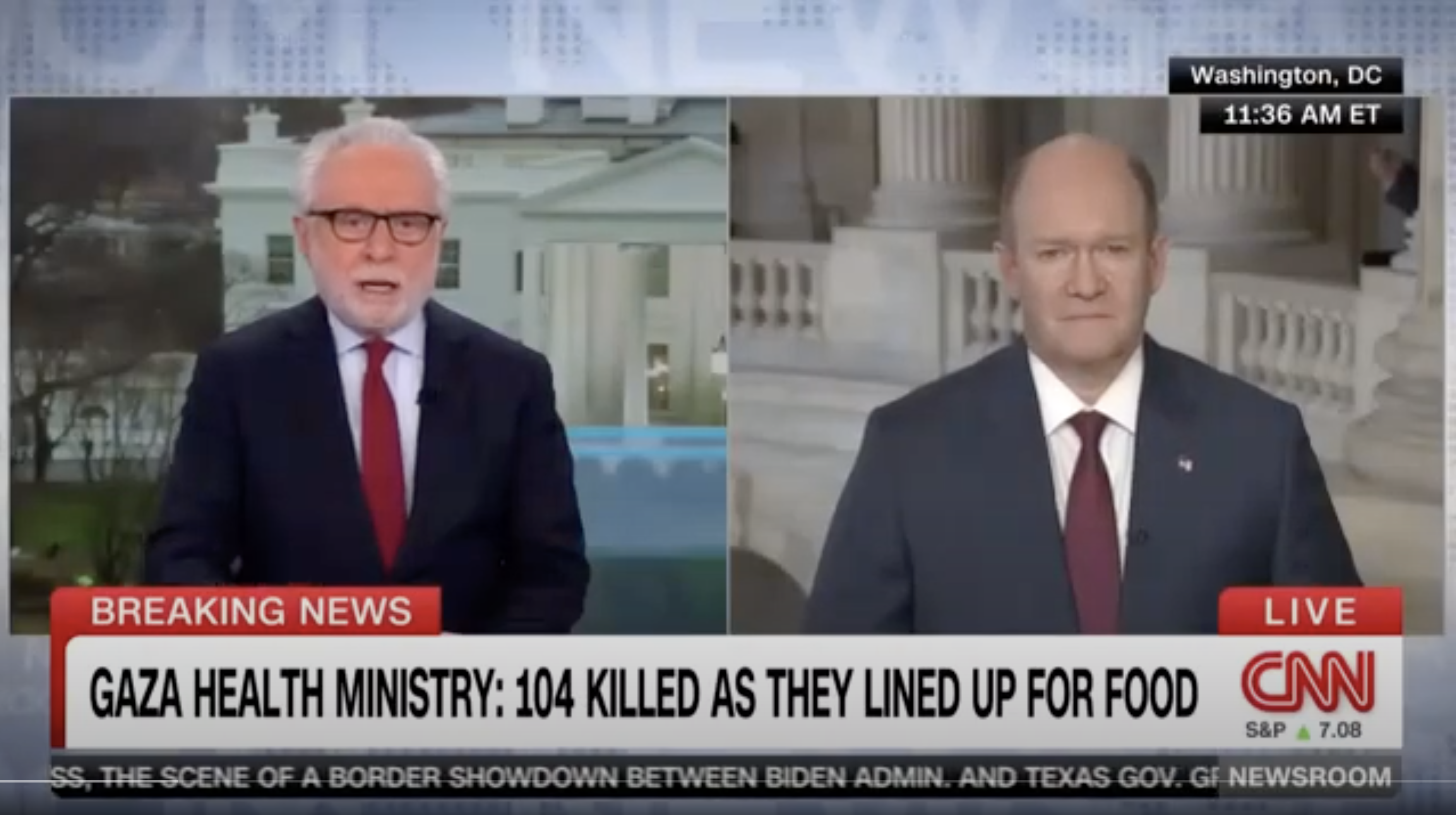
ICYMI: Senator Coons: I’d support restrictions on military aid to Israel “if they go ahead with a full-scale ground campaign into Rafah without taking into account their obligation … to protect civilians and facilitate the distribution of aid”

WASHINGTON – U.S. Senator Chris Coons (D-Del.) opened the door to possible conditions on future U.S. military aid to Israel if the Israeli military launches a full-scale ground offensive against Rafah without significant changes in how civilians are treated and protected. He also emphasized the importance of increased humanitarian aid to civilians in Gaza. 

Screenshot 2024-02-29 at 4

[WATCH]

Senator Coons: I understand the trauma of October 7. Just yesterday, I met with families who lost loved ones in the horrific attack of October 7. But we also have to find a way forward and hold Israel accountable for finding a way forward to delivering humanitarian aid into Gaza. 

Wolf Blitzer: Senator, some of your Democratic senatorial colleagues – and pretty active members – they are working right now to try to put in place specific conditions on future U.S. military assistance to Israel. Is that something you would support, especially in light of today’s incident? 

Senator Coons: If [Israeli] Prime Minister [Benjamin] Netanyahu goes ahead with a full-scale ground offensive against Rafah without having provided significant changes in how civilians are treated and how civilians are protected, and how humanitarian aid is being delivered? Yes, I would.

Wolf Blitzer: You would support restrictions on U.S. military aid to Israel – is that what I’m hearing?

Senator Coons: If they go ahead with a full-scale ground campaign into Rafah without taking into account their obligation under international law to protect civilians and to facilitate the distribution of aid, yes. 


Senators Coons, Lankford, Kaine, and Tillis introduce bipartisan resolution supporting international religious freedom

WASHINGTON – U.S. Senators Chris Coons (D-Del.) and James Lankford (R-Okla.) introduced a bipartisan resolution today to express support for international religious freedom as a fundamental right and a cornerstone of U.S. foreign policy amid concern over increased attacks on religious freedom worldwide. The effort is also cosponsored by Senators Tim Kaine (D-Va.) and Thom Tillis (R-N.C.).

The U.S. Commission on International Religious Freedom (USCIRF) has identified thousands of incidents where religious freedom was violated around the world in 2023, including violence against Rohingya Muslims in Burma, attacks on Uyghurs in China, and persecution of clergy by Russians in Ukraine. In 2023, USCIRF identified more than 2,200 individuals targeted by 27 different countries and entities for their religious beliefs, including Christians, Jews, Muslims, Buddhists, Hindus, and Sikhs. USCIRF also identified the continued destruction of religious sites as an additional threat to religious freedom.  

The resolution urges the U.S. State Department to expand its support for religious freedom around the world, including by leveraging all diplomatic and sanctions tools available to hold violators of religious freedom accountable, and encourages the State Department to promote religious freedom as a central tenet of U.S. foreign policy implementation.

“The right to religious freedom is an American ideal and the cornerstone of our nation’s identity,” said Senator Coons. “Protecting religious minorities must remain central to American foreign policy, and we must call out and condemn attacks on religious people and nonbelievers alike. I’m proud to join with a bipartisan group of colleagues in this effort to make clear that this must remain a priority for our country’s international relations moving forward.”

“The fundamental right of every person to have a faith, live your faith, change your faith, or have no faith at all must be recognized throughout the world. Countries like China, Russia, and Iran continue to target and persecute citizens for living this most basic freedom. The United States must continue its international leadership to defend religious freedom, which is why we are reaffirming our commitment to fight for religious freedom around the world,” said Senator Lankford.

“The Virginia General Assembly passed a statute in 1786 that became the basis of religious freedom in America. Because of our example, many people who live in countries around the world where religious freedom is nonexistent see the U.S. as a beacon of hope – a place where people of all faiths can live in the same neighborhoods, attend the same schools, and work side by side,” said Senator Kaine. “Amid the sharp rise in attacks on faith-based communities, I’m joining my colleagues to send a clear message that we must work together to protect religious freedom at home and abroad.”

“The United States must maintain our steadfast commitment to standing up for religious liberty,” said Senator Tillis. “This resolution expresses our unwavering support for victims of religious persecution and reaffirms our support for safeguarding religious freedom worldwide.”

“USCIRF commends the Senators’ bipartisan efforts to advance international religious freedom. We welcome this vital resolution and will continue to provide foreign policy recommendations to the President, Secretary of State, and Congress to deter religious persecution and promote freedom of religion or belief abroad. We also want to thank Congress for its continued support of USCIRF,” said USCIRF Chair Abraham Cooper and Vice Chair Frederick A. Davie. “Twenty-five years after the enactment of the International Religious Freedom Act (IRFA), religious freedom issues are more integrated than ever into U.S. foreign relations, yet state and nonstate actors around the globe continue to perpetrate or tolerate severe religious persecution. In too many countries, individuals and communities are targeted for their religious beliefs, activity, or identity, or for their religious freedom advocacy. Those individuals and communities are why IRFA was enacted. They also are why global efforts to promote freedom of religion or belief for all remain essential today and in the future.”

The legislation is also supported by Freedom House, the Alliance Defending Freedom, Global Christian Relief, Coalition for Jewish Values, Advancing American Freedom, International Conference of Evangelical Chaplain Endorsers, National Committee for Religious Freedom, Catholics Count, First Rights Global, International Christian Ambassadors Association, International Christian Concern, Faith and Liberty, Religious Freedom Coalition, and AdvanceUSA.

A one-pager on this resolution is available here.

The text of this resolution is available here.

Senator Coons and Senator Tillis are Co-Chairs of the Senate Human Rights Caucus.

Senators Coons, Cornyn host Law Enforcement Caucus roundtable on fentanyl and xylazine

WASHINGTON – U.S. Senators Chris Coons (D-Del.) and John Cornyn (R-Texas) hosted a Senate Law Enforcement Caucus roundtable yesterday featuring on-the-ground perspectives on the fentanyl and xylazine crises from Delaware and Texas. The Senators also discussed their bipartisan bill, the Fentanyl Safe Testing and Overdose Prevention (STOP) Act, which would make clear that fentanyl and xylazine testing strips are not considered illegal drug paraphernalia under federal law. Senators Catherine Cortez Masto (D-Nev.) and Amy Klobuchar (D-Minn.) also spoke about the drug overdose epidemic’s impact on their respective states.

“Fentanyl and xylazine are among the worst public health and law enforcement crises we’ve seen in my lifetime,” said Senator Coons. “This issue affects people from all walks of life. Fentanyl doesn’t care whether you’re an independent, a Democrat, or a Republican, and that’s why Senator Cornyn and I have come together to introduce commonsense legislation that supports law enforcement and public health officials.”

“The fentanyl crisis is not only a law enforcement matter; it’s a public health crisis,” said Senator Cornyn. “This is a nonpartisan issue, and I want to thank my colleague Senator Coons and others for joining together with law enforcement and public health officials to try to address this devastating epidemic.”

During the round table, Sandra Gibney, M.D., CEO and Medical Director of Gibney Mobile Healthcare – an organization she founded in Wilmington, Delaware, to treat and care for those experiencing homelessness or those who are otherwise underserved – provided a medical professional’s insight into the fentanyl and xylazine crises’ impact on a vulnerable patient population. Eric Wright, Ph.D., Superintendent of the Hays Consolidated Independent School District in Kyle, Texas, discussed his district’s proactive approach to combating fentanyl and xylazine abuse among students, a program that now serves as a model for other schools around the country. Dave Humes, who lost his son, Greg, to an accidental opioid overdose and is a founding member of  the advocacy group atTAcK Addiction in Bear, Delaware, spoke about the group’s legislative successes across the country, including laws increasing access to naloxone, a medication used to reverse opioid overdoses.

To offer perspective on law enforcement’s response to the drug overdose epidemic, Chief Wilfredo Campos of the Wilmington Police Department, Major Peter Sawyer of the Delaware State Police, and Lieutenant Allen Herring of the New Castle County Police Department in Delaware discussed the state’s approach to combating fentanyl and xylazine abuse. They emphasized the importance of law enforcement and public health officials working together to combat the epidemic and the need to ensure that departments have adequate resources to respond to the crises.

Senator Coons is Co-Chair of the Senate Law Enforcement Caucus and a member of the Senate Judiciary Committee.


Senator Coons joins bill to protect access to IVF treatment

WASHINGTON – U.S. Senator Chris Coons (D-Del.) joined a legislative effort led by U.S. Senators Tammy Duckworth (D-Ill.) and Patty Murray (D-Wash.) and Congresswoman Susan Wild (D-Pa.) to protect every American’s right to access in-vitro fertilization (IVF) and other assisted reproductive technology (ART) services that millions of Americans rely on to build their families. The move comes after a recent Alabama Supreme Court decision upended access to IVF treatment in the state and raised new questions about the legality of the procedure nationwide. 

“Far-right extremists were never planning to stop at abortion after the Dobbs decision, and the recent Alabama ruling makes clear that IVF is next,” said Senator Coons. “Congress needs to affirm that fertility treatment, relied on by millions of Americans to grow their families, remains legal in Alabama and across the nation. Parents struggling to conceive have enough to worry about without the threat that they or their doctors could be charged with a felony for pursuing safe, routine fertility care.”

“Since the Supreme Court threw out Roe v. Wade, our nation has seen a wave of Republican-led states not only enacting strict abortion bans that severely limit their residents’ right to access basic reproductive care – but also pushing proposals that would jeopardize access to IVF and other assisted reproductive technologies that millions of Americans need to start or grow their families,” said Senator Duckworth. “Without the miracle of IVF, I wouldn’t have my beautiful baby girls – and there are so many other people like me who have had trouble getting pregnant and relied on IVF to start the families of their dreams. As many hopeful parents continue to be understandably worried about their access to IVF amid Republicans’ escalating attacks on reproductive health care, I’m proud to introduce the Access to Family Building Act to establish a statutory right to access IVF and other ART for every American – no matter what state they live in.”

The legislation is endorsed by the American Society for Reproductive Medicine and RESOLVE: The National Infertility Association.

“Americans deserve to know that medical care to build their family, such as IVF, is legal and available anywhere in the U.S. and will always be legal and available,” said Barbara Collura, President/CEO of RESOLVE: The National Infertility Association. “RESOLVE strongly supports the Access to Family Building Act, a bill that ensures IVF is protected as well as protecting the healthcare providers offering that care. Each year our advocates are forced to fight anti-family bills introduced in statehouses across the country, creating fear among people who simply want to be a parent. We call on Members of Congress to support this pro-family bill and are honored to work alongside our champions Senator Duckworth and Congresswoman Wild.”

The Access to Family Building Act would:

  • Establish a statutory right for an individual to access, without prohibition or unreasonable limitation or interference, ART services, such as IVF, and for a health care provider to provide ART services;
  • Establish an individual’s statutory right regarding the use or disposition of their reproductive genetic materials, including gametes;
  • Allow the U.S. Department of Justice to pursue civil action against any state, government official, individual, or entity that violates protections in the legislation; and
  • Create a private right of action for individuals and healthcare providers in states that have limited access to ART.

Earlier this month, the Alabama Supreme Court ruled that frozen embryos are considered “extrauterine children” under state law, and those who destroy unused embryos – a common practice in IVF treatments – can be held liable for the wrongful death of a minor. The decision built on the precedent set by the U.S. Supreme Court’s 2022 Dobbs v. Jackson Women’s Health Organization decision, which struck down 50 years of precedent established by Roe v. Wade and eliminated the national right to have an abortion. In response to the Alabama Supreme Court’s decision, several health providers in the state, including the hospital for the University of Alabama at Birmingham, the largest in the state and eighth-largest in the nation, paused IVF treatments. Advocates fear other courts across the country will follow in Alabama’s footsteps and use the Dobbs decision to end IVF treatments in other states.  

The full bill text is available here.


Senator Coons statement on two-year anniversary of Russia’s full-scale invasion of Ukraine

WILMINGTON, Del. – U.S. Senator Chris Coons (D-Del.) released the following statement today marking the two-year anniversary of Russia’s full-scale invasion of Ukraine:

“Two years into the war in Ukraine, Vladimir Putin has suffered a strategic defeat. His campaign to quickly overrun Ukraine and contain NATO has instead been met with fierce Ukrainian resistance, and NATO has expanded. Putin bet on a brutal war of attrition, counting on Ukraine and its allies to grow weary. On the second anniversary of Russia’s full-scale invasion, Russia has suffered massive battlefield losses and Ukrainians are as determined as ever, but some Americans are wavering in their defense of democracy, risking handing Putin a victory.  

“More than fifty countries have contributed to Ukraine’s defense, overall exceeding the contributions of the U.S., but without our sustained partnership, Ukraine cannot hold off the Russian invaders indefinitely. Almost two weeks ago, the Senate passed President Biden’s national security supplemental funding request with an overwhelming, bipartisan majority. The Republican-led House must pass the supplemental bill funding Ukrainian assistance now, or risk abandoning our Ukrainian partners and standing on the wrong side of history.”

Senator Coons is Chair of the Senate Appropriations Subcommittee on State and Foreign Operations (SFOPS) and a member of the Senate Foreign Relations Committee.


Senator Coons statement on visit to Israel, Jordan, Lebanon, Iraq, and Oman

WILMINGTON, Del. – U.S. Senator Chris Coons (D-Del.) released the following statement today after returning from a congressional delegation with Senator Richard Blumenthal (D-Conn.) to Israel, Jordan, Lebanon, Iraq, and Oman:  

“My meetings across the region reinforced that the war in Gaza has had profound impacts throughout the Middle East. The coming weeks hold the potential to be either the beginnings of a path to peace or an expansion of conflict regionally. I conveyed to Israeli leaders my grave concerns about the human costs and political consequences of a large-scale ground assault on Rafah and urged them to seriously pursue negotiations for a humanitarian ceasefire and hostage exchange that could lay the foundation for regional progress in reducing conflict. Leaders on all sides must work to end the fighting in Gaza as quickly as possible and immediately increase access to humanitarian aid among Palestinians.

“I am also concerned about the real possibility of a full-blown conflict between Hezbollah and Israeli forces over the Israel-Lebanon border, which would be devastating for civilians. In Jerusalem and Beirut, I urged leaders to pursue a diplomatic solution that would end border hostilities and allow both Israeli and Lebanese citizens who have been displaced to return safely home. The Lebanese Armed Forces have a critical role to play in moving forward the implementation of peace, and I will support ongoing efforts to reduce tensions in Lebanon. 

“During my visit, I was especially glad to meet with important U.S. partners, like King Abdullah II in Jordan and General Joseph Aoun in Lebanon, who have for years worked closely with the United States to uphold regional stability and improve the daily lives and safety of civilians. When I return to Washington, I will continue to work with my Senate colleagues and the Biden administration to support U.S. partners in the region, increase the delivery of vital humanitarian aid and investment in the region’s future, and address pressing security threats in order to stem the growing tide of regional instability. 

“Throughout my visit, I made clear that the United States will not tolerate assaults on U.S. troops. Iranian proxies in Iraq and Syria in recent months launched many attacks that have already taken the lives of three American soldiers. The United States will not hesitate to respond and protect our troops, as we have done in recent weeks, should those attacks resume. During my meetings in Iraq and Oman, I emphasized our interest in building sustained economic partnerships and continuing to invest in security and development with our longstanding partners in the region. Across the five countries I visited, our partners clearly want more sustained American engagement, and we have real opportunities to advance peace and reduce conflict.

“Lastly, I’d like to thank our ambassadors, diplomats, and everyone who made this trip possible. Our ambassadors in the region – Jack Lew in Israel, Yael Lempert in Jordan, Lisa Johnson in Lebanon, Alina Romanowski in Iraq, and Ana Escrogima in Oman – are serving our nation well at a demanding time and show why it is so important to have confirmed ambassadors around the globe.”

In Israel, Senator Coons met with national leaders, including Prime Minister Benjamin Netanyahu, President Isaac Herzog, Minister of Strategic Affairs Ron Dermer, Defense Minister Yoav Gallant, and Leader of the Opposition Yair Lapid. In Jordan, Senator Coons visited with U.S. service members at Muwaffaq Salti Air Base and met with King Abdullah II and Chief of Defense Major General Yousef Huneiti. In Lebanon, Senator Coons participated in a roundtable with leaders of U.N. humanitarian agencies, including the World Food Program, UNICEF, the U.N. High Commissioner for Refugees (UNHCR), and the U.N. Relief and Works Agency for Palestine Refugees in the Near East (UNRWA). He also met with government leaders, including caretaker Prime Minister Najib Mikati, Foreign Minister Abdallah Bou Habib, Speaker of Parliament Nabih Berri, and Commander of the Lebanese Armed Forces Joseph Aoun. In Iraq, Senator Coons met with Prime Minister Mohammed Shia Al-Sudani, National Security Advisor Qassim al-Arraji, and Defense Minister Thabet Al-Abbassi as well as with U.S. troops and the Commander of Combined Joint Task Force-Operation Inherent Resolve, Major General Joel Vowell.

Senator Coons is the Chair of the Senate Appropriations Subcommittee on State and Foreign Operations (SFOPS) and a member of the Senate Foreign Relations Committee.


Resolution from Senators Coons and Young establishing National FFA Week passes Senate

WASHINGTON – A bipartisan resolution introduced by Senators Chris Coons (D-Del.) and Todd Young (R-Ind.) to establish February 17-24, 2024 as “National FFA Week” recently passed the U.S. Senate.

The resolution highlights the important role of the National FFA Organization in developing the next generation of leaders by providing educational and career opportunities to students. The resolution also celebrates the 10th anniversary of the “Give the Gift of Blue” program, which has donated more than 17,000 FFA blue jackets to members in need.

“Young leaders in the First State learn to meet agricultural challenges and develop leadership skills through programs offered by the Delaware FFA and the National FFA Organization, taught by our talented agricultural educators,” said Senator Coons. “Here in the Senate, I’m proud to join Senator Young to introduce a bipartisan resolution honoring this critical organization and its members who contribute so much to the fabric of our communities.”

“Throughout Hoosier communities and our country, FFA plays a critical role in the development of students through agricultural education. The lessons, tools, and resources gained through the FFA program equip Indiana’s future leaders with the skills needed to succeed in a variety of fields,” said Senator Young. “I’m glad to lead this resolution establishing National FFA Week in support of the more than 13,000 FFA members in Indiana.”

“National FFA Week is a meaningful week for members across our country as we celebrate an organization that is welcoming to all and crucial to developing the next generation of leaders and those who will fill the ever-growing need in the talent pipeline,” said National FFA Advisor Travis Park. “Not only is it an opportunity to share our message with a broader audience, but it’s also an opportunity for our FFA chapters and members to celebrate agriculture and agricultural education while thanking their supporters – their local alumni and supporters chapters, agriculture teachers, or local businesses.”

In addition to Senators Coons and Young, Senators John Barrasso (R-Wyo.), Marsha Blackburn (R-Tenn.), Richard Blumenthal (D-Conn.), Cory Booker (D-N.J.), John Boozman (R-Ark.), Mike Braun (R-Ind.), Katie Britt (R-Ala.), Laphonza Butler (D-Calif.), Shelley Moore Capito (R-W.Va.), Tom Carper (D-Del.), Susan Collins (R-Maine), John Cornyn (R-Texas), Catherine Cortez Masto (D-Nev.), Tom Cotton (R-Ark.), Kevin Cramer (R-N.D.), Mike Crapo (R-Idaho), Ted Cruz (R-Texas), Steve Daines (R-Mont.), Tammy Duckworth (D-Ill.), Dick Durbin (D-Ill.), Joni Ernst (R-Iowa), Lindsey Graham (R-S.C.), Chuck Grassley (R-Iowa), Bill Hagerty (R-Tenn.), Maggie Hassan (D-N.H.), John Hickenlooper (D-Colo.), John Hoeven (R-N.D.), Cindy Hyde-Smith (R-Miss.), Tim Kaine (D-Va.), Mark Kelly (D-Ariz.), John Kennedy (R-La.), Angus King (I-Maine), Amy Klobuchar (D-Minn.), James Lankford (R-Okla.), Ben Ray Luján (D-N.M.), Cynthia Lummis (R-Wyo.), Roger Marshall (R-Kan.), Mitch McConnell (R-Ky.), Jeff Merkley (D-Ore.), Markwayne Mullin (R-Okla.), Jon Ossoff (D-Ga.), Pete Ricketts (R-Neb.), Jim Risch (R-Idaho), Eric Schmitt (R-Mo.), Rick Scott (R-Fla.), Tim Scott (R-S.C.), Jeanne Shaheen (D-N.H.), Kyrsten Sinema (I-Ariz.), Tina Smith (D-Minn.), Debbie Stabenow (D-Mich.), John Thune (R-S.D.), Thom Tillis (R-N.C.), Raphael Warnock (D-Ga.), and Roger Wicker (R-Miss.) also cosponsored the resolution.

U.S. Representative Jimmy Panetta (D-Calif.) introduced a companion resolution in the U.S. House of Representatives that garnered 101 cosponsors.

“Our country needs a new generation of young farmers, ranchers, and producers ready to take the lead and cement the United States’ agricultural leadership,” said Representative Panetta. “This bipartisan resolution recognizes the vital contributions of the National FFA Organization in training leaders who are ready to bolster both American food security and innovation. I am proud to once again work with my FFA Caucus Co-Chair, Representative Tracey Mann (R-Kan.), to support the men and women who wear the blue jacket and are moving American agriculture forward.”

You can view the full text of the Senate resolution here


Senators Coons, Tillis, Hirono, Lankford voice concerns about proposed global pandemic accord’s broad IP waivers in letter to National Security Advisor

WASHINGTON – U.S. Senators Chris Coons (D-Del.), Thom Tillis (R-N.C.), Mazie Hirono (D-Hawaii), and James Lankford (R-Okla.) wrote today to U.S. National Security Advisor Jake Sullivan to express “serious concerns” about the World Health Organization’s (WHO) proposed global accord on pandemic prevention, preparedness, and response, which would weaken intellectual property (IP) protections for companies that use public funding to develop successful pandemic-related treatments. Such a move would disincentivize research and development into vaccines for future pandemics, hindering the global ability to respond to another public health emergency. While the U.S. Department of Health and Human Services (HHS) has issued a request for public input (RFI) on the proposed WHO agreement, the Senators urged Sullivan to explore additional feedback.

The lawmakers wrote, “We agree that it is critical to prepare for the next pandemic and, in doing so, to think about how we can promote better global access to vaccines and medical treatments. We are concerned, however, that the proposed agreement threatens these laudable goals by undermining intellectual property (IP) laws based on a faulty premise that IP rights impeded the global response to the COVID-19 crisis. The facts tell a different story. Indeed, a recent U.S. International Trade Commission report investigating the supply and demand of COVID-19 diagnostics and therapeutics found that many factors other than IP were responsible for barriers to treatment access, including distribution challenges, delays in regulatory approval, weak healthcare infrastructure, and insufficient health education. …

They continued, “The draft agreement under consideration, however, contains many provisions that would undercut – If not destroy – the very aspects of our innovation ecosystem that just recently produced such positive results. For example, the proposal mandates that companies that receive public funding will have to essentially give away their IP if they develop a successful treatment, whether through compulsory licensing, non-exclusive licensing, or by foregoing royalties. The proposed language does not limit these IP waivers to vaccines or medical treatments; instead, the waivers would apply to all ‘pandemic-related products’ – a term that broadly includes any ‘products that are needed for pandemic prevention, preparedness and response.’ This means that if a company successfully develops a pandemic-related product, that company will not be able to realize any return on investment, thereby discouraging the acceptance of public funding or pursuing research and development for public health products in the first place. In future pandemics, governments may offer money only to find that no one will accept it. As a result, governments would lose a critical tool to address future public health crises. …

They concluded, “We commend the initiative to improve the global response to the next pandemic, but waiving a broad scope of IP rights is the wrong way to accomplish that goal. As such, we urge you to seek significantly more public feedback than the recent HHS RFI, through hearings and studies, to inform U.S. input on the WHO pandemic agreement.”

Senator Coons is Chair of the Senate Judiciary Committee’s Intellectual Property Subcommittee, Chair of the Senate Appropriations Committee’s State and Foreign Operations and Related Programs Subcommittee, and Co-Chair of the Senate Caucus on Malaria and Neglected Tropical Diseases.

The full text of the letter is available here.


Senator Coons statement on passing of Alexei Navalny

MUNICH, Germany – U.S. Senator Chris Coons (D-Del.) issued the following statement after reports of the death of Russian opposition leader Alexei Navalny:

“I’m heartbroken to hear reports of the passing of Alexei Navalny. His death is not just a blow to those who care about the freedom of Russian citizens, but to those who care about freedom and democracy everywhere. His choice to go back to Russia – even after an attempted assassination attempt – was inspiring. I just listened to his wife Yulia’s brave and compelling remarks at the Munich Security Conference. His family’s determined support in his fight for the Russian people has been courageous.

“If these reports are true and Alexei has indeed died in a Russian prison, he is the latest victim of the brutality of Vladimir Putin. Putin’s invasion of Ukraine and his repeated attacks on democratic voices in and out of Russia must reinforce our efforts to push back on Putin’s thuggery across the globe. May we recommit ourselves today to the cause of freedom in Alexei’s name.”

Senator Coons is Chair of the Senate Appropriations Subcommittee on State and Foreign Operations and a member of the Senate Foreign Relations Committee.