Related Issues

Related Issues

Senator Coons statement on State and Foreign Operations appropriations bill

WASHINGTON – U.S. Senator Chris Coons (D-Del.), Chair of the Appropriations Subcommittee on State and Foreign Operations (SFOPS), released the following statement today after the SFOPS funding bill was made public as part of a six-bill appropriations package:

“This SFOPS bill makes critical investments in our diplomatic and development workforce, prioritizes meeting U.S. international commitments, stands by our partners and allies overseas, and delivers badly needed humanitarian assistance to those most in need. This bill rejects the efforts of those who would see us turn inward and continues to embrace the simple fact that we are safer and more prosperous at home when we engage globally to help shape a world based on the core values of rule of law, human rights, and democratic governance. 

“This bill contains more than $58 billion for the U.S. State Department, the U.S. Agency for International Development, and related foreign assistance programs to deliver on those priorities. That includes $10.3 billion for sustainable and inclusive development, nearly $3.5 billion to fully meet our commitments to the United Nations and other international organizations, and more than $1.8 billion to help create a secure, free, and prosperous Indo-Pacific region. More than $10 billion will also go to address critical global health initiatives, including HIV/AIDS, malaria, and tuberculosis.

“There are many examples of how this bill advances our core principles. I’m pleased that it includes funding for the International Criminal Court as it continues to pursue charges against senior Russian officials, including President Vladimir Putin, for committing war crimes in Ukraine. I’m also proud that we were able to secure 12,000 additional Special Immigrant Visas for our Afghan allies. While we must pass the Afghan Adjustment Act to fully uphold our commitment to the Afghans who stood by us, these visas will provide a critical lifeline for many who helped us when we needed it most.

“The bill also makes critical investments in global development and economic growth, helping partner governments lift their populations out of poverty and strengthening our efforts to diversify and secure critical supply chains that have direct benefits here at home and counter our adversaries’ malign activities abroad. Additionally, while I will continue to work alongside many of my colleagues for the long-term reauthorization of PEPFAR – the President’s Emergency Plan for AIDS Relief – the one-year extension included in this bill buys us critical time for that work. 

“As important as what is in this bill is what is not included. The bill does not include many policy provisions proposed by the House bill that would have significantly set back years of global development efforts. 

“These bills are always products of negotiation. I am particularly concerned about the yearlong prohibition on funding for UNRWA, the U.N. Relief and Works Agency for Palestine Refugees in the Near East, everywhere it operates. I remain deeply concerned about the plight of innocent civilians in Gaza and will continue working with the Biden administration to encourage additional steps to be taken to alleviate their suffering.

“I am also concerned that the House has yet to take up and pass the Senate-passed national security supplemental, which includes more than $9 billion in humanitarian assistance and additional security and economic assistance for Ukraine and other partners. For every day that passes without the enactment of the supplemental resources, Putin and Chinese President Xi Jinping are emboldened, our reliability as a partner is called into question, and millions of innocent people who rely on U.S. humanitarian leadership are left in need. This makes the world less safe for all of us.

“While I will continue working toward passage of the supplemental, I urge my colleagues to swiftly pass the package of appropriations bills before us to show the world that the United States continues to provide critical leadership.”
 

Senator Coons Joins Colleagues in Urging the Biden Administration to Establish a Framework for U.S. Recognition of a Nonmilitarized Palestinian State

WASHINGTON – In light of the ongoing negotiations around a humanitarian ceasefire in Gaza, today, Senator Chris Coons (D-Del.) signed onto a letter with 18 of his Senate colleagues to the Biden Administration today, urging President Biden to establish a bold, public framework for the U.S. to recognize a nonmilitarized Palestinian state. As a strong diplomatic leader in the region for decades, the U.S. must continue this role and take concrete action toward a two-state solution, in line with established U.S. foreign policy.

“Given the severity of the current crisis, this moment requires determined U.S. leadership that must move beyond facilitation. As such, we request the Biden Administration promptly establish a bold, public framework outlining the steps necessary for the U.S. to recognize a nonmilitarized Palestinian state, which includes the West Bank and Gaza, to be governed by a revitalized and reformed Palestinian Authority,”the Senators wrote.

They continued: “The diplomatic steps that you and your Administration have taken have been of utmost importance, and we urge you to do even more. We believe it is critical at this moment for the United States to signal our willingness to lead a regional peace initiative that would eventually result in U.S. recognition of a nonmilitarized Palestinian state, as well as Israel’s full integration into the region. The road to enduring peace in the region depends entirely on the two-state solution—the establishment of a Palestinian state, existing in concert with a regionally-integrated Israel. Despite decades of U.S. support for this policy, there has been limited success in bringing it to fruition. In order to prevent future deaths and insecurity for both Palestinians and Israelis, the U.S. must continue to take decisive action to bring about a two-state solution once and for all.”

In addition to Senator Coons, the letter was signed by Senators Tom Carper (D-Del.), Tammy Baldwin (D-Wis.), Sherrod Brown (D-Ohio), Dick Durbin (D-Ill.), Martin Heinrich (D-N.M.), Mazie Hirono (D-Hawaii), Amy Klobuchar (D-Minn.), Ed Markey (D-Mass.), Jeff Merkley (D-Ore.), Chris Murphy (D-Conn.), Brian Schatz (D-Hawaii), Jeanne Shaheen (D-N.H.), Tina Smith (D-Minn.), Chris Van Hollen (D-Md.), Raphael Warnock (D-Ga.), Elizabeth Warren (D-Mass.), Peter Welch (D-Vt.), and Sheldon Whitehouse (D-R.I.).

In line with longstanding U.S. policy, Senator Coons has advocated for a two-state solution to resolve the decades of conflict between Israelis and Palestinians. This letter builds on Senator Coons’ advocacy for peace and stability in the Middle East, and strengthening diplomatic relations. Since the attacks of October 7th, 2023, Senator Coons has:

  • Joined nearly the entire Senate Democratic caucus on an amendment that reiterates U.S. commitment to a two-state solution while also promoting a negotiated compromise for Israelis and Palestinians to live peacefully in the region.
  • Co-sponsored a resolution to condemn Hamas and reaffirm his support for Israel and the right to defend itself. This resolution passed the Senate on October 19, 2023.

Read the full letter here and below.

Dear President Biden,

On October 7, 2023, Hamas terrorists committed heinous atrocities leading to the deadliest day in Israel’s history, and more than 100 hostages remain in Gaza today. The ensuing war that Israel has waged in Gaza has resulted in devastation and tens of thousands of deaths. We call on you to continue to take bold diplomatic action during this time of crisis. It is our firm belief that only with two states for two peoples – an independent Israel alongside an independent Palestinian state – will we see enduring peace in the region and safety and security for Israelis and Palestinians alike. To that end, in an effort to reignite U.S. leadership on a diplomatic solution to the Israeli-Palestinian conflict, we call on you to publicly outline a path for the United States to recognize a nonmilitarized Palestinian state.

For decades, the United States – under presidents of both political parties– has been a leader in facilitating diplomatic negotiations and in urging both sides to come to the table. For example, in March 1991, President George H.W. Bush announced to Congress that, “the time has come to put an end to the Arab-Israeli conflict,” and initiated eight months of diplomacy led by the U.S. Secretary of State James Baker that culminated in the Madrid Peace Conference in October 1991. For the first time, under American leadership, all of the parties to the Israeli-Palestinian conflict came together to hold direct negotiations. Additionally, in September 1993, President Bill Clinton brought together Israeli Prime Minister Yitzhak Rabin and then-Palestine Liberation Organization (PLO) negotiator Mahmoud Abbas at the White House in a symbol of unity to sign a peace agreement, commonly known as the Oslo Accords. This marked the first time Israeli and Palestinian leaders acknowledged and accepted each other’s right to self-governance. And, subsequently, in June 2002, President George W. Bush cemented the two-state solution as official U.S. foreign policy when he shared his vision for “two states, living side by side in peace and security.”

Given the severity of the current crisis, this moment requires determined U.S. leadership that must move beyond facilitation. As such, we request the Biden Administration promptly establish a bold, public framework outlining the steps necessary for the U.S. to recognize a nonmilitarized Palestinian state, which includes the West Bank and Gaza, to be governed by a revitalized and reformed Palestinian Authority. We believe the framework’s parameters should also include:

  • A set of governmental and institutional reforms to the Palestinian Authority, among them reforms to democracy and governance, including:
    • Reforms to the education system;
    • Reforms to the judicial and security systems;
    • Reforms to the prisoner payments program; and,
    • Concerted efforts to combat corruption and incitement to violence.
  • A requirement for the reformed Palestinian Authority, as the governing body of the West Bank and Gaza, to reaffirm its recognition of the State of Israel; and,
  • A mandate within the reformed Palestinian Authority for government ministers and senior officials to commit to nonviolence, accept the principles of two states – an Israeli and a Palestinian state – and renounce Hamas and all terrorist activity.

Only with the success of the aforementioned initiatives and regional support for a two-state solution can the State of Israel exist with security and Israelis live without fear. We recognize that in order for this framework to be achieved, the Israeli government must take parallel steps, beginning with facilitating a major surge of humanitarian aid into Gaza and enabling the process of rebuilding Gaza. While we have been particularly disappointed by Prime Minister Benjamin Netanyahu’s refusal to engage on a path to a Palestinian state, we believe that this provides even more reason for the Biden Administration to lead and push the Israeli government to take the following additional actions:

  • Take effective action against settler violence in the West Bank;
  • End home demolitions, including evictions of Palestinians from their property;
  • Stop settlement planning and construction in the West Bank;
  • Release customs revenues to the Palestinian Authority; and,
  • Reactivate permits for Palestinian workers from the West Bank to enter Israel.

We recognize that none of this is possible until there is a ceasefire in Gaza, all hostages are released, and unfettered humanitarian aid is allowed into Gaza. We are grateful for the role that you and your Administration have played thus far in demonstrating your support for a diplomatic two-state solution and, throughout the war, demanding the protection of civilian life, access to necessary life-saving humanitarian aid for Palestinians in Gaza, and aiding the hostage negotiations that resulted in a week-long pause in fighting and the safe return of 105 hostages last year, including two Americans.

The diplomatic steps that you and your Administration have taken have been of utmost importance, and we urge you to do even more. We believe it is critical at this moment for the United States to signal our willingness to lead a regional peace initiative that would eventually result in U.S. recognition of a nonmilitarized Palestinian state, as well as Israel’s full integration into the region. The road to enduring peace in the region depends entirely on the two-state solution—the establishment of a Palestinian state, existing in concert with a regionally-integrated Israel. Despite decades of U.S. support for this policy, there has been limited success in bringing it to fruition. In order to prevent future deaths and insecurity for both Palestinians and Israelis, the U.S. must continue to take decisive action to bring about a two-state solution once and for all.

This crisis has reached an inflection point. Your leadership is needed at this time now more than ever. As you said on October 25, 2023, “Israelis and Palestinians equally deserve to live side by side in safety, dignity, and peace. And there’s no going back to the status quo as it stood on October the 6th.” We agree. By providing a roadmap for U.S. recognition of a Palestinian state, the United States can set a path to finally realizing a two-state solution and reinvigorate conversations towards a comprehensive regional peace plan. This would be in the interest of not only Palestinians but, crucially, also in the interest of our ally Israel. We strongly believe that the solution to this conflict will be found through diplomacy and that you are uniquely positioned to provide American leadership toward a two-state solution that will forge enduring peace in the region.

Mr. President, heed the call of history—seek peace and pursue it.

Sincerely,


Senators Coons, Ernst, Kaine, and Ricketts introduce bipartisan bill to enhance USAID’s locally led development

WASHINGTON – Today, U.S. Senators Chris Coons (D-Del.), Joni Ernst (R-Iowa), Tim Kaine (D-Va.), and Pete Ricketts (R-Neb.) introduced the Locally Led Development and Humanitarian Response Act to improve U.S. Agency for International Development (USAID) collaboration with local partners when implementing humanitarian and development programs around the world. 

The bill incentivizes USAID to localize its partner base by granting new authorities to the agency. Notably, the bill would make it easier for local partners to submit grant applications in their native language, authorize USAID to provide local organizations with time extensions for certain reporting requirements, and authorize USAID to limit competition to local organizations for awards of up to $25 million.

“Development and humanitarian assistance programs are more effective and sustainable when local communities drive assistance goals and implementation,” said Senator Coons. “After all, local communities often know best where resources are needed and how assistance can be implemented most effectively to meet local needs. The Locally Led Development and Humanitarian Response Act will push a larger share of funding directly to local leaders, reduce burdens on local partners, and create incentives for USAID to strengthen projects led by local communities. I’m proud to introduce this bill with my colleagues and hope the Senate will swiftly take up our legislation.”

“I have been tirelessly working to ensure that taxpayer dollars are spent discerningly and efficiently. While USAID has resisted my previous oversight, I’m taking bipartisan action to clarify USAID’s policies to ensure they are localizing needs and ending abuses of taxpayer dollars, so developing countries reduce their dependence on U.S. dollars,” said Senator Ernst.

USAID recognizes that local leadership and authority are important for creating long-lasting results across humanitarian assistance and development work. In November 2021, USAID set a goal of providing at least 25% of the agency’s program funds directly to local partners by the end of 2025. By 2030, 50% of USAID’s programs will put local communities in the lead. While prior administrations have worked to direct funding to local organizations, only 10% of all USAID funding has been allotted to local entities in recent years.

The Locally Led Development and Humanitarian Response Act seeks to increase transparency around USAID’s efforts to engage with local entities that would expand and diversify its partner base. Specifically, the bill would:

  • Authorize USAID to limit competitions just to local entities for awards valued up to $25 million
  • Authorize USAID to increase the de minimis indirect cost rate to 15% for local entities receiving assistance awards
  • Authorize USAID to accept applications or proposals in languages other than English, and order USAID to explore various options for resources and translation services for local languages
  • Require USAID to submit an annual progress report focused on the strategies and polices its executing to advance locally-led development, including details on funding allocated both directly and indirectly by local entities   

A one-pager on the bill is available here.

The text of the bill is available here.

Senator Coons is chair of the Senate Appropriations Subcommittee on State and Foreign Operations (SFOPS) and a member of the Senate Foreign Relations committee.


Senators Coons, Cornyn, colleagues introduce bill to protect state and local judges

WASHINGTON – U.S. Senators Chris Coons (D-Del.), John Cornyn (R-Texas), Jerry Moran (R-Kan.), Jeanne Shaheen (D-N.H.), and Sheldon Whitehouse (D-R.I.) today introduced the Countering Threats and Attacks on Our Judges Act, which would establish a State Judicial Threat Intelligence and Resource Center to provide technical assistance, training, and threat monitoring for state and local judges and court personnel.

“Every public servant, including the members of our state and local judiciary, should be able to do their jobs free from threats to themselves, their families, or their livelihoods,” said Senator Coons. “Unfortunately, heightened polarization and partisanship have coincided with a spike in threats and attacks on members of the bench that endangers the independence of our justice system. This bipartisan bill helps keep state and local judges safe so they can do their jobs without fear or prejudice.”

“Any threat or attack against judges, their families, or court personnel is unacceptable, and more must be done to ensure they can do their jobs safely and live their lives without fear,” said Senator Cornyn. “By establishing a resource center to identify and respond to bad actors, this legislation would ensure our nation’s courts and their employees are protected and judicial independence remains intact.”

“Judges perform a critical community service at every level of our justice system,” said Senator Moran. “Regardless of how a judge rules on a case, any form of harassment or intimidation is unacceptable. In response to growing threats and attacks against members of the judiciary, this legislation would provide needed resources and support to local law enforcement tasked with protecting judges and courthouses.”

“As courts across the nation experience an uptick in violence directed towards judges and their staff, we must do more to help ensure they have the protections they need to keep our public servants out of harm’s way,” said Senator Shaheen. “This legislation will establish a State Judicial Threat Intelligence and Resource Center to help implement the enhanced security measures necessary to keep people safe around the country and in New Hampshire.”

“It’s a sad reality that threats meant to intimidate judges and court personnel have increased significantly in recent years,” said Senator Whitehouse. “Our bipartisan bill to improve security at courthouses and judges’ homes will protect court officials from violence and harassment and help safeguard the integrity of the judicial system.”

The Countering Threats and Attacks on Our Judges Act would create a State Judicial Threat Intelligence and Resource Center that would, among other security-focused objectives:

  • Provide technical assistance to state and local judges and court personnel around judicial security;
  • Provide physical security assessments for courts, homes, and other facilities where judicial officers and staff conduct court-related business; and,
  • Conduct research to identify, examine, and advance best practices around judicial security.

The center would be housed within the existing State Justice Institute, a private nonprofit and nonpartisan corporation established by Congress in 1984.

The legislation is supported by the Conference of Chief Justices, Conference of State Court Administrators, Council of Chief Judges of the State Courts of Appeal, All Rise, National Association for Presiding Judges and Court Executive Officers, National Association for Court Management, American Judges Association, National Center for State Courts, and the National District Attorneys Association.


Senators Coons, Kennedy introduce bill to help small businesses compete for federal contracts

WASHINGTON – U.S. Senators Chris Coons (D-Del.) and John Kennedy (R-La.) introduced the Small Business Contracting Transparency Act of 2024 today to help ensure that small businesses owned by women or service-disabled veterans, and those located in economically distressed areas, can better compete for federal contracts. Congresswoman Chrissy Houlahan (D-Pa.) and Congressman Pete Stauber (R-Minn.) introduced the bill in the House of Representatives, where it passed unanimously.

“When small businesses are able to fulfill federal contracts, everyone wins,” said Senator Coons. “This commonsense, bipartisan legislation is a key step toward ensuring the federal government keeps its promises to women, veterans, and underserved communities when awarding federal contracts. This bill will increase oversight of programs that provide valuable opportunities for the hardworking yet underrepresented entrepreneurs and small businesses that are the foundation of our state’s economy.”

“Louisiana’s small businesses are the backbone of our economy, and they deserve a fair shot at working with the federal government,” said Senator Kennedy. “The Small Business Contracting Transparency Act would require the Small Business Administration to tell the public about the contracts it grants so that job creators can take advantage of every opportunity that’s open to them.”

“As a former entrepreneur who built and scaled several businesses in southeastern Pennsylvania, I am all too familiar with the challenges many small business owners face,” said Congresswoman Houlahan. “Ensuring that women, veterans, and underrepresented communities have fair access to federal contracts is an important step in expanding opportunities for small businesses while making sure the federal government has access to the widest possible selection of quality goods and services. For decades, the Small Business Administration has supported programs to help federal dollars go to small businesses that reflect the makeup of our nation. These programs have helped scores of Americans, but with additional oversight and data, we can continue to improve their efficiency and impact – and Congress agrees. I’m proud to have worked alongside Representative Stauber to pass this bill unanimously in the House and thankful for the leadership of Senators Coons and Kennedy in the Senate.”

“The federal government is the largest consumer of goods and services in the world, and the SBA’s contracting programs provide small businesses with opportunities to participate,” said Congressman Stauber. “Unfortunately, the government has failed to meet its goals in awarding business to these entrepreneurs. We must do more to ensure proper safeguards are in place. That’s why I’m proud to support this legislation that would bring much-needed oversight to the federal procurement marketplace and improve opportunities for our small businesses.” 

The Small Business Administration (SBA) oversees three programs – the Women-Owned Small Business Program (WOSB), the Historically Underutilized Business Zone Program (HUBZone), and the Service-Disabled Veteran-Owned Small Business Program (SDVOSB) – that help qualifying small businesses compete for federal contracts. Federal agencies have statutory goals of awarding 5% of federal prime contracts to women-owned small businesses; 3% to small businesses in economically distressed Census tracts, counties, or Indian reservations; and 3% to service-disabled veteran-owned small businesses.

However, the federal government often fails to meet these goals. The Small Business Contracting Transparency Act of 2024 would begin to address these shortcomings by requiring the SBA to submit annual reports including the following data:

  • The number of small businesses certified to participate in the SBA’s WOSB, HUBZone, and SDVOSB programs;
  • The total dollar amount and percentage of federal contracts awarded to qualifying small businesses in each SBA program; and
  • The number of ineligible businesses found to be erroneously awarded a contract in each SBA program.

Providing such data will help the SBA identify shortcomings and correct flaws in the WOSB, HUBZone, and SDVOSB programs to ensure that the U.S. government is hitting its goals for awarding prime contracts to underserved small businesses. 

A one-pager on the bill is available here.

The text of the bill is available here.

Senator Coons is a member of the Senate Committee on Small Business and Entrepreneurship.


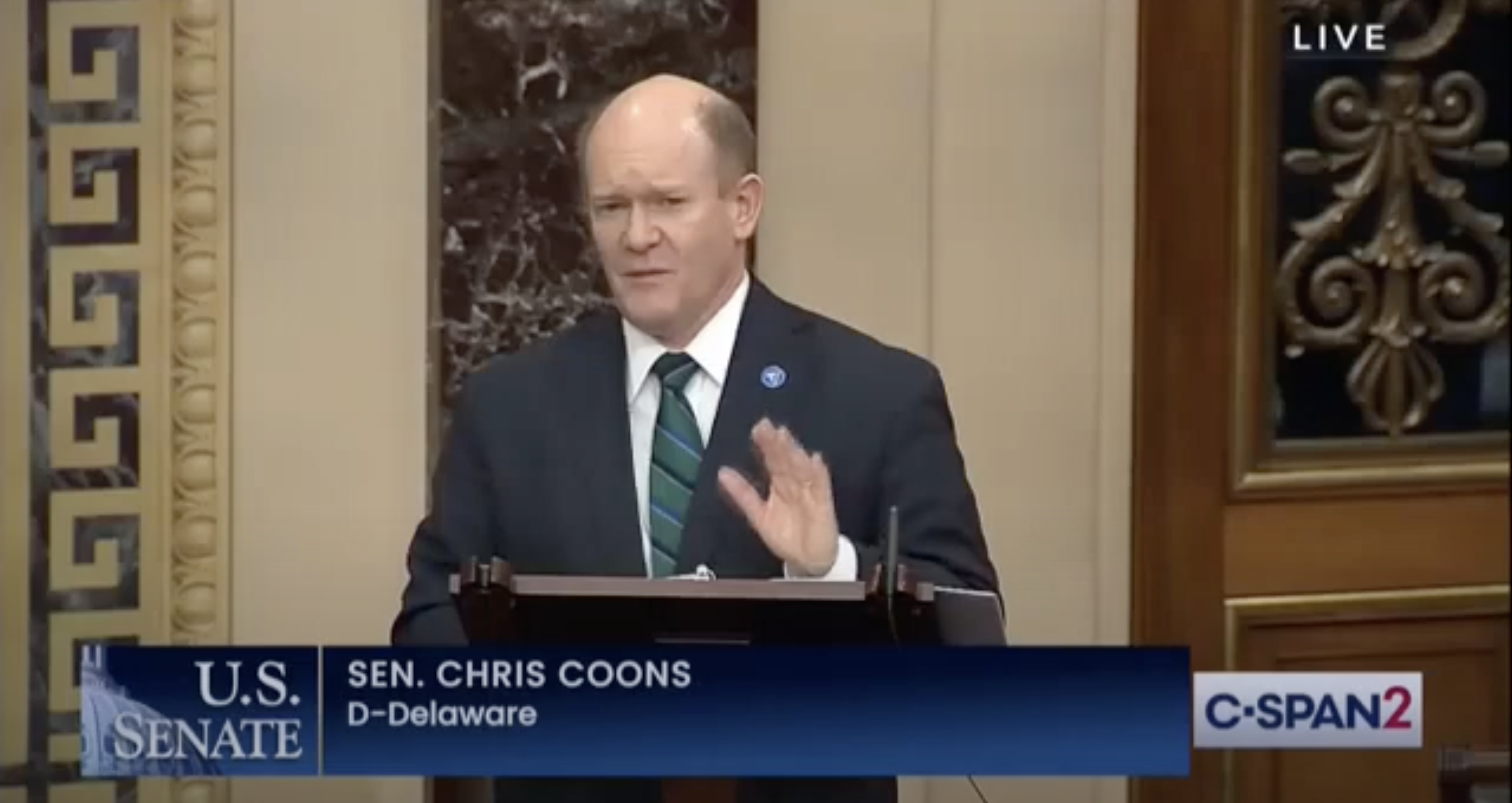
Senator Coons gives floor speech on AmeriCorps Week: “The best thing we can do for our nation is to [commit] to each other through national service”

WASHINGTON – U.S. Senator Chris Coons (D-Del.) yesterday delivered a floor speech in the U.S. Senate to mark AmeriCorps Week and highlight the significant impact that national service has had in his life and in the life of over 1 million Americans. Senator Coons is Co-Chair of the Congressional National Service Caucus. AmeriCorps Week runs from March 10 to 16. 

WATCH

Screenshot 2024-03-14 at 4

A full transcript is available below:

Senator Coons: Mr. President, volunteerism and service has long defined the very heart of the American spirit. It was Alexis de Tocqueville in the middle of the 19th century – at the really, the dawn of the modern American republic – who observed that it was the willingness to take initiative, to get engaged, to roll up your sleeves and get to work helping build your community that distinguished the people of this new continent from the Old World. And I’ll say I’ve seen it myself. 

I’m here to celebrate the 30th anniversary of America’s national service program, something called AmeriCorps. It was created in a bipartisan effort. At the end of the George H.W. Bush administration, at the beginning of the Bill Clinton administration, there was a concerted, bipartisan effort to recognize that models around the country that showed the impact on young Americans of spending a year of their lives in service to others was worth expanding and replicating. This week actually happens to be AmeriCorps Week, March 10th to the 16th. And we are celebrating 30 years of service.

I’ve just introduced a bipartisan and bicameral resolution with Senator [Bill] Cassidy [R-La.], with Congresswoman [Doris] Matsui [R-Calif.] and Congressman [Garret] Graves [R-La.]. And as I mentioned, AmeriCorps has been bipartisan from the start, and I look forward to continuing its future in a bipartisan way. I’ve long had a connection to AmeriCorps, going back to one of the very first national direct AmeriCorps programs, that I ran with the I Have a Dream Foundation in the mid-’90s. When I was working for I Have a Dream, we had 150 AmeriCorps members serving in 10 cities, doing after-school programming and summer programming with children from disadvantaged backgrounds. It’s one of many ways in which young Americans participating in AmeriCorps have contributed to their community, have developed their skills, and have earned money for college.

Years later, when I was a county executive, I launched the New Castle County Emergency Services Corps to help strengthen the volunteer fire service in my home community. There are dozens of volunteer fire companies in Delaware, and they have often served the backbone not just of the first responder community, but of every community. I grew up in a very small town named Hockessin, and that siren going into the middle of the night from our volunteer fire company was a reminder to me of the call that is at the very foundation of our nation: to get up in the middle of the night, to jump in your truck, drive down to the fire hall, and to take on the risk of serving and saving your neighbor.

Recruiting, training, and supporting AmeriCorps members through the I Have a Dream Program was one of the most rewarding opportunities in my life. I actually for many years served on the commission that directs and oversees AmeriCorps in Delaware, and it was through that service that I met my wife. Over a million Americans have served in AmeriCorps since 1994. Delaware today, alone, has more than 361 traditional AmeriCorps members, more than 900 AmeriCorps Seniors, and they do a very wide range of things, from tutoring children, responding to disasters, improving and rebuilding housing, helping veterans, and much more.

Let me briefly mention two currently serving members of AmeriCorps in Delaware: Sharon, an adult literacy instructor, who works with Literacy Delaware, teaches English to our newest Americans. She spoke of the joy an immigrant mother felt when the school administrator called to tell her about her son and to communicate something positive about his progress in school, and she could understand everything for the first time, as she was coming to master English without an interpreter. Or Shristi, an academic coach at Team Sharp, a college access program for underrepresented high school students, spoke of how fulfilling it was to help young men and women in Delaware, just as she herself had benefited from similar mentoring and tutoring. These two examples are a reminder of what more than a million AmeriCorps members over 30 years have experienced: that service brings America together. It helps us bridge our divides.

AmeriCorps has organized, for decades now, an annual 9/11 day of service that brings people of all backgrounds together to be reminded of what citizenship means in our nation: service to others. And as we reflect on 30 years, I think it needs to be a call for all of us to engage in the work of service, to take up the challenge of reauthorizing, strengthening, and expanding AmeriCorps as a program, and to recognize that the best thing we can do for our nation is to get committed to each other through national service. Congratulations to all who’ve served in AmeriCorps over the last 30 years and to the millions more Americans whose future will be enlivened, brightened, and strengthened through the opportunity to serve. Thank you.


Senator Coons sends bipartisan letter urging inclusion of 20,000 additional visas for Afghan allies

WASHINGTON – U.S. Senator Chris Coons (D-Del.), Chair of the Senate Appropriations Subcommittee on State, Foreign Operations, and Related Programs (SFOPS), today sent a bipartisan letter to Senate leadership urging that the final SFOPS appropriations bill uphold our commitment to the Afghan Special Immigrant Visa (SIV) program and include the 20,000 additional SIVs contained in the SFOPS bill the Senate passed. U.S. Senators Jeanne Shaheen (D-N.H.), Mike Rounds (R-S.D.), Ben Cardin (D-Md.), Thom Tillis (R-N.C.), Jack Reed (D-R.I.), Jerry Moran (R-Kan.), Amy Klobuchar (D-Minn.), Tammy Duckworth (D-Ill.), Robert Menendez (D-N.J.), Chris Van Hollen (D-Md.), Tim Kaine (D-Va.), Jeff Merkley (D-Ore.), Bill Cassidy, M.D. (R-La.), and Lisa Murkowski (R-Alaska) joined Senator Coons on the letter.

In part, the senators wrote: “According to the Department of State, as of March 1, 2024, there are approximately 7,000 visas remaining, with 1,000 visas issued every month. 12,000 applicants have received Chief of Mission (COM) approval and are awaiting visa interviews and another 8,000 have COM approval and are collecting the necessary documents to become interview ready. This means that approximately 20,000 principal applicants will soon require visas.”

They continued: “There have been credible reports of hundreds of Afghans killed while waiting for the SIV application to be processed. Congress must ensure that the visas are available to bring every eligible SIV applicant – including the surviving spouse in cases where our Afghan ally has already been killed – to the United States.”

Full text of the letter can be found here.

Senator Coons has been a leader on efforts to protect Afghan allies in the wake of the U.S. withdrawal from Afghanistan. Last Congress, he was an original cosponsor of the Afghan Adjustment Act, which would improve and expand the SIV process for Afghans who served alongside U.S. servicemembers. He reintroduced and has repeatedly fought to pass the Afghan Adjustment Act this Congress as well.


Bipartisan Senate Climate Solutions Caucus Co-Chairs Coons and Braun host concrete and asphalt decarbonization event

WASHINGTON – U.S. Senators Chris Coons (D-Del.) and Mike Braun (R-Ind.), Co-Chairs of the bipartisan Senate Climate Solutions Caucus, hosted a caucus event today to explore opportunities for innovation and decarbonization in the concrete and asphalt sectors. Participants included David Crane, Undersecretary for Infrastructure at the U.S. Department of Energy; Jeremy Harrell, Chief Strategy Officer at ClearPath; Leah Ellis, CEO and Founder of Sublime Systems, Inc.; David Perkins, Vice President of Governmental Affairs at Heidelberg Materials; and Heather Dylla, Vice President of Sustainability at Construction Partners, Inc. 

Senator Coons has introduced bipartisan legislation with Senator Thom Tillis (R-N.C.) to accelerate the use of low-emissions concrete and asphalt. 

“Reducing the emissions it takes to produce the world’s most plentiful building material is a unique opportunity to position American leadership in clean manufacturing, create good-paying jobs, and help us meet our climate goals,” said Senator Coons. “I’m glad that the bipartisan Senate Climate Solutions Caucus could examine opportunities and challenges for innovation in this important space with this esteemed group of panelists today.” 

“This event was a good opportunity to hear from materials industry leaders about their plans to innovate in the concrete and asphalt manufacturing process,” said Senator Braun.

The bipartisan Senate Climate Solutions Caucus was founded in 2019 by Senators Coons and Braun as a forum for senators across party lines to find common ground on solutions to address a changing climate. The caucus has convened business leaders, topic experts, local leaders, international figures, and more on a variety of topics ranging from emerging technologies to climate resilience to critical minerals. This is the caucus’ second event this year.


Senators Coons, Cassidy, Heinrich, Capito and Reps. Matsui, Graves celebrate AmeriCorps Week

WASHINGTON – U.S. Senators Chris Coons (D-Del.) and Bill Cassidy, M.D. (R-La.), Senate Co-Chairs of the National Service Congressional Caucus; Senators Martin Heinrich (D-N.M.) and Shelley Moore Capito (R-W.Va.), Vice Chairs of the caucus; and House of Representatives Co-Chairs Garret Graves (R-La.) and Doris Matsui (D-Calif.), today released a resolution in celebration of AmeriCorps Week, which runs March 10-16, 2024. Founded 30 years ago to increase national service opportunities while providing a pathway to education, AmeriCorps members comes from all backgrounds and walks of life to engage in meaningful service for others.

“Over the past three decades, more than 1 million AmeriCorps members have rolled up their sleeves and gotten things done for our nation,” said Senator Coons. “This week, we celebrate their work to mentor students, tackle food insecurity, improve public health, respond to disasters, protect the environment, and support local communities across our country. As Co-Chair of the National Service Caucus, I applaud the more than 200,000 current AmeriCorps members and AmeriCorps Seniors volunteers who rise each day to make America a better place and encourage all those contemplating national service to consider AmeriCorps as a way to make meaningful change.”

“AmeriCorps members dedicate their lives to those who need a helping hand. From empowering students in the classroom to supporting veterans transitioning to civilian life, they help build stronger communities,” said Senator Cassidy. “This resolution ensures their service does not go unnoticed.”

“Every day, AmeriCorps empowers people of every background to step forward and serve their fellow Americans,” said Congresswoman Matsui. “AmeriCorps members are a truly uniting force – bridging divides, extending a helping hand, and offering a trusted framework for building powerful and sustainable relationships across our communities. This resolution celebrates these achievements and uplifts the essential role of national service programs. The spirit of service is an integral part of our national identity, and my National Service Caucus Co-Chairs and I are dedicated to finding ways to expand opportunities for national service to every corner of our nation.”

“We in South Louisiana feel the direct impact of national service volunteers in our communities – like the Cajun Navy, Samaritan’s Purse, and Baptist Relief Missions, AmeriCorps volunteers have joined thousands in our community to help gut, clean, and rebuild tens of thousands of flooded homes,” said Congressman Garret Graves. “They also work in our schools to help chart a better course for our youth, and their public health initiatives focus on expanding and modernizing health care access in rural areas. Their mission is focused on community recovery, improvements in education, decreasing preventable illness, and helping folks find pathways to independence. How could you not celebrate that? I’m proud to recognize their contributions to our communities across the nation this week and always.”

“For the last 30 years, we’ve seen time and time again that national service unites us and builds shared purpose in our communities,” said Michael D. Smith, CEO of AmeriCorps. “As our country celebrates the lasting impact of generations of AmeriCorps members and AmeriCorps Seniors volunteers during AmeriCorps Week, I am especially grateful for the bipartisan leaders of the National Service Congressional Caucus who make their service possible. Thank you to Senator Coons and Senator Cassidy, and Representative Matsui and Representative Graves, for their efforts to make national service an indispensable part of the American experience while reducing barriers to serve. The Biden-Harris administration believes in the transformative power of service to tackle pressing challenges while inspiring unity.”

“As we celebrate AmeriCorps Week this year, we also celebrate AmeriCorps’ 30th anniversary – three decades of tens of thousands of young people responding to the country’s most immediate and critical needs and supporting local nonprofit, faith-based, and community organizations,” said AnnMaura Connolly, President of Voices for National Service. “As always, we’re deeply grateful to Senators Chris Coons, Bill Cassidy, Shelley Moore Capito, and Martin Heinrich and Representatives Doris Matsui and Garret Graves for their leadership of the National Service Congressional Caucus. We are especially thankful for their commitment to AmeriCorps, a commonsense solution we can all agree should be expanded and strengthened.”

“The National Service Caucus serves as a vital bipartisan voice helping to educate Congress on the importance of national service and its ability to address key needs while bringing communities together,” said Kaira Esgate, CEO of America’s Service Commissions. “On behalf of state and territorial service commissions, we applaud Senators Coons, Cassidy, Heinrich, and Capito, and Representatives Graves and Matsui, for their efforts in growing the bipartisan support and reach of the caucus. We look forward to continuing to work with the caucus on ensuring AmeriCorps and our states and territories have adequate resources to support opportunities to serve in AmeriCorps and AmeriCorps Seniors on projects that develop new workforce pathways, aid veterans and their families, recover from natural disasters and build climate resilience, and help students overcome learning loss and make educational gains.”

AmeriCorps by the numbers, nationally:

  • 200,000 members and volunteers in more than 2,000 organizations dedicated to strengthening their communities in 20204.
  • 245,000 veterans and military families connected to education opportunities, jobs, and benefits they have earned annually.
  • 310,000 elderly Americans provided with independent living services annually.
  • $4.5 billion earned in education awards since 1994.

AmeriCorps by the numbers in Delaware:

  • $7.8 million in AmeriCorps investment, including $5.1 million in federal funding, to support cost-effective community solutions.
  • 205 service locations and 1,297 members of all ages and backgrounds united to meet local needs, strengthen communities, and expand opportunity in Delaware.
  • 5.4 million hours worked and more than $13.9 million in education awards earned by more than 3,700 Delaware residents.
  • $5.8 million in education award payments to higher education institutions and other organizations in Delaware.

The full text of the resolution is available here.

###

Senator Coons statement on Senate passage of six-bill appropriations package

WASHINGTON – U.S. Senator Chris Coons (D-Del.) released the following statement after he voted with the Senate to pass the first six of 12 fiscal year 2024 appropriations bills, which fund the Departments of Agriculture, Commerce, Energy, Interior, Justice, Transportation, Veterans Affairs, and Housing and Urban Development, before today’s deadline:

“This bipartisan six-bill spending package funds critical priorities for Delaware and the country as a whole, supporting our service members and veterans, providing affordable housing for working families, and spurring adoption of clean energy technologies, among many other projects. I am also proud to have secured over $100 million for projects up and down Delaware that will address our affordable housing shortage, support public safety, and invest in environmental efforts.  

“I thank Senate Majority Leader Chuck Schumer, Senate Republican Leader Mitch McConnell, Appropriations Committee Chair Patty Murray, and Appropriations Committee Vice Chair Susan Collins for their bipartisan work to keep our government open and operating.”

Senator Coons is a member of the Senate Appropriations Committee and Chair of the Appropriations Subcommittee on State and Foreign Operations (SFOPS).