Related Issues

Related Issues

Senator Coons calls for increased efforts to protect American intellectual property

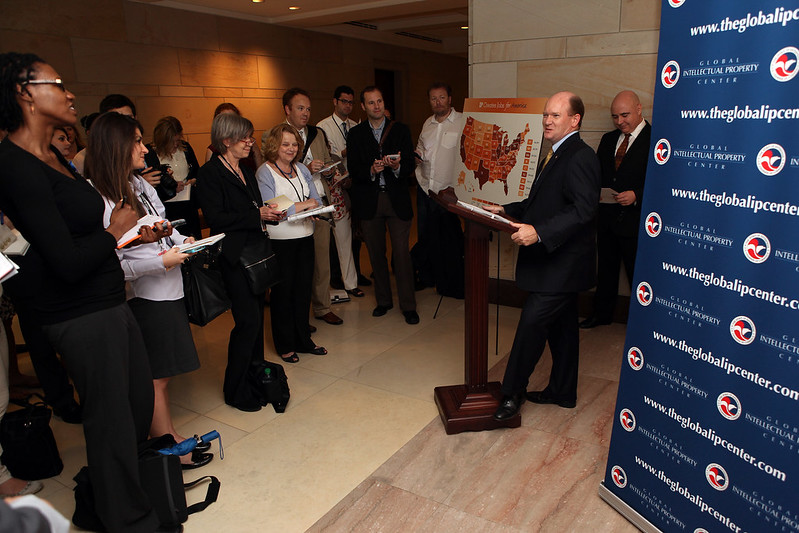
Photo of Senator Coons speaking at event on intellectual property

WASHINGTON – Speaking at an event hosted by the U.S. Chamber of Commerce’s Global Intellectual Property Center on Wednesday, U.S. Senator Chris Coons (D-Del.) praised new research that maps the broad impact that intellectual property has on the American economy and called for increased work by Congress to protect the ideas and innovations powering our economic recovery.

“Protecting American innovation means protecting American jobs,” Senator Coons said. “When thieves steal American intellectual property, they’re stealing American jobs. It really is just that simple. Offline and online, protecting American intellectual property is an economic security imperative.”

Wednesday’s event unveiled new research, which is available online at www.IPCreatesJobs.com, found that intellectual property supports 150,110 jobs in Delaware — including 57,692 direct jobs. Delaware’s intellectual property accounts for $4.9 billion in exports annually. The study also found that Delaware companies invest more than 40 percent  in research and development than the national average.

Senator Coons, who is a member of the Senate Judiciary Committee and has introduced several bills to strengthen American innovation and intellectual property, pointed to two Delaware companies whose success depends on the sanctity of their intellectual property.

“Frank Masley started stitching gloves to solve a key problem – military-issue gloves that were warm and waterproof were too bulky for key tasks,” Senator Coons said. “He used materials from several Delaware companies to develop a better glove, perfect for flying Chinooks and other military aircraft. Masley Enterprises in Newark now has military contracts and 40 employees making gloves using a proprietary tooling process. If a competitor had access to his trade secrets, his company couldn’t continue to grow. He couldn’t create more jobs.”

“IP has a real impact on companies like Adesis — a small organic chemistry company in New Castle, Delaware,” Senator Coons said, “which was crippled when a disgruntled employee walked away to a competitor with Adesis’ trade secrets in hand. As that company prospered, Adesis was forced to lay off half of its 40 employees. Adesis won the court case and is on the rebound with 55 employees today, but imagine where they could be were it not for that setback.”

A fact sheet on the impact of intellectual property on the Delaware economy can be found here: http://www.theglobalipcenter.com/sites/default/files/delaware-2012.pdf

###

Senators Coons, Rubio, Warner, and Moran introduce bill to help startups create jobs

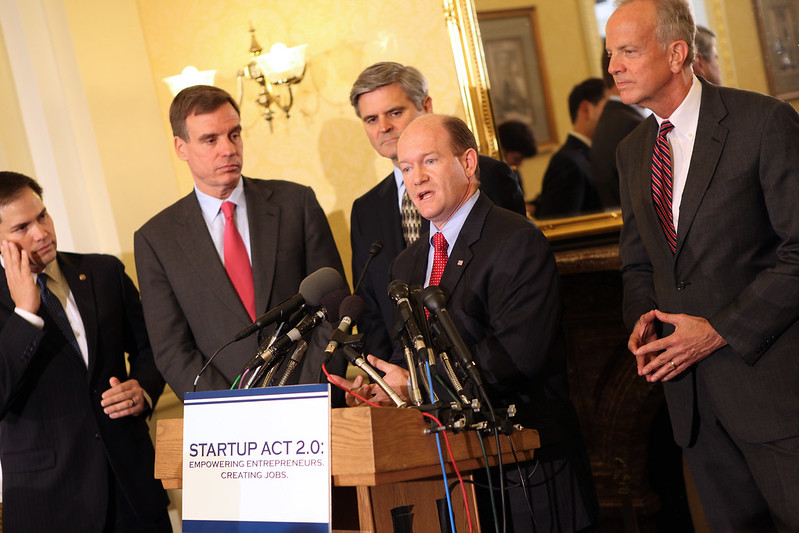
Photo from Startup Act 2.0 press conference

WASHINGTON – U.S. Senators Chris Coons (D-Del.), Marco Rubio (R-Fla.), Mark R. Warner (D-Va.), and Jerry Moran (R-Kan.) introduced bipartisan legislation, Startup Act 2.0, on Tuesday to help jumpstart the economy through the creation and growth of new businesses and jobs.  It is based upon research showing that for close to three decades, companies less than five years old have created almost all of the net new jobs in America, averaging about three million new jobs each year.

Startup Act 2.0 seeks to help move university-based research from the laboratory to the marketplace more quickly. It also makes targeted changes to the tax code to encourage investments in younger, smaller startup companies, and the bill also seeks to ease regulatory requirements that could make it more difficult for smaller businesses to expand and create jobs. Startup Act 2.0 also creates new opportunities for American-educated, entrepreneurial immigrants to remain in the U.S., where their talent and ideas can fuel growth and create American jobs.

Startup Act 2.0 builds upon the original Startup Act introduced by Sens. Warner and Moran in December, and it has been strengthened by including widely-supported provisions of S. 1866, the AGREE Act, introduced by Sens. Coons and Rubio in November. Startup Act 2.0 picks up where the JOBS Act left off by doing more to create an environment in which entrepreneurs can succeed. 

“A central tenet of the AGREE Act, which Senator Rubio and I introduced last fall, was that there is not a shortage of good ideas for helping our economy create jobs, but a shortage of political will to come together and advance them,” Senator Coons said. “Startup Act 2.0 builds on that philosophy, containing an array of smart ideas for supporting our innovative entrepreneurs. I am proud to join Senators Moran, Warner and Rubio in introducing those ideas today, and look forward to working with them to help Startup Act 2.0 become law.”

Startup Act 2.0 includes the following provisions:

  • Creates a new STEM visa so that U.S.-educated foreign students, who graduate with a master’s or Ph.D. in science, technology, engineering or mathematics, can receive a green card and stay in this country where their talent and ideas can fuel growth and create American jobs. It also creates an Entrepreneur’s Visa for legal immigrants so they can remain in the United States, launch businesses and create jobs, and eliminates the per-country caps for employment-based immigrant visas, which hinders U.S. employers from recruiting the top-tier talent they need to grow.
  • Makes permanent the exemption of capital gains taxes on the sale of startup stock held for at least five years, so investors can provide financial stability at a critical juncture of firm growth.
  • Creates a targeted research and development tax credit for young startups less than five years old and with less than $5 million in annual receipts. This R&D credit is designed to allow startups to offset employee taxes, freeing up resources to help these young companies expand and create jobs.
  • Uses existing federal R&D funding to better support university initiatives designed to bring cutting-edge R&D to the marketplace more quickly, where it can propel economic growth.
  • Requires government agencies to conduct a cost-benefit analysis of proposed “major rules” with an economic impact of $100 million or more. This new requirement will help determine the potential impact of proposed regulations on the formation and growth of new businesses.
  • And Startup Act 2.0 directs the U.S. Department of Commerce to assess state and local policies that aid in the development of new businesses. Through the publication of reports highlighting these “best practices” from across the country, policymakers will be better equipped to encourage entrepreneurship by adopting the most effective and successful policies.

“When Senator Coons and I introduced the AGREE Act last fall, we hoped it would lead to greater cooperation on job creation policies that already enjoy broad bipartisan support,” Senator Rubio said. “Teaming up with Senators Moran, Warner and Coons on Startup Act 2.0 is a worthy effort to break through Washington’s gridlock and help entrepreneurs create new jobs through key reforms to our tax, visa and regulatory systems. Startup Act 2.0 is built on ideas that have bipartisan support and could become law tomorrow if Washington stopped playing games and started working for the people.”

“Startup 2.0 offers smart, commonsense steps to support and encourage America’s innovators and entrepreneurs,” Senator Warner said. “Working together, we have put together bipartisan proposals that will help us compete and win the global contest for talent. We also propose responsible steps that will help our colleges and universities move taxpayer-funded R&D out of the lab and into the marketplace. Startup 2.0 the logical ‘next step’ following enactment of the bipartisan JOBS Act earlier this year.”

“Our bipartisan economic growth plan sets out to prove the critics wrong: Congress can get something done during an election year by coming together to strengthen the economy and create jobs,” Senator Moran said. “To get America’s economic engine roaring once again, entrepreneurs – both American and foreign-born – must be free to pursue their ideas, form companies in the United States, and hire employees. Startup Act 2.0 will create jobs for Americans by creating a circumstance in which entrepreneurs can succeed and the United States can win the global battle for talent.” 

Many of the principles included in Startup Act 2.0 are endorsed by the President’s Council on Jobs and Competitiveness, which was represented at today’s announcement by Steve Case, a co-founder of AOL. 

“The passage of the JOBS Act demonstrated that despite a tough political climate, Democrats and Republicans can come together around policies that will help entrepreneurs innovate and create jobs,” Steve Case said. “Startup Act 2.0 builds on that momentum and its passage will help solidify America’s position as the world’s most entrepreneurial nation. I am particularly pleased the bill includes a provision that will enable highly skilled engineers and entrepreneurs to start companies in the United States, as winning the global battle for talent is essential if we are going to keep our entrepreneurial economy moving forward. I commend Senators Moran, Warner, Rubio and Coons for their leadership and their willingness to come together in a bipartisan manner to focus on what unites us: a desire to create jobs, accelerate economic growth, and ensure our nation remains competitive globally.”

Startup Act 2.0 had been endorsed by TechAmerica, Financial Services Forum, National Small Business Association, CONNECT, CEA and the Computer and Communications Industry Association.

###
Congressional Delegation hosts free grant fair and workshop in Dover

DOVER, Del. — More than 200 people visited Delaware State University on Monday for a free grant fair and workshop hosted by U.S. Senators Tom Carper and Chris Coons, and U.S. Representative John Carney (all D-DE).  The event was to help Delawareans better understand the process for finding and securing grant opportunities, as well as put them in contact with 25 funders from state and federal agencies, private businesses, and the non-profit community.  In addition, participants could attend two workshops offered during the day focused on grant writing, the grant evaluation process, and best practices for securing funding.

“Today’s fair gave grant seekers an opportunity to ask questions and get answers to help them with the grant application process,” said Sen. Carper. “It’s our job to ensure that the hard working organizations seeking funding to help their communities, as well as our state, get access to the best information possible so they can compete and hopefully win critical federal grant money. Going forward, I hope these organizations continue to utilize our Congressional Delegation’s offices as a helpful resource for the grant application process.”

“This grant fair and workshop succeeded at forging connections between grant seekers and grant writers,” Sen. Coons said.  “Researching, writing and applying for grants can be a daunting process, and I’m hopeful that this event made the system easier and more accessible for small business owners, entrepreneurs and non-profits.  I look forward to hearing success stories where connections were made, applications were filed, and ultimately grants were awarded.”

“Today’s grant fair was about helping Delawareans who are doing great work in our community get better access to the resources and support they need to be successful,” said Congressman Carney.  “The state and federal grant process can be very competitive and complicated.  I’m hopeful that the lessons shared and connections made today will result in more grants awarded to deserving Delaware organizations.”

Dr. Harry L. Williams, president of Delaware State University, said that this is just another example of the teamwork of the Delaware Congressional Delegation as they continually strive for the success and prosperity of the residents of the First State.

“As our faculty here at Delaware State University has learned, there is a lot that goes into successful federal grant writing,” said Dr. Williams. “And just as this University has been able to obtain millions of dollars in federal grants, this unique opportunity has provided others with valuable information and insight that could bring more federal dollars into Delaware.” 

###

Senator Coons applauds progress on two bills to enhance law enforcement protection

WASHINGTON – U.S. Senator Chris Coons (D-Del.), a member of the Senate Judiciary Committee and a co-chair of the Senate Law Enforcement Caucus, praised the Judiciary Committee’s passage Thursday of two bills that will help better protect members of our local, state, and federal law enforcement: the Officer Safety Act of 2012 and the Bulletproof Vest Partnership Grant Act of 2012.

“Police officers look out for our communities and our families every day, risking their own safety to do so,” Senator Coons said. “We need to look out for them, too, and should be doing all we can to ensure they have the tools and resources to do their jobs safely. The bills we passed today will help protect our officers from bodily harm while on the job and will make sure federal agents have access to a fair court process if they ever need it. I applaud my colleagues’ work today and for coming together during National Police Week to support our nation’s first responders. I hope both bills will be considered by the full Senate soon.”  

The Officer Safety Act of 2012, which was introduced by Senator Coons and Senator Chuck Grassley (R-Iowa) in April, would allow federal law enforcement officers who acted to protect the life of a potential victim and were charged with a crime in state court an opportunity to petition to have the agent’s case heard before a federal court. The legislation is modeled after the Good Samaritan Act, but is narrower and applies only to criminal actions. The bill does not provide immunity to federal law enforcement officers, but simply allows for case removal to federal court where the officer will be required to defend his or her actions.

The Bulletproof Vest Partnership (BVP) Grant Act of 2012, which was introduced by Senator Patrick Leahy (D-Vt.) earlier this month and of which Senator Coons is an original cosponsor, is a reauthorization of the competitive grant program from the Bureau of Justice Assistance that provides funding to state and local law enforcement agencies to assist in their purchasing of ballistic-resistant and stab-resistant body armor that complies with National Institute of Justice body armor standards.  Since the BVP program’s first authorization in 1999, it has reimbursed grantees approximately $247 million for their purchases of nearly 1 million vests. In 2011, the BVP program provided police departments in Delaware with $141,027, enough for 1,791 vests; in 2010, the BVP program provided $120,000, enough for 502 vests; and in 2009, the program provided $94,000, enough for 588 vests.

The Senate and House Law Enforcement Caucuses held a briefing earlier this week for Members and their staff featuring a panel presentation on the function and science behind bullet- and stab-resistant body armor. To learn more about the briefing, click here: http://www.coons.senate.gov/vestsevent

###

Senator Coons reacts to House passage of discriminatory version of reauthorization of Violence Against Women Act

WASHINGTON – U.S. Senator Chris Coons (D-Del.), a member of the Senate Judiciary Committee, co-chair of the Senate Law Enforcement Caucus, and a strong supporter of the Violence Against Women Act (VAWA), today condemned the House of Representatives’ passage of a reauthorization measure, H.R. 4970, that fails to include critical provisions from the bipartisan reauthorization approved by the Senate last month. Reflecting the recommendations of law enforcement, the Senate version includes new protections for victims of domestic abuse who live on Native American reservations, are members of the LGBT community, or are immigrants to this country.

“Domestic violence touches all segments of our society, and every person who has been a victim of abuse — regardless of their race, sexual orientation or residency status — should be able to seek justice,” Senator Coons said. “The Republican-led House of Representatives today once again chose to play politics with America’s women by passing a discriminatory measure that would deliberately exclude whole segments of our society from receiving fair treatment under the law. Instead of taking up the bipartisan Senate-passed Violence Against Women Act, House Republicans are actively delaying and denying critical resources to local law enforcement agencies and advocacy groups.”

On April 26, the Senate passed a strong, bipartisan Violence Against Women Act reauthorization with a 68 to 31 vote, upholding the bipartisan tradition of VAWA reauthorizations. 

Senator Coons is a cosponsor of that bill, S.1925, which would improve existing programs to address evolving needs in the fight against domestic violence, dating violence, sexual assault, and stalking. The legislation supports training for those on the front lines of efforts to eliminate domestic violence. It takes the important step of explicitly preventing grant recipients from discriminating against victims who are gay, lesbian, bisexual or transgender, and modifies the U-Visa program to make it easier for law enforcement to gain the cooperation of victims in prosecuting dangerous perpetrators. 

The House version, in contrast, doesn’t include any language to protect the LGBT community; fails to provide for concurrent special domestic violence criminal jurisdiction by tribal authorities over non-Indians; fails to provide needed support to law enforcement by expanding the U-Visa program; and fails to address the high rates of dating violence and sexual assault experienced by young people in college and other higher education institutions.

At a press conference on Wednesday morning, Senator Coons called on the House to pass the Senate-version of VAWA reauthorization. VIDEO: http://bit.ly/JwBlhm.

“While the Senate, sadly, initially faced partisan opposition, my colleagues joined together to rise above party politics and do what is right for the safety of Americans,” Senator Coons said. “It is my hope that the House follows our lead on the Violence Against Women Act reauthorization and swiftly passes the Senate bill that helps to ensure safety for all.”

Originally drafted by then-Senator Joe Biden, VAWA was signed into law by President Clinton in 1994, and has since been reauthorized twice: in 2000 and 2005. The law’s current authorization, however, expired in September 2011.  Programs supported by VAWA have provided victims with critical services such as transitional housing, legal assistance, and supervised visitation services. VAWA has also encouraged communities to coordinate their responses to domestic and sexual violence by bringing together victim advocates, law enforcement, the courts, health care professionals and leaders within faith communities.

###

Senator Coons joins colleagues in urging Senate action on farm bill

WASHINGTON – U.S. Senator Chris Coons (D-Del.) this week sent a letter, along with 43 of his Senate colleagues, on a letter to Senate Majority Leader Harry Reid (D-Nev.) and Republican Leader Mitch McConnell (R-Ky.) calling for a timely and open debate on the Senate farm bill.

“With our constant focus on job creation, we write to urge you to schedule floor consideration of the ‘Agriculture Reform, Food and Jobs Act of 2012’ as soon as possible,” the senators wrote. “The bill takes steps to reduce the deficit and decrease government spending by $23 billion. It passed the Senate Committee on Agriculture, Nutrition and Forestry on April 26 with a bipartisan vote of 16 to 5. This sets an example of how Senators can come together in a bipartisan way to craft meaningful, yet fiscally responsible, policy. We believe there is strong support in the full Senate to consider the bill in a fair and open manner that allows Senators the opportunity to offer amendments.”

The farm bill passed by the Senate Agriculture Committee would reduce the deficit and save taxpayers more than $23 billion while strengthening and preserving farm risk management programs. The bill also streamlines conservation programs and helps prevent fraud and abuse in nutrition programs.

The risk management, conservation, research, trade promotion and nutrition programs in the legislation impacts nearly every American. Many of these programs will expire at the end of the year if no action is taken to reauthorize the farm bill. While Senator Coons believes the bill is not perfect, he believes it represents a strong bipartisan compromise and should be considered by the full Senate.

The signed letter can be found here: http://bit.ly/MkPIVT

The 44 senators who signed the letter were: John Barrasso (R-Wyo.), Max Baucus (D-Mont.), Michael Bennet (D-Colo.), Richard Blumenthal (D-Conn.), Roy Blunt (R-Mo.), Scott Brown (R-Mass.), Sherrod Brown (D-Ohio), Maria Cantwell (D-Wash.), Bob Casey (D-Pa.), Dan Coats (R-Ind.), Kent Conrad (D-N.D.), Chris Coons (D-Del.), Mike Crapo (R-Idaho), Mike Enzi (R-Wyo.), Al Franken (D-Minn.), Kristen Gillibrand (D-N.Y.), Chuck Grassley (R-Iowa), Kay Hagan (D-N.C.), Tom Harkin (D-Iowa), John Hoeven (R-N.D.), Kay Bailey Hutchison (R-Texas), Daniel Inouye (D-Hawaii), Mike Johanns (R-Neb.), Tim Johnson (D-S.D.), John Kerry (D-Mass.), Mark Kirk (R-Ill.) Amy Klobuchar (D-Minn.), Herb Kohl (D-Wis.), Pat Leahy (D-Vt.), Dick Lugar (R-Ind.), Claire McCaskill (D-Mo.), Jeff Merkley (D-Ore.), Jerry Moran (R-Kan.), Ben Nelson (D-Neb.), Bill Nelson (D-Fla.), Jim Risch (R-Idaho), Bernie Sanders (I-Vt.), Jeanne Shaheen (D-N.H.), Olympia Snowe (R-Maine), Jon Tester (D-Mont.), John Thune (R-S.D.), Mark Udall (D-Colo.), Tom Udall (D-N.M.), and Ron Wyden (D-Ore.).

###

Senators Coons, Alexander introduce bill to keep foreign-born U.S. grad students here “instead of sending them home to create jobs in other countries”

WASHINGTON – U.S. Senators Chris Coons (D-Del.) and Lamar Alexander (R-Tenn.) introduced the SMART Jobs Act — the Sustaining our Most Advanced Researchers and Technology (SMART) Jobs Act of 2012 — on Wednesday to create a clear path forward for foreign-born, American-educated holders of masters and doctoral degrees in science, technology, engineering and math (STEM) fields to remain in the United States to work and create jobs. Upon earning their graduate degrees, these students would be allowed to remain in the U.S. for up to 12 months while they look for work related to their field of study. Once employed, the students would be allowed to change their immigration status and receive a green card. These new STEM green cards would not count toward any existing green card caps or limits.

“Many of the best and brightest young minds in the world are educated at American colleges and universities, and instead of sending them home after graduation, we should be encouraging them to stay in the U.S. to pursue their innovations and create jobs here,” Senator Coons said. “When we send off these graduates to pursue their innovations in India and China, we are literally subsidizing our competitors. We are fueling the economies that are trying to beat us in the global marketplace – and they’re winning. The SMART Jobs Act is a bipartisan idea to create a clear path forward for foreign-born, American-educated students with advanced degrees in science, technology, engineering and math to stay in the United States after graduation to create jobs here. I’ve been proud to work with Senator Alexander on this bill, am grateful for the support of the coalition that has rallied behind this bill, and look forward to working to make it law.”

Alexander said of the bill, “It makes no sense to attract the most talented scientists and engineers from other countries to our schools to educate them, only to send them home to compete with American companies and create jobs – perhaps even the next Google – in other countries.”

Studies have shown that immigrants are nearly twice as likely as U.S.-born individuals to start new businesses, and in Silicon Valley, more than half of new high-tech startups had an immigrant founder. Immigrant-founded startup companies created 450,000 jobs in less than a decade, and collectively they have generated over $50 billion in sales in a single year. More than 40 percent of Fortune 500 companies were founded by immigrants or their children, but arbitrary and limiting per-country visa caps are sending nearly 20,000 foreign-born, American-educated degree-holders out of the country each year. With them go their ideas, innovations, and their potential to create jobs here in the U.S.

The SMART Jobs Act has been endorsed by Compete America, Oracle, Bloom Energy, Third Way, the Information Technology and Innovation Foundation, Tech America, the Silicon Valley Leadership Group, Immigration Voice, Delaware State University, and Steve Case, the CEO of Revolution LLC and a member of the President’s Council on Jobs and Competitiveness.

“When it comes to ensuring our competitiveness and maximizing economic growth and job creation, it is essential that the United States win the global battle for talent,” Mr. Case said. “The SMART Jobs Act is an important, bipartisan step forward. By allowing more foreign-born graduates with advanced STEM degrees from American universities to stay in the United States, we can help ensure that a whole new wave of great, entrepreneurial companies take root in this country. These highly-skilled men and women have proven to be job creators, so as a nation, we need to do everything we can to ensure they stay here and innovate, rather than force them to leave and start companies in other countries that then end up competing with the companies in our country.”

To ensure accountability, the SMART Jobs Act requires the Department of Homeland Security to provide an annual report on the number of F-4 visas granted, the country of origin of F-4 students, and the schools they attended.

The legislation as introduced can be downloaded here:

http://www.coons.senate.gov/media/2012-05-16-SMARTJobs-Act.pdf

A summary of the legislation can be downloaded here:

http://www.coons.senate.gov/media/2012-05-16-SMARTJobs-Summary.pdf

###

Senator Coons convenes briefing in Washington on bulletproof vests

WASHINGTON – U.S. Senator Chris Coons (D-Del.), a member of the Judiciary Committee and co-chair of the Senate Law Enforcement Caucus, hosted a briefing on Tuesday for members of Congress and their staff to learn about and experience wearing bullet-resistant and stab-resistant body armor. The event, “Protection through Innovation: Bullet – and Stab-Resistant Body Armor and Our Nation’s Law Enforcement Officers,” was sponsored by the Senate and House Law Enforcement Caucuses and featured speakers from local and national law enforcement agencies, and the company that manufactures Kevlar, DuPont.

“Our brave police officers put their lives in harm’s way day-in and day-out to protect our communities, the least we can do is provide them with the proper safety gear to help minimize work related injuries,” Senator Coons said. “It is important that we facilitate opportunities for the study of best practices and latest developments in the field to better educate those who are advocating on behalf of our first responders. During my time in county government, I worked closely with our local law enforcement agencies to ensure they had adequate resources to protect themselves while patrolling our streets.  I pledge to continue to fight for the safety of those who risk so much to protect our families.”

Safety issues that were addressed during the briefing include the scientific testing process for body armor, body armor wear rates and special-fit issues for body armor worn by women,  and efforts to minimize the risks of backface signature injuries.

Held during National Police Week, Tuesday’s briefing highlighted the Bulletproof Vest Partnership Grant Act of 2012, which will be voted-on by the Senate Judiciary Committee on Thursday. Senator Coons is an original cosponsor of this legislation, which provides funding to state and local law enforcement agencies to assist in their purchasing of ballistic-resistant and stab-resistant body armor through competitive grants from the Bureau of Justice Assistance.

Since the Bulletproof Vest Partnership program’s first authorization in 1999, it has reimbursed grantees approximately $247 million for their purchases of nearly 1 million vests. In 2010, the BVP program provided local police departments in Delaware with $120,000 for assistance in purchasing 502 vests. In 2009, the BVP program provided Delaware police departments with $94,000 for 588 vests.

In addition to Senator Coons, the event was co-hosted by Senator Roy Blunt (R-Mo.), Representative Dave Reichert (R-WA-8), and Representative Bill Pascrell, Jr. (D-NJ-8). Senator Coons delivered keynote remarks followed by Chief Jeffrey Horvath, Lewes, Delaware, Police Department and Chairman of the Delaware Police Chefs Council; Retired Chief Ron McBride, IACP/DuPont Kevlar Survivors’ Club; Stephanie Garlock, National Sheriffs’ Association; and Jeff Fackler, DuPont Protection Technology.

The Senate Law Enforcement Caucus and the House Law Enforcement Caucus educate and inform Members and staff about the policies, programs, and initiatives that enhance public safety and strengthen our criminal justice system. In the midst of shrinking budgets, law enforcement agencies all across the country continue to work tirelessly to keep our communities and families safe. 

###

Senator Coons honors National Police Week at ceremony in Washington

WASHINGTON – Tens of thousands of law enforcement officers from around the world traveled to Washington, D.C., this week to honor colleagues who have made the ultimate sacrifice in the protection of their communities. President Obama and U.S. Senator Chris Coons (D-Del.) joined officers and their families on the steps of the U.S. Capitol on Tuesday for an event to mark National Police Week and honor those whose names have been added to the National Law Enforcement Officers Memorial, including New Castle County Police Lieutenant Joe Szczerba, who was killed in the line of duty in September.

“The police officers who protect our communities have earned our profound respect and deep gratitude, and National Police Week is an important opportunity to honor their work and remember the sacrifices of those who have fallen in the line of duty,” Senator Coons said. “National Police Week serves as an important reminder to Congress that we must continue to work to ensure that our agencies receive the resources they need to effectively protect our communities.” Senator Coons is a member of the Senate Judiciary Committee and a co-chair of the Senate Law Enforcement Caucus.

The names of the 163 police officers killed in the line of duty in 2011 have been added to the National Law Enforcement Officers Memorial in Washington, including Lt. Szczerba’s.

“Joe Szczerba was a good person and great police officer whose spirit has been carried on by his family and his colleagues on the New Castle County police force,” Senator Coons said. “As our nation pauses today to honor his memory, we are reminded that Delaware is truly blessed to have such great men and women risking their lives to protect our communities.”

In 1962, President John F. Kennedy signed a proclamation designating May 15th as Peace Officers Memorial Day and the week in which that date falls as National Police Week. Between 25,000 and 40,000 people from departments throughout the United States and agencies around the world come to Washington to mark the day.

###

Carper, Coons, Carney host annual youth conference at Wesley College

DOVER, Del. – The annual Congressional Youth Conference hosted by U.S. Senators Tom Carper and Chris Coons, and U.S. Representative John Carney drew 118 juniors from high schools across Delaware to Wesley College in Dover on Monday.  Students had the opportunity to interact with the Congressional delegation, and to attend breakout sessions on cyber security, leadership through service, and the impact of digital channels on news.  Congressional staff was also on hand to answer questions about the application process for earning a nomination to the United States service academies.  

The late U.S. Senator Bill Roth hosted the first Youth Leadership Conference in 1969, and hosted it annually until 2000.

 “The Congressional Youth Conference is a long-standing tradition of connecting Delaware’s students with resources like workshops and service academy opportunities,” Senator Carper said. “Today’s conference gave me a chance to meet and talk to Delaware’s students about issues affecting them and to discuss the work I am doing on their behalf in Delaware and Washington D.C.

“For more than 40 years, students attending the Congressional Youth Conference have been benefiting from Senator Roth’s vision,” Senator Coons said.  “This tradition provides an opportunity for aspiring leaders from across Delaware to come together, to share ideas, and to gain insight into real world challenges and opportunities.  I thoroughly enjoyed talking with the students about their futures, and I look forward to hearing from them down the road when they are the next U.S. senator, a scientist, journalist or educator.”

“The Congressional Youth Conference is an excellent way for young people in Delaware to learn about the importance of public service, options they should consider after graduation, and some of the critical challenges facing the nation,” said Congressman Carney.  “It’s also a great opportunity for me to hear the opinions of young people regarding the issues facing our nation.  We had a productive discussion today, and it’s clear that these students are well on their way to being leaders in our community.”

Participants also took part in a service project where they presented the Food Bank of Delaware with canned good donations.

# # #