Related Issues

Related Issues

Senator Coons cosponsors bipartisan bill to support critical harbor and port maintenance

WASHINGTON – U.S. Senator Chris Coons (D-Del.) joined U.S. Senator Carl Levin (D-Mich.) in introducing bipartisan legislation on Monday to fund critical operations and maintenance of the nation’s harbors, including the Delaware River. The Harbor Maintenance Act of 2013 (S.218) would require funds in the Harbor Maintenance Trust Fund be spent for their intended purpose of maintenance and operations of federal ports, instead of being redirected to other uses.

“Maritime trade is one of Delaware’s oldest and most thriving industries, creating high-paying, good-quality jobs and fueling our local economy,” Senator Coons said. “The ports and harbors around the nation and here in Delaware are suffering, however, due to the lack of sufficient funds for maintenance and operations. The Harbor Maintenance Act will ensure that the taxes levied on shipping companies go right back to supporting the upkeep and repairs of our waterways to keep our maritime trade strong and our ports competitive.”

America’s ports and harbors support about 13 million jobs and account for $4 trillion in economic impacts. However, the Army Corps of Engineers estimates that the full depth of shipping channels at the nation’s 59 busiest ports are available less than 35 percent of the time, because they are inadequately maintained. The American Society of Civil Engineers’ estimates that aging infrastructure at our marine ports and inland waterways threatens more than 1 million U.S. jobs.

With the scheduled expansion of the Panama Canal by 2015, the average size of cargo ships will increase significantly, creating even more of a need to invest in infrastructure at our nation’s harbors and ports in order for them to remain competitive. As such, fully utilizing the Harbor Maintenance Trust Fund for its intended purpose — dredging — will be even more critical going forward. This is especially true for our East Coast ports, including the Port of Wilmington, which will see a significant increase in these Panamax cargo ships once the canal expansion is complete.

The Harbor Maintenance Tax and Harbor Maintenance Trust Fund were created in 1986 to fund operations and maintenance of federal ports and harbors. The tax is levied against the value of imports and domestic cargo arriving at U.S. ports that have federally maintained harbors and channels. The Harbor Maintenance Trust Fund currently has a balance of more than $5.7 billion, but the fund is not being fully used to address critical maintenance needs of harbors and ports around the country.

Similar problems once faced the Highway Trust Fund and the Airports and Airways Trust Fund, but Congress enacted similar legislation to correct them.

Including Senator Coons, the Harbor Maintenance Act of 2013 has already received 28 bipartisan cosponsors. The legislation has been referred to the Senate Committee on Environment and Public Works.

###

Senator Coons to help commemorate Black History Month

WASHINGTON – To celebrate the remarkable contributions of African Americans to our state and our country, U.S. Senator Chris Coons (D-Del.) will join his Senate colleagues Monday to introduce a resolution commemorating Black History Month. The resolution encourages Americans to pause and reflect on the role of African Americans in building our country and shaping its future.

“African Americans have made remarkable contributions to our state and our country, leading the way in fields like science, business and the arts,” Senator Coons said. “From the Milford Eleven, who were the first brave students to integrate Milford High School, to Underground Railroad conductors like Samuel D. Burris, Delaware’s history is full of African American heroes. The Senate’s resolution commemorating Black History Month honors their legacy, and I hope it will also inspire the next generation of leaders as they step forward to shape our future.”

The resolution, which will be introduced later today, is expected to pass the Senate unanimously later this week. The full text is below:

RESOLUTION

Celebrating Black History Month.

Whereas, in 1776, the United States of America was imagined, as stated in the Declaration of Independence, as a new nation dedicated to the proposition that ‘‘all men are created equal, that they are endowed by their creator with certain unalienable rights, that among these are life, liberty, and the pursuit of happiness’’;

Whereas, on November 19, 1863, President Abraham Lincoln, in reference to the Declaration of Independence, stated, ‘‘Four score and seven years ago our fathers brought forth, upon this continent, a new nation, conceived in liberty, and dedicated to the proposition that all men are created equal.’’;

Whereas the history of the United States includes injustices and the denial of basic, fundamental rights at odds with the words of the founders of the United States and the sacrifices commemorated at Gettysburg, Pennsylvania;

Whereas the injustices committed in the United States include approximately 250 years of slavery, 100 years of lynchings, denial of both fundamental human and civil rights, and withholding of the basic rights of citizenship;

Whereas the vestiges of slavery still exist in the systemic in- equalities and injustices in society;

Whereas Sojourner Truth, Fredrick Douglass, Harriet Tubman, W.E.B. Dubois, Charles Hamilton Houston, the Tuskegee Airmen, Lena Horne, Ralph Bunche, Jackie Robinson, Constance Baker Motley, James Baldwin, Dorothy Height, Thurgood Marshall, and Shirley Chisholm each lived a life of incandescent greatness while many African Americans lived, toiled, and died in obscurity, never achieving the recognition they deserved, but paved the way for future generations to succeed;

Whereas many African-American men and women worked against racism to achieve success, such as James Beckwourth, Bill Picket, Colonel Allen Allensworth, Clara Brown, and many others who were pivotal in the exploration and westward expansion of the United States;

Whereas pioneers such as David Dinkins, Mae Jemison, Arthur Ashe, Carol Moseley Braun, Oprah Winfrey, James Earl Jones, Ursula Burns, Alice Walker, Ronald Brown, Alexis Herman, Kenneth Chenault, and Magic Johnson have all served as positive beneficiaries of our forefathers and as great role models and leaders for future generations;

Whereas, on November 4, 2008, the people of the United States elected an African-American man, Barack Obama, as President of the United States, and African Americans continue to serve the United States at the highest levels of the government and Armed Forces;

Whereas Carter G. Woodson, the ‘‘Father of Black History’’, stated, ‘‘We have a wonderful history behind us…. If you are unable to demonstrate to the world that you have this record, the world will say to you, ‘You are not worthy to enjoy the blessings of democracy or anything else.’ ’’;

Whereas Black History Month, celebrated during the month of February, dates back to 1926 when Carter G. Wood- son set aside a special period of time in February to recognize the heritage and achievement of black Americans;

Whereas, on February 22, 2012, President Barack Obama and First Lady Michelle Obama, along with former First Lady Laura Bush, celebrated the groundbreaking of the National Museum of African American History and Culture on the National Mall in Washington, D.C.; and

Whereas Hiram Rhodes Revels, Blanche Kelso Bruce, Ed- ward William Brooke, Carol Moseley Braun, Barack Obama, and Roland Burris have all served as African- American firsts in the exclusive body known as the United States Senate, and on January 2, 2013, Tim Scott became the first African American to serve as Senator of South Carolina: Now, therefore, be it

Resolved, That the Senate—

(1) acknowledges that all of the people of the United States are the recipients of the wealth of his- tory given to us by black culture;

(2) recognizes the importance of Black History Month as an opportunity to reflect on the complex history of the United States, while remaining hopeful and confident about the path that lies ahead;

(3) acknowledges the significance of Black History Month as an important opportunity to recognize the tremendous contributions of African Americans to the history of the United States;

(4) encourages the celebration of Black History Month to provide a continuing opportunity for all people in the United States to learn from the past and to understand the experiences that have shaped the United States;

(5) remembers the injustices that African Americans have endured and commends the African-American community for overcoming those injustices and changing the course and nature of history by forging the fight for equality; and

(6) agrees that while the United States began in division, the United States must now move forward with purpose, united tirelessly as one Nation, indivisible, with liberty and justice for all, and honor the contribution of all pioneers who help ensure the legacy of these great United States.

###
Senator Coons and Delaware leaders call for renewal of Violence Against Women Act

WASHINGTON – U.S. Senator Chris Coons (D-Del.), a member of the Senate Judiciary Committee, and public safety leaders in Delaware offered their support Monday for a Senate bill to reauthorize the landmark Violence Against Women Act (VAWA). The legislation, which is similar to legislation passed by the Senate last year, faces a procedural vote Monday afternoon and is likely to be considered for final passage on Thursday.

“Domestic violence tears too many homes apart and rips at the fabric of our communities,” Senator Coons said. “The Violence Against Women Act has meant so much to the safety of women in our communities, and it is shameful that partisan politics prevented its renewal last year. We’re not giving up, though, and today the Senate has its first chance of the new Congress to show its commitment to strengthening and reauthorizing this law. VAWA programs provide critical support for efforts to eradicate this kind of violence, and I remain committed to working with my colleagues to ensure it can continue to play the vital role it has in our communities.”

Senator Coons is a cosponsor of the legislation, as he was during the previous Congress. Although a bipartisan coalition of senators passed the legislation 68-31 last April, the House of Representatives refused to take up the measure and put the programs supported by VAWA at risk.

“The scale of domestic violence work has dramatically changed over the last two decades,” Delaware Coalition Against Domestic Violence Executive Director Carol Post said. “This is due to many factors, but certainly the Violence Against Women Act is one of the major reasons for Delaware’s improved, strengthened, and coordinated community response to domestic violence, sexual assault and stalking.  We cannot afford to lose the ground we have gained over the last 20 years. Since its last reauthorization, nearly 3,400 women and children sought the safety and security of local shelters in Delaware and over 21,000 calls were made to local hotlines. Although progress has been made, our work is not complete. VAWA’s reauthorization will ensure greater protections, services and justice to all victims. We are grateful for Delaware’s continued leadership in this cause to end violence towards women and urge Congress to reauthorize the Violence Against Women Act now.” 

“The Violence Against Women Act has been a true asset to Delaware,” State Senate Majority Leader Patti Blevins said. “Thanks to VAWA, we have been able to send funding directly to service providers to give victims of domestic violence and sexual assault counseling, legal assistance, translation services and so much more. We have been able to train police, enhance prosecution efforts and assist our courts in providing more targeted services to victims. The loss of VAWA funding would be tragic to Delaware and our efforts to make our state safer for victims of violence.”

“Violence against women is a pervasive issue, not only in the City of Wilmington, but throughout the whole state of Delaware,” Wilmington Police Chief Christine Dunning said. “Last year, the Wilmington Police Department’s Victim Services Unit fielded over 1,500 reported cases of domestic violence, however, only a third of these reported victims accepted services. We believe these statistics only reflect the tip of the iceberg. Our Victim Services Unit advocates reported that women encounter multiple safety concerns and barriers that prevent them from reporting violence perpetuated against them. Some of these barriers are financial, where others may be due to limited English proficiency. It has been reported that the most dangerous time for a woman is after she initiates reporting violence inflicted against her. In order to combat this violence, additional resources must be dedicated to ensure women’s safety and the safety of future generations.”  

The legislation would improve existing programs to address evolving needs in the fight against domestic violence, dating violence, sexual assault, and stalking. The legislation supports training for those on the front lines of efforts to eliminate domestic violence. It takes the important step of explicitly preventing grant recipients from discriminating against victims who are gay, lesbian, bisexual or transgender. The legislation also promotes accountability to ensure that federal funds are used for their intended purposes, and consolidates programs and reduces authorization levels to address fiscal concerns while focusing on the programs that have been the most successful.

“In drafting the Violence Against Women Act nearly 20 years ago, Joe Biden revolutionized the way law enforcement confronts domestic violence,” Senator Coons said. “This legislation has proven effective at diminishing the stigma associated with abuse by empowering more individuals to report cases to their local authorities. Law enforcement agencies across this country count on the critical resources provided under the Violence Against Women Act to support their work on behalf of victims and those at risk of becoming victims.”

Originally drafted by then-Senator Biden, VAWA was signed into law by President Clinton in 1994, and has since been reauthorized twice: in 2000 and 2005. The law’s current authorization, however, expired in September 2011.  Programs supported by VAWA have provided victims with critical services such as transitional housing, legal assistance, and supervised visitation services. VAWA has also encouraged communities to coordinate their responses to domestic and sexual violence by bringing together victim advocates, law enforcement, the courts, health care professionals and leaders within faith communities.

###

Senator Coons named chair of Judiciary Subcommittee on Bankruptcy and the Courts

WASHINGTON – U.S. Senator Chris Coons (D-Del.) has been named chairman of the Senate Judiciary Subcommittee on Bankruptcy and the Courts for the 113th Congress, giving him oversight of the nation’s bankruptcy court system, as well as court administration and management, judicial rules and procedures, the creation of new courts and judgeships, and legal reform and liability issues.

“I am honored by Chairman Leahy’s decision to entrust the Bankruptcy and the Courts Subcommittee to my leadership and thank the full Committee for endorsing that action,” Senator Coons said. “Americans find themselves in contact with the courts when they are at their most vulnerable — usually when they’ve been hurt by someone, find themselves unable to pay their debts, or have been accused of failing to meet their legal obligations to others. We must be mindful that Americans rely on courts to help them when disputes do arise and it is imperative that the courts are able to resolve them fairly, efficiently, and at a minimum of cost and inconvenience to all concerned. I take this obligation seriously.”

“I congratulate Senator Coons on his new subcommittee chairmanship,” Chairman Patrick Leahy (D-Vt.) said. “The Bankruptcy and the Courts Subcommittee will play an important role in ensuring that our federal courts have the resources they need to do their job for the American people. I am confident that Senator Coons will lead this subcommittee with the rigor and passion he has brought to all of his work since joining the Judiciary Committee, and I look forward to working with him on many issues in the 113th Congress.”

Senator Coons has served on the Senate Judiciary Committee since being sworn-into office in November 2010.

“Over the course of this Congress, I hope to examine a broad range of issues that fall under the jurisdiction of the Bankruptcy and the Courts Subcommittee,” Senator Coons said. “We have a judicial vacancy crisis in many parts of this country, and I’d like to look at what can be done to address it. Our federal courts have traditionally been the last bastion for many Americans to assert their civil rights, but recent federal court decisions have made it harder to not only enforce federal civil rights, but also rights that people may have as a consumer or as an employee under state law. That has to change.

“The subcommittee also has jurisdiction over the Bankruptcy Code,” Senator Coons continued. “Delaware has a well established and respected bankruptcy bench and bar, and I look forward to working with Delaware experts to make sure that our bankruptcy system resolves cases predictably and with the proper balance between the interests of creditors and debtors.

“Finally, I look forward to working with Senator Sessions as my ranking member,” Senator Coons said. “Senator Sessions is a respected member of the Judiciary Committee and this will be the seventh consecutive Congress during which he has served as either ranking member of chairman of this subcommittee. I look forward to his guidance and expertise as we work together to shape the subcommittee’s agenda.”

###

Senator Coons re-introduces legislation to help startups invest in innovation and create jobs

WASHINGTON – U.S. Senators Chris Coons (D-Del.) and Mike Enzi (R-Wyo.) have re-introduced legislation that would give innovative startup companies an opportunity to take advantage of the successful Research and Development Tax Credit, which incentivizes American companies to invest in innovation. They teamed up with U.S. Senators Chuck Schumer (D-N.Y.), Marco Rubio (R-Fla.), Roy Blunt (R-Mo.), Debbie Stabenow (D-Mich.), and Jerry Moran (R-Kan.) to re-introduce the bill on Thursday.

The Startup Innovation Credit Act of 2013 allows qualifying companies to claim the R&D Tax Credit against their employment taxes instead of their income taxes. Rep. Jim Gerlach (R-PA-6) and Rep. Ron Kind (D-WI-3) are expected to re-introduce companion legislation in the House of Representatives next week.

“Revitalizing our manufacturing sector will create quality, middle class jobs – but it depends on Americans’ ability to take ideas and turn them into marketable products that can and will be made right here in the United States,” Senator Coons said. “The Research and Development Tax Credit has helped tens of thousands of successful American companies create jobs by incentivizing investment in innovation, but startups can’t take advantage. Firms younger than five years old have been responsible for the overwhelming majority of our new jobs in recent years, and they are driving our nation’s economic recovery by taking risks to turn their ideas into products. Let’s help build the next generation of American manufacturing by investing in American innovators with the Startup Innovation Credit Act.”

“When startup businesses can keep more of their hard-earned cash, they’re able to create the jobs our recovering economy needs,” Senator Enzi said.  “This bill provides a great addition to the current R&D tax credit by helping small businesses stay afloat during their early years.”

“Start-up companies are the job-creating engines of our country’s future, but they face immense challenges getting their businesses off the ground to the point of profitability. As the R&D Tax Credit exists now, these emerging companies are behind the eight ball, without access to the same job-producing programs that already-established companies enjoy,” Senator Schumer said. “This bill will make sure start-ups in New York and throughout the country can devote more resources to innovation and creating jobs.”

Senators Enzi and Schumer are members of the Senate Finance Committee, and Reps. Gerlach and Kind are members of the House Ways and Means Committee, which have jurisdiction over tax policy in Congress.

“Startup companies embody the very essence of America’s entrepreneurial spirit, and we need them to thrive in order to create job opportunities for our people,” Senator Rubio said. “By using the R&D tax credit, startups will be able to invest more money in their ideas that can lead to significant job creation.”

“The Startup Innovation Credit is a common-sense, bipartisan bill that will encourage small and startup businesses to take risks and invest in research and development – in turn, helping to put more Americans back to work,” Senator Blunt said. “Job creators in Missouri and across America need more certainty to do what they do best – create, innovate, and lead. This is a step in the right direction as we work together to boost economic growth and job creation at a critical time.”

“Effective research and development allows America to out-compete and out-innovate the competition,” Senator Stabenow said.  “New start-ups are driving our economic recovery and this bill will help them create and produce even more cutting-edge products and technologies.” Senator Stabenow is chair of the Senate Manufacturing Caucus.

“Our first priority in Congress must be to strengthen the economy so more jobs can be created and more Americans can get back to work,” Senator Moran said. “Between 1980 and 2005, businesses less than five years old accounted for nearly all of the net new jobs created in America. I am glad to join Senator Coons in reintroducing the Startup Innovation Credit Act, which is designed to free up resources to help these young companies grow and create jobs. This R&D credit is an important piece of our Startup Act 2.0 plan, which will remove barriers to growth so entrepreneurs can create more companies and hire more workers.”

Research and development is the cornerstone of any competitive company, institution, or country, and while the Research & Development Tax Credit has proven essential to American innovators, it does not currently help startups.  According to the Government Accountability Office, more than half of the credit claimed by companies each year goes to firms with $1 billion or more in receipts.

To qualify for the Startup Innovation Credit, a company must be less than five years old and have less than $5 million in gross receipts. Since many young companies invest heavily in research and development in their first few years and don’t have income tax liability, they are unable to claim a federal income tax credit, like the R&D Tax Credit. With the Startup Innovation Credit, a startup company that lacks the income tax liability necessary to claim the R&D Tax Credit can instead claim the credit in the following year by reducing its employer-side employment taxes by an equivalent amount up to $250,000.

“R&D is the principal way industry creates knowledge that can be commercialized into economically valuable products and services, and the R&D tax credit is a key way the federal government supports private-sector R&D activities,” Dr. Robert Atkinson, president and founder of the Information Technology and Innovation Foundation said. “The Startup Innovation Credit addresses a key weakness of the current tax credit. During their initial years of existence, small start-up companies trying to innovate and bring new ideas to market don’t yet have tax liabilities. As a result, small, emerging firms don’t have access to the R&D tax credit at a time when it would benefit most, potentially being the difference between success and failure. The Startup Innovation Credit is a practical change to spur more U.S.-based innovation and job growth in key industries like clean energy and information technology.”

“Research and development are essential ingredients for making American companies competitive in the global marketplace,” Rich Heffron, interim president of the Delaware State Chamber of Commerce said. “The Startup Innovation Credit is an imaginative plan for providing entrepreneurs the means to create jobs while their company is still in its infancy. The companies that will make use of this program will be among those leading our country’s economic resurgence. The members of the Delaware State Chamber of Commerce urge Congress to quickly move this legislation to the President’s desk.”

“The Startup Innovation Credit will create jobs and speed up innovation, helping early-stage companies like many of those that belong to Delaware Bio,” Bob Dayton, president of Delaware Bio said. “Startups that are investing in innovation have enormous potential to grow and create jobs, and the Startup Innovation Credit is a creative way to help nurture that potential when it will have the greatest impact.”

The full text of the legislation can be downloaded here:

http://www.coons.senate.gov/download/startup-innovation-credit

###

Statement from Senator Coons on confirmation of John Kerry as secretary of state

WASHINGTON – U.S. Senator Chris Coons (D-Del.), chair of the Senate Foreign Relations Subcommittee on African Affairs, issued the following statement on the nomination of Senator John Kerry (D-Mass.) as secretary of state:

“John Kerry is eminently qualified to serve as secretary of state, and I’m thrilled that the Senate overwhelmingly confirmed his nomination. Today’s vote is a testament to the bipartisan goodwill he has engendered as chairman of the Senate Foreign Relations Committee, and the deep respect he has earned both among his colleagues and in the international community. I congratulate Senator Kerry on his confirmation and look forward to continuing to work together on the many challenges facing our country and its interests abroad.”

Senators Coons, Rubio, Klobuchar and Hatch introduce bill to boost U.S. competitiveness

WASHINGTON – U.S. Senator Chris Coons (D-Del.) teamed up with Senators Orrin Hatch (R-Utah), Amy Klobuchar (D-Minn.), and Marco Rubio (R-Fla.) today to introduce the Immigration Innovation (I2) Act of 2013 to bring long-overdue reforms to the nation’s immigration laws for high-skilled workers and maintain the United States’ global leadership in innovation. 

The bill focuses on areas vital to ensuring the United States can attract the type of workers needed to grow its economy: the quantity of employment-based nonimmigrant visas (H-1B visas), allowing for their growth depending on the demands of the economy; increased access to green cards for high-skilled workers by expanding the exemptions and eliminating the annual per country limits for employment based green cards; and reforming the fees on H-1B and green cards so those fees can be used to promote American worker retraining and education. 

It is the first legislation introduced since a bipartisan group led by Senators Chuck Schumer (D-N.Y.) and John McCain (R-Ariz.) introduced a major framework for comprehensive immigration reform on Monday.

“The creativity, ingenuity, and determination that immigrants have brought to this country have been a large part of our economic success,” Senator Coons said. “Our immigration system is broken, though, and as the Senate gets to work on comprehensive immigration reform, it’s important that we take steps to ensure that the world’s best and brightest do their work here in the United States. Inspiration is a precious resource, and if we want those ideas to be turned into job-creating innovations here in the U.S., we need to make it easier for those individuals to earn status here. It is my hope that this legislation finds a home in the balanced immigration reform package ultimately considered by the Senate this year.” Senator Coons is a member of the Senate Judiciary Committee.

“This bill is a common sense approach to ensuring that those who have come here to be educated in high-tech fields have the ability to stay here with their families and contribute to the economy and our society,” Senator Hatch said. “It’s a market-driven path forward to fulfilling a need in our immigration system and growing the economy. It’s good for workers, good for businesses trying to grow, and good for our economy.” Senator Hatch is a member of the Senate Judiciary Committee

“America must be a country that makes things again, that invents things, that exports to the world, and to do that we need the world’s talent,” Senator Klobuchar said. “Right now we’re educating and training our competition by sending students who obtain advanced degrees here in the U.S. back to their home countries. We don’t want them creating the next Medtronic or 3M in India, we want them creating it right here in Minnesota and across America.” Senator Klobuchar is a member of the Senate Judiciary Committee.

“Our immigration system needs to be modernized to be more welcoming of highly skilled immigrants and the enormous contributions they can make to our economy and society,” Senator Rubio said. “This reform is as much about modernizing our immigration system as it is about creating jobs. It’ll help us attract more highly skilled workers in the fields of science, technology, engineering and math, which will help our unemployed, underemployed, or underpaid American workers find better jobs.”

Sens. Richard Blumenthal (D-Conn.), Jeff Flake (R-Ariz.), Dean Heller (R-Nev.), John Hoeven (R-N.D.), Jeanne Shaheen (D-N.H.), and Mark Warner (D-Va.) are all original cosponsors of the bill.

The bipartisan legislation is the result of constant outreach with leaders in the immigration community and high-tech industry. The legislation has been endorsed by Microsoft, Oracle, Intel, IBM, Hewlett-Packard Company, Facebook, Texas Instruments, U.S. Chamber of Commerce, The National Association of Manufacturers, BSA – The Software Alliance, Compete America, The Semiconductor Industry Association, TechNet, TechAmerica, The Consumer Electronics Association, The Software & Information Industry Association, The Internet Association, The Computer & Communications Industry Association, The Information Technology Industry Council, The Information Technology & Innovation Foundation, TechServe Alliance, The Association for Competitive Technology, The Telecommunications Industry Association, CTIA – The Wireless Association, Sabre Holdings, The Council of Chief State School Officers, and Immigration Voice.

A summary of the bill is below:

  • Employment-Based Non-immigrant H-1B Visas
    • Increase H-1B cap from 65,000 to 115,000
    • Establish a market-based H-1B escalator so that the cap can adjust – up or down – to the demands of the economy (includes a 300,000 ceiling on the ability of the escalator to move)
      • If the cap is hit in the first 45 days when petitions may be filed, an additional 20,000 H-1B visas will be made available immediately 
      • If the cap is hit in the first 60 days when petitions may be filed, an additional 15,000 H-1B visas will be made available immediately 
      • If the cap is hit in the first 90 days when petitions may be filed, an additional 10,000 H-1B visas will be made available immediately 
      • If the cap is hit during the 185-day period ending on the 275th day on which petitions may be filed, an additional 5,000 H-1B will be made available immediately
    • Uncap the existing U.S. advanced degree exemption (currently limited to 20,000 per year)
    • Authorize employment for dependent spouses of H-1B visa holders
    • Increase portability of high skilled foreign workers by:
      • Removing impediments and costs of changing employers;
      • Establishing a clear transition period for foreign workers as they change jobs; and,
      • Restoring visa revalidation for E, H, L, O, and P nonimmigrant visa categories
  • Student Visas
    • Allow dual intent for foreign students at U.S. colleges and universities to provide the certainty they need to ensure their future in the United States
  • Immigrant Visas and Green Cards
    • Enable the recapture of green card numbers that were approved by Congress in previous years but were not used
    • Exempt certain categories of persons from the employment-based green card cap:
      • Dependents of employment-based immigrant visa recipients
      • U.S. STEM advance degree holders
      • Persons with extraordinary ability
      • Outstanding professors and researchers
    • Provide for the roll-over of unused employment-based immigrant visa numbers to the following fiscal year so future visas are not lost due to bureaucratic delays
    • Eliminate annual per-country limits for employment based visa petitioners and adjust per-country caps for family-based immigrant visas
  • U.S. STEM Education & Worker Retraining Initiative
    • Reform fees on H-1B visas and employment-based green cards; use money from these fees to fund a grant program to promote STEM education and worker retraining to be administered by the states

Full text of the legislation can be found here: http://www.coons.senate.gov/download/immigration-innovation-act

The Immigration Innovation Act is the fourth high-skilled immigration bill Senator Coons has introduced since becoming a senator.

  • In November 2011, Senators Coons and Rubio introduced the AGREE Act, which would eliminate the per-country numerical limitation for employment-based immigrant visas and adjust the limitations on family-based visa petitions from 7 percent per country to 15 percent.
  • In May 2012, Senators Coons and Lamar Alexander (R-Tenn.) introduced the SMART Jobs Act to create a clear path forward for foreign-born, American-educated holders of masters and doctoral degrees in STEM fields to remain in the U.S. to work and create jobs. Upon earning their graduate degrees, these students would be allowed to remain in the U.S. for up to 12 months while they look for work related to their field of study. Once employed, the students would be allowed to change their immigration status and receive a green card. These new STEM green cards would not count toward any existing green card caps or limits.
  • In May 2012, Senators Coons and Rubio, with Senators Mark Warner (D-Va.) and Jerry Moran (R-Kan.) introduced the Startup Act 2.0, which would create a new STEM visa so that U.S.-educated foreign-born students who graduate with a masters or Ph.D. in science, technology, engineering or mathematics can receive a green card. It would also create an Entrepreneur’s Visa for legal immigrants so they can remain in the United States and launch businesses, and would eliminate the per-country caps for employment-based immigrant visas, which hinder U.S. employers from recruiting the top-tier talent they need to grow.

###

Statement from Senator Coons on vote to approve long overdue emergency relief for victims of Superstorm Sandy

WASHINGTON – U.S. Senator Chris Coons (D-Del.), issued the following statement Monday after voting to approve long-overdue emergency funding for families and businesses impacted by Superstorm Sandy in Delaware and other parts of the East Coast. The bipartisan legislation, the Disaster Relief Appropriations Act, passed by a final vote of 62-36 and will be sent to President Obama for signature.

“The families, businesses and communities in Delaware and up and down the East Coast that were affected by Superstorm Sandy are ready to repair and rebuild, and I’m glad that federal assistance is now finally on the way. It is, however, inexcusable that there has been a nearly three-month delay in getting emergency relief funds to those who need it most. The partisan obstruction that stalled this legislation in December is simply unacceptable. In the wake of natural disasters, Delawareans have always stood at the sides of Americans in need, and it was disappointing that some in Congress refused to stand by Delawareans and our neighbors after Sandy. Fortunately, that time is now behind us.

“While I was disappointed by some of the cuts in the House version of the bill, including those made to the CDBG program, I am generally satisfied with the bill and am pleased that every project for which Governor Markell identified a need will at least be eligible for some of the funding allocated by this legislation. This bill will help give Delawareans and our East Coast neighbors the resources they need to rebuild their homes, their businesses, and their communities. From here we can move forward together and take the steps necessary to protect lives and property before the next big storm hits.”

Statement from Senator Coons on bipartisan immigration reform framework

WASHINGTON – U.S. Senator Chris Coons (D-Del.), a member of the Senate Judiciary Committee, issued the following statement on the bipartisan framework for balanced immigration reform proposed by U.S. Senators Chuck Schumer (D-N.Y.), John McCain (R-Ariz.) and others on Monday.

“Immigrants have always played a critical role in this country’s success, but the system that makes it possible for them to do so legally is clearly in need of reform. The framework laid out by my colleagues today is a strong first step as the Senate considers a path forward on balanced immigration reform, and I applaud their work in getting to this point. Balance is the key. In my two years here in the Senate, I’ve supported measures that create a path to citizenship for those already in the United States, as well as measures that would expand the opportunity for the world’s best and brightest to come to the U.S. to pursue their ideas. There is a lot to like in this framework, including the creation of a path to citizenship and strengthened prohibitions against racial profiling. This framework also embraces the core premise of the SMART Jobs Act, which I introduced with Senator Alexander last summer and called for the creation of green cards for immigrants who have earned an advanced degree in a science, technology, engineering or math field from an American university.

“This bipartisan framework can be the start of a constructive conversation in our country about how best to confront these challenges, and tomorrow, I will join Senators Hatch, Klobuchar and Rubio in introducing the first piece of legislation in this new conversation, the Immigration Innovation Act. This bill, like the SMART Jobs Act, the AGREE Act, and the Startup Act 2.0 before it, is rooted in a bipartisan commitment to bringing the world’s best and brightest into the American economy.

“I look forward to working with my colleagues on the Judiciary Committee and throughout the Senate on a responsible, bipartisan, and balanced path forward. The opportunity is unique and the moment is urgent. It is my hope that Congress will act this year and enact the long-overdue reforms to our nation’s immigration system that it needs to properly welcome the next generation of new Americans.”

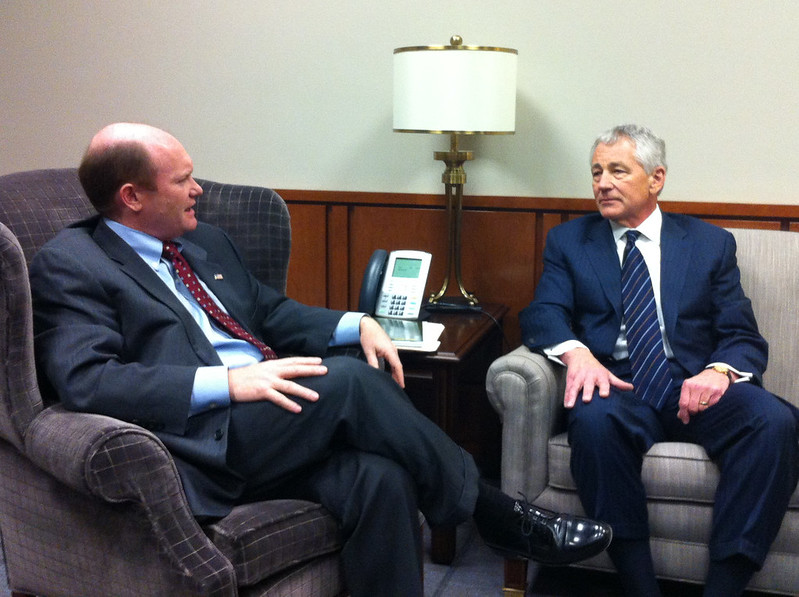
Statement from Senator Coons on meeting with Senator Hagel

WASHINGTON – U.S. Senator Chris Coons (D-Del.), a member of the Senate Foreign Relations Committee, released the following statement after meeting with President Obama’s nominee for secretary of defense, former Senator Chuck Hagel (R-Neb.):

“My meeting with Senator Hagel this afternoon was thorough and constructive, and addressed my concerns over his past comments. I was encouraged by his strong commitments to Israel’s security, to keeping all options open in preventing Iran from acquiring nuclear weapons capability, and to embracing tolerance and inclusion both in our society and our military. We also had a good, far-reaching discussion of our shared interests in Africa, in balancing security and liberty, and in an enduring and engaging role for the National Guard. I believe Senator Hagel will be a strong and effective secretary of defense, and I will be proud to vote for his confirmation.”

Senator Coons meets with Senator Hagel

###