Related Issues

Related Issues

More than 100 advocates urge Senate leadership to move resolution protecting religious freedom forward

A group of 113 religious and secular leaders, human rights advocates, scholars, and practitioners wrote an open letter of support for a bipartisan resolution, introduced by U.S. Senators Chris Coons (D-Del.) and James Lankford (R-Okla.), that recognizes religious freedom as a fundamental right.

The resolution urges the U.S. State Department to widen its support for religious freedom globally by implementing all diplomatic and sanctions tools available to hold violators of religious freedom accountable. It also encourages the State Department to promote religious freedom as a cornerstone of U.S. foreign policy. 

“I’m grateful for the hundreds of advocates who have joined our efforts to recognize religious freedom as a fundamental right necessary for protecting democracy and peace,” said Senator Coons. “I hope this letter encourages my colleagues to promptly move this resolution forward and show the Senate’s strong condemnation of any efforts to suppress religious freedom for believers and non-believers alike.”

“The fundamental right of every person to have a faith, live your faith, change your faith, or have no faith at all must be recognized throughout the world,” said Senator Lankford. “Countries like China, Russia, and Iran continue to target and persecute citizens for living this most basic freedom. I am grateful that so many continue to recognize the importance of protecting religious freedom for all people.”

“We have seen firsthand the increasing threats to religious freedom around the world described in the resolution,” the advocates wrote in their letter. “From ongoing genocides and mass atrocities perpetrated against religious minority groups, to individuals imprisoned and exiled for their faith and beliefs, from unjust restrictions on religious gatherings and practices, to the destruction of religious sites, these threats against both people of faith and no faith are not only grave violations of fundamental human rights, but also lead to instability, insecurity, and a lack of economic development. …

“S. Res. 569 paints an accurate and disturbing portrayal of the religious freedom situation in too many countries,” the advocates continued. “Because of that situation, the resolution’s policy recommendations are vital: promoting religious freedom as an ‘utmost priority’ in U.S. foreign policy, holding violators accountable using all available diplomatic and sanctions tools, working with global partners, and expanding support for leaders and activists working to protect religious freedom worldwide. These recommendations, if followed, would continue and extend the U.S.’s leading role in promoting international religious freedom, expand the coalition of partners so that better outcomes can be achieved, and create a greater space for religious freedom to thrive and grow on the ground where severe violations are currently happening.”

In addition to Senators Coons and Lankford, the resolution is co-sponsored by Senators Tim Kaine (D-Va.) and Thom Tillis (R-N.C.) and endorsed by the U.S. Commission on International Religious Freedom.

The letter can be read in full here

The text of the resolution is available here.

Senator Coons is Chair of the Senate Appropriations Committee’s State and Foreign Operations Subcommittee (SFOPS) and a member of the Senate Foreign Relations Committee. Senators Coons and Tillis are Co-Chairs of the Senate Human Rights Caucus.


Senators Carper, Coons join colleagues in push to strengthen federal Pell Grant program

WASHINGTON – U.S. Senators Tom Carper and Chris Coons (both D-Del.) joined 42 of their Democratic Senate colleagues in sending a letter urging increased funding for the Pell Grant program in fiscal year 2025. In the letter to Senator Tammy Baldwin (D-Wis.), Chair of the Appropriations Subcommittee on Labor, Health and Human Services, Education, and Related Agencies, and Senator Shelley Moore Capito (R-W.Va.), Ranking Member of the subcommittee, the Senators requested a discretionary increase to the award as Congress works toward doubling the Pell Grant for students.

“Throughout my years in public service, I’ve spoken with students all across Delaware who have shared how the federal Pell Grant program opened the door to their higher education,” said Senator Carper. “We must strive to make college more affordable, while also improving access for students who come from underrepresented communities. I’m glad to join 43 of my Senate colleagues in urging increased funding for federal Pell Grants, because this program has the power to change lives.”  

“Federal Pell Grants are a cornerstone of college access, providing critical support to one-third of all undergraduates,” said Senator Coons. “Increasing the maximum Pell Grant award would give students across the country who are often overlooked and underrepresented the opportunity to earn their degree. I’m proud to stand with my Democratic colleagues in fighting to broaden access to higher education.”

Specifically, the letter requests that the discretionary allocation for the Pell Grant effectively:

  • Meets the needs of students;
  • Protects all Pell Grant program reserves; and
  • Expands eligibility to students who have been historically excluded or previously cut out from being eligible for the Pell Grant.

“[W]e remain concerned that the value of the Pell Grant has steadily declined since it was first created – now covering the lowest share of the cost of attendance in its 50-year history,” the Senators wrote. “Increasing the maximum award would provide a substantial investment toward reversing this decades-long decline.”

“The need for Congress to provide robust investment in the Pell Grant program is clear,” the Senators continued. “In the wake of the COVID-19 pandemic, students are still struggling just to meet their basic needs as they pursue higher education. … [I]t is critically important that the Subcommittee continues to protect all Pell Grant reserves from any reallocation, raid, or rescission that would hasten any shortfalls in the program.”

“The Pell Grant is the cornerstone of federal student aid, and currently helps over 6 million students pursue higher education in the United States,” the Senators concluded. “With a continued investment in the Pell Grant, we can better extend educational opportunity to more students from low- and moderate- income families, who will be critical to meeting the demand for a highly educated-workforce.”

In addition to Senators Carper and Coons, the letter is signed by Senators Mazie K. Hirono (D-Hawaii), Jack Reed (D-R.I.), Sheldon Whitehouse (D-R.I.), Angus King (I-Maine), Tammy Duckworth (D-Ill.), Tim Kaine (D-Va.), Raphael Warnock (D-Ga.), Alex Padilla (D-Calif.), Brian Schatz (D- Hawaii), Kirsten Gillibrand (D-N.Y.), Ben Cardin (D-Md.), Richard Blumenthal (D-Conn.), Debbie Stabenow (D-Mich.), Maria Cantwell (D-Wash.), Amy Klobuchar (D-Minn.), Ed Markey (D-Mass.), Chris Murphy (D-Conn.), Bob Casey (D-Pa.), Gary Peters (D-Mich.), Michael Bennet (D-Colo.), Peter Welch (D-Vt.), Mark Kelly (D-Ariz.), Jon Ossoff (D-Ga.), Cory Booker (D-N.J.), Chris Van Hollen (D-Md.), Jeff Merkley (D-Ore.), Elizabeth Warren (D-Mass.), Catherine Cortez Masto (D-Nev.), Maggie Hassan (D-N.H.), Sherrod Brown (D-Ohio), Jon Tester (D-Mont.), Ben Ray Lujan (D-N.M.), Tina Smith (D-Minn.), Jeanne Shaheen (D-N.H.), Dick Durbin (D-Ill.), Kyrsten Sinema (I-Ariz.), Ron Wyden (D-Ore.), Bernie Sanders (I-Vt.), John Hickenlooper (D-Colo.), Jacky Rosen (D-Nev.), Mark Warner (D-Va.), and Laphonza Butler (D-Calif.).  

“APLU applauds Senators Hirono, Reed, and Whitehouse for their critical leadership in working to advance the Pell Grant – the cornerstone of federal student aid,” said Mark Becker, President, Association of Public and Land-Grant Universities (APLU). “Congress has made significant strides to increase the maximum Pell Grant in recent years, but decades of underinvestment after Congress created the program in the 1970s eroded its purchasing power. Working toward doubling the maximum Pell Grant will go a long way to increase college affordability and completion for low-income students.”

“Pell Grants can be literally life-changing for the students and families that most need help to afford a transformational higher education experience that will enable them to achieve their dreams,” said David Lassner, President, the University of Hawai?i. “Our underserved populations and everyone in Hawai’i, and across the nation, will benefit if these efforts by Senator Hirono and her colleagues are successful in reversing the decades-long stagnation of this vital federal assistance.”

“As lawmakers work toward a funding package for fiscal year 2025, we strongly support efforts to increase the maximum Pell Grant award and ensure that funding dedicated to the Pell Grant program is protected and not used to fill budget gaps in other programs,” said Michele Zampini, Senior Director of College Affordability, The Institute for College Access & Success. “The Pell Grant program is the federal government’s foundational investment in college affordability, enabling more than 7 million low- and middle-income students – including 60% of Black undergraduates and half of Latino undergraduates – to attend college each year. By working to double the maximum Pell award and protecting the program’s existing funding reserves, lawmakers can make college far more affordable for millions of students.”

The full text of the letter is available here and below. 

Dear Chair Baldwin and Ranking Member Capito:

As you begin your work on Fiscal Year 2025 (FY 2025) appropriations, we urge the Labor, Health and Human Services, Education, and Related Agencies (LHHS) Subcommittee to make sure the discretionary allocation for the Pell Grant effectively meets the needs of students, protects all Pell Grant program reserves, and expands eligibility to students who have been historically excluded or previously cut out from being eligible for the Pell Grant. We respectfully request you provide a discretionary increase to the award as Congress works toward doubling the Pell Grant for students.

We appreciate the LHHS Subcommittee’s work to increase the Pell Grant maximum award in recent years. But we remain concerned that the value of the Pell Grant has steadily declined since it was first created – now covering the lowest share of the cost of attendance in its 50-year history. Increasing the maximum award would provide a substantial investment toward reversing this decades-long decline.

The need for Congress to provide robust investment in the Pell Grant program is clear. In the wake of the COVID-19 pandemic, students are still struggling just to meet their basic needs as they pursue higher education. Recently, for example, the Center for Community College Student Engagement (CCCSE) reported that 29 percent of the students they surveyed were food insecure, and 14 percent were housing insecure. Especially at a time of expected shortfalls in the Pell Grant program, it is critically important that the Subcommittee continues to protect all Pell Grant reserves from any reallocation, raid, or rescission that would hasten any shortfalls in the program. Pell Grant funds should be retained in the program to increase the maximum award, reverse prior eligibility cuts, and provide new opportunities to provide higher education to historically underrepresented students.

The Pell Grant is the cornerstone of federal student aid, and currently helps over 6 million students pursue higher education in the United States. With a continued investment in the Pell Grant, we can better extend educational opportunity to more students from low- and moderate- income families, who will be critical to meeting the demand for a highly educated-workforce.

Thank you for your continued commitment to the Pell Grant. We appreciate your consideration of these requests.
Senator Coons statement on ICC arrest warrants request

WASHINGTON – U.S. Senator Chris Coons (D-Del.) issued the following statement after the Chief Prosecutor of the International Criminal Court (ICC) announced he would seek arrest warrants from the court for Israeli officials, including Prime Minister Benjamin Netanyahu, in relation to the Israel-Hamas war in the Gaza Strip:

“I strongly condemn this move by the Chief Prosecutor of the International Criminal Court to apply for arrest warrants for Prime Minister Netanyahu and Defense Minister Gallant. The ICC is meant to be a court of last resort only; not only does the ICC not have jurisdiction to prosecute these cases against Israeli officials, Israel has an independent judiciary and the ability to hold its own officials accountable that render the Prosecutor’s decision inappropriate. While I do not agree with every step the IDF has taken in its war against Hamas, the ICC Prosecutor should focus on fulfilling the ICC’s mandate where it exercises legitimate jurisdiction and is needed to deliver accountability. I have long supported the ICC, including in its investigation of Russian war crimes in Ukraine, and I hope to continue working with it if it returns to its legitimate role.” 

Senator Coons is Chair of the Senate Appropriations Subcommittee on State and Foreign Operations and a member of the Senate Foreign Relations Committee.

Senator Coons, colleagues urge WHO Director Tedros to support Taiwan’s participation in World Health Assembly

WASHINGTON – U.S. Senators Chris Coons (D-Del.), Ben Cardin (D-Md.), James Risch (R-Idaho), and Lindsey Graham (R-S.C.) sent a letter to World Health Organization (WHO) Director General Tedros Adhanom Ghebreyesus urging him to allow for Taiwan’s meaningful participation in the WHO and invite Taiwan to participate as an observer in the upcoming World Health Assembly (WHA). The Senators urge Tedros to oppose efforts to restrict Taiwan’s engagement, including the People’s Republic of China’s distortion of U.N. General Assembly Resolution 2758, which takes no position on the issue of Taiwanese sovereignty, does not preclude countries from having diplomatic relations with Taiwan, and does not prevent the United Nations from allowing for Taiwan’s meaningful participation in U.N. activities – contrary to Beijing’s assertions.

“We write to express strong bipartisan support within the U.S. Senate for Taiwan’s meaningful participation in the WHO and the annual WHA meetings,” the Senators wrote. “We are deeply concerned that Taiwan has been largely excluded from WHO and WHA meetings, technical exchanges, and other consultative mechanisms.”

The lawmakers continued: “In recent years, the People’s Republic of China has attempted to use United Nations General Assembly Resolution 2758 as a pretext to obstruct Taiwan’s engagement with the international community. It is crucial to clarify that Resolution 2758 addressed only the issue of China’s representation in the United Nations; it did not, in any part, determine Taiwan’s status or explicitly prohibit Taiwan’s participation in UN agencies and other international fora, including WHO and WHA.”

Senator Coons is Chair of the Appropriations Subcommittee on State and Foreign Operations (SFOPS) and a member of the Senate Foreign Relations Committee.

Full text of the letter is available here and below.

Dear Dr. Tedros,

We write to express strong bipartisan support within the U.S. Senate for Taiwan’s meaningful participation in the World Health Organization (WHO) and the annual World Health Assembly (WHA) meetings. We are deeply concerned that Taiwan has been largely excluded from WHO and WHA meetings, technical exchanges, and other consultative mechanisms. We urge you to make every effort to support Taiwan’s meaningful participation and to oppose proscriptive efforts to circumscribe Taiwan’s engagement. As our experience with the COVID pandemic has demonstrated, it is imperative that global health diplomacy channels remain open and inclusive of all jurisdictions, so that we are best able to address challenges in the complex landscape of international health crises.

In recent years, the People’s Republic of China has attempted to use United Nations General Assembly Resolution 2758 as a pretext to obstruct Taiwan’s engagement with the international community. It is crucial to clarify that Resolution 2758 addressed only the issue of China’s representation in the United Nations; it did not, in any part, determine Taiwan’s status or explicitly prohibit Taiwan’s participation in UN agencies and other international fora, including WHO and WHA. Furthermore, the resolution does not restrict any state from maintaining or pursuing diplomatic relationships with Taiwan.

Taiwan’s exclusion from the WHO and WHA undermines the WHO’s mission to build a healthier future for the global community. Taiwan has demonstrated robust healthcare capabilities, and its global health contributions, particularly visible during the COVID-19 pandemic, have proven indispensable. Taiwan’s proactive and transparent response to health emergencies, as well as its willingness to share expertise and resources, underscores the value it brings to global health initiatives. Denying Taiwan the opportunity to participate in the WHO and WHA not only hinders Taiwan’s 23 million people but also weakens the global health architecture’s ability to respond effectively to health challenges. As the world continues to navigate the repercussions of the COVID-19 pandemic and other emergent health threats, it is more critical than ever to leverage every resource available to advance the resilience of global health systems.

We look forward to your response in addressing this critical issue and ask for a positive resolution ahead of the forthcoming World Health Assembly in late May.


Senator Coons, colleagues introduce Domenic and Ed’s Law to address student loan debt for parents of children who become disabled

WASHINGTON – U.S. Senators Chris Coons (D-Del.) and J.D. Vance (R-Ohio) and Congressman Seth Magaziner (D-R.I.) introduced legislation to allow a parent whose child develops a total and permanent disability to qualify for student loan discharge. 

The bill, named for Domenic Carducci of Steubenville, Ohio, and Ed Desorcy of Harrisville, Rhode Island, would resolve an inconsistency in statute by authorizing the U.S. Department of Education to discharge parents’ Federal Family Education Loans (FFELs) if their child becomes totally and permanently disabled. Currently, parents are allowed to discharge federal student loans if their child passes away, but not if their child develops a total and permanent disability. 

Senator Coons first introduced Domenic and Ed’s Law in the 117th Congress with former Senator Rob Portman (R-Ohio). 

“While I’m proud our legislation to eliminate the tax on discharged federal student loans for students who experience a total and permanent disability was signed into law in 2017, parents who borrow federal funds on their child’s behalf still need relief,” said Senator Coons. “This bipartisan, bicameral legislation will ease the burden of student loan debt for families navigating disability. I urge my colleagues in Congress to pass this important legislation to provide much-needed relief for families across the country.”

“No parent should be forced to shoulder the burden of FFEL loans while caring for their disabled child,” said Senator Vance. “Domenic Carducci, a fellow Buckeye from Steubenville, and his family deserve the relief this bipartisan legislation would provide.”

“When a student becomes disabled, their parents should be focused on providing care and support instead of worrying about paying off student loans they’ve taken out on their child’s behalf,” said Congressman Magaziner. “This bipartisan legislation is partly named after my constituent, Ed Desorcy, who lost his vision while attending college – and due to this tragedy, his parents were saddled with student debt and medical bills. No parent should face this financial burden in these difficult circumstances, and this commonsense legislation will provide much-needed relief to families in Rhode Island and across the nation.” 

Domenic and Ed’s Law is endorsed by the National Association of Councils on Developmental Disabilities, the National Center for Learning Disabilities, the National Association of Disability Representatives, the National Education Association, Young Invincibles, the National Down Syndrome Congress, the Special Needs Alliance, the United Spinal Association Consortium for Constituents with Disabilities, the Social Security Task Force National Association of Disability Representatives, the American Association of People with Disabilities, the National Association of the Deaf, Active Minds, the National Federation of the Blind, the Association of University Centers and Disabilities, the National Association of Councils on Developmental Disabilities, the Association on Higher Education and Disabilities, ACPA – College Student Educators International, the American Association of Community Colleges, the American Association of University Women, the Education Finance Council, the Higher Education Loan Coalition, the American Council on Education, and the Tragedy Assistance Program for Survivors.

The full text of the bill is available here


Senators Coons and Fischer’s Recruit and Retain Act heads to President Biden’s desk

WASHINGTON – The Recruit and Retain Act, introduced by U.S. Senators Chris Coons (D-Del.) and Deb Fischer (R-Neb.), passed out of the House of Representatives on Tuesday and now heads to President Biden’s desk. The bipartisan bill will address staffing shortages nationwide by enhancing law enforcement agencies’ access to hiring tools.

Congressmen Wesley Hunt (R-Texas) and Glenn Ivey (D-Md.) introduced the identical companion legislation in the House. The Recruit and Retain Act passed the Senate in July.

“For too many years, police departments in Delaware have faced alarming recruitment problems,” said Senator Coons. “The Recruit and Retain Act will help departments across our state and across the nation hire more officers by addressing high onboarding costs and authorizing a new pipeline recruitment program. As Co-Chair of the Senate Law Enforcement Caucus, I’m proud to lead this bipartisan bill to ensure that our police departments can hire qualified officers that reflect our communities. I am grateful to my colleagues in the House for their support, and I look forward to President Biden signing this important bill into law.”

“The law enforcement staffing crisis nationwide is not slowing down and continues to threaten public safety,” said Senator Fischer. “My Recruit and Retain Act will reduce hiring costs and create local workforce pipelines to build a new generation of police. I want to thank Nebraska’s law enforcement officers who helped design the legislation, as well as my colleagues for their overwhelming support. I look forward to seeing this bill signed into law.”

“I’m proud to say this bipartisan bill has been endorsed by the Federal Law Enforcement Officers Association, the Fraternal Order of Police, the Major Cities Chiefs Association, Major County Sheriffs of America, the National Association of Police Organizations, the National Sheriff’s Association, and others,” said Congressman Hunt. “When our police departments are well-funded and maintained, our communities are safer.”

“Recruiting and retaining highly trained law enforcement professionals is of the utmost importance,” said Congressman Ivey. “Our ability to attract and develop the best, brightest, and most compassionate and dedicated men and women of differing backgrounds is vital to the health and well-being of our nation. Keeping our residents safe and promoting better relations with our citizenry can only lead to safer streets and better policing. I look forward to working with all who care about our country and a path forward for good law enforcement standards. We must incentivize hiring and keeping the people who will do the job of safeguarding us from border to Broadway and everywhere in between.”

Background
:

  • The Recruit and Retain Act would improve the U.S. Department of Justice’s Community Oriented Policing Services (COPS) grants by making them more responsive to onboarding costs and hiring challenges. The bill’s reforms would help law enforcement agencies across the country hire new officers more easily, as many continue to face staffing shortages and struggle to attract new applicants. This includes the creation of a new program to encourage partnerships between schools and police departments to foster a stronger local pipeline for law enforcement careers.
  • The Recruit and Retain Act has received national endorsements from the Federal Law Enforcement Officers Association, Fraternal Order of Police, Major Cities Chiefs Association, Major County Sheriffs of America, National Association of Police Organizations, National Sheriffs Association, R Street Institute, and the Peace Officers Research Association of California.

The bill contains five key initiatives:

Supporting Officer Onboarding

1. Expands the COPS grants to reduce the financial costs of hiring new law enforcement officers (e.g., background checks, psychological evaluations, etc.).

Reducing Administrative Burdens

2. Allows up to 2% of grant funding to cover the administrative burden of implementing COPS grants. Many law enforcement agencies have noted that this would offset the paperwork burden associated with COPS grants.

Authorizing a New Pipeline Recruitment Program 

3. Authorizes the Pipeline Partnership Program within COPS to encourage collaboration between agencies and local elementary schools, secondary schools, and institutions of higher education for students interested in future careers in law enforcement. Qualifying partnership activities would include dedicated programming for students, work-based learning opportunities, project-based learning, mentoring, community liaisons, career or jobs fairs, worksite visits, job shadowing, and skills-based internships.

Providing Better Grant Guidance for Understaffed Agencies

4. Creates new guidance for COPS hiring grants to clarify the lack of consistent application procedures for understaffed agencies. This ensures more eligible police departments are better able to access COPS grants.

Shining a Light on Recruitment and Retention Challenges

5. Directs a comprehensive study to illuminate recruitment and retention challenges law enforcement agencies face nationwide and document how these trends are impacting public safety.

The full text of the bill can be found here.

Senator Coons is a member of the Senate Judiciary Committee and Co-Chair of the Senate Law Enforcement Caucus.


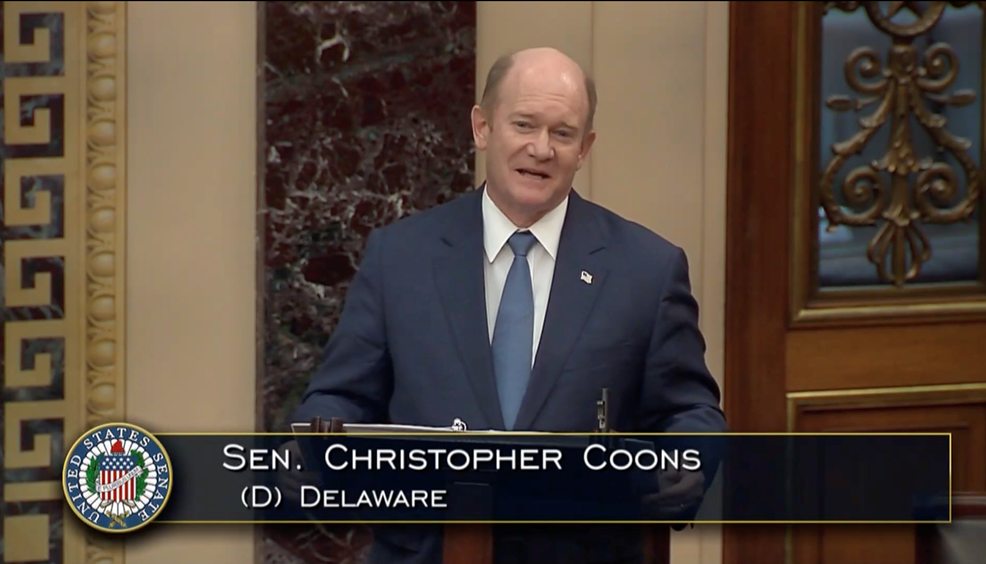
ICYMI: Senator Coons gives floor speech on his Stop Tax Penalties on American Hostages Act, work on hostages and wrongful detainees

WASHINGTON – U.S. Senator Chris Coons (D-Del.) yesterday delivered a floor speech to celebrate the Senate clearing his bipartisan Stop Tax Penalties on American Hostages Act, as well as his broader efforts help Americans held hostage or wrongfully detained abroad. His legislation would prevent the IRS from imposing fines and penalties on American hostages and wrongful detainees for failing to pay taxes while they are held abroad. 

Unknown

Senator Coons was inspired to write the bill after hearing from Jason Rezaian, a Washington Post reporter who was wrongfully detained by the Iranian government for 544 days. Upon his release and return to the United States, Rezaian owed a large sum to the IRS due to non-payment of taxes during his detention.

Senator Coons also discussed his other work on hostage issues, including forthcoming legislation to repair the credit scores of those held hostage or wrongfully detained, and his bipartisan bill that President Biden signed into law to establish a National Hostage and Wrongful Detainee Day and flag.

A full transcript is available below:

Senator Coons: Madam President, I come to the floor today to speak for a few moments about the urgent – the pressing – matter of Americans held hostage or wrongfully detained abroad, and about a specific positive recent development to make sure that when they are released and freed, they’re welcomed home in a positive and meaningful way.

Today, there’s somewhere between 30 and 40 Americans wrongfully detained abroad, and they range all over, from their backgrounds to the countries in which they’re held. I’ve met repeatedly with Rachel and Jon, who are the parents of Hersh Goldberg-Polin, an American Israeli who was attending the music festival in Israel when he was attacked, badly injured, kidnapped by Hamas terrorists, and dragged to Gaza, where he is still today a hostage beneath Gaza in tunnels. Ryan Corbett has been held in Afghanistan for years, an NGO worker who was abducted by the Taliban. Mark Swidan has been held in China on narcotics trafficking charges, a sentence upheld recently but not yet imposed. And of course, Evan Gershkovich, a Wall Street Journal reporter, currently in prison in Russia, whose mother I met with recently and who I joined with his family in continuing to pray and work for his release.

There has recently been a positive step forward in how we welcome home these hostages. But first, Madam President, I have to tell you something disturbing about how we have long welcomed home hostages.

Jason Rezaian. He’s a Washington Post reporter who was taken prisoner in Iran and ultimately served a year-and-a-half – 544 days – in prison in Tehran before he was released. And I want you to guess, what was the first thing Jason got from the United States government when he returned home? It was a tax bill with fines and penalties for his failure to file and pay his taxes on time. Jason came to meet with me and recounted to me that when he pointed out to the IRS that it was front-page news in The Washington Post that he was unjustly imprisoned – of course, he couldn’t pay his taxes on time – they said, ‘We’d like to help you, Mr. Rezaian, but Congress needs to act in order for us to stop imposing tax penalties on American hostages.’

So, today I’m here to celebrate that my dear friend Mike Rounds [S.D.], Republican Senator, and I have introduced, and the Senate has now passed, a bill with the catchy title ‘Stop Tax Penalties on American Hostages.’ It cleared unanimously; thank you. And we now await House action. 

This is the latest in a number of actions several of us have taken together. There is now a National Hostage and Wrongful Detainee Day. It was recognized by a bill that was passed in the defense authorization bill last year and signed into law by President Biden – that’s March 9. We are also working on legislation to repair the credit score of those who are wrongfully imprisoned, held hostage, or detained. As you can imagine, if you spend years in prison in Russia or in Iran or being held captive in Afghanistan or in Gaza, and you aren’t making payments on your bills, your credit score suffers. Senator [Thom] Tillis [R-N.C.] and I are next hoping to move the Fair Credit for American Hostages Act.

Let me conclude by saying this: We have to do more, together, to deter hostage-taking; to restore to the United States those who’ve been wrongfully detained; to cooperate across our government. I’m grateful that the Biden administration has increased its focus on this urgent moral issue and that 47 wrongfully detained Americans have been brought home so far under the present administration. But frankly, all of us should be working together to hold in our prayers and thoughts those who are hostages, those who are wrongful detainees and their loved ones, and to work together, as Senator Rounds and I have in recent weeks, and as the Congress as a whole will in coming days.  


ICYMI: Senator Coons affirms U.S. commitment to Israel, asserts importance of civilian protections

WASHINGTON – In case you missed it, U.S. Senator Chris Coons (D-Del.) answered a question from Senator John Cornyn (R-Texas) after delivering a floor speech today regarding President Biden’s assertion that he would not supply certain weapons for Israel to use in Rafah.

Senator Coons has repeatedly said that if Israel moves forward with a full-fledged military operation in Rafah without taking into account its obligation to protect civilians and facilitate the distribution of aid, the United States should consider restricting security assistance. While affirming the United States’ ironclad commitment to Israel today, he emphasized that we cannot ignore the consequences of using American weapons at scale in a heavily populated location where refugees have sought refuge at Israeli instruction.

As Chair of the Appropriations subcommittee that handles foreign assistance, Senator Coons has continued to fight for and secure billions in humanitarian aid for Gaza and other regions facing acute food insecurity and famine.

Unknown-1

A transcript is available below:

Senator Cornyn: Madam President, I have a great deal of respect for the Senator from Delaware, and we work well together on the Judiciary Committee and always operated in good faith, even though we sometimes have differences of opinion. And I know he spends a lot of time thinking about national security and foreign relations affairs, and he’s traveled the world and knows more leaders of the different countries around the world than I ever will. But I do know that since he shares the concerns about the status, particularly the American citizens who are hostages in Gaza, I’d just like to get some idea from him what his thoughts are about the administration’s pause on weapons delivery to … Israel. And let me predicate this by saying, you know, I remember back when, of course, we were concerned about Al Qaeda in Fallujah[Iraq], where the Marines fought a terrible battle. And unfortunately, anytime there’s a conflict, there’s going to be civilian casualties, and obviously, the goal is to minimize those casualties. Likewise, in places like Mosul, where ISIS made its last stand in Iraq. And I’d just like to get some ideas from the Senator, if he would be so kind as to share with me sort of what his thoughts are about what Israel is supposed to do in Rafah, obviously to satisfy the concerns about civilian collateral damage, but also in a way that allows Israel to eliminate the terrorist threat?

Senator Coons: Madam President, I appreciate the opportunity to speak to what is a pressing concern for so many of us. I’ll simply reflect on my last in-person meeting with Prime Minister [Benjamin] Netanyahu and Defense Minister [Yoav] Gallant, in Israel, now many weeks ago. It was part of a visit I made to a number of countries in the region. But I spoke directly to this, and I believe what I’m saying also reflects the views of the administration: Of course, the United States stands strongly behind Israel and its defense and its security. [U.S.] Secretary of Defense [Lloyd] Austin, when asked this same question about what it might mean that there were pauses or reviews of weapons deliveries, what that might mean: Just yesterday, he said that the administration of the United States retains an ironclad commitment to Israel’s security and defense, as just demonstrated a few weeks ago, when we worked together with Israel, with the U.K., with France, with [the] Saudi kingdom, and with Jordan to provide their defense against 300 missiles and drones launched at Israel by Iran.

So, what is it that we’re saying with regards to Rafah? What I said to the Prime Minister was, you don’t just have the right to defend the Israeli people against Hamas; you have the obligation. After October 7, you have to restore a sense of security and deterrence against this terrorist organization that massacred more Jews, more civilians; 1,200 people of a wide range of backgrounds, in fact. It was the worst day for Jews since the Holocaust. But many who are still held captive beneath Gaza by Hamas are from a dozen different nations, languages, and religions. You have to go after them. You have to finish the job. You have to go into Rafah and go after these four remaining battalions, and you have to secure Gaza and make certain that Hamas does not reemerge as a fighting force that can ever threaten Israel again. And, given that there are a million civilian refugees who’ve flown down to the very bottom of Gaza and are now up against the hard border with Egypt, and given that Egypt will not allow any of them into Egypt, you have to provide a pathway for civilians to leave Rafah before you go in at scale – with a bombing campaign, a ground campaign – to minimize civilian injuries and deaths. If there are 10,000 or so Hamas fighters remaining in Rafah, and if the multiplier, to use a crass term, has been two to onecivilian deaths for every Hamas fighter killed, to contemplate 20 or 30,000 more civilian deaths in Rafah is to contemplate a horrifying outcome.

But it is not acceptable to leave Hamas in control of a segment of Gaza and capable of returning. So, what is it I am hoping and expecting Israel will do? To relocate all of the civilians in Rafah, north in Gaza; screen them so that none of the leaders of Hamas or the fighters of Hamas escape; to provide for humanitarian aid and for shelter in another part of Gaza; and then to go in at scale, get into the tunnels, secure the release of the hostages, if possible, and finish the job. That is difficult, but in my view, doable. And for us to ignore the consequences of using American weapons at scale in a very heavily concentrated place where there’s a million refugees there because they were told to move south as the IDF [Israel Defense Forces] carried out its justified campaign against Hamas over the last six months – would be to undertake a tragic loss of life that is needless. 


Senator Coons, colleagues mark National Fentanyl Awareness Day

WASHINGTON – U.S. Senators Chris Coons (D-Del.), Chuck Grassley (R-Iowa), and Laphonza Butler (D-Calif.) introduced a resolution designating May 7, 2024 as National Fentanyl Awareness Day. The bipartisan effort aims to raise awareness and educate the public regarding the dangers posed by counterfeit fentanyl pills.

“Drugs like fentanyl and xylazine have devastated families across Delaware, especially as suspected drug overdoses in Sussex County and Kent County have spiked,” said Senator Coons. “This bipartisan resolution underscores the Senate’s determination to confront the opioid crisis head-on and educate the public about the extreme threat that fentanyl poses to our community.”

“Counterfeit pills are fueling devastating health crises in our communities,” said Senator Grassley. “Our resolution to drive awareness of these deadly fentanyl pills is a signal the Senate stands unified in its efforts to put an end to the deadly drug.” 

“In my home state of California, fentanyl overdoses are behind one in five deaths of people aged 15 to 24,” said Senator Butler. “This resolution aims to raise public awareness on the dangers of fentanyl use, and bring attention to the work that is being done at all levels of government to address this public health emergency. As we work to combat the spread of this harmful drug, we stand in solidarity with the families and communities who have borne the brunt of this epidemic.”

Senator Coons has emerged as a leader in the fight against the ongoing fentanyl crisis. Last year, he introduced the bipartisan Fentanyl Safe Testing and Overdose Prevention Act with Senator John Cornyn (R-Texas), which aims to prevent deaths from fentanyl poisoning by increasing access to fentanyl test strips. Senator Coons also hosted a Senate Law Enforcement Caucus roundtable this year with Senator Cornyn to hear on-the-ground perspectives on the fentanyl and xylazine crises from Delaware and Texas and discuss ways to support law enforcement and public health officials.

Senator Coons, Grassley, and Butler are joined by Senators Kevin Cramer (R-N.D.), Jeanne Shaheen (D-N.H.), Marco Rubio (R-Fla.), Catherine Cortez Masto (D-Nev.), Steve Daines (R-Mont.), Richard Blumenthal (D-Conn.), Bill Hagerty (R-Tenn.), Jerry Moran (R-Kan.), Michael Bennet (D-Colo.), John Hoeven (R-N.D.), Sherrod Brown (D-Ohio), Jacky Rosen (D-Nev.), Kyrsten Sinema (I-Ariz.), Bob Casey (D-Pa.), Tammy Baldwin (D-Wis.), Sheldon Whitehouse (D-R.I.), Jim Risch (R-Idaho), Ed Markey (D-Mass.), Elizabeth Warren (D-Mass.), Alex Padilla (D-Calif.), Angus King (I-Maine), Mark Kelly (D-Ariz.), Rick Scott (R-Fla.), Jon Tester (D-Mont.), Marsha Blackburn (R-Tenn.), Maggie Hassan (D-N.H.), Bob Menendez (D-N.J.) and Raphael Warnock (D-Ga.).

Background:

  • Drug overdose deaths have surged in recent years, with 109,000 recorded deaths over a 12-month period from November 2022 to November 2023. The Drug Enforcement Administration in 2023 seized more than 79.5 million fentanyl-laced counterfeit pills, up 37% from 2022. The agency estimates 70% of these laced pills contain a potentially lethal dose of fentanyl. 
  • Drug traffickers often market counterfeit fentanyl pills to young Americans through social media. Illicit fentanyl is involved in more youth deaths than all other drug types combined. At the end of 2022, only 48% of American youth were aware of fentanyl-laced counterfeit pills. 

The full text of the resolution can be found here.

Senator Coons is Co-Chair of the Senate Law Enforcement Caucus and a member of the Senate Judiciary Committee.


Senators Coons, Tillis release statement calling for release of wrongfully imprisoned reporters on World Press Freedom Day

WASHINGTON – U.S. Senators Chris Coons (D-Del.) and Thom Tillis (R-N.C.), Co-Chairs of the Senate Human Rights Caucus, released the following statement today, which is World Press Freedom Day:

“On World Press Freedom Day, we celebrate the critical role journalists play in advancing freedom of speech and expression worldwide. A free press is an essential foundation and hallmark of any democracy, and the United States remains committed to ensuring such freedoms are protected for all.

“Russia’s brutal invasion of Ukraine; autocracies in Iran, China, Belarus, and Myanmar, among other nations; and humanitarian crises across the globe are solemn reminders of the heightened threats journalists face as they fight to report the truth, speak out against injustice, and hold governments accountable to their citizens. According to Reporters Without Borders, nearly 800 journalists were jailed at some point in 2023 and more than 45 were killed for simply doing their jobs. We must do everything we can to speak up for those unjustly detained and advocate for the rights of all journalists to ensure that they can safely continue the important work they do to advance human rights and democracy globally.   

“Specifically, we call for the immediate and unconditional release of journalists being unjustly detained around the world, including:

  • American Wall Street Journal reporter Evan Gershkovich, who has been detained in Russia since March 2023 on baseless espionage charges;
  • Alsu Kurmasheva, the Editor for Radio Free Europe/Radio Liberty who is well-known for her writing on the life of ethnic minorities in Russia, who has been detained since October 2023;
  • Vietnamese author and journalist Pham Doan Trang, who was sentenced to nine years in prison in 2021 for her internationally recognized human rights work and advocacy for a freer, more democratic Vietnam;
  • Tsi Conrad, a journalist and human rights defender from Cameroon, who has been sentenced to 15 years in prison for his honest reporting on the excessive use of force against protestors; and
  • Floriane Irangabiye, a Burundian journalist currently serving a 10-year prison sentence for criticizing the government and ongoing human rights abuses in Burundi.”

In addition to serving as Co-Chair of the Senate Human Rights Caucus, Senator Coons is Chair of the Appropriations Subcommittee on State and Foreign Operations (SFOPS) and a member of the Senate Foreign Relations Committee.