Related Issues

Related Issues

Senator Coons applauds extension of energy efficiency initiative

WASHINGTON – Senator Chris Coons (D-Del.), Senator John Boozman (R-Ark.), Rep. Cory Gardner (R-Colo.), and Rep. Peter Welch (D-Vt.) applauded the decision by the Obama Administration Tuesday to extend President Obama’s federal buildings energy efficiency initiative.

The Administration announced yesterday that federal agencies will “work with the Energy Department’s Federal Energy Management Program in early 2014 to identify a pipeline of additional project commitments to further reduce energy use through 2016.”

Gardner, Welch, Coons, and Boozman –  joined by 118 House colleagues and 26 Senate colleagues – sent a letter last month to President Obama requesting an extended residential initiative setting a goal of $1 billion a year for the next five years for the federal government to utilize performance contracts to achieve energy savings.

“Investments in energy efficiency upgrades promote energy independence, help our environment, and support American jobs,” Senator Coons said. “Outdated federal facilities spend billions in taxpayer dollars every year on energy use alone. In just two years, the federal buildings energy efficiency initiative has already yielded significant energy and cost savings for the federal government, and I am pleased the administration has chosen to extend this valuable program.” 

“Americans are tired of a Congress that has a seemingly endless inability to work together,” Rep. Gardner said. “A growing bipartisan group of Members of Congress have come together to achieve a simple goal: save taxpayer money, and reduce the amount of energy the federal government uses. I am glad the Obama Administration had made the decision to extend this commonsense initiative.”

“Energy efficiency is a practical idea that cuts through partisan gridlock in Washington and achieves real progress for the American people by creating jobs and saving taxpayer dollars.  There is broad bipartisan and bicameral support for energy efficiency investments and the Administration’s announcement today reflects that support.  I applaud their decision to extend this program and look forward to working with them achieve even more energy savings,” Rep. Welch said.

“I applaud this commonsense effort to use public-private partnerships to achieve both energy efficiency and savings for American taxpayers. While debate and disagreement are part of a healthy democracy, our bipartisan letter and today’s announcement show that we can also find areas of common ground and agreement to tackle challenges our nation faces,” Senator Boozman said.

In 2011, the President kicked off a 2-year initiative to achieve $2 billion in energy savings in federal buildings. The 2011 executive order employed the use of Energy Savings Performance Contracts (ESPCs) and Utility Energy Services Contracts (UESCs) to achieve energy savings in federal buildings. Under an ESPC or UESC, an energy services company or a utility negotiates a contract with a federal agency that specifies the amount of energy savings it will achieve through retrofits and other measures. The company or utility is then paid for its performance out of the savings it achieves rather than through appropriated funds. 

Senator Coons urges EPA Administrator McCarthy to reduce use of harmful climate change-causing pollutant

WASHINGTON – Today, Senator Chris Coons (D-Del.) joined a group of 16 lawmakers, led by Senator Tom Carper (D-Del.), Chairman of the Subcommittee on Clean Air, and Representative Scott Peters (CA-52), who signed a bicameral letter urging U.S. Environmental Protection Agency (EPA) Administrator Gina McCarthy to use the agency’s authority to reduce the use of hydrofluorocarbon (HFCs) compounds. The use of HFCs could account for approximately 20 percent of greenhouse gas pollution by 2050. Other signers of the letter include Sen. Diane Feinstein (D-Cal.), Sen. Sheldon Whitehouse (D-RI), Sen. Chris Murphy (D-Conn.), Sen. Barbara Boxer (D-Cal.), Sen. Bob Menendez (D-NJ), Sen. Ed Markey (D-Mass.), Sen. Kristen Gillibrand (D-NY), Rep. Anna Eshoo (CA-18), Rep. Susan Davis (CA-53), Rep. Matt Cartwright (PA-17), Rep. Paul Tonko (NY-20), Rep. Alan Lowenthal (CA-47), and Rep. Suzanne Bonamici (OR-01).

“We are writing to ask your agency to pursue commonsense policies that accelerate the replacement phase down of hydrofluorocarbons (HFCs) in this country and globally.  We believe the agency can ensure we continue to have affordable, safe refrigeration and air conditioning, while also driving greenhouse gas emissions down…Recognizing that it may take some time to amend the Montreal Protocol and incorporate those changes into US regulations, we believe the EPA does not need to wait to implement smart policies that can help accelerate these transitions in the United States and globally.  We encourage you to focus your agency on HFC applications where technology solutions and alternative products are already available or soon to be in the market, similar to what the European Union has done with their Mobile Air Conditioning Directive.  The agency should look to where market transitions are already underway and where EPA action could hasten the pace of those transitions, both domestically and elsewhere. We think that such actions would not only have significant cost-effective environmental benefits but would also strengthen the Administration’s hand in the Montreal Protocol negotiations.”

To view a copy of the letter, please click here.

The Montreal Protocol is an example of a very successful multi-national environmental initiative.  Since the United States ratified the Protocol in 1988 there has been a 97% reduction in the global consumption of controlled ozonedepleting substances such as those found in our refrigerants, aerosols and solvents. However, a majority of the ozone-depleting substances are being replaced by hydrofluorocarbons (HFCs) compounds. HFCs are easy to use, efficient and are safe for the ozone but they can have a high potential to contribute to global warming.  If global use of HFCs continues to go unchecked, it is estimated that HFCs could account for approximately 20% of greenhouse gas pollution by 2050.

In response to this problem, the United States had proposed an amendment to the Montreal Protocol to include a phasedown for HFCs along with the other refrigerant gases already regulated under the Protocol.  While there has been some momentum to amend the Montreal Protocol – such as recent agreements between China and the United States — some in the international community are still resisting moving forward to amend the Protocol.  As the international negotiations continue, there are commonsense steps the EPA can take now to start the phaseout of HFCs, helping our environment and sending a powerful signal to the international community that the United States is serious about transitioning away from HFCs. 

This letter supports the Administration’s efforts to use the Montreal Protocol and urges the EPA to use their authority to start phasing out HFCs where there is a clear alternative.

A copy of the letter text follows:

The Honorable Gina McCarthy
Administrator
Environmental Protection Agency
Ariel Rios Federal Building
1200 Pennsylvania Avenue, NW
Room 3000
Washington, DC 20460

Dear Administrator McCarthy,

We are writing to ask your agency to pursue commonsense policies that accelerate the replacement phase down of hydrofluorocarbons (HFCs) in this country and globally.  We believe the agency can ensure we continue to have affordable, safe refrigeration and air conditioning, while also driving greenhouse gas emissions down.

Since its ratification in 1989, the Montreal Protocol has been an example of a highly successful multi-national environmental initiative.  Under the Montreal Protocol, U.S. corporations and corporations in participating countries agreed to replace ozone depleting products –  such as Chlorofluorocarbons (CFCs) and Hydrofluorocarbons (HCFCs) – used globally used in refrigerants, aerosols and solvents.  As a result, we have seen a 97% reduction in the global consumption of controlled ozone depleting substances. 

Today, most countries are choosing to replace CFCs and HCFCs with HFC compounds because HFCs have been found to be a safe and efficient alternative.  The United States has already made the transition to HFCs, meaning HFCs are now used in a majority of our air conditioners and refrigerants found in our homes, cars, hospitals, and supermarkets.  Developing countries participating in the Montreal Protocol are now starting to make their transitions – ramping up their use of HFCs.  As a result, the global use of HFCs is expected to grow rapidly in the coming years.  The increased HFC use is good for the ozone layer, but evidently not good for our climate.  Unfortunately, it is now determined that HFC compounds can have a very high global warming potential.  Should their use go unchecked, it is estimated that HFCs could account for approximately 20 percent of greenhouse gas pollution by 2050.  So by using HFCs, we are addressing one global environmental problem, while contributing to another. 

Our experience with the Montreal Protocol has shown the global community can work together to save the environment without disrupting the market place.  That is why using the Montreal Protocol regime to transition the global use of HFCs to materials that are safe for the ozone and safe for our climate makes sense and why we applaud the Administration’s efforts to do so.  We believe this process will give our country and the world the most flexibility and cost-effective path toward reducing HFCs.

As we wait for global action, some sectors in this country and in other countries are already beginning to transition away from HFCs, influenced by regulation, voluntary programs and a growing suite of alternatives.  For example, many home refrigerators and window air conditioning units have [largely] changed over to hydrocarbon refrigerants. Transitions are also being seen in vending machines, supermarkets, motor vehicle air conditioning, and insulating foams.  It is estimated that the new system will reduce the store’s carbon footprint by 3.4 million pounds of carbon dioxide equivalent every year and will save the store money in the long run in repair and energy costs.  Not all sectors have a clear transition, but for some sectors there are clear, safe alternatives to HFCs. 

Recognizing that it may take some time to amend the Montreal Protocol and incorporate those changes into US regulations, we believe the EPA does not need to wait to implement smart policies that can help accelerate these transitions in the United States and globally.  We encourage you to focus your agency on HFC applications where technology solutions and alternative products are already available or soon to be in the market, similar to what the European Union has done with their Mobile Air Conditioning Directive.  The agency should look to where market transitions are already underway – like in Turner, Maine – and where EPA action could hasten the pace of those transitions, both domestically and elsewhere. We think that such actions would not only have significant cost-effective environmental benefits but would also strengthen the Administration’s hand in the Montreal Protocol negotiations.

Thank you for your efforts in this area and we look forward to working with you on this issue in the future.
Senator Coons to introduce bill to combat discrimination against those with HIV/AIDS

WILMINGTON, Del. – U.S. Senator Chris Coons (D-Del.), a member of the Senate Judiciary Committee, will introduce legislation aimed at helping to end the stigma, discrimination, and stereotypes that negatively impact Americans living with HIV/AIDS, the senator announced Tuesday. The Repeal Existing Policies that Encourage and Allow Legal (“REPEAL”) HIV Discrimination Act, which would require an interagency review of federal and state laws that criminalize certain actions by people living with HIV, will be introduced when the Senate reconvenes in December. 

“It’s simply not fair that someone having been diagnosed with a chronic, treatable medical condition should automatically be subjected to a different set of criminal laws,” Senator Coons said. “A disturbing number of state and local criminal laws pertaining to individuals with HIV/AIDS are rooted not in science, but in outdated fear. They run counter to effective public health strategies, discourage HIV testing, and perpetuate unfair stigma and discrimination against people living with HIV/AIDS – people who are our friends, family, and neighbors. Rather than recognizing that HIV/AIDS is a treatable medical condition, these laws perpetuate the idea that HIV is a deadly weapon and people with HIV/AIDS are dangerous criminals. Our laws need to catch up to our science, and this bill would take an important step in that direction.”

Thirty-two states have criminal statutes based on perceived exposure to HIV, regardless of the actual risk of transmission, and 13 states have laws that criminalize certain acts — like spitting — by people with HIV/AIDS, even though it is not possible to transmit HIV by saliva. Aside from being charged under HIV-specific criminalization statutes, people living with HIV have been charged under aggravated assault, attempted murder, and bioterrorism statutes. 

“The REPEAL HIV Discrimination Act is a common-sense, no-cost measure that will help local states to save taxpayer dollars by ensuring that criminal laws relating to HIV exposure are based on the best and most recent science and knowledge about HIV, including the recent advances of effective HIV treatments,” William McColl, Political Director of AIDS United and co-chair of the Federal Working Group of the Positive Justice Project, said.

“There is little doubt that current HIV-specific criminal laws do not reflect current knowledge about the actual routes, risks and consequences of HIV transmission,” Catherine Hanssens, Executive Director of the Center for HIV Law and Policy and co-chair of the Federal Working Group of the Positive Justice Project, said.  I hope we can agree that something is terribly wrong when individuals serve less time for vehicular manslaughter and rape convictions than for consensual sex while HIV positive.  Our national Positive Justice Project coalition supports this opportunity to review the many HIV criminal laws that are an outdated waste of money when resources for survivors of real crimes such as sexual assault are so limited.”

U.S. Representatives Barbara Lee (D-Calif.) and Ileana Ros-Lehtinen (R-Fla.) introduced the legislation in the House of Representatives in May. H.R. 1843 has 34 cosponsors. More than 150 HIV/AIDS, LGBT, military, public health, racial justice, religious, and women’s organizations have endorsed the legislation, including the Center for HIV Law and Policy, AIDS United, Sero Project, National Minority AIDS Council, American Civil Liberties Union, OutServe – Servicemembers Legal Defense Network, Human Rights Campaign, American Academy of HIV Medicine, Black AIDS Institute, American Psychological Association, Lambda Legal, and National Council of Jewish Women.

World AIDS Day is Sunday, December 1.

Statement from Senator Coons on interim nuclear agreement with Iran

WILMINGTON, Del. — U.S. Senator Chris Coons (D-Del.), a member of the Senate Foreign Relations Committee, issued on the following statement on this weekend’s P5+1 agreement on Iran’s nuclear program.

“While I welcome the progress made by the Administration and the international community in engaging with Iran to negotiate a possible end to its illicit nuclear program, I remain deeply concerned about the still-unspecified details of implementation and enforcement, as well as the interim agreement’s lack of a requirement that Iran comes into compliance with mandatory U.N. Security Council resolutions demanding a suspension of all enrichment activities. Achieving a diplomatic solution that ends Iran’s efforts to achieve a nuclear weapons capability depends on the continued vigorous enforcement of current economic sanctions and retaining a credible threat of military force. The stakes are too high to take any options off the table. 

“The interim agreement reached in Geneva this weekend was made possible because existing comprehensive sanctions successfully forced an economically crippled Iran to the negotiating table. Reducing these sanctions now may weaken our leverage to solidify a permanent agreement once this six-month interim period ends.  It is essential to ensure the implementation of agreed-upon safeguards and inspections in order to strictly enforce the terms of this deal.

“We should pass additional sanctions to be enforced promptly if Iran violates the interim agreement or fails to reach a permanent deal, which is why I have committed to working with Senator Menendez and others to pass a new sanctions bill in December. The bill should include a conditional waiver for the Administration within this six-month window as it attempts to negotiate a final agreement that aims to dismantle Iran’s enrichment infrastructure.

“Over decades, the Iranian regime has earned the distrust of the United States, our vital ally Israel and the world community by supporting terrorism through its proxies Hezbollah and Hamas, violating the rights of its citizens and conducting secret nuclear development programs in violation of UN Security Council resolutions.  Iran’s actions during this interim period must be subject to intrusive inspections and verification.  Until Iran has verifiably terminated its illicit nuclear program, we should continue to enforce sanctions and make clear to Tehran that there will be harsh consequences for failure to comply with the deal.”

Bipartisan statement on Iran sanctions

WASHINGTON – A bipartisan group of 14 U.S. Senators today released the following statement regarding the Senate’s consideration of Iran sanctions legislation:

“A nuclear weapons capable Iran presents a grave threat to the national security interest of the United States and its allies and we are committed to preventing Iran from acquiring this capability.  We will work together to reconcile Democratic and Republican proposals over the coming weeks and to pass bipartisan Iran sanctions legislation as soon as possible.”

The statement was signed by Senators Robert Menendez (D-NJ), Mark Kirk (R-IL), Charles Schumer (D-NY), Lindsey Graham (R-SC), Ben Cardin (D-MD), Marco Rubio (R-FL), Bob Casey (D-PA), John Cornyn (R-TX), Chris Coons (D-DE), Susan Collins (R-ME), Richard Blumenthal (D-CT), Kelly Ayotte (R-NH), Bob Corker (R-TN) and John McCain (R-AZ).

Senator Coons offers bipartisan amendment to protect National Guard role in cyber missions

WASHINGTON – U.S. Senator Chris Coons (D-Del.) joined Senators Jerry Moran (R-Kan.), Heidi Heitkamp (D-N.D.), and Pat Roberts (R-Kan.) in introducing a bipartisan amendment to the National Defense Authorization Act (NDAA) that would support the Delaware National Guard’s 166th Network Warfare Squadron and Department of Defense (DoD) Reserve Components by ensuring their ability to carry out cyber missions in support of DoD.

As part of the DoD strategy requirement in Section 945 of the Senate version of the NDAA, passage of this amendment would halt, and likely prevent, cuts to the 166th Network Warfare Squadron based out of New Castle, Delaware, as well as cyber units across the Air National Guard. The 166th Network Warfare Squadron plays a key role in our nation’s offensive and defensive cyber capability, protecting America’s critical infrastructure systems against the threat of cyber attacks.

“From banks to traffic lights, and air traffic control to power grids, our nation’s economy, health, and safety depend on our cyber infrastructure,” Senator Coons said. “Securing this infrastructure against the very real threat of attacks by organized crime, terrorists, and even nation-states is one of the biggest national security challenges we face. The 166th Network Warfare Squadron and other cyber units of the Air National Guard work on the front lines of this critical mission. This amendment would ensure that our nation’s top defense planners recognize and utilize their unique capabilities to help us win the fight against cyber crime at home and overseas.”

The amendment would enhance Section 945 of by requiring DoD to develop a strategy on the use of the Reserve Components in cyber missions. The amendment provisions include:

  1. Providing for an inventory of the existing cyber skills of reserve component personnel, including the skills of units and elements in the reserve components that are transitioning to cyber missions;
  2. Providing for an inventory of the existing infrastructure of the reserve components that contribute to the cyber missions of the United States Cyber Command, including the infrastructure available to units and elements in the reserve components that are transitioning to such missions;
  3. Developing an estimate of the personnel, infrastructure and training required, and the costs that would be incurred, in connection with implementing the strategy for integrating the reserve components into the total force for support of the cyber missions of the Department and United States Cyber Command. The estimate will examine whether there are any misalignments between unit mission and facility readiness to support such missions; and
  4. Protecting against unintended duplicate spending, preventing reduction in personnel of a cyber unit of the Air National Guard of the United States from being implemented or carried out in fiscal year 2014 before the submittal of the strategy.

Click here to read the full text of the amendment #2365.

Senator Coons votes to end gridlock on nominations

WASHINGTON – U.S. Senator Chris Coons (D-Del.), a member of the Senate Judiciary Committee, voted on Thursday to end Republican obstruction of President Obama’s nominees. After filibustering two highly qualified and non-controversial nominees for the D.C. Circuit Court last week, Senate Republicans blocked a third on Monday. He released the following statement:

“Americans expect and deserve a Senate that is capable of performing — at a minimum — its constitutional responsibility of voting on the president’s nominees. Right now, the Senate is broken. The Senate has a proud tradition of respecting minority rights, and with rights come responsibilities.  Republicans have so badly abused the rules that govern the Senate’s operations that to let this continue would be an historic disservice to the nation. I’d hoped that respect for the institution, reverence for the Constitution, and basic fairness would make reforms to the basic processes of the Senate unnecessary, but sadly, the gridlock has only worsened. It has to end.

“Over the past several years, we have seen nominees for the cabinet, agencies, judgeships, and even ambassador filibustered and threatened with filibuster time and again. In just the last month, simple up-or-down votes have been blocked on Patricia Millett, Nina Pillard, and Robert Wilkins — three eminently qualified and politically non-controversial nominees for the D.C. Circuit Court — and on Congressman Mel Watt’s nomination to run the Federal Housing Finance Authority. No serious questions have been raised about the qualifications of any of the nominees and the trumped-up caseload argument about the D.C. Circuit flies in the face of recent history when, during the previous administration, a Republican-led Senate confirmed controversial nominees on four different occasions to fill the very same seats they are now filibustering. The range and duration of obstruction of nominations has made clear that simply hoping for an end to the Republican strategy of gridlocking the Senate is not enough. 

“I cast my vote in favor of these reforms today with a heavy heart but a clear conscience. The current system just is not working for the American people. We took a step today toward fixing it.”

Bipartisan coalition of 117 House Members and 22 senators push to extend 2011 energy efficiency initiative in federal buildings

WASHINGTON — Rep. Cory Gardner (R-CO), Rep. Peter Welch, (D-VT), Sen. Chris Coons (D-DE) and Sen. John Boozman (R-AR), joined by 117 House colleagues and 22 Senate colleagues, are calling for a 5-year extension of President Obama’s federal buildings energy efficiency initiative. 

In 2011, the President kicked off a 2-year initiative to achieve $2 billion in energy savings in federal buildings. The bipartisan, bicameral coalition of legislators is calling on the President to continue the successful use of performance contracting in federal facilities by launching a 5-year, $5 billion extension of the 2011 initiative.

The 2011 executive order employed the use of Energy Savings Performance Contracts (ESPCs) and Utility Energy Services Contracts (UESCs) to achieve energy savings in federal buildings. Under an ESPC or UESC, an energy services company or a utility negotiates a contract with a federal agency that specifies the amount of energy savings it will achieve through retrofits and other measures. The company or utility is then paid for its performance out of the savings it achieves rather than through appropriated funds. 

The federal government spends over $6 billion annually on energy use in federal facilities. 

Rep. Gardner, Rep. Welch, and Senator Coons have introduced legislation (H.R.2689 and S.1308) to advance the use of ESPCs and UESCs in the federal government that mirrors the expansion proposed in the coalition’s letter to the President. 

The legislators point out in their letter that the 2011 initiative has led to “a substantial increase in federal facility upgrades carried out by private-sector entities without any upfront cost to the taxpayer … There is still substantial potential for achieving more savings and the success of the past two years’ effort has created important momentum that should now be continued.”

117 House Members, including 70 Democrats and 47 Republicans, have signed onto the Gardner-Welch letter which can be read here. 22 Senators, including 16 Democrats and 6 Republicans, have signed the identical Coons-Boozman letter which is still open for signatures in the Senate.

The following Representatives and Senators have signed the Gardner-Welch-Coons-Boozman letter to date:

HOUSE SENATE
Rep. Mark Amodei Sen. Chris Coons
Rep. Andy Barr Sen. John Boozman
Rep. John Barrow Sen. Ron Wyden
Rep. Marsha Blackburn Sen. Rob Portman
Rep. Earl Blumenauer Sen. Bernie Sanders
Rep. Bruce Braley Sen. Lamar Alexander
Rep. Paul Broun Sen. Tom Udall
Rep. Julia Brownley Sen. John Hoeven
Rep. Vern  Buchanan Sen. Jeanne Shaheen
Rep. Cheri Bustos Sen. Saxby Chambliss
Rep. Lois  Capps Sen. Brian Schatz
Rep. Tony Cardenas Sen. Jim Inhofe
Rep. Matt Cartwright Sen. Al Franken
Rep. Judy Chu Sen. Jeff Merkley
Rep. Howard Coble Sen. Mark Begich
Rep. Mike Coffman Sen. Martin Heinrich
Rep. Steve Cohen Sen. Ed Markey
Rep. Doug Collins Sen. Richard Blumenthal
Rep. Gerald  Connolly Sen. Chris Murphy
Rep. John Conyers Sen. Robert Menendez
Rep. Jim Cooper Sen. Jack Reed
Rep. Rodney Davis Sen. Dick Durbin
Rep. John Delaney

Rep. Rosa DeLauro

Rep. Jeff Denham

Rep. Charlie Dent

Rep. Donna Edwards

Rep. Renee Ellmers

Rep. Anna Eshoo

Rep. Sam Farr

Rep. Stephen Fincher

Rep. Mike Fitzpatrick

Rep. Bill Flores

Rep. Trent Franks  
Rep. Cory Gardner

Rep. Chris Gibson

Rep. Phil Gingrey

Rep. Paul Gosar

Rep. Tim Griffin

Rep. Raul Grijalva

Rep. Brett Guthrie

Rep. Ralph Hall

Rep. Richard Hanna

Rep. Denny Heck

Rep. Jim Himes

Rep. Rush Holt

Rep. Mike Honda

Rep. Jared Huffman

Rep. Randy Hultgren

Rep. Lynn Jenkins

Rep. Pitts Joseph

Rep. Bill Keating

Rep. Joseph P. Kennedy, III

Rep. Derek Kilmer
Rep. Adam Kinzinger  
Rep. Anne McLane Kuster  
Rep. Jim Langevin  
Rep. Barbara Lee  
Rep. Zoe Lofgren  
Rep. Alan Lowenthal  
Rep. Dan Maffei  
Rep. Jim Matheson  
Rep. Doris Matsui  
Rep. Michael McCaul  
Rep. Betty McCollum  
Rep. Jim McDermott  
Rep. Jim McGovern  
Rep. Mike McIntyre  
Rep. David McKinley  
Rep. George Miller  
Rep. Jim Moran  
Rep. Mick Mulvaney  
Rep. Patrick Murphy  
Rep. Richard Nolan  
Rep. Alan Nunnelee  
Rep. Bill Owens  
Rep. Frank Pallone  
Rep. Bill Pascrell  
Rep. Erik Paulsen  
Rep. Ed  Perlmutter  
Rep. Scott Peters  
Rep. Pingree Pingree  
Rep. Mark Pocan  
Rep. Jared Polis  
Rep. Bill Posey  
Rep. David Price  
Rep. Mike Quigley  
Rep. Charlie Rangel  
Rep. Reid Ribble  
Rep. Raul Ruiz  
Rep. Tim Ryan  
Rep. John Sarbanes  
Rep. Jan Schakowsky  
Rep. Kurt Schrader  
Rep. Robert “Bobby” Scott  
Rep. Carol Shea Porter
Rep. Mike Simpson  
Rep. Krysten Sinema  
Rep. Jackie Speier  
Rep. Lee Terry  
Rep. John Tierney  
Rep. Paul Tonko  
Rep. Niki Tsongas  
Rep. Fred Upton  
Rep. Chris Van Hollen  
Rep. Greg Walden  
Rep. Jackie Walorski  
Rep. Henry Waxman  
Rep. Daniel Webster  
Rep. Peter Welch  
Rep. Ed Whitfield  
Rep. Roger Williams  
Rep. Joe Wilson  
Rep. Frank Wolf  
Rep. Steve Womack  
Rep. John Yarmuth  
Rep. Todd Young  

The letter is backed by a broad and diverse coalition of groups including:

ABM
AO Smith Corporation
Alliance for Industrial Efficiency
Alliance to Save Energy
Ameresco
American Council for an Energy Efficient Economy (ACEEE)
Boulder County Board of County Commissioners
Business Council for Sustainable Energy (BCSE)
Conservation Services Group (CSG)
Constellation
Danfoss
Digital Energy & Sustainability Solutions Campaign (DESSC)
Energy Future Coalition
Environment America
Environmental and Energy Study Institute (EESI)
Federal Performance Contracting Coalition (FPCC)
Honeywell
Information Technology Industry Council (ITIC)
Institute for Market Transformation (IMT)
Johnson Controls
National Association of Energy Service Companies (NAESCO)
National Association of State Energy Officials (NASEO)
National Electrical Manufacturers Association (NEMA)
National Grid
Natural Resources Defense Council (NRDC)
NORESCO
Northeast Energy Efficiency Council (NEEC)
Schneider Electric
Siemens
Sierra Club
Trane/Ingersoll Rand
U.S. Chamber of Commerce
U.S. Green Building Council

Senator Coons works to boost hiring of veterans

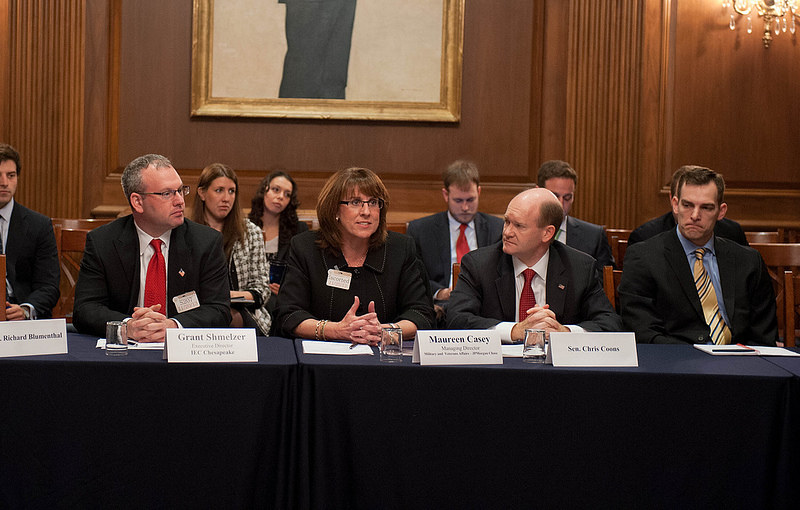
Senator Coons was joined by Maureen Casey and U.S. Army First Lieutenant Anthony K. Odierno, both of JPMorgan Chase's Military & Veterans Affairs Department at a Senate roundtable on boosting the hiring of veterans held in the Capitol on November 20, 2013.

WASHINGTON – U.S. Senator Chris Coons (D-Del.) participated in a roundtable discussion in the Capitol on Wednesday focused on initiatives to expand career opportunities for veterans. The meeting featured leaders from businesses and organizations that have demonstrated a strong commitment to employing veterans and providing them with the resources and support necessary for success.

Maureen Casey, JPMorgan Chase’s Director for Military and Veterans Affairs, was among the participants and briefed senators on the company’s successful practice of hiring veterans as part of the 100,000 Jobs Mission, a coalition of companies committed to providing job opportunities for veterans. Other participants shared their perspectives on how private organizations can work with the Senate to strengthen programs that help veterans successfully transition to civilian employment. 

“America’s highly trained veterans bring valuable skills and experience to the civilian workforce,” Senator Coons said. “Yet too many veterans come home to find their opportunities limited rather than enhanced by their time spent serving our nation. No veteran should return from defending our country abroad only to face unemployment or underemployment at home. Today’s discussion highlighted successful programs that have helped businesses, like JPMorgan Chase in Delaware, recruit more of our nation’s talented veterans. I look forward to working with my colleagues to build and expand upon these important efforts so we can get more of our veterans back to work.”

At 10 percent, the national unemployment rate for post-9/11 veterans is significantly higher than the overall national rate of 7.3 percent. In October, the Bureau of Labor Statistics estimated that 750,000 veterans were without jobs of approximately 11 million of working age.

“It’s important for the public and private sectors to continue working together to position our nation’s military veterans for success in their post-service careers,” Casey said.  “Veterans have the knowledge, skills and experience employers need, so hiring them isn’t just the right thing to do for veterans, it’s also the right thing to do for our business. That’s why JPMorgan Chase has hired more than 6,000 veterans since 2011 and why we are proud to be part of the 100,000 Jobs Mission, whose members have collectively hired nearly 93,000 veterans so far.” Casey is JPMorgan Chase’s Director for Military and Veterans Affairs.

The 100,000 Jobs Mission was launched in 2011 as a coalition of 11 companies committed to hiring 100,000 veterans by 2020, and has since grown to 126 members representing nearly every sector of the U.S. economy. After hiring a combined 92,869 veterans in less than three years, coalition members have doubled their goal to hire 200,000 veterans.

Senator Coons, colleagues introduce innovative bipartisan infrastructure bill

WASHINGTON – A bipartisan coalition of ten U.S. senators that includes U.S. Senator Chris Coons (D-Del.) introduced legislation Thursday to establish a new infrastructure financing authority to help states and localities better leverage private funds to build and maintain the nation’s outdated infrastructure. The Building and Renewing Infrastructure for Development and Growth in Employment Act, or BRIDGE Act, helps to address the nation’s alarming investment shortfall in maintaining and improving its transportation network, water and wastewater systems, and energy infrastructure. The legislation would provide an additional financing tool for states and localities, which can create new jobs here at home while also increasing our nation’s economic competitiveness.

“Investments in America’s infrastructure are investments in American jobs,” Senator Coons said. “Construction jobs, production jobs, and jobs at nearly every American business all depend on functioning infrastructure. Our country needs to be investing more in its infrastructure, not less. The bipartisan BRIDGE Act is an innovative approach to getting the funding we need to sustain and strengthen America’s critical infrastructure.”

America currently spends roughly 2 percent of its GDP on infrastructure — about half what it did 50 years ago. By comparison, Europe spends around 5 percent, and China spends 9 percent of GDP on infrastructure. According to the World Economic Forum’s Global Competitiveness Report, the United States currently ranks 19th among 148 countries surveyed in quality of overall infrastructure compared to our global competitors. 

“We put off and put off these investments because it’s politically convenient, but when we do, we’re only putting off the inevitable,” Senator Coons continued. “The American Society of Civil Engineers estimates that in the next five years, our country will come up about $1.1 trillion short of what it needs to bring American infrastructure to even adequate condition. When we neglect America’s infrastructure, we’re actually adding to America’s debt. We cannot keep kicking this can down the road, especially since this road is falling apart.” 

To begin addressing this shortfall, the BRIDGE Act will establish an independent, nonpartisan financing authority to complement existing U.S. infrastructure funding. The authority would provide loans and loan guarantees to help states and localities fund the most economically viable road, bridge, rail, port, water, sewer, and other significant infrastructure projects.  The authority would receive initial seed funding of up to $10 billion, which could incentivize private sector investment and make possible up to $300 billion in total project investment. The authority is structured in such a way as to make it self-sustaining over time.

  • The BRIDGE Act includes broad eligibility for funding: 
    Projects would have to be at least $50 million in size, and be of national or regional significance to qualify. Five percent of the authority’s overall funding would be dedicated to projects in rural regions, and rural projects would be required to be $10 million in size.
  • The BRIDGE Act addresses current gaps in infrastructure financing:
    The authority would finance no more than 49 percent of the total costs of the project in order to avoid crowding out private capital. Loans and loan guarantees would be subject to modest additional fees, which will allow the authority to quickly become self-sustaining over time. 
  • The BRIDGE Act establishes independent, non-partisan operations:
    Having project finance experts in-house will help states and localities go toe-to-toe with private sector partners to ensure that taxpayers are getting good value for our investments through public-private partnerships. The authority would operate independently of existing federal agencies, led by a Board of Directors with seven voting members and a CEO, all of whom would be required to demonstrate proven expertise in financial management and be confirmed by a vote of the Senate.

In addition to Senator Coons, the BRIDGE Act is sponsored by Senator Mark Warner (D-Va.), Roy Blunt (R-Mo.), Lindsey Graham (R-S.C.), Kirsten Gillibrand (D-N.Y.), Dean Heller (R-Nev.), Amy Klobuchar (D-Minn.), Roger Wicker (R-Miss.), Claire McCaskill (D-Mo.), and Mark Kirk (R-Ill.).