Related Issues

Related Issues

Statement from Senator Coons on passage of bipartisan budget agreement

WASHINGTON – U.S. Senator Chris Coons (D-Del.), a member of the Senate Budget Committee and the conference committee tasked with reconciling the budgets passed by the Senate and House of Representatives, voted Wednesday to approve the agreement reached by conference committee chairs Senator Patty Murray (D-Wash.) and Congressman Paul Ryan (R-Wis.). The Senate voted 64-36 to approve the budget agreement, which will now head to the President for his signature. 

“Congress has finally fulfilled one of its most fundamental duties – agreeing to a budget for the federal government that reduces our deficits and invests in our long-term competitiveness,” Senator Coons said. “The bipartisan budget passed today replaces the reckless structure of the across-the-board sequester cuts with smarter savings – found through a mix of targeted spending cuts and new revenue – that allow us to continue to invest in important priorities.

“This budget is by no means perfect,” Senator Coons continued. “It does not address all of our nation’s fiscal challenges and difficult debates remain over how best to restore economic certainty to our country. I also remain concerned about the 3,600 Delawareans who will lose their unemployment insurance benefits in 10 days if Congress fails to act. However, I am hopeful that the passage today of a bipartisan budget marks the beginning of a renewed effort in Congress to return to regular order and end the destructive practice of governing from crisis to crisis. The American people deserve a functional Congress and this is an important step in that direction.”

The Senate Appropriations Committee, on which Senator Coons also serves, is now responsible for producing a spending bill at the levels set in the budget approved Wednesday. The current continuing resolution funding the federal government expires on January 15, 2014.

National Defense Authorization requires administration strategy on Somalia

WASHINGTON – The National Defense Authorization Act (NDAA) approved by the House and being considered by the Senate this week includes language from legislation written by U.S. Senator Chris Coons (D-Del.), chair of the Senate Foreign Relations Subcommittee on African Affairs, requiring the administration to present a strategy for stability in Somalia.

The Somalia Stabilization Act, which was introduced in October, aims to promote security, stability, and good governance in Somalia by requiring a coordinated, interagency U.S. government strategy for consolidating recent security and political gains there. The legislation was filed as an amendment to the NDAA in November and subsequently included in an updated version of the underlying bill written by the chairs of the House and Senate Armed Services committees. The bill was approved by the House of Representatives last week.

“Following the U.S. withdrawal from Somalia, and after 20 years of lawlessness, recent developments have finally given us reason for hope,” Chairman Coons said. “While African Union-led forces have deprived al-Shabaab of territory and revenue, and created much-needed space to begin building functioning state structures, significant challenges remain. The Somali people are increasingly frustrated with the government’s failure to provide basic services – such as education and health care – and the humanitarian situation remains severe. I am concerned that despite significant financial investment, the United States’ strategy has not kept pace with changing realities on the ground and would benefit from clearer benchmarks for measuring progress, as well as a timeline for implementation.”

Since 2006, the U.S. has provided nearly $700 million to the African Union Mission in Somalia and the Somali National Army to support their efforts to combat al Qaeda affiliate al-Shabaab. The U.S. has also spent nearly $140 million in the past two years to support stabilization, democracy, and economic growth.

Chairman Coons convened a hearing of the Senate Foreign Relations Subcommittee on African Affairs on the security and governance situation in Somalia on October 8.

The legislative text, beginning on page 574, can be downloaded here: http://1.usa.gov/1kVKNHY

Senator Coons cosponsors bill to continue support for older Americans

WASHINGTON – U.S. Senator Chris Coons (D-Del.) is working with a bipartisan group of senators to reauthorize the Older Americans Act (OAA), legislation that funds social and nutritional services for America’s seniors. First passed by Congress in 1965, the OAA has long provided critical support for meal programs, transportation services, job training, and safeguards to prevent the abuse, neglect, and exploitation of older Americans. The five-year OAA reauthorization includes strengthened protections for vulnerable seniors and expanded support for family caregivers.

“We owe it to our seniors to ensure they have the resources they need to age with dignity and security,” Senator Coons said. “As the population of Americans age 60 and older continues to grow, it’s imperative that we invest in the health and welfare of older Americans. The OAA funds vital programs that support seniors and their caregivers, and its reauthorization will ensure they can continue serving those in need.”

The OAA Reauthorization Act of 2013 includes a number of important updates to strengthen existing OAA programs. New provisions will bolster the Long-Term Care Ombudsman program, which provides advocates for residents of adult care facilities, and strengthen elder abuse screening and prevention efforts. The reauthorization bill also features improvements to facilitate the efficient use of transportation services, promote the delivery of evidence-based programs, and improve coordination between programs at the federal, state, and local levels.

Investments in programs for seniors yield significant cost savings for the federal government. According to one study, every $1 in federal spending on Meals on Wheels yields as much as $50 in Medicaid savings alone. Another program to prevent falls, the leading cause of injuries for people 65 and older, has been credited with reducing accidents that necessitate costly hospital and nursing home care.

The OAA Reauthorization Act of 2013 was introduced by Senator Bernie Sanders (D-Vt.) and is also supported by Senators Lamar Alexander (R-Tenn.), Mark Begich (D-Ark.), and Tom Harkin (D-Iowa). 

More than 50 organizations devoted to senior welfare have endorsed the bill, including AARP, the National Committee to Preserve Social Security and Medicare, the National Council on Aging, the Alzheimer’s Association, and the Meals on Wheels Association of America.

Congressional leaders urge comprehensive response to wildlife trafficking

WASHINGTON – A group of bipartisan leaders from the Senate Foreign Relations Committee and House Foreign Affairs Committee have sent a letter to Secretary of State John Kerry, Secretary of the Interior Sally Jewell, and Attorney General Eric Holder urging the full use of available government resources to comprehensively combat wildlife trafficking. The letter was signed by Senate Foreign Relations Subcommittee on African Affairs Chairman Chris Coons (D-Del.) and Subcommittee on East Asian and Pacific Affairs Chairman Ben Cardin (D-Md.), and House Foreign Affairs Committee Chairman Ed Royce (R-Calif.) and Subcommittee on Asia and the Pacific Chairman Steve Chabot (R-Ohio).

“We are writing to ensure that the National Strategy the Task Force produces is bold, goal-oriented and implemented through a whole-of-government approach,” the members wrote. “We believe for the National Strategy to be effective it must include elements to dismantle illicit transnational networks, incorporate security and intelligence resources, and ensure local security forces have the capacity to combat poaching.” 

Secretaries Kerry and Jewell, and Attorney General Holder are co-chairs of the Presidential Task Force on Wildlife Trafficking, established by President Obama in July to develop a national strategy for addressing the growing problem of illicit wildlife trafficking. The task force, along with an Advisory Council made up of non-governmental experts, is working to enhance coordination among existing U.S. programs and policies to combat wildlife trafficking, and assist other nations to do the same. The national strategy is expected to be released in early 2014.

Driven primarily by consumer demand in Asia, poaching of elephants, rhinos, and other wildlife across the globe has reached unprecedented levels in recent years. The crisis is particularly acute in Central Africa, where heavily armed poachers have decimated elephant populations, and in South Africa, which houses the continent’s largest proportion of rhinos. Profits from the multi-billion dollar wildlife trade are frequently funneled to transnational crime syndicates, whose activities threaten to disrupt the rule of law in developing countries across the globe. 

To combat these illicit networks, the members emphasized that U.S strategy must “identify steps to build capacity of law enforcement systems in key countries, including the training and equipping of government eco-guards and rangers, and use of technological innovations.” “To ensure effectiveness,” the members wrote, “programs must include methods to aggressively deal with the pervasive corruption that prevents effective wildlife law enforcement in many countries. Another portion of the strategy should focus on building prosecutorial, judicial and investigative capacity to prosecute wildlife crime cases more effectively.”

The text of the letter is below. It can be downloaded as a PDF here: http://1.usa.gov/1bdssQZ

December 17, 2013 

The Honorable John F. Kerry                                                          
Secretary of State                                                                      
U.S. Department of State                                                             
2201 C Street, N.W.                                                                   
Washington, DC 20515  

The Honorable Eric H. Holder
Attorney General
U.S. Department of Justice
950 Pennsylvania Avenue, N.W.
Washington, DC 20530                                                               

The Honorable Sally Jewell
Secretary of the Interior
U.S. Department of the Interior
1849 C Street, N.W.
Washington, DC 20240

Dear Mr. Secretary, Mr. Attorney General, and Madam Secretary:

As Co-Chairs of the Presidential Task Force on Wildlife Trafficking, you are charged with developing and implementing a National Strategy for Combating Wildlife Trafficking. As you are well aware, the current poaching and wildlife trafficking crisis is severely impacting communities and species globally and has become within our national security interest to help quell. We appreciate the efforts thus far of the Task Force to respond to Executive Order 13648.

We are writing to ensure that the National Strategy the Task Force produces is bold, goal-oriented and implemented through a whole-of-government approach. An important objective of the Task Force is to create greater coordination between existing activities of the various agencies working on wildlife trafficking, while also bringing new agency partners to the table to strengthen the U.S. Government response. We also believe for the National Strategy to be effective it must include elements to dismantle illicit transnational networks, incorporate security and intelligence resources, and ensure local security forces have the capacity to combat poaching. 

The linchpins of illegal wildlife trafficking are the large-scale criminal syndicates that enjoy significant profits because of the strong demand for rhino horns and elephant tusks. These criminal organizations most often utilize existing drug, arms, and human trafficking networks and infrastructure to successfully move wildlife products to market. We must combat wildlife trafficking networks with similar methodologies, tools, and resources as other illicit networks.  An effective National Strategy must include strong elements aimed at breaking up these wildlife networks, with a focus on high-level personnel within the networks, as well as clear and measurable indicators to measure progress. 

There are clear connections between criminal wildlife trafficking activities and threats to national security interests in sub-Saharan Africa and Asia. General James Clapper, the Director of National Intelligence, noted in his March 2013 Worldwide Threat Assessment that “illicit trade in wildlife…threatens to disrupt the rule of law in important countries around the world. These criminal activities are often part of larger illicit trade networks linking disparate actors – from government and military personnel to members of insurgent groups and transnational organized crime organizations.” Given the evidence and implications of this connection, we would like to see the National Strategy actively engage and utilize the security and intelligence resources of the U.S. Government in providing solutions. The scale of criminal financing through wildlife trafficking operations has risen to unprecedented levels, and the National Strategy should strive to employ the best intelligence, data, and technology at our disposal in order to combat it. 

Additionally, the National Strategy should identify steps to build capacity of law enforcement systems in key countries, including the training and equipping of government eco-guards and rangers, and use of technological innovations. To ensure effectiveness, programs must include methods to aggressively deal with the pervasive corruption that prevents effective wildlife law enforcement in many countries. Another portion of the strategy should focus on building prosecutorial, judicial and investigative capacity to prosecute wildlife crime cases more effectively.

As you enter the final stages of developing the National Strategy, we urge you not only to rely on traditional conservation approaches but to produce a strategy that strongly reflects the criminal, financial, and security aspects of wildlife trafficking and contains ambitious measures to address them. Failure to do so will inevitably limit the effectiveness of the U.S. response and do little to properly combat wildlife trafficking and poaching.

We thank you for your leadership on this issue and for your attention to our suggestions. We look forward to reviewing the forthcoming National Strategy for Combating Wildlife Trafficking and working with you on this critical issue going forward.

Sincerely,

CHRIS COONS
Chairman
Subcommittee on African Affairs
Committee on Foreign Relations
United States Senate

EDWARD R. ROYCE
Chairman
Committee on Foreign Affairs
U.S. House of Representatives

BEN CARDIN
Chairman
Subcommittee on East Asian and Pacific Affairs
Committee on Foreign Relations
United States Senate

STEVE CHABOT
Chairman
Subcommittee on Asia and the Pacific
Committee on Foreign Affairs
U.S. House of Representatives

Senator Coons sponsors legislation to exempt volunteer fire companies from healthcare mandate

WASHINGTON – U.S. Senator Chris Coons (D-Del.) announced his support Wednesday for the Protect Volunteer Firefighters and Emergency Responders Act, which aims to clarify the “Shared Responsibility” provision of the Affordable Care Act to ensure that Delaware’s 6,000 volunteer firefighters and emergency responders will not be counted as “employees” in the eyes of the Internal Revenue Service, potentially triggering the law’s coverage mandate for businesses with more than 50 employees.

“Although the Affordable Care Act was designed to make healthcare more accessible and more affordable than ever before, unintended impacts have emerged and need to be fixed. This is one of them,” Senator Coons said. “Delaware’s volunteer firefighters do not receive compensation or financial benefits and should not be considered ‘employees’ of their departments in the eyes of the federal government. This bill would ensure that Delaware’s 60 volunteer fire companies are not considered employers large enough to qualify for the coverage mandate. It is my hope that Republicans in the Senate and House will work with us in implementing these repairs instead of clinging to their demand for repeal of the Affordable Care Act.”

“The Volunteer Firefighters in the State of Delaware appreciate the work by Senator Warner, Senator Coons and all of the Senate sponsors of this important legislation,” Warren Jones of the Delaware Volunteer Firefighter’s Association said. “We are greatly concerned of the possible inclusion in the PPACA, what the implications of that inclusion could be and, overall, how that would affect the communities we serve. The volunteer fire service has been part of the thread of our country since before the American Revolution. We would hate to see that put in jeopardy. We would also hope the House would move similar legislation out of their committee and onto the floor for a vote, as well. The volunteer firefighter provides service every day to the citizens of America no matter their race, creed, religion or political affiliation. He or she deserves bipartisan support and passage of this legislation.”

Most volunteer first responders have other full-time employment, and few receive even nominal compensation or financial benefit. Many emergency response agencies do not have the resources to provide pay or benefits to volunteers, nor do most volunteer first responders expect to receive compensation or health coverage as a result of their volunteer public service.

On Monday, Senator Coons sent a letter to Treasury Secretary Jack Lew urging the Administration to explore a fix for this issue independent of Congress. It can be downloaded as a PDF here: http://bit.ly/Jsz2g7

National Defense Authorization includes Coons-authored protection for National Guard role in cyber missions

WASHINGTON – The National Defense Authorization Act (NDAA) approved by the House and being considered by Senate this week includes a bipartisan amendment written by U.S. Senator Chris Coons (D-Del.) that would support the Delaware National Guard’s 166th Network Warfare Squadron and Department of Defense (DoD) Reserve Components by ensuring their ability to carry out cybersecurity missions.

The New Castle-based 166th Network Warfare Squadron plays a key role in our nation’s offensive and defensive cyber capability, protecting America’s critical infrastructure systems against the threat of cyber attacks. As part of the DoD strategy requirement in Section 933 of the House-Senate NDAA committee agreement, the language would halt, and likely prevent, cuts to the Squadron, as well as cyber units across the Air National Guard.

“From banks to traffic lights, and air traffic control systems to power grids, our nation’s economy, health, and safety depend on our cyber infrastructure,” Senator Coons said. “Securing this infrastructure against the very real threat of attacks by organized crime, terrorists, and even nation-states is one of the biggest national security challenges we face. The 166th Network Warfare Squadron and other cyber units of the Air National Guard work on the front lines of this critical mission. This amendment would ensure that our nation’s top defense planners recognize and utilize their unique capabilities to help us win the fight against cyber crime at home and overseas.”

Cosponsored by Senators Jerry Moran (R-Kan.), Heidi Heitkamp (D-N.D.), Pat Roberts (R-Kan.), Tom Carper (D-Del.), John Hoeven (R-N.D.), and Mary Landrieu (D-La.) the legislation was filed as an amendment to the NDAA in November and subsequently included in an updated version of the underlying bill written by the chairs of the House and Senate Armed Services committees. The bill was approved by the House of Representatives last week.

The language requires DoD to develop a strategy on the use of the Reserve Components in cyber missions. The amendment provisions include:

  1. Providing for an inventory of the existing cyber skills of reserve component personnel, including the skills of units and elements in the reserve components that are transitioning to cyber missions;
  2. Providing for an inventory of the existing infrastructure of the reserve components that contribute to the cyber missions of the United States Cyber Command, including the infrastructure available to units and elements in the reserve components that are transitioning to such missions;
  3. Developing an estimate of the personnel, infrastructure and training required, and the costs that would be incurred, in connection with implementing the strategy for integrating the reserve components into the total force for support of the cyber missions of the Department and United States Cyber Command. The estimate will examine whether there are any misalignments between unit mission and facility readiness to support such missions; and
  4. Protecting against unintended duplicate spending and preventing reduction in personnel of a cyber unit of the Air National Guard of the United States from being implemented or carried out in fiscal year 2014 before the submittal of the strategy.

The legislative text can be downloaded here: http://1.usa.gov/1cz8Rfe

Senator Coons, colleagues introduce Silver Alert bill to help locate missing seniors

WASHINGTON – U.S. Senator Chris Coons (D-Del.), co-chair of the Senate Law Enforcement Caucus, introduced legislation today to help law enforcement locate missing adults and senior citizens with dementia. The National Silver Alert Act would create a nationwide network for missing seniors modeled after the successful AMBER Alert system for abducted children. The bill would provide federal coordination and assistance to local and state law enforcement agencies, similar to the Gold Alert system currently in place in Delaware. 

“Every day, the families of those suffering with dementia live with the fear that their loved one will go out and forget the way home,” said Senator Coons. “Lost seniors and adults with medical conditions are especially susceptible to illness, injury, or death if they are not found within 24 hours. Since 2008, Delaware’s Gold Alert program has coordinated state and local efforts to quickly locate missing seniors and persons with disabilities. This bill will ensure law enforcement officials across the nation have the resources they need to bring lost loved ones home safely.”

Each year, vulnerable adults go missing who are prone to wandering due to a physical or cognitive disability or medical condition such as Alzheimer’s. As many as five million Americans suffer from Alzheimer’s disease and related dementia, and about 60 percent of those will wander away from their homes or health care facilities. According to the Alzheimer’s Association, up to 50 percent of wanderers not recovered within 24 hours die or suffer serious health consequences before they are found.

Using the successful AMBER Alert system as a model, the National Silver Alert Act supports the creation of a national system to rapidly mobilize law enforcement and news media to locate seniors and adults who have gone missing. The legislation authorizes $500,000 for the Department of Justice to coordinate the Silver Alert network. 

The bill is led by Senator Joe Manchin (D-W.Va.) and is also supported by Senators Jay Rockefeller (D-W.Va.), Chuck Schumer (D-N.Y.), Claire McCaskill (D-Mo.), and Amy Klobuchar (D-Minn.). 

The National Silver Alert Act is endorsed by the Alzheimer’s Association, Alzheimer’s Foundation of America, Elder Justice Coalition, National Association of Police Organizations, and the National Sheriffs’ Association.

New congressional report details revitalization of American manufacturing sector

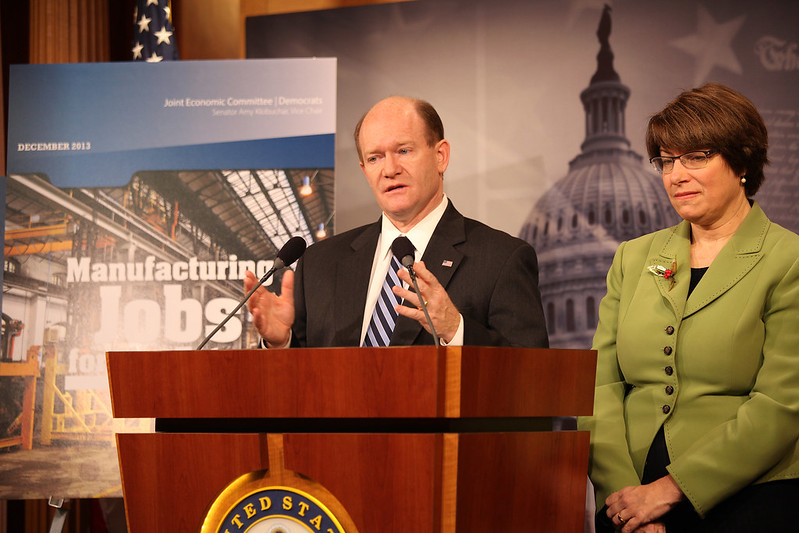
Photo of Senators Coons and Klobuchar unveiling new report on manufacturing jobs

WASHINGTON – A new congressional report released Tuesday found that after a decade of devastating declines, the American manufacturing sector is recovering, and that now is the time for Washington to invest in its confirmed growth. The report, authored by Joint Economic Committee Democratic staff, concluded that “manufacturing is the most innovative sector of the economy and is vital to U.S. competitiveness” and found that the value of U.S. manufacturing exports has surpassed the country’s pre-recession peak. 

“America’s manufacturing sector is already coming back and is a critical part of our nation’s economic recovery,” said U.S. Senator Chris Coons (D-Del.), who leads the Manufacturing Jobs for America initiative in the Senate. “This report makes clear why it is so important that Washington focuses on manufacturing jobs instead of manufactured crises. Manufacturing jobs are high-quality jobs — they pay more in wages and benefits, create local service jobs, and contribute significantly to the local economy. This report thoroughly and thoughtfully lays out how Congress can make a difference in helping American manufacturers grow and create these good jobs, and I appreciate the excellent work by Senator Klobuchar and the Joint Economic Committee in putting it together.”

“America is a country that innovates, makes things, and exports to the world, and manufacturing has long been an engine of economic growth and a key source of good jobs,” said U.S. Senator Amy Klobuchar (D-Minn.), Vice Chair of the Joint Economic Committee. “This report highlights immediate, bipartisan actions Congress can take to strengthen American manufacturing, from cutting red tape to increase U.S. exports to boosting STEM education, and I will continue to work to move these initiatives forward so we can move our economy forward.”

Among the report’s most compelling findings about American manufacturing:

  • Manufacturing exports are up in value 38 percent since 2009 – beating their pre-recession peak
  • Roughly 600,000 high-skilled positions went unfilled in 2012 because of a lack of qualified workers
  • Manufacturing accounts for 12 percent of the nation’s gross domestic product
  • Manufacturers provide nearly 12 million jobs
  • The manufacturing sector has grown by 554,000 jobs since February 2010, adding jobs in 36 of the last 45 months

“Manufacturing in America is fundamentally different today than it was when it fueled the post-war boom and built our middle class,” Senator Coons said. “As the report shows, one of the areas that has changed is the nature of manufacturing work itself. Today, workers need to be better educated and more skilled – especially in science, technology, engineering, and math. Rather than relying on assembly lines made up of many workers repeating the same task over and over again, modern manufacturers are increasingly requiring workers to carry out more complex and varying tasks. Our workers need to be more productive and more skilled because they are overseeing highly complex operations. Manufacturing still holds the same potential as it did before – we just need to modernize our manufacturing sector for the 21st century.”

Since its debut in October, Manufacturing Jobs for America has grown to include 44 bills from 26 senators. Thirty of the bills have already been introduced, many with bipartisan support, around four principles:

  • Strengthening America’s 21st century workforce
  • Opening markets abroad
  • Creating the conditions necessary for growth
  • Expanding access to capital

Statement from Senator Coons on vote to advance bipartisan budget agreement

WASHINGTON – U.S. Senator Chris Coons (D-Del.), a member of the Senate Budget Committee and the conference committee tasked with reconciling the budgets passed by the Senate and House of Representatives, voted Tuesday to advance the agreement reached by conference committee chairs Senator Patty Murray (D-Wash.) and Congressman Paul Ryan (R-Wis.). The Senate voted 67-33 to invoke cloture on the budget agreement, clearing the way for a vote on final passage on Wednesday.

“The budget we advanced today represents a commitment to compromise and shared sacrifice that has been absent from this chamber for far too long. While this agreement is not perfect, it represents a critical first step toward addressing the broader fiscal challenges facing our nation. This budget agreement will reduce our deficits, replace the harmful structure of the sequester for the next two years, and pave the way for restored funding in critical priority areas through a balance of targeted spending cuts and new revenue.

“Yet, like any compromise, this agreement could not accomplish everything we hoped. I am disappointed that a week after the agreement was announced, there is still no path forward in Congress for the preservation of unemployment insurance for millions of American jobseekers. With 3,600 in Delaware scheduled to lose their benefits in 11 days, Congress must act quickly to restore this vital lifeline. I am hopeful that the bipartisan progress made today is evidence that Congress can come together once again to address this and other important priorities for the American people.”

Senator Coons, colleagues urge IRS to exempt volunteer first responders from healthcare mandate

WASHINGTON – U.S. Senator Chris Coons (D-Del.) and seven of his colleagues wrote to Treasury Secretary Jack Lew on Monday to clarify the “Shared Responsibility” provision of the Affordable Care Act for volunteer first responders. Senator Coons is seeking to ensure that Delaware’s 6,000 volunteer firefighters and emergency responders are not counted as employees under the provision, potentially triggering the law’s coverage mandate for businesses with more than 50 employees.

“Many combination and volunteer fire departments are lacking the necessary guidance as to how they may be affected by Employer Shared Responsibility Provision of the ACA,” the senators wrote. “We believe that it is critical that volunteer firefighters and emergency personnel not be counted as employees as it relates to the ACA and any employer responsibilities to ensure the continuation of this important aspect of our public safety infrastructure.”

“Nominally compensated volunteers often have other full-time jobs which offer health insurance and generally do not have any expectation of receiving health insurance in exchange for their volunteer service.”

Most volunteer first responders have other full-time employment, and few receive even nominal compensation or financial benefit. Many emergency response agencies do not have the resources to provide pay or benefits to volunteers, nor do most volunteer first responders expect to receive compensation or health coverage as a result of their volunteer public service.

“The Fair Labor Standards Act (FLSA) and section 457(e) of the Internal Revenue Code (IRC) allow volunteer firefighters and emergency medical personnel to be nominally compensated for their service,” the senators explained. “However, the Internal Revenue Service (IRS) also tends to treat volunteers firefighters and emergency medical personnel as employees of the agencies that they serve for the purpose of taxing their nominal benefits. This however, leads to some confusion as to whether the classification of volunteer firefighters as ‘employees’ will also apply for the purposes of the Shared Responsibility Provision of the ACA.”

“We believe that it would be fair to use existing standards in the Internal Revenue Code to ensure that ‘bona fide volunteers performing fire fighting and prevention services, emergency medical services, or ambulance services’ are not defined as employees for purposes of calculating the shared responsibility provisions of the ACA,” the senators continued. “Properly distinguishing between full-time, paid emergency responders and volunteers is necessary if we want to protect essential emergency response agencies that keep our communities safe and protect over one-third of the U.S. population.” 

The text of the letter is below. It can be downloaded as a PDF here: http://bit.ly/Jsz2g7

December 16, 2013

The Honorable Jacob Lew
Secretary
Department of the Treasury
1500 Pennsylvania Avenue, NW
Washington, D.C. 20220

Dear Secretary Lew:

We write regarding the treatment of nominally compensated volunteer firefighters and emergency medical personnel under the Patient Protection and Affordable Care Act (PPACA) (P.L. 111-148). Many combination and volunteer fire departments are lacking the necessary guidance as to how they may be affected by Employer Shared Responsibility Provision of the ACA.  We believe that it is critical that volunteer firefighters and emergency personnel not be counted as employees as it relates to the ACA and any employer responsibilities to ensure the continuation of this important aspect of our public safety infrastructure.

Approximately 780,000 volunteer firefighters serve in 20,000 all-volunteer and 7,000 combination career-volunteer fire departments throughout the United States. Many communities rely exclusively upon volunteer fire departments for fire protection and emergency medical services.  In fact, ninety-two percent of the nation’s fire departments utilize volunteer personnel, whose donated services are estimated to be worth approximately $140 billion annually.

Many volunteer fire and emergency medical personnel receive nominal benefits, which boost recruitment and retention by demonstrating that their efforts are appreciated. The Fair Labor Standards Act (FLSA) and section 457(e) of the Internal Revenue Code (IRC) allow volunteer firefighters and emergency medical personnel to be nominally compensated for their service. However, the Internal Revenue Service (IRS) also tends to treat volunteers firefighters and emergency medical personnel as employees of the agencies that they serve for the purpose of taxing their nominal benefits.  This however, leads to some confusion as to whether the classification of volunteer firefighters as “employees” will also apply for the purposes of the Shared Responsibility Provision of the ACA.

We believe the allowances made in the FLSA and the IRC for individuals to receive nominal compensation in return for their service while still being classified as “volunteers” are critically important in the public safety community. Nominally compensated volunteers often have other full-time jobs which offer health insurance and generally do not have any expectation of receiving health insurance in exchange for their volunteer service.

We believe that it would be fair to use existing standards in the Internal Revenue Code to ensure that “bona fide volunteers performing fire fighting and prevention services, emergency medical services, or ambulance services” are not defined as employees for purposes of calculating the shared responsibility provisions of the ACA.  Properly distinguishing between full-time, paid emergency responders and volunteers is necessary if we want to protect essential emergency response agencies that keep our communities safe and protect over one-third of the U.S. population.

It is imperative that clarifying guidance be issued as soon as possible in order to provide clear guidance to combination and volunteer fire departments.

Thank you for your attention to this important matter.

Sincerely,

Mark R. Warner

Joe Manchin

Chris Coons

Mary Landrieu

Mark Begich

Susan Collins

Robert Menendez

Robert Casey, Jr.

CC: Thomas E. Perez, Secretary of Labor

Daniel I. Werfel, Acting IRS Commissioner