Related Issues

Related Issues

Senators Coons applauds Senate passage of Fire Grants and Safety Act to help Delaware fire departments access funding

WASHINGTON – U.S. Senator Chris Coons (D-Del.) celebrated the Senate’s passage of the Fire Grants and Safety Act, which will help local fire departments access funding for training, personnel, and equipment. Several of the grant programs funded in the bill are particularly important to small and volunteer fire departments. 

“Local departments in Delaware and across the country are struggling to meet the needs of the communities they serve, as fire and emergency services face rising call volumes, declining rates of volunteer firefighters, and low recruitment numbers,” said Senator Coons. “The Fire Grants and Safety Act reauthorizes crucial programs that allow local fire departments to acquire new equipment and maintain proper staffing levels. Swiftly enacting this reauthorization will protect our nation’s firefighters and keep more Delawareans safe.” 

Across the nation, many local fire departments struggle to address staffing needs. These shortages prevent departments from meeting industry staffing and response time standards, while placing firefighters at greater risk. The Fire Grants and Safety Act would reauthorize the Federal Emergency Management Agency’s Assistance to Firefighters Grant (AFG) program, the Staffing for Adequate Fire and Emergency Response (SAFER) grant program, and the U.S. Fire Administration (USFA). The grant programs, set to expire in the coming years, provide hundreds of millions of dollars of assistance to rural fire companies across the country annually. The bill reauthorizes $95 million for USFA – a nearly $20 million increase from current authorized levels – and would extend the authorization for all three programs until 2028. Without passage of this bill, AFG and SAFER will expire on September 30. 

The SAFER program provides federal grants to career and volunteer local fire departments to hire more firefighters and attain 24-hour staffing to protect local communities from fire hazards. The AFG program provides federal grants to local fire departments and unaffiliated Emergency Medical Services (EMS) organizations to help address a variety of equipment, training, and other firefighter-related and EMS needs. The USFA is the primary representative of fire and emergency services in the federal government and provides fire research, public safety education, and data collection to help train departments across the nation. 

The Fire Grants and Safety Act is endorsed by the International Association of Fire Chiefs, the National Volunteer Fire Council, the Congressional Fire Service Institute, the International Association of Fire Fighters, the National Fallen Firefighters Foundation, the National Association of State Fire Marshals, and the International Society of Fire Service Instructors. 

Congress established the AFG grant program in 2000, providing vital funding for career, combination, and volunteer departments. Congress then authorized the SAFER program in 2003 to address staffing shortages in career, combination, and volunteer departments across the nation.


REMARKS: Senator Coons in speech on African Growth and Opportunity Act: “Africa is the most important continent of this century, and we in the United States need to act like it”

WASHINGTON – U.S. Senator Chris Coons (D-Del.) delivered a speech at the Wilson Center Africa Program’s Brown Capital Management Africa Forum on the importance of reauthorizing the African Growth and Opportunity Act (AGOA). Senator Coons is Chair of the Senate Appropriations Subcommittee on State and Foreign Operations and a member of the Senate Foreign Relations Committee.

In his speech, Senator Coons stressed the importance of increased U.S. engagement with Africa – the youngest and fastest-growing continent – and how AGOA facilitates deeper investment and stronger commercial ties between the United States and sub-Saharan African countries. AGOA is currently due to sunset next year unless it is renewed.

[WATCH]

Read coverage here: Road to AGOA Reauthorization: The Future of US-Africa Trade and Investment, The Wilson Center

Senator Coons’ AGOA Renewal and Improvement Act with U.S. Senator Jim Risch (R-Idaho), introduced in April, would extend AGOA until 2041, giving U.S. investors and African partners much-needed certainty. Senator Coons traveled to five AGOA-eligible countries in March and wrote an op-ed in The Hill on Kenyan President William Ruto’s state visit to the United States in May.

Senator Coons’ full remarks are below:

Senator Coons: As you heard from [Wilson Center President and CEO] Mark [Green] in his introduction, we’ve worked together and respected each other and have done our best to make a lasting difference across, now, several different roles in several different administrations. I first got to know him in his role as ambassador to Tanzania. I worked very closely with him when he was leading USAID [U.S. Agency for International Development] and I’m grateful for your leadership here at the Wilson Center.

AGOA, next year, turns 25. And so, in just my 14 years in the U.S. Senate, it’s been a majority of the time that AGOA has stood as a remarkable and enduring trade arrangement: duty-free and quota-free access to the U.S. market. Now, lots of folks say that the goal right in front of us should be improving AGOA, because at some point in the future, Africa is going to be this great continent of promise. My argument would be, that moment is now; it has already happened. And there are some who debate it as if it is a hypothetical or [in the] future, but, demonstrably, Africa is the most important continent of this century, and we in the United States need to act like it.

It is the fastest-growing continent; the youngest population. [There are] more than 350 companies across the continent with a market capitalization above $1 billion. Thirty years from now, the middle class of Africa will exceed 1 billion people. One of my favorite little data points for doubting neighbors and friends back home is that there are more smartphone users on the continent than there are in the entire United States.

As you heard, I have worked closely with Republican Senator Jim Risch [Idaho] of the Foreign Relations Committee to introduce the AGOA Renewal and Improvement Act. Our goal [is] to secure this cornerstone of U.S.-Africa economic relations and to lay the foundation for a deeper and more enduring economic partnership going forward. As I suspect everyone in this room knows – but it bears repeating – AGOA is a trade and development program. It provides duty-free access to the U.S. market for exports from eligible countries, encourages investment, and promotes economic development, but eligibility also depends upon good governance and human rights, which I believe has helped incentivize democratic reform and the rule of law.

It’s slated to expire in September of next year. And as someone who worked in the private sector for a global manufacturing company for a decade before first being elected, I’m well aware that supply chain decisions by integrated global companies don’t happen within the month of the expiration of the law. Only in Congress do we think we’re doing our job when we do it at the absolute last possible second, or, maybe we’ll do an overtime extender and we’ll then do it a month from now. Governing by continuing resolution is unfamiliar to the private sector. And so, this work with Jim Risch – to extend it all the way to 2041 – has both an early and a late component; the late component is giving it significant reach so that there is no concern that it will expire in five or 10 years. But we need to do it as soon as possible, so that we don’t risk the loss of this moment.

What is this moment? Well, in a world that is increasingly isolationist and protectionist, it stands as one of the few remaining, long-lasting, reliable market-access mechanisms to the United States market. [There are] businesses that, after the shocks and the dislocation of the pandemic, are looking to diversify their supply chain. A lengthy and early extension of AGOA takes advantage of this moment. But we also have to be mindful that businesses look for predictability.

Businesses have options; so, too, does sub-Saharan Africa. Africa, in the 14 years since I first chaired the Africa subcommittee in the Senate, has dramatically integrated economically with China. Back when AGOA was passed, all of China trade to Africa was $8 billion; $8 billion. 2022 was $280 billion. Those two numbers give you a stark sense of just how dramatically Chinese trade with Africa has expanded and as we all know, they’ve invested far more in African infrastructure in recent years than any other country – in roads and rail, ports and energy and telecommunications. Russia, too, has recently prioritized engagement with the continent, both from a military and diplomatic perspective.

[But] the United States cannot view its engagement with Africa through the lens of great power conflict. That is disrespectful to the relationships that we have had – that we hope to build on with other countries – but if we want to be relevant, if we want to compete, if we want to engage with nations that have options, we have to show up, and we have to show up at scale.

In 2022, President Biden hosted a U.S.-Africa Leaders Summit. The United States and American companies committed $55 billion in investment over the ensuing three years. It was based on economic and diplomatic engagement rooted in respect and shared values. And we need to build upon the successes of that summit: There needs to be a clear commitment to another summit and there needs to be a clear path forward towards implementing some of the recommendations of that summit. Just last month, President Biden hosted a very successful visit by William Ruto, the President of Kenya, and I’ll remind you that his principal and primary ask in the runup was the swift reauthorization of AGOA. Kenya has grown dramatically its capacity to export – particularly in the apparel sector to the United States – and I think this is something that we need to prioritize and do so quickly. 

Look, in absolute terms, AGOA is actually a relatively small trade program. If you exclude oil, it’s about $5.7 billion a year, in the eligible countries. But it’s very meaningful – across the continent, about 1.3 [million], 1.5 million jobs are indirectly or directly supported by AGOA. In Kenya, it sparked the growth of a dynamic new apparel sector; I’ve had the opportunity to visit a number of new light manufacturing companies that are in the business because of the opportunities of AGOA, and it’s driving more investment in both agriculture and manufacturing at exactly the time when every African leader whom I meet looks for more and better jobs at higher ends in the value chain. We have to renew AGOA to reinforce the progress we’re trying to make.

So, what would my bill with Jim Risch be? It would support African governments in developing specific strategies for making the most of AGOA’s benefits so that we can see broader and more diversified participation in benefiting from AGOA’s renewal and extension. It would build on, as Mark Green mentioned, the African Continental Free Trade Agreement, so that we see that we’re incentivizing the integration of continental supply chains and enabling more trade between, and among, African countries. It clarifies how eligibility is reviewed and enforced; with clarifying eligibility criteria, it would reduce the frequency of regular reviews; it would strengthen the ability to conduct an out-of-cycle review and would give the President a broader menu of options for enforcement in circumstances where a country seems to be well outside the values framework that we’ve set for AGOA participation.

I think this clarity is important as both the Congress and the President assess some challenging calls like South Africa – given their growing closeness, and some integration issues, with both Russia and China. What the path forward for AGOA looks like – specifically, with relation to South Africa – has been raised over and over by members of the House and Senate. We will not get through reauthorization without directly addressing that. We have had – we have had real progress with Congress recently; concrete progress. There was an AGOA hearing two weeks ago in the Senate; there was a House hearing last week. There’s broad bipartisan and bicameral support for renewal. There will be an AGOA Forum here in Washington, D.C., in late July, as I think all of you may know.

I think passing this bill by then would send an important and timely message with great economic value. But, if somehow, we don’t get this done by then, we need to extend it at least before the end of this calendar year. We should not, once again – as happened before – suffer the dislocation with embarrassment, the consternation, of it coming right up to the end. It’s an essential step, but not the only step … to strengthen U.S. engagement with Africa.

As chair of the Appropriations subcommittee that funds all of our foreign assistance – USAID, MCC [Millennium Challenge Corporation], DFC [U.S. International Development Finance Corporation], and the State Department – I can say we’re working to modernize economic development through public-private partnerships, through changes to the MCC and the DFC that will help African partners move up the value chain – from mining to the processing of minerals; from basic material production to complex manufacturing. Yes, African countries have many options, but what we offer is far better than the debt-trap diplomacy extended by some of our competitors. I think we need to offer and help countries graduate from AGOA to a durable, reciprocal trading partnership, and I think the STIP [Strategic Trade and Investment Partnership] negotiations with the United States and Kenya are a promising start and should serve as a first step towards the negotiation of a comprehensive free-trade agreement.

Just a few weeks ago, I visited five African countries, all of them AGOA-eligible. And I reminded [Appropriations Committee] Chair Patty Murray [D-Wash.], as we were leaving Angola, that there’d been a remarkable transformation in the attitude towards the United States of [Angola] President [João] Lourenço, a former guerrilla, formerly the leader of a Marxist party, long closely aligned with both the PRC [People’s Republic of China] and the former Soviet Union. And I reminded her as we took off, that, in our conversation, the one thing he asked for over and over was more partnership, more investment, more engagement. Yes, other countries are there in Angola and are looking to take advantage of the opportunities of Angola’s rapid development. The United States should show up; we should be reliable, we should be open-handed, and we should be the strongest possible partner for sub-Saharan Africa.

Africa is the continent of this century; the United States, in a global competition to see which system works best, needs to show up and prove that through the pull of AGOA, through modernizing the MCC and the DFC, and through engagement, engagement, engagement, we have the better model and a better opportunity. And I look forward to working with all of you to make that a reality.
 

Senator Coons, colleagues call on Biden administration to protect Documented Dreamers from deportation

WASHINGTON – U.S. Senator Chris Coons (D-Del.) joined a bipartisan group of lawmakers from both the U.S. Senate and the U.S. House of Representatives calling on the Biden administration to take urgent action to protect the more than 250,000 “Documented Dreamers” – children of long-term visa holders – who are at risk of aging out of their dependent status and will be forced to self-deport if they are ineligible for another status.

Despite growing up in the United States with legal status, children of long-term visa holders age out of their dependent status when they turn 21 and are often left with no choice but to leave the United States if they cannot transition to a new status. This is largely because families’ adjustments of status applications face extensive backlogs, preventing them from securing permanent resident status.

Senator Coons previously cosponsored bipartisan legislation, led by Senators Alex Padilla (D-Calif.) and Rand Paul (R-Ky.), to protect over 250,000 Documented Dreamers through the America’s CHILDREN Act.

“These young people grow up in the United States, complete their education in the American school system, and graduate with degrees from American institutions,” the lawmakers wrote in a letter to U.S. Homeland Security Secretary Alejandro Mayorkas and U.S. Citizenship and Immigration Services Director Ur M. Jaddou. “However, due to the long green-card backlog, families with approved immigrant petitions are often stuck waiting decades for permanent resident status.”

“While we continue to pursue legislative solutions to permanently protect these individuals, such as the bipartisan and bicameral America’s Children Act of 2023, we urge you to take administrative action to protect the thousands of children who may be forced to self-deport each year,” the lawmakers continued.

In addition to Senators Coons and Padilla, the letter was also signed by Senators Michael Bennet (D-Colo.), Ben Cardin (D-Md.), Catherine Cortez Masto (D-Nev.), Tammy Duckworth (D-Ill.), Dick Durbin (D-Ill.), Mazie Hirono (D-Hawaii), Ben Ray Luján (D-N.M.), Jeff Merkley (D-Ore.), Jacky Rosen (D-Nev.), Kyrsten Sinema (I-Ariz.), Raphael Warnock (D-Ga.), Elizabeth Warren (D-Mass.), and Sheldon Whitehouse (D-R.I.), as well as U.S. Representatives Deborah Ross (D-N.C.), Ami Bera (D-Calif.), Suzanne Bonamici (D-Ore.), André Carson (D-Ind.), Judy Chu (D-Calif.), Jim Costa (D-Calif.), Mark DeSaulnier (D-Calif.), Debbie Dingell (D-Mich.), Veronica Escobar (D-Texas), Daniel Goldman (D-N.Y.), Raúl Grijalva (D-Ariz.), Chrissy Houlahan (D-Pa.), Jonathan Jackson (D-Ill.), Hank Johnson (D-Ga.), Young Kim (R-Calif.), Raja Krishnamoorthi (D-Ill.), Barbara Lee (D-Calif.), Mike Levin (D-Calif.), Zoe Lofgren (D-Calif.), Mariannette Miller-Meeks (R-Iowa), Jerrold Nadler (D-N.Y.), Joe Neguse (D-Colo.), Eleanor Holmes Norton (D-D.C.), Scott Peters (D-Calif.), Mike Quigley (D-Ill.), Delia C. Ramirez (D-Ill.), María Elvira Salazar (R-Fla.), Marilyn Strickland (D-Wash.), Juan Vargas (D-Calif.), and Debbie Wasserman Schultz (D-Fla.).

Full text of the letter is available here and below:

Dear Secretary Mayorkas and Director Jaddou:

We write to urge swift administrative action to protect children who have grown up in the United States with full legal documentation as dependents of long-term visa holders who are at risk of aging out of status or deportation because of our outdated immigration laws.

Many other families have no pathway to permanent residence and can live in the United States only as long as they maintain their work visas. Meanwhile, the children of these immigrants age out of their dependent status when they turn 21 and are forced to leave the United States if they cannot find a new status.

While we continue to pursue legislative solutions to permanently protect these individuals, such as the bipartisan and bicameral America’s Children Act of 2023, we urge you to take administrative action to protect the thousands of children who may be forced to self-deport each year.

We are grateful for the policy guidance issued by U.S. Citizenship and Immigration Services (USCIS) in February 2023 that updates when an immigrant visa “becomes available” for the purpose of calculating age under the Child Status Protection Act for individuals seeking lawful permanent resident status. The change to calculating individuals’ ages using the Dates for Filing chart rather than the Final Action Date chart provides relief to young adults who otherwise would have narrowly aged out of the system. However, more must be done to fully address the problems that this population faces.

We urge you to consider the following actions:

1. Clarify the applicability of potential grants of deferred action on a case-by-case basis, where discretion is warranted, for children of long-term visa holders who age out of status. Deferred action is a discretionary determination to defer removal of an individual as an act of prosecutorial discretion. USCIS recently updated its policy manual to clarify that it would consider deferred action for individuals with approved Special Immigrant Juvenile Status petitions who cannot adjust status because a visa number is not available. USCIS should similarly clarify the applicability of deferred action to children of long-term visa holders on a case-by-case basis where discretion is warranted.

2. Expand eligibility for Employment Authorization to child dependents of visa holders, and to individuals with approved I-140 petitions. The Department of Homeland Security (DHS) should authorize employment for additional categories of nonimmigrants, including child dependents, in any category for which the spouse of the primary visa holder is authorized to work, as well as nonimmigrants with an approved I-140 petition who are stuck in the green-card backlog. DHS should also expand eligibility for a compelling circumstances Employment Authorization Document (EAD) to include children who are aging out. According to USCIS, a compelling circumstances EAD is a “temporary stopgap measure intended to address particularly difficult situations, including those that may have otherwise forced individuals on the path to lawful permanent residence to abruptly stop working and leave the United States.” Currently, only principal applicants of certain employment-based petitions and their dependent spouses and children are eligible for a compelling circumstances EAD. We urge DHS to include children of long-term visa holders who are raised in America in any expansion of eligibility for compelling circumstances EADs.

3. Grant parole to children of long-term visa holders who age out. USCIS has authority to grant parole on a case-by-case basis for urgent humanitarian or significant public benefit reasons. We urge USCIS to create a process to allow children of long-term visa holders who have aged out to seek parole on a case-by-case basis, if warranted for urgent humanitarian reasons or to advance a significant public benefit.

We urge you to fully consider each of these actions. We ask that you provide a response detailing which actions you intend to pursue, and, if any actions are not practicable, why that is your determination.

Sincerely,


Senators Coons and colleagues’ bill to protect state and local judges passes Senate

WASHINGTON – The Countering Threats and Attacks on Our Judges Act, led by U.S. Senators Chris Coons (D-Del.), John Cornyn (R-Texas), Sheldon Whitehouse (D-R.I.), and Jerry Moran (R-Kan.), unanimously passed the Senate last night. The bill would establish a State Judicial Threat Intelligence and Resource Center to provide technical assistance, training, and threat monitoring for state and local judges and court personnel.

“I’m delighted that the Senate has unanimously passed our bipartisan bill to help keep state and local judges safe, so they can do their jobs without fear or prejudice,” said Senator Coons. “Every public servant, including the members of our state and local judiciary, should be able to do their jobs free from threats to themselves, their families, or their livelihoods. It is a shame that heightened polarization and partisanship has led to a spike in threats and attacks on members of the bench that endangers the independence of our justice system.”

“In the face of unacceptable attacks on our judiciary, more must be done to protect our nation’s courts, the men and women who work in them, and the judicial independence they uphold each and every day,” said Senator Cornyn. “This bipartisan legislation would establish a resource center to identify and respond to bad actors who threaten judges, their families, and employees, and I urge the House to quickly send it to the President’s desk.”


“Judges perform a critical community service at every level of our justice system,” said Senator Moran. “In response to growing threats and attacks against members of the judiciary, the Senate has advanced our legislation to provide needed resources and support to local law enforcement tasked with protecting judges and courthouses.”

“It’s a sad reality that threats meant to intimidate judges and court personnel have increased significantly in recent years,” said Senator Whitehouse. “Our bipartisan bill to improve security at courthouses and judges’ homes will protect court officials from violence and harassment and help safeguard the integrity of the judicial system.”

The bill is cosponsored by Senators Jeanne Shaheen (D-N.H.), John Barrasso (R-Wyo.), Tammy Baldwin (D-Wis.), Ben Cardin (D-Md.), and Mark Kelly (D-Ariz.).

Background:

The Countering Threats and Attacks on Our Judges Act would create a State Judicial Threat Intelligence and Resource Center to:

  • Provide technical assistance to state and local judges and court personnel around judicial security;
  • Provide physical security assessments for courts, homes, and other facilities where judicial officers and staff conduct court-related business; and
  • Conduct research to identify, examine, and advance best practices around judicial security.

The resource center would be housed within the existing State Justice Institute, a private nonprofit and nonpartisan corporation established by Congress in 1984.

The legislation is supported by the Conference of Chief Justices, Conference of State Court Administrators, Council of Chief Judges of the State Courts of Appeal, All Rise, National Association for Presiding Judges and Court Executive Officers, National Association for Court Management, American Judges Association, National Center for State Courts, and the National District Attorneys Association.


Senators Coons, Grassley introduce resolution recognizing July as National Anti-Counterfeiting and Consumer Education and Awareness Month

WASHINGTON – U.S. Senators Chris Coons (D-Del.) and Chuck Grassley (R-Iowa) introduced a bipartisan resolution yesterday recognizing the month of July as National Anti-Counterfeiting and Consumer Education and Awareness Month, which highlights the importance of the roles of trademarks in the American economy and in protecting consumer safety. In addition to Senators Coons and Grassley, this resolution is also cosponsored by U.S. Senators Thom Tillis (R-N.C.) and Mazie K. Hirono (D-Hawaii).

“Combating counterfeits doesn’t just spur innovation by giving creators faith that their ideas will be protected; it also safeguards trust in our community, ensuring quality and performance, and keeps consumers safe,” said Senator Coons. “As Co-Chair of the Congressional Trademark Caucus, I’m committed to raising awareness for American consumers of the harms of counterfeit goods and the importance of trademarks to our intellectual property system.”

“Counterfeits violate intellectual property rights, stifle innovation, and threaten consumers’ well-being,” said Senator Grassley. “I’m glad to promote this bipartisan effort to educate Americans on the importance of trademarks and the dangers of unsafe and unreliable knockoffs.”

“Counterfeit products pose a serious risk to inventors, consumers, and our economy,” said Senator Tillis. “I’m proud to co-sponsor this resolution, which recognizes the month of July as National Anti-Counterfeiting and Consumer Education and Awareness Month. Through educating consumers, we can curb the malign influence of counterfeits in our marketplaces, protect creators from intellectual property theft, and ensure consumers purchase safe and authentic products.”

“The wide dissemination of counterfeit products not only harms our national and state economies; it also does a disservice to the consumers who are spending their hard-earned money to purchase them,” said Senator Hirono. “I’m glad to support this resolution to recognize National Anti-Counterfeiting and Consumer Education and Awareness Month to bring attention to this issue and educate communities across the country about the risks of counterfeiting and counterfeit products.” 

Senator Coons has been a longstanding advocate of protecting U.S. intellectual property rights and protecting the American consumer from counterfeit goods. He introduced the SHOP SAFE Act with Senator Tillis to protect consumers from harmful counterfeit products sold online. As Chair of the Senate Judiciary Committee’s Intellectual Property Subcommittee, Senator Coons held a hearing on oversight of the U.S. Patent and Trademark Office last year to ensure U.S. intellectual property laws are being enforced reliably, effectively, and predictably.  

Senators Coons and Grassley previously cosponsored a similar resolution last year, and another in the 117th Congress.

Senator Coons is the Chair of the Senate Judiciary Committee’s Intellectual Property Subcommittee and Co-Chair of the Congressional Trademark Caucus.


Senator Coons statement on FDA v. Alliance for Hippocratic Medicine decision

WASHINGTON – U.S. Senator Chris Coons (D-Del.) released the following statement today after the Supreme Court issued its unanimous opinion in U.S. Food and Drug Administration (FDA) v. Alliance for Hippocratic Medicine, concluding that the anti-choice plaintiffs did not have legal standing to challenge the FDA’s changes to its regulations of mifepristone, a drug most commonly used to end an early pregnancy:

“This decision is a victory for those who believe that every woman in America has the right to make her own reproductive health care choices. I’m glad this decision allows mifepristone to remain on the market and maintains access to this critical medication. The court’s opinion also reaffirms the independence of the FDA, which approved mifepristone as safe and effective after a thorough and comprehensive review process more than two decades ago.

“While I welcome this news, the court’s decision to strike down Roe v. Wade two years ago paved the way for increasing attacks on reproductive freedom, including access to contraception and fertility treatments. I remain committed to strengthening access to women’s health care and will fight any attempts to further erode reproductive freedom.”

Senator Coons is a member of the Senate Judiciary Committee.


Senator Coons gives floor speech on Supreme Court Ethics, Recusal, and Transparency Act

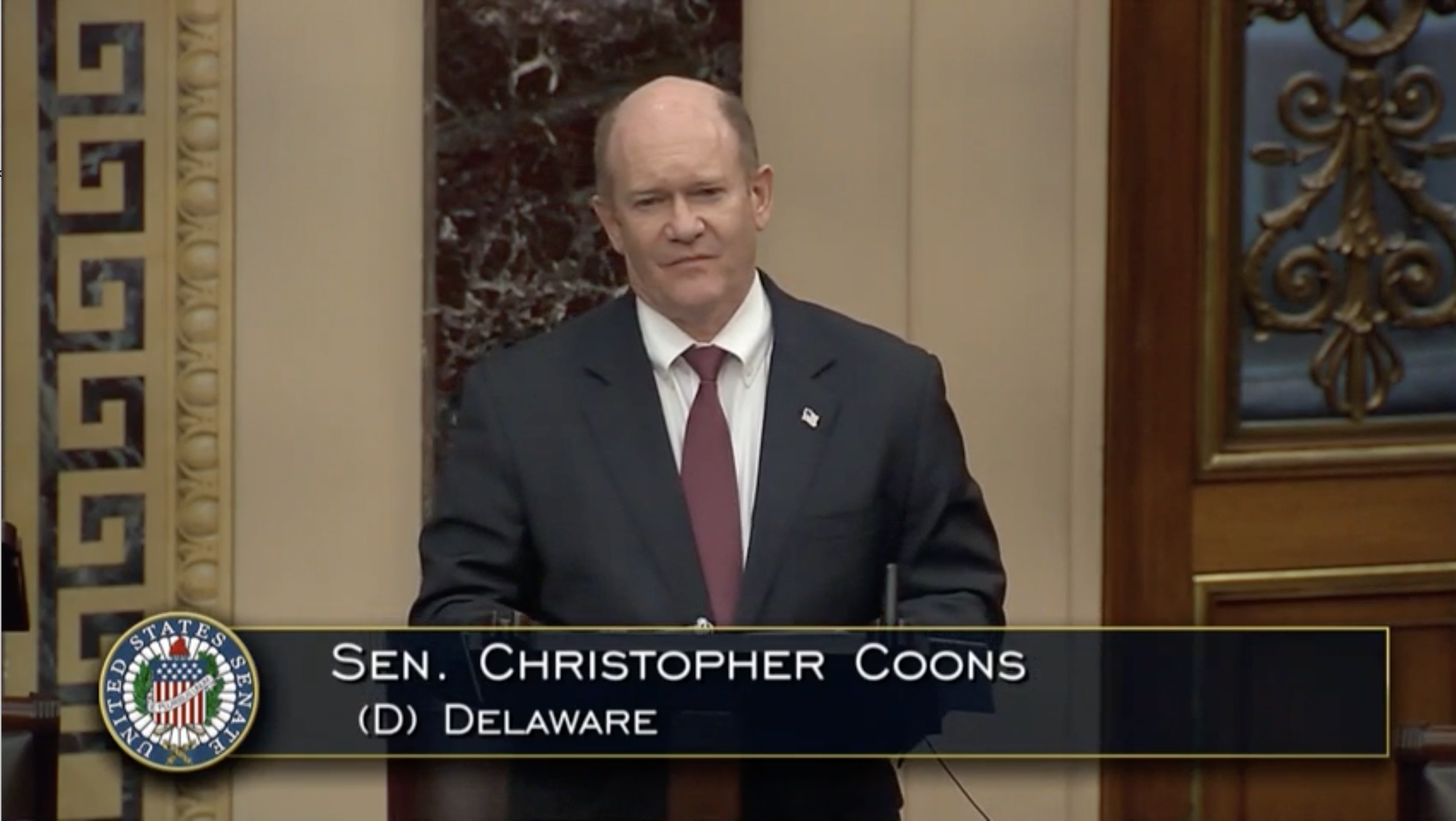
WASHINGTON – U.S. Senator Chris Coons (D-Del.) delivered a floor speech yesterday encouraging the passage of the Supreme Court Ethics, Recusal, and Transparency (SCERT) Act, a bill that would – for the first time – require the U.S. Supreme Court to adopt a binding and enforceable code of ethics.

floor speech

Senator Coons highlighted recent polling that shows the American people are losing confidence in the independence of the Supreme Court. The failure of some justices to disclose millions of dollars’ worth of trips and gifts, as well as the repeated display of political signs on residential property, have contributed to the Supreme Court’s declining standing in public opinion. Despite these concerns, Supreme Court justices are not bound by an enforceable code of conduct, unlike every other federal judge.

In his speech, Senator Coons urged the passing of the SCERT Act as a way to restore the standing of the Supreme Court and bolster public confidence in the integrity of its rulings.

A full transcript is available below:

Senator Coons: Mr. President, I rise to urge this body to reconsider the objection that was just made by my colleagues.

The rule of law – the system of ordered liberty for which so many Americans have served and sacrificed at home and abroad – is a fragile thing. It is at times a mere tissue, and it is held together by the confidence of our people in the ethics and integrity of those whom they elect, or who are appointed, nominated, [and] confirmed to serve them.

We’ve seen a number of challenging chapters around ethics and integrity and public service recently, but tonight, we’re on this floor to speak about our Supreme Court, and a simply shocking series of revelations about ways in which justices have accepted, over years, huge amounts of gifts.

The suggestion has been made by a number of my colleagues that this is just Democrats – that this is just a partisan attack on a few justices to try and roll back or undermine decisions they’ve made that we dislike, or their legitimacy. 

Well, I can give you a compelling counterpoint. My friend and colleague, Senator [John] Cornyn [R-Texas], and I – seeing a whole series of stories in The Wall Street Journal in 2021 that revealed that there were dozens of federal judges who had stock holdings in companies where issues before them implicated the value of that company – moved us to introduce the bipartisan Courthouse Ethics and Transparency Act. Your typical bill takes six, seven, eight years to become law here in the Senate. This one moved faster than almost any other, and on the Senate Judiciary Committee and here on the floor of the Senate, nobody argued that the Supreme Court needed to be above it all. Nobody argued that the justices of the Supreme Court shouldn’t be required to disclose their stock holdings and be accountable for their failures; to recuse or disclose. In fact, that bill passed unanimously. Why, then, is this one not similarly situated? 

Every federal judge is subjected to a binding code of ethics; every Senator; virtually every federal employee of a senior decision-making role is bound by a code of ethics. That’s how the American people know that if there is some slight or fault, some self-dealing, or some action that creates the appearance of impropriety, that action will be taken. After months and months and months of reports of misconduct, failure to disclose questionable conduct by a justice or two of the Supreme Court, a recent poll by Marquette [University] shows that a majority of the American people have lost faith in this institution and no longer have confidence in the political independence and the ethics of our Supreme Court. 

Mr. Chief Justice, I hope you listen or watch. We believe you to be concerned about the legitimacy of this important institution. The Supreme Court is the only federal court not bound by a code of conduct that is enforceable and where these disclosures and their consequences cannot be acted upon. The highest court in our land should not have the lowest ethical standards. We should take a vote on this bill, the Supreme Court Ethics Recusal and Transparency Act. 

It should not be controversial or partisan. This isn’t about attacking one justice or another. As someone who clerked for a federal judge, as someone whose chief counsel clerked for a federal judge – many of us are lawyers in this body and clerked for federal judges – we know the importance of having an independent judiciary, of having a nonpartisan judiciary, and the most powerful court in the land is the Supreme Court. When it issued landmark decisions unanimously, it moved the arc of history. Today, it issues decision after decision that are 5-4 and that are producing challenging secondary waves in our body politic. If the Supreme Court is to hold the role that our framers intended, it must do so above reproach. That is not where we are today. Our Supreme Court must make itself accountable to the American people. We shouldn’t read disclosure after disclosure in the press to learn about the conduct of the justices. 

Just a few moments ago, earlier this evening, along with the rest of the Delaware delegation, I had the honor of meeting with the newest nominees to our nation’s service [academies]. Young men and women who are raising the right hand and volunteering to serve our nation, who will be granted the opportunity at a free education in exchange for which they sign on the dotted line and agree to go serve our nation at home and abroad, and to defend our nation and our Constitution from all enemies, foreign and domestic. 

I’ve just completed a trip to the South Pacific, where I visited Manila [Philippines], and there, there is a World War II cemetery that includes crosses marking the graves of 17,000 Americans who served and sacrificed in the convulsion that was the Second World War. Those crosses do not mark on them “Democrat” or “Republican.” The freedom for which they fought, the system of justice, the rule of law, the Constitution, for which they took up arms against Imperial Japan and worked so tirelessly alongside our allies to free a world under assault from fascism and imperialism, [they] did not do so based on a sense of partisan principles but out of a commitment to our nation. 

We should honor those who served and sacrificed, a generation or two ago, and those who are willing to serve and sacrifice today going forward, by restoring ethics and transparency to the United States Supreme Court. They have cast a shameful shadow; not just the appearance of impropriety but a genuine conflict. It can be resolved. We must help them take the action they should take and resolve it. We should pass this bill.


Senators Coons, Young celebrate bipartisan passage of their JUDGES Act by the Senate Judiciary Committee

WASHINGTON – U.S. Senators Chris Coons (D-Del.) and Todd Young (R-Ind.) today celebrated the bipartisan passage of their Judicial Understaffing Delays Getting Emergencies Solved (JUDGES) Act of 2024 out of the Senate Judiciary Committee by a unanimous vote of 20-0. The bill would add 66 new federal judgeships in districts across the country to help address rising caseloads and ensure that Americans have swift access to justice regardless of where they live.

“I’m delighted that the Senate Judiciary Committee has gotten serious about the crisis facing overworked judges across the country today by taking up and advancing my bipartisan JUDGES Act to the Senate floor,” said Senator Coons. “For too long, Congress has failed to add new federal judgeships to keep pace with the rising caseloads around the country, and our nation’s federal courts – especially in Delaware, where there are only four active judgeships – have paid the price. Senator Young and I worked with members of the committee on both sides of the dais to amend this bill and make it stronger; that the bill garnered unanimous support is a testament to the legislative process working as it should and as Americans deserve. I hope my Senate colleagues will follow the committee’s lead and pass this bill so we can get our judiciary working again.”

“Too many Hoosiers and Americans are being denied access to our justice system due to an overload of cases and a shortage of judges,” said Senator Young. “Our bipartisan bill will help alleviate this shortage and ensure all Americans have the opportunity to have their day in court. Senator Coons and I have worked diligently with our colleagues to ensure this legislation effectively addresses these judicial shortages and fairly distributes the additional judgeships across multiple presidential administrations. Today’s unanimous vote on our amended bill is a testament to bipartisanship and commonsense legislating. I urge the full Senate to pass this important legislation as soon as possible.”

Federal courts across the country face crushing caseloads, as newly authorized judgeships fail to keep pace with population growth and increased case filings. Indeed, Congress has not authorized a new judgeship in more than two decades, and a comprehensive package of new judgeships like the one proposed in the JUDGES Act has not been enacted in nearly 35 years. Since then, the population of the United States has increased by nearly 100 million people, and federal case filings have skyrocketed by 40%. This has had severe consequences for our justice system, including significant delays in case resolution and burnout for overburdened judges. 

This bipartisan bill would address this problem by increasing the number of federal district judges in the most overworked regions of the country. Based on the 2023 findings of the Judicial Conference of the United States, the bill would establish the 66 recommended judgeships, splitting the new judges into six tranches spread across three presidential administrations. In total, the bill would add judgeships in 25 districts across 13 states.

The JUDGES Act of 2024 was introduced in April 2024 by Senators Coons and Young, along with U.S. Senators Alex Padilla (D-Calif.), James Lankford (R-Okla.), Mazie Hirono (D-Hawaii), Ted Cruz (R-Texas), Ben Ray Luján (D-N.M.), and Thom Tillis (R-N.C.). 

The full text of the bill can be found here.


Senators Coons and Young introduce bipartisan Youth Lead Act to support established youth service organizations

WASHINGTON – U.S. Senators Chris Coons (D-Del.) and Todd Young (R-Ind.) introduced the Youth Lead Act yesterday to bolster investments in youth agriculture and service organizations, including the Girl Scouts of the United States of America, the Boy Scouts of America, the National 4-H Council, and the National FFA Organization.

“Organizations like Scouting America, the FFA, and 4-H provide critical opportunities for young Delawareans to find mentors, learn life skills, and develop leadership techniques,” said Senator Coons. “Our entire state benefits when more Delawareans, no matter where they’re from, have the opportunity to join these programs. This bipartisan bill with Senator Young recognizes the importance of investing in the next generation and ensures that every Delawarean, especially those from rural communities, will have the chance to grow.” 

“Our bipartisan bill will help ensure young leaders in Indiana and across the country can continue to participate in the educational opportunities and hands-on experiences provided by agricultural youth programs,” said Senator Young.

“On behalf of the membership of the National FFA Organization, I express our thanks to Senators Todd Young and Chris Coons for their support of FFA, 4-H, Boy Scouts, and Girl Scouts through the Youth Lead Act of 2024,” said Travis Park, Advisor and Board Chair, National FFA Organization. “Their commitment, along with the commitment of their colleagues who have signed on to the bill, shows the value that the U.S. Senate puts toward youth development. We hope this legislation will be included in the final versions of the farm bill conversations and that the grant program receives consideration through the appropriations process.”

“The Youth Lead Act of 2024 represents an investment in the future of our nation’s youth,” said Jill Bramble, President and CEO, National 4-H Council. “This legislation would enable Cooperative Extension’s 4-H program to expand experiences for all youth to develop the skills they need to succeed in work and in life.”

The bipartisan bill strengthens the crucial role of the youth organizations in developing the next generation of leaders in rural communities by providing $5 million in funding to the U.S. Department of Agriculture for grants to service in rural areas and small towns. This will ensure that more children across the country have access to the important programs offered by each organization. The funding from this grant program will help these organizations provide more opportunities for all children, enhance career development, and teach leadership skills. This legislation highlights the importance of the FFA, 4-H, and Scouting America in the development of students through education and community engagement.

U.S. Representatives Don Bacon (R-Neb.), Tracey Mann (R-Kan.), and Jimmy Panetta (D-Calif.) introduced a companion bill in the U.S. House of Representatives.

You can read the full text of the bill here. 


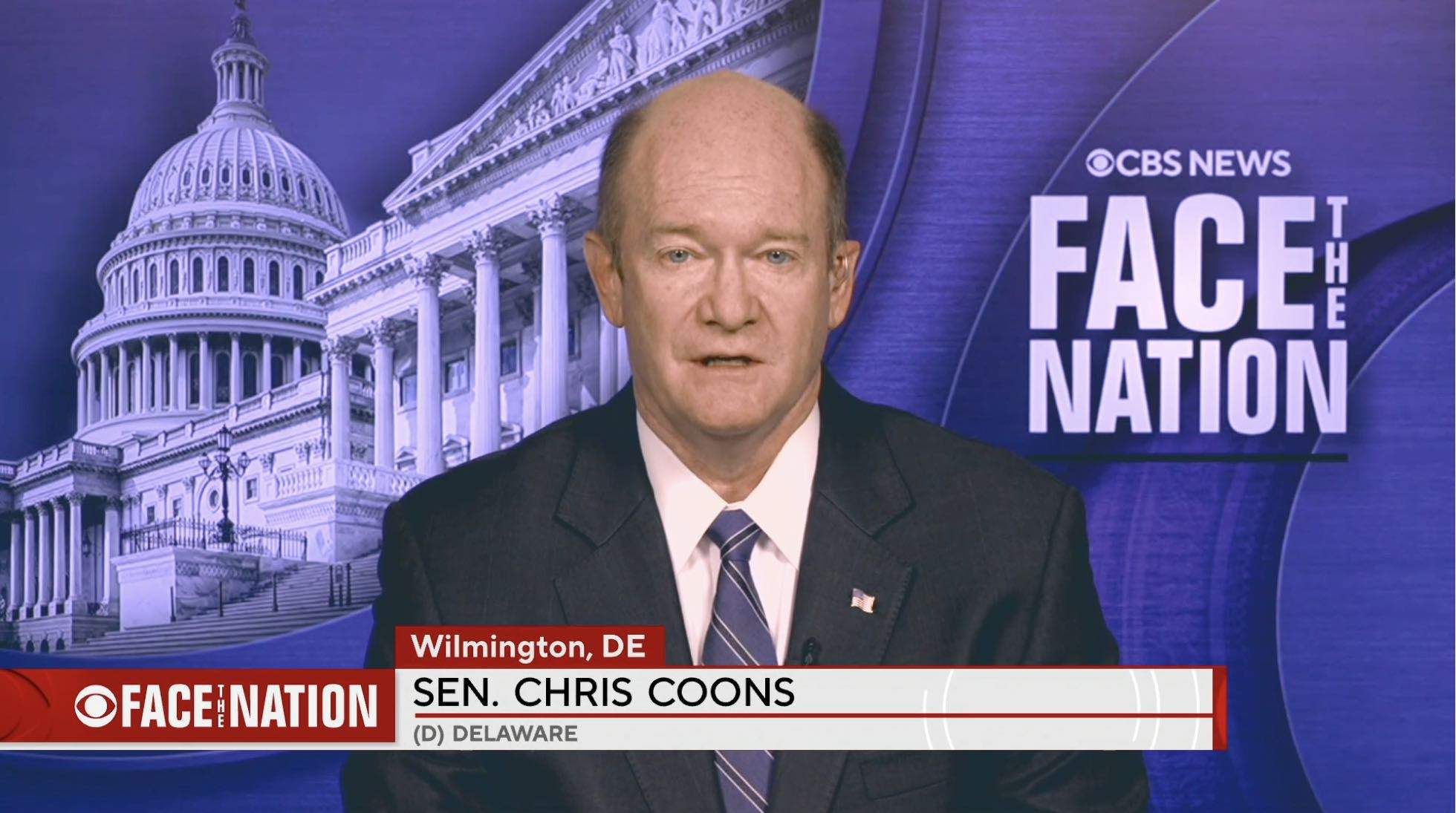
ICYMI: Senator Coons highlights President Biden’s leadership at the border on CBS’ Face the Nation

In case you missed it, U.S. Senator Chris Coons (D-Del.) joined CBS’ Face the Nation with Margaret Brennan on Sunday to highlight the clear distinction between President Biden’s and former President Trump’s border policies.

Senator Coons, a member of the Senate Judiciary Committee, praised President Biden’s commitment to effective actions that will address the situation at the border, while former President Trump has promoted cruel and ineffective family separations, a Muslim ban, and potential mass deportations of millions living here.

ICYMI CBS


Senator Coons: There’s a stark difference in the values that President Biden and former President Trump bring to trying to address the issue of border security and immigration. I’ll remind you, Margaret, that former President Trump tried to implement a Muslim ban. A ban on entry to this country explicitly based on one religion. He also used cruelty – the forceful separation of parents from their children and the caging of children at our border – to try and deter folks from coming to seek asylum or to seek refuge in our country. 

…

President Biden has, time and time again, asked Congress to enact a broad solution to our border security and immigration challenges. 

…

Former President Trump tried to use gimmicks like building a border wall, and is now threatening to nationalize, to federalize, the National Guard, and use it to deport tens of millions of people already here in the United States. The difference between Trump’s approach and Biden’s approach is one of cruelty versus effectiveness.

Watch the full interview here.

Â