Related Issues

Related Issues

Senator Coons cosponsors bill to strengthen fight against Alzheimer’s

WILMINGTON, Del. – U.S. Senator Chris Coons has cosponsored bipartisan legislation to step up investment in lifesaving Alzheimer’s research at the National Institutes of Health (NIH). The Alzheimer’s Accountability Act would support implementation of the National Alzheimer’s Plan, first developed by the NIH in 2012 with the goal of effectively preventing and treating Alzheimer’s by 2025. The bill would require the NIH to submit an annual budget to Congress and the President to determine the level of funding needed to meet the plan’s research targets.

“Alzheimer’s is a devastating disease that has stolen too many Americans from their loved ones,” Senator Coons said. “Though our understanding of this disease has progressed remarkably over the last 15 years, there is still no known cure or treatment capable of slowing its progression. With the population of older Americans growing at a rapid pace, there has never been a more urgent time to fight for a cure. The Alzheimer’s Accountability Act will support groundbreaking research at the NIH aimed at effectively preventing and treating Alzheimer’s by 2025. This bill will ensure doctors and researchers at the NIH have the resources they need to do what they do best: deliver hope and a cure to families affected by Alzheimer’s.” 

In 2010, Congress unanimously passed the bipartisan National Alzheimer’s Project Act, which called for an annually updated National Alzheimer’s Plan. The first version of the plan was released in 2012 and updated in June 2013. While NIH has established research milestones and timelines for implementation of the plan, they have not established the level of funding necessary to reach them. The bipartisan Alzheimer’s Accountability Act would authorize the NIH to submit an annual Alzheimer’s research budget specifying the funding levels NIH experts need to meet the plan’s goals. 

“We are extremely grateful to Senator Coons for co-sponsoring the Alzheimer’s Accountability Act, and commend his recognition of the enormous impact of Alzheimer’s disease on our nation and the need to address this epidemic,” said Katie Macklin, Delaware Executive Director for the Alzheimer’s Association Delaware Valley Chapter. “Alzheimer’s is the sixth leading cause of death in the U.S. and the only cause of death among the top 10 without a way to prevent, stop or even slow its progression.  It is only through adequate funding and a strong implementation of the National Plan to Address Alzheimer’s Disease, that we will meet the plan’s most transformational goal – preventing and effectively treating Alzheimer’s by 2025 – saving billions of lives and trillions of dollars. The Alzheimer’s Accountability Act is needed so that Congress will hear directly from scientists what are the next steps necessary to advance the fight against Alzheimer’s disease.“

Alzheimer’s is the most costly disease in the U.S., with more than $140 billion from Medicare and Medicaid going to care for Alzheimer’s patients last year. Five million Americans currently suffer from Alzheimer’s, and the trajectory of the disease over the next few decades threatens to overwhelm our ability to treat and care for these patients. The number of individuals with Alzheimer’s is projected to increase to an estimated 13 to 16 million by 2050, and the costs to Medicare and Medicaid will be more than $800 billion in today’s dollars. The Alzheimer’s Accountability Act is led in the Senate by Senators Ed Markey (D-Mass.) and Mike Crapo (R-Idaho), with companion legislation led by Reps. Brett Guthrie (R-Ky.) and Paul Tonko (D-N.Y.) introduced in the House of Representatives.

Approximately 16,000 Delawareans – or 11 percent of seniors – are currently living with Alzheimer’s disease. Senator Coons is also a cosponsor of the Health Outcomes, Planning, and Education (HOPE) for Alzheimer’s Act (S. 709), which would provide Medicare coverage of comprehensive Alzheimer’s diagnoses and services.
Statement of Senator Coons on announcement of Attorney General Beau Biden

WILMINGTON, Del. – U.S. Senator Chris Coons (D-Del.), a member of the Senate Judiciary Committee, released the following statement on the announcement by Delaware Attorney General Beau Biden that he would not seek re-election.

“Beau Biden has been an effective Attorney General and I’m sorry to see him leave this critical law enforcement office. He has a lot to offer our state and I think he has a bright future ahead of him.”

Senator Coons introduces bill to help patients take better control of their medical care

WASHINGTON – U.S. Senators Chris Coons (D-Del.) and Tom Coburn (R-Okla.) have introduced legislation to encourage Medicare beneficiaries to create advance directives — legal documents that allow patients to articulate their preferences for their medical care should they suffer from a debilitating illness or condition. The Medicare Choices Empowerment and Protection Act would offer a small, one-time financial incentive to encourage Medicare beneficiaries to provide clear guidance to their medical providers and family members should they become incapable of speaking for themselves.

“Every American deserves the opportunity to make their own decisions about their medical care,” Senator Coons said. “Too many Americans leave their end-of-life care to chance or to the preferences of distraught family members. This bill will encourage more Americans to proactively make choices about their medical care, reducing confusion and empowering individuals to spend their final days and hours on their own terms. I am proud to work with Dr. Coburn on this bipartisan legislation and intend to work with all of my colleagues to see it become law.”

“Advance directives are a valuable, voluntary tool that offers patients the ability to protect patients’ future health care preferences or to specify someone to act on their behalf,” Dr. Coburn said. “This bill would encourage their adoption by Medicare beneficiaries and is intended to start a discussion about how best to move this policy forward. We welcome constructive comments from stakeholders to improve this plan and to better encourage the voluntary adoption of advance directives by Medicare beneficiaries that can be accessible in real-time by their physicians and hospitals.”

According to a 2006 study by the Pew Research Center, 70 percent of Americans have thought about their end-of-life health care preferences, but only one-third have completed an advance directive. Under the Medicare Choices Empowerment and Protection Act, Medicare beneficiaries would be able to voluntarily create and register an advance directive with the Centers for Medicare & Medicaid Services (CMS) at any time. Advance directives would be created through and maintained by outside organizations certified by CMS, and could be modified or terminated at any time by the beneficiary. An advance directive would include any written statement that outlines the kind of treatment and care a beneficiary wants or does not want under certain conditions, and can include identification of a health care proxy. Beneficiaries would also receive a small, one-time incentive for registering an advance directive.

“The Medical Society of Delaware appreciates the efforts of United States Senator Chris Coons to introduce the Medicare Choices Empowerment and Protection Act – S. 2240,” said Dr. Nancy Fan, president of the Medical Society of Delaware. “The Medical Society has always taken a position in support of advance directives and that such directives should be shared with family, and friends, and most of all – with their physicians. With the considerable technological advances in health care today, and to come in the future, it is essential that patients communicate with their physicians regarding their individual expectations of end-of-life care. Such discussions and documentation can provide great clarity when patients and their loved ones are confronted with difficult treatment decisions. We applaud Senator Coons for bringing this legislation to the forefront and look forward to working with him on this critically important subject.”

To address concerns about confidentiality, the Medicare Choices Empowerment and Protection Act requires both CMS and outside groups maintaining advance directives to hold the highest standards for privacy and security protection as well as system functionality. CMS would only keep track of the certified organization through which a beneficiary has created an advance directive and would not keep a database of these documents. The bill does not interfere with any state laws governing advance directives. 

“Quality advance care planning is a critical element in comprehensive advanced illness care, and we applaud the efforts of Sens. Coons and Coburn in taking the initiative to engage Americans in this critical dialogue,” said Tom Koutsoumpas, co-chair of the Coalition to Transform Advanced Care. “Advanced illness is an issue that will touch the lives of every single one of us, and it is vital that all Americans and their families are as prepared as possible when facing health care decisions during the most difficult of times.”

The American College of Emergency Physicians and MyDirectives.com, which independently registers Americans’ advance directives, have endorsed the legislation. Senator Richard Blumenthal (D-Conn.) is also a cosponsor of the bill. 

National Healthcare Decisions Day, held this year on Wednesday, April 16, is an initiative to raise awareness among the public and health care providers about the importance of advance care planning.

As of 2012, more than 157,000 Delawareans — approximately 17 percent of the state’s population — were Medicare beneficiaries.

The full text of the bill is available here: http://www.coons.senate.gov/download/medicare-choices-empowerment-and-protection-act

Senator Coons brings together leaders for second discussion on urban unemployment

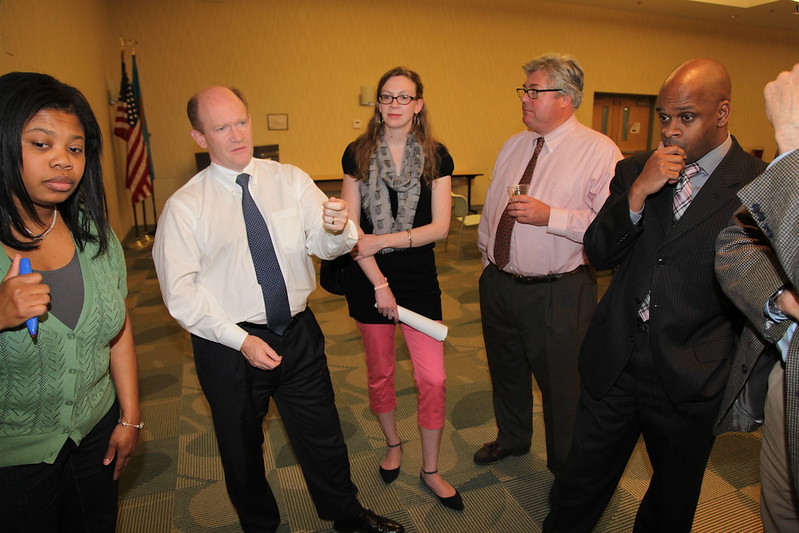
Sen. Coons listens to members of the Urban Unemployment Series attendees

WILMINGTON, Del. – On Friday afternoon, U.S. Senator Chris Coons and two-dozen community and neighborhood leaders from around Delaware came together for the second in a series of four discussions on “Winning the Fight Against Urban Unemployment.” During Friday’s meeting, which was hosted by the Goodwill of Delaware and Delaware Country, participants brainstormed solutions on housing, crime and recidivism, education and job skills training, and social and soft skills.

“Helping our neighbors who face chronic urban joblessness requires folks from every community coming together and pushing in the same direction,” Senator Coons said. “Whether it’s inadequate work training, lack of support systems, or economic barriers to getting and holding a job, the causes of these challenges are complex and intertwined. It’s going to require people from all walks of life contributing their wisdom and insights to find the comprehensive solutions we need.”

“Today’s discussion was another positive step forward on the path to solutions. From ways to better engage employers, support those struggling with substance abuse or looking for a second chance, and provide better opportunities for our children – we do not suffer from a lack of ideas and ingenuity. I walked away this afternoon confident that we have the tools to break these tragic cycles, and I very much look forward to continuing our work.”

Friday’s 90-minute long conversation was the second in a series of conversation that are planned in the run-up to a larger summit this year. The opening discussion was held on Wednesday, February 19, also at the Goodwill of Delaware and Delaware County.

Participating in Friday’s discussion were:

  • Zanthea Nichols, Director of Workforce and Business Development, Goodwill of Delaware & Delaware County (co-host)
  • Patti Mengers, Regional Workforce Development Manager, Goodwill of Delaware & Delaware County (co-host)
  • Secretary Rita Landgraf, Delaware Housing and Social Services
  • Deborah Wilson, President, Metropolitan Wilmington Urban League
  • Charles Madden, Executive Director, HOPE Commission
  • Victor Santos, Government Relations, Delaware State University
  • Dr. Yasser Payne, Professor, University of Delaware
  • Don Mell, JP Morgan Chase
  • Darryl Graham, VP Global Philanthropy & Community Relations, JP Morgan Chase
  • Rev. Donald Morton, Pastor and Community Leader
  • Andrew McKnight, Executive Director, the Challenge Program
  • Jim Coyne- Director, Strategy and Community Engagement, United Way
  • Rev. Terrence Keeling, Pastor and Community Leader
  • Rhonda Austin, Business Community Liaison, Wilmington Job Corps
  • Kia Ervin, Regional Director, Communities in Schools
  • Saad Solomon, Re-Entry Specialist, United States Probation Office
  • Matt Heckles, Delaware State Housing Authority
  • Joanne Champney, Delaware Center for Justice
  • Pricilla Turgon, Pathways
  • Paul  Calistro, West End Neighborhood House
  • Chief Alan Grinstead, Department of Corrections
  • Susan Starrett, Homeless Planning Council
  • Debbie Wilson, Metropolitan Wilmington Urban League

 ###

In hearing on merger, Senator Coons presses Comcast on service, jobs

WASHINGTON – U.S. Senator Chris Coons (D-Del.), a member of the Senate Judiciary Committee, pressed Comcast Executive Vice President David Cohen Wednesday about how Comcast’s proposed merger with Time Warner Cable will affect consumers and local jobs. At a Judiciary Committee hearing examining the merger, Senator Coons echoed constituent concerns about the cable provider’s customer service record, pricing, jobs, net neutrality, and commitment to diversity in programming. 

“The main concerns I’ve heard from my constituents in Delaware have to do with customer service, future price, and employment,” Senator Coons said. “Are there any assurances you can give us today about how the significant benefits – that you’ve described both in writing and in testimony – to this merger will inure in some ways, not just to shareholders, but also to customers?”

On issues with customer service, Cohen conceded, “This is a place where we’re having issues, and I can tell you as a company, we are laser-focused on trying to improve the customer experience.”

On Delaware jobs: “Most of our jobs are the customer-facing jobs of technicians in call centers and local management of our systems, and we don’t anticipate any reductions in those jobs.”

Cohen also denied that the transaction would result in increased prices for Comcast customers.

On February 13, 2014, Comcast announced an agreement to purchase Time Warner Cable for $45.2 billion in stock. If approved, the deal would combine the first and fourth largest pay-TV providers and first and second largest cable-TV providers in the country. The combined company would serve 30 million cable subscribers, approximately 30 percent of the overall pay-TV market. Wednesday’s Judiciary hearing examined concerns over the size and power of a post-merger Comcast and how these changes will affect consumers. The merger is currently under review by the FCC and Department of Justice.

Senator Coons cosponsors bill to modernize drug-sentencing policy

WASHINGTON – U.S. Senator Chris Coons (D-Del.), a member of the Senate Judiciary Committee, has cosponsored a bill to modernize U.S. drug sentencing polices by giving federal judges more discretion in sentencing those convicted of non-violent offenses. With federal prison populations skyrocketing and nearly half of the nation’s federal inmates serving sentences for drug offenses, these incremental and targeted changes could save taxpayers billions in the first years of enactment and improve the fairness of criminal sentencing.

“Every American has the right to a criminal justice system that imposes fair criminal penalties based on the facts of each case,” Senator Coons said. “Mandatory minimum sentencing jeopardizes that right by trading judicial discretion for one-size-fits-all sentencing requirements. Sentences imposed under this outdated law are unnecessarily punitive, costly, and have not improved public safety. The Smarter Sentencing Act will take important steps to modernize this policy by empowering judges to determine appropriate sentences for non-violent offenders. These reforms will reduce the strain on our federal prison system and improve the quality of justice delivered by our courts.” 

The United States has seen a 500 percent increase in the number of inmates in federal custody over the last 30 years, in large part due to the increasing number and length of certain federal mandatory sentences. Mandatory sentences, particularly drug sentences, can force a judge to impose a one-size-fits-all sentence without taking into account the details of an individual case. 

Many of these sentences have disproportionately affected minority populations and helped foster deep distrust of the criminal justice system. Despite the fact that more than two-thirds of crack cocaine users in the U.S. are white or Hispanic, African American offenders have historically made up more than 80 percent of the offenders sentenced under the federal crack cocaine laws, and have served substantially more time in prison for drug offenses compared to whites.

This large increase in prison populations has also put a strain on our prison infrastructure and federal budgets. The Bureau of Prisons is nearly 40 percent over capacity and this severe overcrowding puts inmates and guards at risk. There is more than 50 percent overcrowding at high-security facilities. This focus on incarceration is also diverting increasingly limited funds from law enforcement and crime prevention to housing inmates. It currently costs nearly $30,000 to house just one federal inmate for a year. There are currently more than 219,000 inmates in federal custody, nearly half of them serving sentences for drug offenses.

The bipartisan Smarter Sentencing Act is led by Senators Dick Durbin (D-Ill.) and Mike Lee (R-Utah). The bill is an incremental approach that does not abolish any mandatory sentences. Rather, it takes a studied and modest step to modernize drug-sentencing policy by:

  • Modestly expanding the existing federal “safety valve”: Our legislative “safety valve” has been effective in allowing federal judges to appropriately sentence certain non-violent drug offenders below existing mandatory minimums. This safety valve, however, only applies to a narrow subset of cases. The Smarter Sentencing Act would modestly broaden criteria for eligibility. This change, which only applies to certain non-violent drug offenses, is supported by nearly 70 percent of federal district court judges. 
  • Promoting sentencing consistent with the bipartisan Fair Sentencing Act: The bipartisan Fair Sentencing Act of 2010 – which was authored by Senator Durbin and unanimously passed the Senate before it was signed into law – reduced a decades-long sentencing disparity between crack and powder cocaine offenses. Unfortunately, because of the timing of their sentences, some individuals are still serving far-too-lengthy sentences that Congress has already determined are unjust and racially disparate. The Smarter Sentencing Act allows certain inmates sentenced under the pre-Fair Sentencing Act sentencing regime to petition for sentence reductions consistent with the Fair Sentencing Act and current law. Federal courts successfully and efficiently conducted similar crack-related sentence reductions after 2007 and 2011 changes to the Sentencing Guidelines. This provision alone could save taxpayers more than $1 billion. 
  • Increasing individualized review for certain drug sentences: The Smarter Sentencing Act lowers certain drug mandatory minimums, allowing judges to determine, based on individual circumstances, when the harshest penalties should apply. The Act does not repeal any mandatory minimum sentences and does not lower the maximum sentences for these offenses. This approach keeps intact a floor at which all offenders with the same drug-related offense will be held accountable but reserves the option to dole out the harshest penalties where circumstances warrant. These changes do not apply to penalties for violent offenses.

The bipartisan Smarter Sentencing Act is supported by faith leaders from the National Association of Evangelicals to the United Methodist Church. It is also supported by groups and individuals including Heritage Action, Justice Fellowship of Prison Fellowship Ministries, the ACLU, Grover Norquist, the National Organization of Black Law Enforcement Executives, the Leadership Conference on Civil and Human Rights, the NAACP, the Sentencing Project, Open Society Policy Center, the American Bar Association, NAACP Legal Defense and Educational Fund, the National Association of Criminal Defense Lawyers, Families Against Mandatory Minimums, the Constitution Project, Drug Policy Alliance, Brennan Center for Justice, and Lawyers’ Committee for Civil Rights Under Law.

Senator Coons welcomes U.N. peacekeeping operation in the Central African Republic

WASHINGTON – U.S. Senator Chris Coons (D-Del.), chair of the Senate Foreign Relations Subcommittee on African Affairs, applauded the unanimous vote of the United Nations Security Council on Thursday authorizing the deployment of 12,000 peacekeepers and police to the Central African Republic. Thousands have been killed in the last year and 2.5 million — about half of the nation’s population — need humanitarian aid. More than 700,000 have been internally displaced and more than 290,000 have fled to neighboring countries as refugees.

“Preventing a genocide in the Central African Republic is a global imperative, and today’s vote of the U.N. Security Council is a critically urgent step forward,” Senator Coons said. “After the Rwandan genocide — which began 20 years ago this week — the world vowed to never again stand by while innocent civilians were targeted for slaughter, as they are now in the Central African Republic. The United Nations has spoken in one voice today to aid the African Union’s ongoing efforts to protect civilians and restore law and order in the Central African Republic, and I’m proud that the United States will support this mission.”

“Our commitment to peacekeeping must be demonstrated not only in our rhetoric, but in our actions,” Senator Coons continued. “While I welcome the announcement that the U.S. will provide an additional $22 million in humanitarian assistance, Congress’ failure to lift the U.S. cap on funding U.N. peacekeeping operations, and the growing shortfalls in our peacekeeping budget, make funding this and future peacekeeping missions even more challenging. There is no excuse for the United States to ignore its financial responsibilities to the international community, especially with so many innocent lives at stake. I intend to work with my colleagues on the Senate and House Appropriations Committees over the coming months to ensure the United States fully funds this important mission, along with other ongoing U.N. peacekeeping operations, including the mission in Mali. Congress should also lift the cap on U.S. contributions to U.N. peacekeeping operations and support a new funding mechanism to ensure that we have flexible funding to support international peacekeeping operations.”

The Central African Republic has experienced escalating violence and lawlessness since a March 2013 coup. The violence has forced at least 700,000 to flee their homes, many hiding in the bush or taking refuge in dangerous conditions around churches and schools, and half the population of 4.6 to 5 million needs humanitarian assistance.

In March, the Senate voted to condemn the violence in the Central African Republic, welcome international peacekeeping and humanitarian efforts, and urge President Obama to work with our international partners to develop a strategy for achieving a cease-fire and establishing a sustainable peace.

In December, Senator Coons chaired a hearing of the Senate Foreign Relations Subcommittee on African Affairs on the crisis in the Central African Republic. He also applauded the U.N. Security Council’s increased efforts to stop the violence, and the decision by the United States to increase humanitarian assistance to the Central African Republic.

Bill to spur manufacturing innovation clears Senate Commerce Committee

WASHINGTON – A bill cosponsored by U.S. Senator Chris Coons (D-Del.) to establish a national network for manufacturing innovation took a big step forward Wednesday, clearing the Senate Commerce Committee by a voice vote. The bipartisan Revitalize American Manufacturing and Innovation Act of 2013, led by Senators Sherrod Brown (D-Ohio) and Roy Blunt (R- Mo.), would establish specialized manufacturing innovation ‘hubs’ around the country, creating thousands of high-paying, high-tech manufacturing jobs while enhancing the United States’ role as the world’s leader in advanced manufacturing. 

“Research and development is a critical piece of the innovation pipeline that feeds our growing manufacturing sector and creates high quality jobs,” Senator Coons said. “Manufacturers invest more in R&D than any other sector, but high costs and significant risk often limit the scope and impact of their efforts. Manufacturing innovation institutes leverage limited resources by bringing researchers and manufacturers together to spur innovation, commercialize R&D, and create good jobs. Building on this innovative model will increase our nation’s capacity for invention and support middle class jobs long into the future.”

The legislation would bring together industry, universities and community colleges, federal agencies, and all levels of government to accelerate manufacturing innovation in technologies with commercial applications. These public-private institutes would leverage resources to bridge the gap between basic research and product development. The institutes will also partner with local colleges and universities to train workers to develop the skills manufacturers need.

Using this model, the Administration announced on February 25 the launch of two new advanced manufacturing innovation institutes headquartered in Detroit and Chicago. The Detroit hub will concentrate on lightweight and modern metals manufacturing while the Chicago hub will focus on digital manufacturing and design technologies. The Administration plans to establish a total of eight institutes across the country by the end of this year, but legislation is needed to sustain the program over the long-term, ensure Congressional oversight, and put applicants, rather than the federal government, in control of directing research.

Coons, Kirk, Pryor applaud passage of key manufacturing amendment

WASHINGTON – U.S. Senators Chris Coons (D-Del.), Mark Kirk (R-Ill.), and Mark Pryor (D-Ark.) today applauded the Commerce Committee’s passage of their American Manufacturing Competitiveness Act, which was introduced in Committee by Senator Pryor as an amendment to the Brown-Blunt Revitalize American Manufacturing and Innovation Act of 2013. The Coons-Kirk legislation, introduced last fall, is co-sponsored by Senators Roy Blunt (R-Mo.), Sherrod Brown (D-Ohio), Debbie Stabenow (D-Mich.), Lindsey Graham (R-S.C.), and Tom Harkin (D-Iowa). The bill would require the development of a national manufacturing strategy in order to better support American manufacturers that employ more than 12 million Americans.

“Growing our manufacturing sector is the key to bringing high-quality, middle class jobs back to this country,” Senator Coons said. “While many of our global competitors have thoroughly developed strategies for supporting and sustaining manufacturing growth, the U.S. government does not have a coordinated strategy for supporting our manufacturers. Developing a national strategy that looks at skills training, R&D, trade, and other key factors will help ensure our manufacturers have the resources to compete and succeed on the global market. I’m grateful to my colleagues on the Commerce Committee for their support of this important measure, as well as the underlying Revitalize American Manufacturing and Innovation Act, and hope this legislation will proceed quickly to a vote on the Senate floor.”

“Manufacturing in Illinois accounts for 13.3% of our state’s economic output,” Senator Kirk said. “Our nation’s competitiveness relies on our ability to create stable jobs, which boost our local economies and increase our country’s economic standing abroad. This bill will help to ensure that our nation becomes more competitive and continues to contribute nearly $2 trillion to our economy annually. I urge the full Senate to swiftly pass this legislation in order to secure more high-paying, quality jobs for millions of Americans.”

“America is a powerhouse when it comes to manufacturing, but there’s more we can do to ensure ‘Made in America’ remains the gold standard around the world,” Senator Pryor said. “My common-sense amendment gives us the blueprint we need to maintain and expand the manufacturing industry, strengthen our economy, and create jobs here at home. I hope the Senate will take up and pass this bill immediately.”

Congressman Dan Lipinski (D-Ill.-3) introduced companion legislation in the House last year.

Senator Pryor’s amendment – a modification of the Coons-Kirk American Manufacturing Competitiveness Act, S. 1709 – to the Brown-Blunt legislation would require the President to submit to Congress an updated National Strategic Plan for Advanced Manufacturing every four years. While the United States government has numerous programs spread throughout several federal departments and agencies aimed at supporting manufacturing, there is no cohesive national strategy aimed to ensure these programs are successfully working together toward the unified goal of revitalizing American manufacturing. 

Additionally, the legislation would requires the Advanced Manufacturing Partnership Steering Committee of the President’s Council of Advisers on Science and Technology to provide recommendations to assist in the updates to the strategic plan.

Over 17 million jobs are linked to the manufacturing industry. This legislation is bipartisan, and would not increase government spending.

Organizations supportive of the Coons-Kirk legislation include:

·      AFL-CIO

·      Alliance for American Manufacturing

·      American Iron and Steel Institute

·      American Small Manufacturers Coalition

·      Archer Daniels Midland

·      AMT – The Association for Manufacturing Technology

·      Campbell Soup

·      The Dow Chemical Company

·      DuPont

·      General Aviation Manufacturers Association

·      IBM

·      International Association of Machinists

·      Johnson & Johnson

·      Magno International

·      NACFAM – National Council for Advanced Manufacturing

·      National Defense Industrial Association

·      National Tooling and Machining Association

·      North American Die Casting Association

·      Permac Industries

·      Precision Machined Products Association

·      Precision Metalforming Association

·      United Autoworkers

·      United Steelworkers

Senator Coons votes to end wage discrimination

WASHINGTON – A day after the nation marked Equal Pay Day, U.S. Senator Chris Coons (D-Del.) voted to pass the Paycheck Fairness Act, legislation he cosponsored to deter wage discrimination by closing loopholes in the Equal Pay Act and barring retaliation against workers who disclose their wages to colleagues. The measure was blocked by a Republican filibuster.

“When women are paid less for doing the same job as men, it hurts entire families. More than 45,000 Delaware households are headed by women, yet they continue to make just 80 cents on the dollar compared to men. Today we had a chance to correct this shameful and longstanding injustice by passing the Paycheck Fairness Act and leveling the playing field for women in the workforce. Instead, my Republican colleagues in the Senate once again chose the status quo. We can and should do better for our nation’s hardworking women and the families who depend on their income. I am disappointed in the Senate today, but I won’t give up on this important fight. Wage discrimination has no place in our society and I’ll keep working until equal pay for equal work is a guarantee for all.”