Related Issues

Related Issues

Senator Coons’ agriculture priorities included in appropriations bill

WASHINGTON – U.S. Senator Chris Coons (D-Del.), a member of the Senate Appropriations Committee and co-chair of the Senate Chicken Caucus, joined Appropriations Committee members Thursday to approve an FY15 agriculture appropriations bill that supports key programs for Delaware farmers, poultry growers, and the Port of Wilmington. The bill will now move to the Senate floor for consideration.

“From Sussex County’s vibrant poultry industry to fresh bananas shipped through the Port of Wilmington, Delaware plays a vital role in feeding America’s families,” Senator Coons said. “In partnership with farmers, states, and the private sector, USDA programs support our hardworking farmers and poultry growers and ensure our food supply remains the safest in the world. This bill supports USDA programs that will protect Delaware’s poultry growers from disease and catastrophic loss, and help farmers continue their conservation efforts in the Chesapeake Bay. The bill also supports updated regulations that will ensure the Port of Wilmington remains North America’s leading fresh fruit importer. I’m pleased the Committee has approved this important legislation, and look forward to working with my colleagues to see it become law.”

Throughout the appropriations process, including during Subcommittee negotiations, Senator Coons has fought for a number of Delaware priorities that were included in the bill approved by the Senate Appropriations Committee Thursday. They are highlighted below: 

Conservation

Includes strong funding for farm bill conservation programs, including the new Regional Conservation Partnership Program. Since 2008, conservation programs have borne a significant share of the deficit reduction burden, enduring nearly $3.2 billion in cuts. In April, Senator Coons led a letter to the Committee signed by 26 senators advocating against cuts to any of these programs in the FY15 bill. In an improvement over previous years, all but one received funding level with the President’s budget request. A recent USDA report shows that conservation practices adopted by farmers in the Chesapeake Bay watershed have significantly reduced nutrient pollution since 2006.

Poultry

Includes more than $52 million for USDA Avian Health programs that work in partnership with states and universities to monitor, prevent, and control the spread of diseases in the commercial poultry industry. Senator Coons advocated against cuts to these important programs, and the Committee complied, increasing funding for Avian Health programs by more than half a million dollars.

Supports implementation of a farm bill provision authored by Senator Coons and Senator Saxby Chambliss (R-Ga.) to assist poultry growers during uncertain economic times. The Coons-Chambliss provision commissions a pair of studies on the feasibility of insurance programs to protect America’s poultry growers from catastrophic loss, such as disease outbreaks, and from bankruptcies of poultry integrators. More here: http://1.usa.gov/1iHs1rb

Port of Wilmington

Supports expediting approval of new proposed USDA user fee regulations that will ensure imported, perishable fruits and vegetables receive timely inspections during busy seasons. The Port of Wilmington is the continent’s leading importer of bananas and fresh fruit. New proposed regulations will allow private companies to pay overtime costs for the Port’s agriculture inspectors to ensure adequate staffing during their busiest import seasons. Senator Coons has pushed for reforms to update USDA’s current outdated regulations and advocated for inclusion of supportive language in the FY15 appropriations bill.

Food Aid

Includes $35 million in flexible funding for international food aid programs that will allow USAID and NGOs providing food aid to reach 200,000 more people a year. Senator Coons, a leading advocate for food aid reform, supported an amendment in Committee that restored this funding, which had been cut from the original FY15 appropriations bill. 
Senator Coons co-chairs hearing on escalating wildlife trafficking crisis

WASHINGTON – U.S. Senators Chris Coons (D-Del.), chair of the Senate Foreign Relations Subcommittee on African Affairs, and Ben Cardin (D-Md.), chair of the Subcommittee on East Asian and Pacific Affairs, led a joint Africa-East Asia Subcommittee hearing on Wednesday to examine the far-reaching ecological, economic, and national security threats tied to intensified illegal global trafficking of elephant ivory, rhino horn, and other wildlife products.

Wednesday’s hearing examined major factors contributing to the crisis – including the involvement of illicit transnational criminal networks and armed terrorist groups, increased demand for illegal wildlife products in Asia, and weak enforcement capacity in source and demand countries – as well as agency plans to implement the Administration’s National Strategy for Combating Wildlife Trafficking.

Wildlife trafficking is “a multi-billion dollar industry, driven by dangerous and sophisticated transnational criminal syndicates and used by some terrorist groups to fund their operations,” Senator Coons said. “The scale at which these poachers are operating is threatening the very survival of some of the world’s most iconic wildlife. The loss of these wildlife populations, coupled with the security and stability threats of poachers and traffickers, is also having a serious impact on the economic development of many African communities that rely on tourism for revenue.”

“Dealing with this issue over the long run will require robust partnerships at every level between governments, NGOs, the private sector, and communities throughout Africa, Asia, and around the world,” Senator Coons said.

Worth an estimated $8–10 billion annually, the illegal wildlife trade is among the world’s most lucrative criminal activities, and increased demand in Asia for elephant ivory and rhino horn has driven poaching of these species to crisis levels in source countries across Africa. In July 2013, President Obama established a Presidential Taskforce on Wildlife Trafficking, composed of the State, Interior, and Justice departments, to develop a comprehensive strategy to address the issue. The Taskforce released its national strategy in February 2014.

Officials from two co-chair agencies of the Presidential Taskforce – the State Department Bureau of Oceans and International Environmental and Scientific Affairs and the U.S. Fish and Wildlife Service – testified along with witnesses from USAID and the State Department Bureau of International Narcotics and Law Enforcement Affairs (INL) about steps the U.S. can take to combat poaching and decrease demand for illicit wildlife products at home and abroad.

Noting that the U.S. is the world’s second largest market, behind China, for illegal wildlife products, the officials emphasized the importance of increasing domestic awareness around the issue, strengthening law enforcement capacity, and intensifying penalties for those engaging in illegal trafficking.

“While we are very engaged right now, and we want this to remain a priority for the years to come, addressing this in a comprehensive way is going to be a generational challenge, and we need to make sure it stays on the radar,” INL Deputy Assistant Secretary Brooke Darby said.

Fish and Wildlife Service Director Daniel Ashe discussed the Service’s efforts to create the first program for stationing special agents at U.S. embassies in Bangkok and Dar es Salaam in order to coordinate investigations and support wildlife enforcement capacity building. More support is needed, Ashe said, to further expand the program and grow the Service’s law enforcement ranks, which have remained roughly the same size since 1978.

“We simply need additional resources,” Ashe said. “I think liaison positions in U.S. embassies will be a quantum leap forward, as we have people in country that are developing direct relationships. As I think has been noted here, trust is a key element as we do law enforcement on the international scale – people share information with people they trust.”

Senator Coons was among a group of bipartisan leaders from the Senate Foreign Relations Committee and House Foreign Affairs Committee who sent a letter to the chairs of the Presidential Task Force on Wildlife Trafficking in December urging the development of a strong national strategy and the full use of available government resources to combat poaching. A member of the Senate Appropriations Committee, he also supported the inclusion of the first-ever dedicated funding to combat wildlife trafficking in the omnibus appropriations bill approved by Congress in January.

Senator Coons cosponsors bipartisan bill to accelerate breast cancer research

WASHINGTON – U.S. Senator Chris Coons (D-Del.) has cosponsored bipartisan legislation to create a national commission dedicated to advancing breast cancer research and ending breast cancer by 2020. The Commission to Accelerate the End of Breast Cancer fills a void in federal research efforts by facilitating collaboration between agencies, disciplines, and sectors, and by highlighting promising research pathways that are not currently prioritized or funded. The Accelerating the End of Breast Cancer Act is led by Senators Sheldon Whitehouse (D-R.I.) and Dean Heller (R-Nev.).

“More than 750 Delawareans will be diagnosed with breast cancer this year, and thousands more across the country will lose their battle with this deadly disease,” Senator Coons said. “Innovative research has transformed breast cancer diagnosis and treatment, but breast cancer rates have continued to rise, and women today face a greater risk of contracting the disease than they did four decades ago. It’s time to scale up our efforts to combat this disease, so we can move closer to our goal of eliminating breast cancer by 2020. This bill will ensure we use every resource at our disposal in this critical fight, and I look forward to working with my colleagues to advance it through the Senate.”

The Accelerating the End of Breast Cancer Act would create a commission to identify promising, underfunded research, encourage partnerships between the public and private sectors, and create opportunities for collaboration across agencies, disciplines, and sectors in the fight against breast cancer. The Commission would report annually to the President and Congress, and is required to ensure that activities are not duplicative with efforts of other government agencies. The bill has 30 bipartisan cosponsors in the Senate and a House companion bill has 192 cosponsors.

“Senator Coons is truly making a difference in the fight against breast cancer,” said Vicky Cooke, Executive Director of Delaware Breast Cancer Coalition, Inc. “His co-sponsorship of the Accelerating the End of Breast Cancer Act will leverage resources and focus on the goal of ending this disease. By identifying strategies for prevention and understanding and preventing metastasis, breast cancer will not be a concern for our grandchildren. In 1975 the chance of women developing breast cancer was 1 in 11; today is has increased to 1 in 8. We can no longer accept the status quo and need to take action to end this disease. We are gratified Senator Coons is helping to meet the 2020 deadline to end breast cancer.”

According to the American Cancer Society, approximately 40,000 Americans will die from breast cancer this year. Nationwide, health care costs associated with breast cancer totaled $16.5 billion in 2010 and resulted in $12.1 billion in lost productivity, according to an estimate by the National Cancer Institute.

Carper, Coons, Carney host job fair in Sussex County

REHOBOTH BEACH, Del. – U.S. Senators Tom Carper and Chris Coons and U.S. Representative John Carney (all D-Del.) hosted a job fair at the Rehoboth Beach Convention Center on Monday featuring more than 70 employers hiring for 800 open positions. This was the third job fair hosted by the delegation this year.

Companies including Allen Harim Foods, Beebe Healthcare, Royal Farms, WSFS Bank, and Resort Quest received hundreds of applications and in some cases conducted on-the-spot job interviews. 

“I’m so proud that since 2011, the Congressional Delegation has hosted 19 job fairs to connect out-of-work Delawareans with employers,” said Senator Carper. “These good-paying jobs, coupled with its first-class workforce, make Delaware a great place to live and work.”

“Holding regular job fairs is a simple and effective way to connect Delaware jobseekers with local businesses looking for new talent,” Senator Coons said. “For those still struggling to find work, a job fair can open doors that lead to new opportunities and a new career. While Congress remains paralyzed by gridlock and valuable job-creating legislation continues to face obstruction, these job fairs are one small way we can help our out-of-work neighbors get back on their feet.”

“I’m glad that today’s job fair brought together hundreds of job seekers with employers who are ready to hire,” said Congressman Carney.  “In today’s competitive job market, that connection can make all the difference.  I hope those who attended today left with opportunities and information they can use going forward.”

Since 2011, the Congressional Delegation has hosted 19 job fairs in Delaware, including four specifically for veterans.

Senator Coons demands response to kidnapping of Nigerian schoolgirls

WASHINGTON – U.S. Senator Chris Coons (D-Del.), chair of the Senate Foreign Relations Subcommittee on African Affairs, chaired a hearing Thursday to review the United States’ response to the April 15 abduction of nearly 300 schoolgirls from the Government Girls Secondary School in Chibok, Nigeria. The hearing, held one month to the day of the abductions, examined U.S. offers of assistance and impediments that have slowed the deployment of that assistance. The hearing also took a broader look at Nigeria’s response to the abductions and root causes of Boko Haram’s years-long terror campaign, as well as the regional implications of this growing threat.

“Every day that these girls are missing, it becomes less likely that they will be returned home safely,” Senator Coons said. “It took too long for the Nigerian government to respond to the girls’ abduction. It took too long for the Nigerian government to accept offers of assistance from the United States, the United Kingdom, France, and China, and once accepted, it took too long for that assistance to be fully implemented. I’m glad a U.S. team is on the ground now, and we need to make sure that not another day is wasted. We cannot stand by while Boko Haram viciously attacks Nigerian citizens, their freedom, their security, and their right to an education.”

U.S. Administration officials testifying before the Subcommittee Thursday included Principal Deputy Assistant Secretary of State for African Affairs Ambassador Robert Jackson, USAID Assistant Administrator for African Affairs Earl Gast, and Department of Defense Principal Director for African Affairs Alice Friend. Lantana Abdullahi, a project manager at the international non-profit Search for Common Ground, testified via Google Hangout from Jos, Nigeria.

Senator Coons pressed each of the officials on exactly how long it took U.S. government agencies to offer assistance to the Nigerian government, the types of support offered, and any barriers they have faced in terms of implementation. Ambassador Jackson testified that Secretary Kerry first called Nigeria’s president roughly two weeks ago to offer assistance, and that the U.S. government deployed an 18-member interagency team on May 12 to provide the Nigerian government with military and law enforcement assistance, as well as intelligence, surveillance, and reconnaissance (ISR) support. 

“We have provided commercial imagery and are flying manned and unmanned ISR aircraft over Nigeria to support the search,” Jackson said. “We are working closely with international partners on the ground, including the UK and France, and we are pressing for additional multilateral action, including UN Security Council sanctions on Boko Haram.”

“Resolving this crisis is now one of the highest priorities of the U.S. Government,” Jackson said.

Principal Director Friend testified that the Nigerian government accepted U.S. assistance on May 4th and that the Department of Defense had ISR overflight by May 9th. She also spoke to the work DoD is doing to provide training assistance to Nigerian security forces, and the challenges the agency has faced to adequately vet military units so as to ensure aid is not provided to officers or units implicated in human rights abuses, as restricted by existing U.S. law.

Commenting on the poor human rights record of the Nigerian security services, Friend said “It is… a persistent and very troubling limitation on our ability to provide assistance, particularly training assistance, that the Nigerians so badly need.” 

Given Boko Haram’s targeting of schools in northern Nigeria, Senator Coons also raised concerns about levels of U.S. support for international education programs, particularly for women and girls, in developing countries and conflict areas like northern Nigeria. Gast said that while USAID is devoting at least 10 percent of its total education budget for Africa to programs in Nigeria, access issues have made it extremely difficult to program resources in the North.

“We are working with DFID, the British development agency, and we believe we’re very close to announcing a major effort to support education, primarily girls’ education, secure education in the North,” Gast said.

Testifying from Nigeria, Lantana Abdullahi addressed the Nigerian government’s slow response to the crisis and its hesitancy to accept offers of international aid, stating that the government’s eventual cooperation was a result of building pressure from both inside and outside the country.

“The government were very skeptical,” said Abdullahi. “They were very…slow in accepting those offers.  But I think Nigerians have actually pushed for that, and we’ve seen it, you know, happening now. And we hope that apart from just wanting to have the girls released, we also work beyond… the abduction to address… those root causes.”

The Subcommittee previously looked at the threat of Boko Haram to Nigeria’s stability and security in March 2012. More on that hearing is available here: http://1.usa.gov/1l7aSX2 and http://1.usa.gov/1gfZ40m

Senators Coons, Kirk introduce bill to designate nation’s first coast-to-coast trail

WASHINGTON – U.S. Senators Chris Coons (D-Del.) and Mark Kirk (R-Ill.) introduced legislation Thursday to bring national recognition to the American Discovery Trail – the nation’s only coast-to-coast, non-motorized recreational trail. The National Discovery Trails Act of 2014 would make the American Discovery Trail part of the National Trails System, bringing greater visibility to the trail and boosting tourism in local communities across 15 states and the District of Columbia. The official designation would also allow non-governmental organizations to post signs directing hikers and bikers navigating the trail.

“The American Discovery Trail connects trails in state parks and federal lands with county roads in rural areas and sidewalks in towns and communities from coast to coast,” Senator Coons said. “I’m a strong believer in the value of trails and what they represent: recreation for families, friends, and individuals, tourism and economic development for local parks and towns, and the opportunity to connect communities with the outdoors. Bringing national recognition to the American Discovery Trail will give more Americans the opportunity to enjoy this unique network of trails, beginning in Delaware’s own Cape Henlopen State Park.”

“Illinois is the crossroads of our nation, and our unique network of trails connects rural and urban communities to nature,” Senator Kirk said. “With two routes stretching across our state – including through the Quad Cities, LaSalle and Joliet in Northern Illinois, and Chester and the Shawnee National Forest in Southern Illinois – the American Discovery Trail will drive tourism, boost local economies and bring national attention to our state’s vast environmental treasures.”

The 1968 National Trails System Act created a framework for a national network of connected scenic, historic, and recreational trails. Today, the National Trails System includes eight National Scenic Trails, 15 National Historic Trails, and more than 1000 National Recreational Trails, but no trail linking the network from coast to coast. The National Discovery Trails Act of 2014 would create a new category within the National Trails System for long-distance trails that connect urban areas with outdoor resources, public lands, rural areas, and other communities. The bill would designate the American Discovery Trail the first of this new category of “Discovery Trails.”

 “The American Discovery Trail, which will run from Cape Henlopen State Park to the Point Reyes National Seashore in California, makes trail history here in Delaware,” DNREC Secretary Collin O’Mara said at a press conference held last month at Cape Henlopen. “Senator Coons has bolstered – in a big way – our efforts to recognize and utilize all of our special trails in Delaware. This will help Delawareans and visitors alike to enjoy the First State’s great outdoors.”

“I’m very happy to have Senator Coons’ support for the American Discovery Trail,” said American Discovery Trail Society Delaware director Serinda Connor. “Each year we are seeing more and more hikers using this trail. The hope of funding for signage to enhance the trail through all states for these hikers would be a wonderful safety benefit. Thank you Senator Coons for your support and interest!”

The American Discovery Trail is made up of more than 6,800 miles of continuous, multi-use pathways stretching from Delaware’s Cape Henlopen State Park to Pt. Reyes National Seashore, California. The trail splits into northern and southern routes at Cincinnati, Ohio, rejoining at Denver, Colorado.

Senator Coons, Delaware Wild Lands director participate in roundtable on conservation priorities

Steering and Outreach weekly meeting with Sportsmen/Conservation

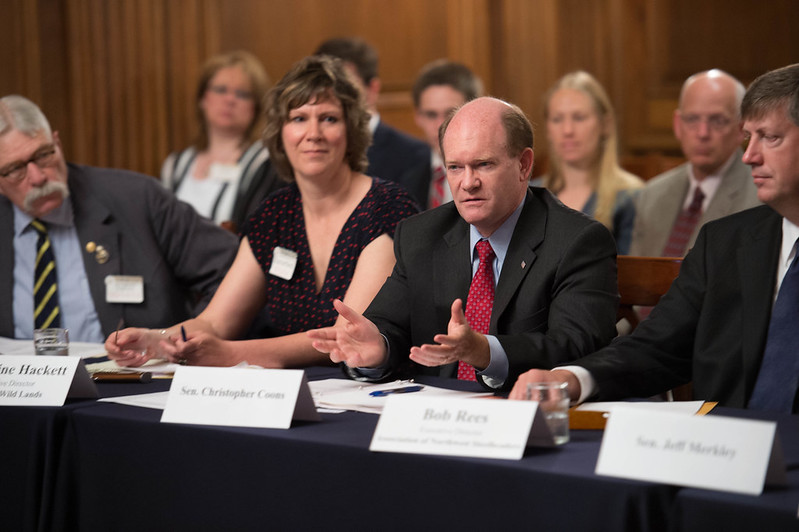
WASHINGTON – U.S. Senator Chris Coons (D-Del.) participated in a roundtable discussion with leaders from the conservation and sportsmen’s communities in the Capitol on Wednesday focused on habitat protection, access to public lands and water, wildlife conservation, land management, and the Bipartisan Sportsmen’s Act of 2014, a package of measures that seeks to boost conservation efforts and expand outdoor recreation opportunities. Kate Hackett, executive director of Delaware Wild Lands, was among the participants and briefed senators on the organization’s successful work leveraging public and private funds to preserve key wildlife habitat in Delaware.

“Conservation and recreation go hand in hand, and Delaware’s passionate community of hunters, fisherman, and outdoor enthusiasts have long been a driving force for conservation in our state,” Senator Coons said. “Congress must continue working with sportsmen and conservationists to preserve our nation’s precious natural resources for future generations, and today’s meeting was a valuable opportunity to collaborate directly with these leaders. Delaware Wild Lands has been a critical partner in state and local efforts to conserve and sustainably manage important wildlife habitat areas in Delaware. I’m grateful to Kate for joining today’s discussion, and look forward to working with her to protect Delaware’s great outdoors.”

“Development of programs that support environmental and economic goals, and initiatives that foster compatible use of land and water resources are absolutely essential to preserving the intrinsic and functional values of this country’s most important wetlands, farms, forests, and salt marshes,” said Delaware Wild Lands Executive Director Kate Hackett. “These resources provide clean water and clean air, respite and recreation, thriving habitat and abundant wildlife, and undiminished natural beauty for all. For more than 50 years, with the help of outdoor enthusiasts, charitable individuals and entities, and partner organizations and agencies, Delaware Wild Lands has made keystone investments in conserving Delaware’s most important natural resources.  We must continue to work more diligently and more creatively, finding common ground for the use and conservation of natural resources so that we can successfully pool multiple funding sources and achieve tangible conservation results.” 

Since 1961, Delaware Wild Lands has played a pivotal role in the acquisition and regulatory protection of 30,000 acres of land, including Delaware’s coastal areas and Great Cypress Swamp. The organization owns and actively manages 20,000 acres of land, which it has dedicated to enhancing biodiversity and supporting traditional land uses. Delaware Wild Lands has also conveyed 10,000 acres of land to the State of Delaware for public recreation and education. 

Senator Coons urges FTC, DOJ to look at anti-trust and anti-consumer implications of Pfizer’s potential takeover of AstraZeneca

WASHINGTON – Led by U.S. Senator Chris Coons (D-Del.), six senators wrote to the Federal Trade Commission and Department of Justice on Wednesday to express concern over anti-trust, anti-consumer, and tax-avoidance implications of Pfizer’s attempted acquisition of AstraZeneca. The senators urged the agencies to launch a review of the transaction if a deal is reached.

“Pfizer’s record of reducing efforts to innovate and bring new products to market following prior acquisitions is plain,” the Senators wrote. “We share the concerns raised by other observers that a major round of cost-cutting through elimination of R&D jobs will follow the proposed acquisition, leading to fewer drugs and diminished consumer welfare.”

U.S. Senators Richard Blumenthal (D-Conn.), Sherrod Brown (D-Ohio), Mazie Hirono (D-Hawaii), Sheldon Whitehouse (D-R.I.) and Dick Durbin (D-Ill.) joined Senator Coons on the letter. Key passages follow:

On the supply of prescription drugs:

“We are especially concerned about the impact this transaction would have on the drug supply and availability of medicines for our nation’s most vulnerable citizens – patients with rare diseases, seniors, and children.

On research and development:

“Given Pfizer’s track record of decreased investment in research jobs and innovation post-merger, a ‘snapshot’ focus on individual drugs on the market at the time of acquisition is inappropriate in this case. Elimination of R&D does not always produce efficiencies, even where two R&D efforts may overlap. Analysis of the total loss of competition and research across a broad range of conditions is necessary to assess potential anticompetitive harm. Any efficiencies claimed to justify this merger may be vastly outweighed by the significant competitive harm to consumers and patients.”

On tax avoidance:

“Pfizer has made clear its goal is to move its tax residence to England, and thereby access billions of dollars it has stored overseas while operating as a U.S. company, without any payment of U.S. taxes.  We do not believe that this transfer from U.S. taxpayers to Pfizer constitutes a pro-competitive justification for the merger and encourage your careful review to ensure that consumers, patients and the marketplace are protected from anticompetitive harm.

The letter is available as a PDF here: http://1.usa.gov/1qDx0he

The full text is below:

May 14, 2014

The Honorable Edith Ramirez                       The Honorable William J. Baer
Chairwoman                                             Assistant Attorney General, Antitrust Division
Federal Trade Commission                           United States Department of Justice
600 Pennsylvania Avenue, NW                       950 Pennsylvania Avenue, NW
Washington, DC 20850                                 Washington, DC 20530


RE:  Proposed Acquisition of AstraZeneca by Pfizer

Dear Chairwoman Ramirez and Assistant Attorney General Baer,

On May 2, 2014, Pfizer, Inc. announced a $106 billion bid to acquire AstraZeneca plc.  Should a merger or acquisition ultimately be accepted by AstraZeneca, whether under the terms of that offer or any subsequent offer, we want to bring to your attention our significant concerns with the potentially harmful impact to consumers that would result.

As you know, the pharmaceutical industry has undergone significant consolidation over the past decade.  Pfizer’s acquisition of Wyeth Laboratories and Merck’s Acquisition of Schering-Plough, both in 2009, resulted in elimination of two of the largest pharmaceutical firms with global reach.  Prior significant mergers have included Pfizer acquisitions of Pharmacia (2003) and Warner-Lambert (2000); Novartis acquisition of Alcon (2011); Sanofi-Aventis acquisition of Genzyme (2011); and Roche consolidation of Genentech (2009).

Should this acquisition proceed, the combined Pfizer-AstraZeneca entity would rank first in global pharmaceutical sales, U.S. pharmaceutical sales, and pharmaceutical R&D spending.1 We also expect that the increase in concentration (as measured by the Herfindahl-Hirschman Index, or HHI) will be sufficient to raise significant competitive concerns, beginning with certain prescription drugs (e.g., Crestor and Lipitor). 

Among other important considerations, the Horizontal Merger Guidelines call upon the antitrust enforcement agencies to determine whether a merger or acquisition is “likely to diminish innovation competition by encouraging the merged firm to curtail its innovative efforts below the level that would prevail in the absence of the merger.”2 The Guidelines further state: “That curtailment of innovation could take the form of reduced incentive to continue with an existing product-development effort or reduced incentive to initiate development of new products.”3

Pfizer’s record of reducing efforts to innovate and bring new products to market following prior acquisitions is plain: following its 2009 acquisition of Wyeth, Pfizer closed six of 20 research sites worldwide4 and effectively cut R&D spending to half of what the companies spent individually in 2008.5 Since 2009, the consolidated pharmaceutical industry has resulted in more than 156,000 jobs lost in the U.S. alone.6 We share the concerns raised by other observers that a major round of cost-cutting through elimination of R&D jobs will follow the proposed acquisition,7 leading to fewer drugs and diminished consumer welfare. 

We are especially concerned about the impact this transaction would have on the drug supply and availability of medicines for our nation’s most vulnerable citizens – patients with rare diseases, seniors, and children.  Given Pfizer’s track record of decreased investment in research jobs and innovation post-merger, a “snapshot” focus on individual drugs on the market at the time of acquisition is inappropriate in this case.  Elimination of R&D does not always produce efficiencies, even where two R&D efforts may overlap.8 Analysis of the total loss of competition and research across a broad range of conditions is necessary to assess potential anticompetitive harm.9 Any efficiencies claimed to justify this merger may be vastly outweighed by the significant competitive harm to consumers and patients.    

In addition, we view with skepticism any pro-competitive justification offered in support of this acquisition in light of Pfizer’s stated motivation for the transaction – avoidance of U.S. taxation.  Pfizer has made clear its goal is to move its tax residence to England, and thereby access billions of dollars it has stored overseas while operating as a U.S. company, without any payment of U.S. taxes.  We do not believe that this transfer from U.S. taxpayers to Pfizer constitutes a pro-competitive justification for the merger and encourage your careful review to ensure that consumers, patients and the marketplace are protected from anticompetitive harm.

We look forward to your attention to these concerns should this transaction proceed.

Sincerely,

U.S. Senator Chris Coons

U.S. Senator Richard Blumenthal

U.S. Senator Sherrod Brown

U.S. Senator Mazie Hirono

U.S. Senator Sheldon Whitehouse

U.S. Senator Dick Durbin


1  Annual Reports (10-K) of the major pharmaceutical companies with a U.S. presence.

2  See FTC-DOJ Horizontal Merger Guidelines (2010), Section 6.4 at 23.

3  Id.

4  “In Drug Mergers, There’s One Sure Bet: The Layoffs,” Wall Street Journal, April 29, 2014.

5  See “Potential Impact on R&D Of A Pfizer Takeover Of AstraZeneca,” Forbes.com, April 24, 2014.

6  Id., citing data from Challenger Gray & Christmas.

7  “A Case for Rejecting Pfizer’s Bid for AstraZeneca,” NY Times DealBook, May 8, 2014.

8  See Munos, “Lessons from 60 years of pharmaceutical innovation,” 8 Nature Reviews: Drug Discovery, vol. 8 issue 12 at 959-968 (2009).

9  See Comanor and Scherer, “Mergers and innovation in the pharmaceutical industry,” Journal of Health Economics vol. 32 at 106-113 (2013).

Police survivors of New Castle Courthouse shooting join Senator Coons at hearing on Bulletproof Vest Partnership

WASHINGTON – As the country observes National Police Week, Delaware Capitol Police Sergeant Michael Manley and Corporal Steve Rinehart, whose lives were saved by protective vests purchased through the federal Bulletproof Vest Partnership, joined U.S. Senator Chris Coons (D-Del.) on Wednesday at a Senate Judiciary Committee hearing examining the urgent need to reauthorize the life-saving program. Senator Coons and Judiciary Committee Chairman Patrick Leahy (D-Vt.) have pushed for passage of legislation they authored to strengthen and reauthorize the program, which was last reauthorized in 2008, but the bill is currently facing obstruction on the Senate floor. 

“For Delaware, the Bulletproof Vest Partnership and its benefits are real, tangible, and personal,” Senator Coons said. “Chief Horsman of the Capitol Police is with us here today, along with Sergeant Mike Manley and Corporal Steve Rinehart…who are here because of the grace of God, and the Bulletproof Vest Partnership.”

On February 11, 2013, bulletproof vests purchased through the federal Bulletproof Vest Partnership saved the lives of Sergeant Manley and Corporal Rinehart during a shooting at the New Castle County Courthouse in Wilmington. Both officers were struck, but survived because of their vests.

Testifying before the Committee Wednesday were Officer Ann Carrizales of the Stafford, Texas Police – another shooting survivor whose life was saved by the program – and International Association of Chiefs of Police President Chief Yousry Zakhary.

“We don’t get paid a lot of money, most officers can’t afford to buy their own custom vests,” Officer Carrizales said. “So we have to rely on funds or what we get from our agencies. It gives me great comfort to know that not only would this bill provide those funds, but it would also make sure that we are wearing vests that were tested and tried and proven to save our lives when it mattered most.”

The Bulletproof Vest Partnership is a competitive grant program that subsidizes the purchase of bullet-resistant and stab-resistant body armor by state and local law enforcement agencies. The program has supplied Delaware law enforcement with nearly 4,000 vests in the last five years. Nationwide, the program has subsidized more than a million vests, saving the lives of more than 3,000 police officers, according to the U.S. Department of Justice. Agencies can be reimbursed for up to 50 percent of the cost of body armor that complies with National Institute of Justice standards.

Last May, Senator Coons and Chairman Leahy re-introduced the Bulletproof Vest Partnership Grant Act to reauthorize the program, which is administered by the Bureau of Justice Assistance. The President’s budget proposal for FY14 zeroed out funding for the program, but Senator Coons, co-chair of the Senate Law Enforcement Caucus, pushed to restore it in the omnibus bill passed by Congress in January.

“The bottom line here is that this bill must pass, and we should not rest in our efforts to do what’s right by public safety officers all over this country while they continue to risk their lives,” Senator Coons said. “In the middle of Police Week – while we mourn the loss of 268 officers who died and whose names have been added to the Police Memorial – between last night’s candlelight vigil and tomorrow’s wreath-laying ceremony, we have an opportunity to once again, in a bipartisan way, commit ourselves…to reaffirming the federal commitment to state and local law enforcement and to officer safety.”

Business leaders endorse Senator Coons’ bipartisan bill to strengthen protection of trade secrets

WASHINGTON – Business leaders from the pharmaceutical, aerospace, and steel manufacturing industries urged Congress Tuesday to take urgent action to combat trade secret theft and protect American jobs by passing the Defend Trade Secrets Act, legislation introduced by U.S. Senators Chris Coons (D-Del.) and Orrin Hatch (R-Utah) to empower companies to defend their trade secrets in federal court and recover stolen intellectual property before it is sold to competitors.

In testimony before the Senate Judiciary Subcommittee on Crime and Terrorism, representatives from Eli Lilly and Company, Boeing, and Marlin Steel Wire Products spoke about the tremendous burden of trade secret theft on small and large companies alike, and the benefits of having access to the federal courts under a uniform cause of action to defend their trade secret rights. All three witnesses praised the bipartisan Defend Trade Secrets Act for taking meaningful steps to help companies better protect their investments in innovation, as well as the thousands of jobs they support.

Pursuing trade theft cases in state courts results in “a whole lot more expense,” said Doug Norman, Vice President and General Patent Counsel for Eli Lilly, as well as “a whole lot more risk, because we may not be able to isolate and seize the stolen materials as quickly.”

Norman praised the Coons-Hatch legislation’s ex-parte provision, which would allow companies like Eli Lilly to act immediately to prevent former employees from selling valuable trade secrets to competitors.

“A federal cause of action, where we can go to a single court and institute the power of the federal court system to seize stolen materials, would be extraordinarily helpful in those situations,” Norman said.

“Stopping criminals from getting on a plane with our trade secrets and, thereby, preventing their disclosure, is indeed our highest priority,” said Peter Hoffman, Vice President of Intellectual Property Management at the Boeing Company, in testimony before the subcommittee. “And in those worst cases, where the secret is disclosed to a competitor and a company is seriously harmed, companies should be empowered to seek damages, so long as appropriate safeguards are in place to prevent abuse. We look forward to working with Senator Coons and Senator Hatch on this bill, and supporting your efforts to encourage the Congress to act quickly to pass this important legislation.” 

The Defend Trade Secrets Act would also bolster the ability of smaller manufacturers, like Baltimore-based Marlin Steel Wire Products, to prevent theft and recover losses.

“The Defend Trade Secrets Act is very well-crafted,” said Marlin Steel Wire Products President Drew Greenblatt. “Little companies can’t afford having lawyers in five different states on retainers trying to go after a bad actor.”

By providing companies with federal jurisdiction, “the Coons-Hatch bill would tremendously accelerate our ability to stop bad actors and get good results,” he said.

Theft of corporate trade secrets leads to the loss of an estimated $160 billion to $480 billion each year in the United States and puts U.S. jobs and innovation at risk. Although the Economic Espionage Act of 1996 made trade secret theft a crime, the Department of Justice brought only 25 trade secret theft cases last year. State-level civil trade secret laws alone have not been sufficient to stop interstate theft. Federal courts are better suited to working across state and national boundaries to facilitate discovery, serve defendants or witnesses, or prevent a party from leaving the country. Laws also vary state-to-state, making it difficult for U.S. companies to craft consistent policies.

The Defend Trade Secrets Act would:

  • Harmonize U.S. law by building on the Economic Espionage Act to create a uniform standard for trade secret misappropriation. Companies will be able to craft one set of nondisclosure policies secure in the knowledge that federal law will protect their trade secrets. 
  • Provide for injunctions and damages, to preserve evidence, prevent disclosure, and account for the economic harm to American companies whose trade secrets are stolen.
  • Be consistent with the approach taken to protecting other forms of intellectual property, such as patents, trademarks and copyrights — all of which are already covered by federal civil law.

Read more about the bill here: http://www.coons.senate.gov/newsroom/press-releases/senators-coons-hatch-introduce-bill-to-combat-theft-of-trade-secrets-and-protect-jobs

The full text of the bill can be downloaded as a PDF here: http://www.coons.senate.gov/download/defend-trade-secrets-act