Related Issues

Related Issues

Advocates for consumers, victims of domestic violence back Senator Coons’ bill to end stalking apps

WASHINGTON – Consumer protection and victims’ advocates testifying Wednesday before the Senate Judiciary Subcommittee on Privacy, Technology and the Law endorsed legislation sponsored by U.S. Senators Chris Coons (D-Del.) and Al Franken (D-Minn.) to outlaw stalking apps, which abusers can put on victims’ smartphones to secretly track their location. The Location Privacy Protection Act of 2014, introduced in March, would require companies to get consumers’ permission before collecting location data off their smartphones, tablets, or in-car navigation devices like OnStar and Garmin. The bill would also require permission before sharing location information with third parties. 

In testimony before the Subcommittee, Sally Greenberg, Executive Director of the National Consumers League, noted that while federal laws exist to protect other types of sensitive consumer information, “there is no adequate legal framework protecting consumers’ location data.” Absent such a framework, “consumers must rely on businesses to adhere to often voluntary and inconsistently applied company policies and industry best practices,” Greenberg said.

The Location Privacy Protection Act “would help to restore consumer trust in location-based services and ensure that the many benefits of this technology continue to flow to consumers and the economy,” said Greenberg. “By prohibiting so-called ‘stalking apps,’ the law will appropriately outlaw a class of inherently deceptive and predatory applications that compromise the personal safety of domestic violence victims.”

Jessica Rich, Director of the Federal Trade Commission’s Bureau of Consumer Protection called the bill “an important step forward” that requires “clear and accurate disclosures and opt-in consent from consumers before this sensitive data can be collected.”

Cindy Southworth, Vice President of Development and Innovation at the National Network to End Domestic Violence, noted the many positive ways that technology has contributed to the safety of and support for survivors of abuse and stalking. 

“The Location Privacy Protection Act of 2014 will narrowly impact a handful of bad actors that design or operate products created and sold to facilitate terrifying crimes,” Southworth said.

The Location Privacy Protection Act is built on similar legislation first introduced by Senators Coons and Franken in 2012, which passed out of the Senate Judiciary Committee with bipartisan support. Their updated legislation would:

  • Require that companies get individuals’ permission before collecting location data off of their smartphones, tablets, or in-car navigation devices, and before sharing it with others. This rule doesn’t apply to parents tracking kids, emergencies, and similar scenarios;
  • Stymie GPS stalking by preventing companies from collecting location data in secret;
  • Require that any company that collects the location data of 1,000 or more devices publicly disclose the data they’re collecting, what they do with it, who they share it with, and how people can stop that collection or sharing;
  • Ban the development, operation, and sale of GPS stalking apps–and allow law enforcement to seize the proceeds of those sales to fund anti-stalking efforts; and
  • Require that the federal government gather more information about GPS stalking, facilitate reporting of GPS stalking, and prioritize training grants for law enforcement.

The bill has the support of the nation’s leading consumer and anti-domestic violence groups, including the National Center for Victims of Crime, the National Network to End Domestic Violence, the National Women’s Law Center, the Minnesota Coalition for Battered Women, Consumer Action, Consumers Union, the National Association of Consumer Advocates, the National Consumers’ League, and the Online Trust Alliance.

A more detailed summary of the bill is available here.
Senator Coons urges action to rein in spending on campaigns

WASHINGTON – U.S. Senator Chris Coons (D-Del.), a member of the Senate Judiciary Committee, spoke at a Judiciary hearing Tuesday about the corrosive effects of unrestricted spending on our political system and the need for congressional action to restore protections against corruption.

Tuesday’s hearing examined S.J. Res. 19, a constitutional amendment cosponsored by Senator Coons and crafted in response to Supreme Court rulings that have drastically expanded the role of money in politics, including Citizens United v. FEC and, earlier this year, McCutcheon v. FEC. S.J. Res. 19 would overturn the Supreme Court’s ruling in Citizens United and restore the authority to regulate campaign finance to Congress, individual states, and the American people.

“The recent Supreme Court majority opinions seem singularly focused on whether a specific person or corporation’s intended giving constitutes quid pro quo corruption, while failing to consider other forms of corruption that are corrosive of our political order, that undermine public confidence, and that distract the deliberative workings of legislative bodies at all levels,” Senator Coons said. 

He continued, “The cumulative impact of money, particularly, secret money, and big money on politics, I think, is very negative. We need to work in a bipartisan way, to find a responsible solution to this challenge. If you look at the trajectory of recent decisions, I think we are just one or two decisions away from the removal of all limitations whatsoever.”

North Carolina State Senator Floyd McKissick, Jr. testified before the committee Tuesday about the flood of outside political spending unleashed by Citizens United and its impact on North Carolina voters and elections.

“When you have a centrist state with voters that are centrist in perspective, and you can see this massive amount of spending that’s in some situations three, four, five times the amount of money that individual candidates can put toward an issue or their campaigns, you see distorted outcomes,” McKissick said. “Distorted outcomes across the board.”

Asked by Senator Coons about the Constitutional grounds for extending free speech rights to corporations, American University law professor Jamie Raskin said recent rulings have distorted the intended purpose of the First Amendment, which was meant to protect individual speech and self-expression.

“I think everybody would agree, or should agree, that money is not speech,” Raskin said. “Money can be a courier of speech. It can amplify speech. But precisely because the first amendment right is an individual right and not a collective right, that’s why the Supreme Court had always said, up until Citizens United, that corporations as artificial entities chartered by the state governments do not have the First Amendment rights of the people.”    

Senator Coons spoke on the Senate floor in May about the growing influence of big spending on our political system. Watch and read his remarks here: http://1.usa.gov/1mj4dNc

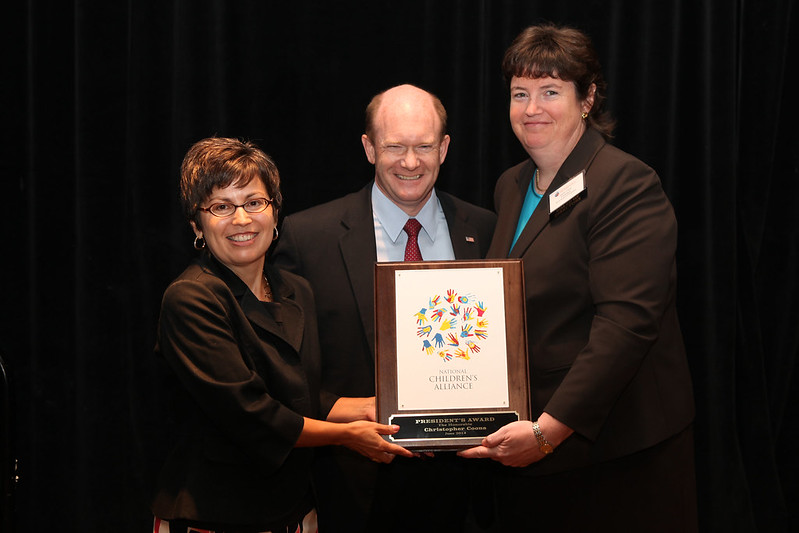
Senator Coons honored for fighting to save Children’s Advocacy Centers

U.S. Senator Chris Coons is given the National Children's Alliance President's Award in Washington, DC on June 3, 2014.

WASHINGTON – The National Children’s Alliance honored U.S. Senator Chris Coons (D-Del.) on Tuesday for his efforts to sustain Children’s Advocacy Centers in Delaware and around the nation. Children’s Advocacy Centers (CACs) employ a multi-disciplinary team of trained professionals to conduct forensic interviews of children who have been victims of abuse. These interviews are designed to be admissible in court, preventing children from being re-traumatized by having to tell their stories multiple times.  Although the success of these federal-state and public-private partnerships have earned them broad bipartisan support, Congressional authorization for Children’s Advocacy Centers lapsed in 2005, and the President’s proposed budgets for 2013 and 2014 have zeroed out federal funding. 

During an impassioned speech before the leaders of CAC facilities in Washington this morning for their annual conference, Senator Coons shifted focus to the heroic work being done at Children’s Advocacy Centers and pledged to keep fighting to protect it.

“The work that you do is the work of healing,” Senator Coons said. “The work that you do is work that transforms victims into survivors, and survivors into advocates. Parents who are struggling deeply with how some such evil thing could happen under their own roof and who are struggling to make sense of the world, find some path forward. And children who have been robbed of that one greatest gift of God — innocence — find some adult who cares for them and who they can trust in the beginning of a journey out of victimization. You do awesome work. Just awesome work.”

“What you do every day stands up to evil,” the Senator continued. “There is no darker corner of the human psyche – there is no greater wrong — than robbing a child of innocence through sexual abuse. There is nothing worse in this world. It is critical that we sustain the authorization for your work. It is unthinkable to me that we have to fight for it. That this is not just done routinely by voice vote, but it isn’t. In this most dysfunctional Congress in modern times, we have to fight for it.”

“I can think of no one more deserving of this award,” Children’s Advocacy Centers of Delaware Executive Director Randy Williams said. “Senator Coons’ passion for the issue of child abuse prevention, his knowledge about the role of the Children’s Advocacy Centers and multidisciplinary teams in responding to allegations of child abuse and his steadfast support and advocacy for CACs across the country serves as an inspiration to all of us in the field. He is truly a champion.”

“During his time in the Senate, he has truly been a champion for children and a champion for the work of Children’s Advocacy Centers all over the U.S.,” National Children’s Alliance Executive Director Teresa Huizar said. “When our funding was zeroed out a couple of years ago, this really became something of personal interest to Senator Coons. It something he was deeply – not only ‘aware’ of – but the impact on Delaware on others, he understood right from the get-go and began to advocate not only with his Senate colleagues, but with the Administration on this issue. We truly appreciate all his incredible dedication.”

Senator Coons is a member of the Senate Judiciary Committee and the Senate Appropriations Subcommittee on Commerce, Justice and Science, which controls appropriated funds to the Children’s Advocacy Centers. The full Appropriations Committee will mark up the FY2015 Commerce, Justice and Science spending bill on Thursday.

Senators Coons, Roy Blunt (R-Mo.), along with Senators Jeff Sessions (R-Ala.) and Mazie Hirono (D-Hawaii) introduced legislation in December 2013 to reauthorize and strengthen the Victims of Child Abuse Act. Read more about the bill here: http://1.usa.gov/1fjTb3o

National Children’s Alliance is the national association and accrediting body for the over 775 Children’s Advocacy Centers and 48 State Chapters serving each of the 50 states and the District of Columbia. Dedicated to helping local communities respond to allegations of child abuse in ways that are effective and efficient, and put the needs of child victims of abuse first, National Children’s Alliance provides support and advocacy to its accredited membership, as well as numerous developing centers, multidisciplinary teams and child abuse professionals around the country, and the world. As the national authority on multidisciplinary approaches to supporting child victims of abuse, the purpose of National Children’s Alliance is to empower local communities to provide comprehensive, coordinated and compassionate services to victims of child abuse. Founded in 1998, National Children’s Alliance provides accreditation opportunities, financial assistance, training, technical assistance, research and education to communities, child abuse professionals and children’s advocacy centers throughout the United States in support of child abuse intervention, advocacy and prevention.

IRS enacts Coons-Roberts provision to make R&D tax credit accessible to small businesses

WASHINGTON – The IRS has enacted a provision championed by U.S. Senator Chris Coons (D-Del.), leader of the Senate’s Manufacturing Jobs for America initiative, and Senator Pat Roberts (R-Kan.) that will make the valuable research and development tax credit more accessible to small businesses. The IRS announced a change to regulations this week that will for the first time allow small companies to claim the Alternative Simplified Credit, a simpler version of the R&D tax credit, on amended tax returns. Senators Coons and Roberts first proposed this change in the bipartisan Innovators Job Creation Act, introduced in January.

“Research and development are the lifeblood of innovation, and many of today’s most successful innovations are coming from the small business world,” Senator Coons said. “Our tax code should encourage job-creating R&D, but until now, IRS regulations prevented many small companies from claiming the most user-friendly version of the R&D tax credit. This simple change will help thousands of small manufacturers access the capital they need to invest in innovation, grow their businesses, and create good jobs. I’m grateful to Senator Roberts for his partnership on the Innovators Job Creation Act, and look forward to working with him to enact the other important provisions of this bill.”

 “I am glad the IRS agrees with me that small businesses, the most dynamic part of our economy, should be able to take fuller advantage of the Research and Development Tax Credit,” Senator Roberts said. “The sensible change in the IRS’ regulations – a change I have long pushed for – will provide funds to allow innovative small business owners to create new jobs, expand businesses and keep businesses growing.”

Congress created the Alternative Simplified Credit (ASC) in 2006 to provide businesses with a simpler version of the complex R&D tax credit. The ASC is especially beneficial to small companies, who often lack the resources and expertise to perform the complicated calculations required to claim the traditional R&D credit. The ASC was intended to make these calculations easier, but IRS regulations previously barred its use on amended tax returns.

Senators Coons and Roberts introduced the bipartisan Innovators Job Creation Act in January to allow businesses to claim the ASC on amended returns and extend access to valuable R&D tax credits to small businesses and startups. The Innovators Job Creation Act is cosponsored by Senators Mike Enzi (R-Wyo.) and Chuck Schumer (D-N.Y.).

This legislation has been endorsed nationally by more than three-dozen organizations and companies, including the Information Technology & Innovation Foundation (ITIF), BIO, the Association for Manufacturing Technology, CompTIA, TechVoice, the American Small Manufacturers Coalition, the Telecommunications Industry Association, Plug In America, American Institute of Architects, and the Technology Councils of North America. Text of the Innovators Job Creation Act can be found here: http://bit.ly/1eGIeJL

Senator Coons introduces bill to reform and modernize America’s food aid program

WASHINGTON – U.S. Senators Chris Coons (D-Del.) and Bob Corker (R-Tenn.), both members of the Senate Foreign Relations Committee, introduced bipartisan legislation Tuesday reforming the U.S. global food assistance program. The bill would free up as much as $440 million annually through greater efficiencies in delivering aid, allowing the U.S. to reach an estimated seven to nine million more people, and do so in a shorter time period.

“More than anything else, the mission of America’s food aid program is to save lives,” said Senator Coons, chair of the Senate Foreign Relations Subcommittee on African Affairs. “Our current system for acquiring and distributing food aid is inefficient and often hurts the very communities it is trying to help. This bill will modernize America’s food aid program and help it to reach as many as nine million more people each year. It will also help get food aid to where it is needed months sooner. The reforms in this bill build on reforms in the FY14 omnibus appropriations bill and 2014 farm bill, and have broad and bipartisan support from policy experts and humanitarian organizations.”

“At a time when our budget is strained and U.S. resources are limited, Congress needs to find ways to be more efficient and effective with every dollar,” said Senator Corker, ranking member of the Senate Foreign Relations Committee. “Food aid remains one of the most tangible ways U.S. foreign aid can help improve stability around the world, and by reforming the program to allow for flexibility we can deliver more food to those in need faster and at a lower cost. Our legislation will reorganize this vital program in a more sensible way so we can better align our food aid efforts with U.S. national interests.”

The Food for Peace Reform Act of 2014 would transfer current food aid authorities from the farm bill into the Foreign Assistance Act and implement the following reforms that were proposed in the President’s FY 2014 budget request:

  • Cost-Effective Procurement: Current law requires 100 percent of food aid commodities be produced in the United States (recent changes in the Farm Bill could allow a small amount to be used as cash to offset monetization and for locally procured food). The Corker-Coons bill would lift this requirement and allow both U.S. and locally or regionally procured (LRP) commodities, vouchers, and cash transfers to be used—whichever is the most cost effective option. As a result of an LRP pilot project, the U.S. Agency for International Development (USAID) found that using LRP commodities allows the U.S. to feed more people, more quickly and at a lower cost. Senator Coons passed an amendment to the farm bill with Senator Johanns to increase the authorization for the successful LRP program – which was made permanent – from $40 million to $60 million a year. The final farm bill conference further increased the authorization for this program to $80 million a year. The impact of this reform on the U.S. shipping and agricultural sectors would be small considering U.S. food aid contributed just 0.86 percent of total U.S. agricultural exports from 2002 – 2011 and just 1.41 percent of net farm income.
  • Cargo Flexibility: Current law requires 50 percent of donated food aid to be shipped on American-flagged vessels. According to USAID, Government Accountability Office (GAO), and a study by Cornell University, removing the cargo preference requirement will save an estimated $50 million per year and speed delivery to a larger population. This legislation would provide USAID with the flexibility to ship on vessels that are readily available. The Cornell study found cargo preferences in 2006 contributed to a 46 percent increase in freight costs above competitive market rates. These unreimbursed costs to U.S. food aid agencies, according to the study, roughly equal USAID’s entire non-emergency food aid to Africa. In separate letters to the House Foreign Affairs Committee, the U.S. Departments of Defense and Transportation have determined the changes to cargo preferences will not undermine U.S. maritime readiness.
  • Eliminate Monetization: Current law requires 15 percent of all U.S. donated food to be sold first by aid organizations, producing cash that then funds development projects. GAO has warned this process – known as “monetization” – is “inefficient and can cause adverse market impacts” in recipient countries. GAO also found monetization loses an average of 25 cents on every taxpayer dollar spent. According to USAID, eliminating monetization could feed an additional 800,000 people and free up an estimated $30 million per year.

Click here for a copy of the legislation. 

Senator Coons applauds new standards to cut carbon pollution from existing power plants

WASHINGTON – U.S. Senator Chris Coons (D-Del.) released the following statement on Monday applauding the EPA’s Clean Power Plan, the nation’s first carbon pollution standards for existing power plants. By 2030, new standards will cut carbon emissions from the power sector by 30 percent nationwide, reduce particle pollution, nitrogen oxides, and sulfur dioxide by more than 25 percent, and prevent thousands of premature deaths and asthma attacks in children.

“Carbon pollution is heating our planet at an alarming rate, altering weather patterns and raising sea levels that could put up to 11 percent of Delaware under water by the end of the century. These changes have already begun, but we still have an opportunity – and an obligation – to save our communities from irreversible damage.

“To mitigate the impacts of climate change, we have to reduce the level of damaging carbon emissions we pump into the atmosphere. If enacted, the EPA’s Clean Power Plan will ensure America’s power plants – our country’s single largest source of carbon pollution – move to responsibly curb harmful emissions. These guidelines set strong targets for reducing carbon pollution, while giving states the flexibility they need to achieve emissions goals in a cost-effective way. This critical effort will protect public health, strengthen the market for energy efficiency, and spur transition to affordable, homegrown clean energy.

“Delaware is already implementing similar standards that have brought enormous benefits to our region over the last five years. As part of the Regional Greenhouse Gas Initiative – the country’s first regional cap and trade system – Delaware and eight other states have cut regional carbon pollution by nearly a third and raised more than $700 million for investment in renewable and energy efficiency projects. This successful initiative can serve as a national model for states across the country.

“I applaud the EPA for taking strong action today to move our nation toward a cleaner and more stable future. The world is looking to the United States to lead the global charge against climate change. These historic guidelines for power plants – together with fuel economy standards already in place – are a clear demonstration of that leadership, and now our competitors around the world must follow suit. We cannot and should not be in this alone.

“We have a responsibility – to our children and the generations to come – to stand up to this challenge. Our children don’t care about the politics, the pushback, the endless excuses for inaction and indifference. They will ask us only whether, when we had the opportunity, we did all we could to protect our planet.” 

Senators of the Chesapeake Bay Watershed praise USDA for recognizing the Bay as a critical conservation area

WASHINGTON – DELMARVA Senators Ben Cardin and Barbara A. Mikulski (Both D-Md.), Mark Warner and Tim Kaine (Both D-Va.), Tom Carper and Chris Coons (Both D-Del.), and Senator Bob Casey (D-Pa.) lauded the announcement today by the U.S. Department of Agriculture (USDA) that the Chesapeake Bay Watershed has been officially designated as one of eight Critical Conservation Areas that is eligible for set-aside funding as part of the consolidated Regional Conservation Partnership Program. The RCPP, which was first detailed in the 2012 Farm Bill and passed into law in February 2014 with approval of the Conference Report on the 2014 Farm Bill, benefits the region’s farmers and continues a strong foundation for restoring the health of the Chesapeake Bay Watershed. 

“Agriculture is Maryland’s number one industry despite the great challenges, so our farmers understand how valuable a healthy Chesapeake Bay is to our region and our nation. It’s why we fought for assurances that USDA’s conservation programs will continue to provide ample resources to producers in our state to protect the Chesapeake. Keeping these conservation programs robust was a priority for the Chesapeake delegation in the 2013 Farm Bill,” said Senator Cardin, Chairman of the Senate Water and Wildlife Subcommittee. “I will continue to work hard to provide Maryland farmers with the resources they need to continue their responsible efforts to conserve the watershed. Restoring the full health of the Chesapeake Bay requires coordination among all sectors in the region.”  

“The Chesapeake Bay is an integral part of who we are as Marylanders – our heritage, our economy and our culture,” said Senator Mikulski. “Maryland farmers and communities want to stand up for the health of the Bay, but they can’t do it on their own. I was proud to stand with my colleagues to protect this federal investment in the lives and livelihoods that depend on the Bay. I will continue to fight to protect the Bay to sustain jobs and support Maryland’s farmers with the resources they need.” 

The Regional Conservation Partnership Program (RCPP), which will receive more than $100 million annually in mandatory funds, emphasizes  cooperation between producers and regional stakeholders to work together to improve the effectiveness of agricultural conservation activities by leveraging non-government funds in support of conservation projects. The RCPP also focuses conservation funds on regions with the greatest conservation needs. 

“With one-third of Delaware connected to the Chesapeake Bay Watershed, it’s critical that we keep supporting efforts to protect and restore the Chesapeake Bay so our children and grandchildren can enjoy it the same way we have for generations,” Senator Carper said.  “We need to continue encouraging common sense land conservation policies as well as measures to help preserve Delaware’s strong agricultural heritage.  That’s why earlier this year I joined Senator Cardin, Senator Coons, and other Mid-Atlantic senators to ensure that the Farm Bill will continue to make resources available to protect the Chesapeake Bay. I’m glad to see those efforts starting to pay off.”

“The Potomac and Susquehanna River watersheds are critical to Pennsylvania’s economy. I’m pleased USDA recognized the significant need for these watersheds and the Chesapeake Bay region to be chosen as a critical conservation area in the Regional Conservation Partnership Program. This program provides important conservation resources to help ensure farmers and foresters continue to thrive, provide Pennsylvanians with local foods and drive the Commonwealth’s economy,” said Senator Casey.

The Chesapeake Bay is the world’s largest and most productive estuary. With a 64,000 square mile watershed and 11,684 miles of tidal shoreline – more than the entire U.S. West Coast – the Bay has been deemed a national treasure by President Obama and his predecessors. It has an economic value over $1 trillion, but that value is dependent on the health of the Bay’s waters and fisheries.Twenty-five percent of lands within the watershed are used for agricultural purposes.

“I am proud that we were able to push the USDA to recognize the importance of the Chesapeake Bay by designating it as a Critical Conservation Area,” Senator Warner said. “This will allow us to continue protecting the Commonwealth’s 3,300 miles of coast, which provide vital economic contributions to tourism, recreation, commercial and sport fisheries, as well as important environmental resources.”

“The waters of the Chesapeake Bay support the livelihoods of thousands in Delaware and millions across our region,” Senator Coons said. “Preserving the health of this vital resource is more than an environmental obligation, it is an economic necessity. With help from the Natural Resources Conservation Service, Delaware farmers have employed effective conservation practices that have significantly reduced pollution in the watershed. It’s critical that these efforts continue under the new Regional Conservation Partnership Program, and I’m thrilled that the USDA will continue to make conservation in the Bay a top priority.”

“I applaud USDA for designating the Chesapeake Bay as a Critical Conservation Area, which will bolster the Bay’s share of federally-funded conservation projects that benefit both farmers and the environment,” said Senator Kaine, who made Chesapeake Bay cleanup and conservation a priority as Governor of Virginia. “I was proud to support the bipartisan farm bill containing these important priorities.”

The Chesapeake Bay Watershed Senators negotiated with Senate Agriculture Committee Chairman Debbie Stabenow (D-MI) and Ranking Members Pat Roberts (R-KS) (2012) and Thad Cochran (2013) to increase the overall funding for the new regional conservation program, as well as improve the set-aside for “Critical Conservation Areas” like the Chesapeake Bay Watershed, and solidify the Bay as a priority within the RCCP. Allocation of the funding is divided between a state competitive process (25%), USDA’s National Resource Conservation Service (NRCS) for projects based on a national competitive process (40%) and projects in up to eight critical conservation areas (35%).

Eligible purposes are projects that would be eligible under Agri­cultural Conservation Easement Pro­gram (ACEP), Environmental Quality Incentives Program (EQIP), Conser­vation Stewardship Program (CSP) and a few other NRCS conservation programs designed to preserve and protect water quality and water quantity and forested lands.

Examples of eligible conservation activities include:

  • Water quality restoration or enhancement projects, including nutrient management and sediment reduction
  • Water quality conservation, restoration or enhancement projects relating to surface water groundwater resources including; the conversion of irrigated cropland to the production of less water-intensive commodities, dry land farming; irrigation system improvement
  • Drought mitigation
  • Flood prevention
  • Water retention
  • Air Quality improvement
  • Habitat conservation, restoration, and enhancement
  • Erosion control and sediment reduction
  • Forest restoration
  • Easement acquisition activities associated with wetland restoration and protection or the preservation of working agricultural lands.

Producers may apply for RCPP assistance in several ways: At the producer’s request, a partner may submit the application for participation in a selected project area; directly at their local USDA Service Center in a selected project area; directly at their local USDA Service center in a critical conservation area designated by the Secretary of Agriculture. Pre-proposals are due July 14, and full proposal are due September 26.  For more information, see this link at USDA.

Senator Coons cosponsors three bills to strengthen veterans’ medical care

WASHINGTON – U.S. Senator Chris Coons (D-Del.) cosponsored three bills this week to strengthen the care America offers its veterans. The Suicide Prevention for American Veterans Act and the Medical Evaluation Parity for Servicemembers Act would improve access to critical mental health services, and the Military and Caregiver Services Improvement Act would ensure family caregivers have the support they need to provide for wounded veterans.

“For many veterans, the trauma of combat does not end when they return home,” Senator Coons said. “Our veterans deserve the best medical care available, but far too often, veterans suffering from PTSD, Traumatic Brain Injury, and other psychological impacts slip through the cracks. Every day, our nation loses more than 20 veterans to suicide, and many more struggle to cope with untreated mental illnesses. These wounds are treatable, and these tragedies preventable. Congress must act to expand mental heath services for veterans and ensure all service members receive the timely, comprehensive care they need. Together, these bills would take important steps toward strengthening our approach to mental health care and fulfilling our commitment to all who bravely serve our nation.”  

The Suicide Prevention for American Veterans Act, S.2182, aims to reduce the number of veterans — now estimated at 22 per day — who tragically take their own lives. Among other things, the bipartisan bill would:

  • Extend special combat eligibility from 5 to 15 years, providing troops and veterans with access to care for an additional 10 years. 
  • Increase the number of mental health professionals at the VA by repaying medical school loans for psychiatrists who commit to long-term service in the VA.
  • Improve mental health care and suicide prevention programs by demanding an annual review of care programs within DOD and the VA to ensure resources are effectively combatting the problem of veteran suicide.
  • Ensure seamless care and greater collaboration between the VA and DOD by putting a timeline on the National Defense Authorization Act mandate to make all DOD and VA records electronic.
  • Establish a common drug formulary between DOD and the VA.  The SAV Act requires DOD and the VA to adopt the same drug formulary for prescription medication to ensure treatment is consistent. 

The Medical Evaluation Parity for Servicemembers Act of 2014, S. 2231, would improve the military’s assessment and treatment of mental health issues by instituting mental health screenings for all service members. The bipartisan bill would:

  • Require a mental health screening upon entry and separation from military service.
  • Require a report on DOD’s ability to provide electronic medical records of separating service members. 
  • Create a more comprehensive and holistic approach to mental health assessments in the military and remove some of the barriers to effective care. 

The Military and Caregiver Services Improvement Act, S. 2243, increases federal support for those who provide care to wounded servicemembers and veterans. This legislation would:

  • Expand eligibility for the VA family caregivers program by incorporating a wider array of needs that may require caregiving, placing greater emphasis on mental health injuries, and removing restrictions on who is eligible to become a caregiver.
  • Expand services to caregivers including eligibility for VA child care programs, financial advice, and legal counseling, addressing some of the top needs of family caregivers.
  • Allow the federal government to meet the unique needs of employees who are caregivers with flexible work arrangements so they can stay employed while caring for their loved one.

This week, in response to reports that certain VA Medical Centers used a recordkeeping gimmick to disguise backlogs in patient treatment – resulting in the deaths of up to 40 veterans in Phoenix – Senator Coons wrote to the head of the Wilmington VA Medical Center seeking assurances that Delaware veterans are not being subjected to the same misconduct. Read his letter here: http://1.usa.gov/1lGHbtp

A member of the Senate Appropriations Committee, Senator Coons also voted Thursday for legislation that would fund a nationwide investigation of alleged scheduling misconduct at the VA. The military construction/veterans affairs appropriations bill will also fund work to reduce the backlog in disability claims at the VA, and increases funding for repairs to veterans’ long-term care facilities, including the Delaware Veterans Home in Milford. Read more here: http://1.usa.gov/1t05lD7

Senator Coons votes to fund nationwide investigation into allegations of scheduling misconduct at VA

WASHINGTON – U.S. Senator Chris Coons (D-Del), a member of the Senate Appropriations Committee, voted Thursday for legislation that would fund a nationwide investigation of scheduling practices in Veterans Administration facilities. The military construction/veterans affairs appropriations bill also funds work to reduce the backlog in disability claims at the VA, and increases funding for repairs to veterans’ long-term care facilities, including the Delaware Veterans Home in Milford.

“Our veterans have earned the same level of service and care they delivered on the battlefield,” Senator Coons said. “Recent reports of misconduct and neglect at the Phoenix VA are appalling and unworthy of a nation built on the service and sacrifice of generations of veterans. No service member should ever have to struggle to access the health services and disability benefits he or she is owed. Our nation has to do a better job of caring for its veterans, and this bill is an important start. I’m glad funding in this bill will help to shed light on the tragic situation that occurred in Phoenix and work to ensure it never happens again at another VA facility.”

Some of Senator Coons’ veterans priorities, included in the bill approved by the Appropriations Committee on Thursday, are highlighted below:

VA Patient Scheduling Investigation

Provides an additional $5 million above the President’s budget request for the VA Office of Inspector General to conduct a nationwide investigation of all VA scheduling practices and procedures. The investigation comes in response to reports that certain VA Medical Centers used a recordkeeping gimmick to disguise backlogs in patient treatment, resulting in the deaths of up to 40 veterans at the Phoenix VA Medical Center alone. The bill will ensure all scheduling procedures receive thorough examination in order to prevent a recurrence of this issue, and will prohibit the payment of performance bonuses to Veterans Health Administration employees until the investigation is complete and necessary reforms have been instituted.

VA Claims Backlog Processing

Building on the 10-point claims processing initiative included in the FY14 appropriations bill, the FY15 bill includes additional funding and oversight provisions to support the VA’s surge to eliminate the current disability claims backlog. The bill includes workplace management reforms to improve oversight of claims handling, and adds $30 million to hire additional personnel to expedite claims processing. The FY15 bill also includes $10 million above the President’s request for hardware upgrades at Regional Offices to aid the VA’s rapid transition from a paper-based claims processing system to one using modern technology. The bill also provides additional funds to streamline the cumbersome appeals process.

Construction of extended care facilities for veterans

Includes $100 million for the State Veterans Home Construction Grant Program to help address the current $489 million backlog in construction projects for state veterans homes. State long-term care facilities like Delaware Veterans Home in Milford rely on VA construction grants to pay for important life-safety improvements, major repairs and renovations, and construction of new facilities for aging, injured, and ill veterans. The current backlog has delayed needed repairs to these facilities, including a dining and kitchen renovation project at Delaware Veterans Home. Together with Senator Carper, Senator Coons advocated for no less than $85 million in the FY15 appropriations bill to address the nationwide backlog, and the Committee complied, increasing funding by more than $20 million over the President’s budget request and $15 million over FY14. 

Senator Coons seeks assurances that Delaware VA facilities are not disguising scheduling delays

WASHINGTON – U.S. Senator Chris Coons (D-Del.) wrote to the head of the Wilmington Veterans Administration (VA) Medical Center Thursday seeking assurances that Delaware veterans are not being subjected to the same recordkeeping gimmick reportedly being used to disguise scheduling delays at as many as 26 VA facilities around the country. 

“The mere possibility that bureaucratic misconduct would lead to neglect and suffering of our veterans is appalling, so I am writing today to ensure that no such behavior is occurring at VA facilities in Delaware,” Senator Coons wrote.

An investigation by the VA Inspector General found that, to avoid being seen exceeding a 14-day deadline on the scheduling of appointments, VA hospitals in Phoenix, Arizona, were found to have maintained secret secondary waitlists. Only when an appointment fewer than 14 days away became available would the veteran’s request be entered into the system, thus disguising the true wait time. These delays have been linked to as many as 40 deaths.

“Over the last year, I discussed with your predecessor the disconcerting practice of transferring cases from the Philadelphia and Baltimore VAMCs to the Wilmington VAMC,” Senator Coons wrote. “It appears the percentage of backlogged cases in Delaware has still fallen considerably, and that patients are getting the care they need. This is encouraging news, but recent reports compel me to confirm that these backlog-reductions are not the result of the kind of fraudulent behavior seen around the country at other VA centers.”

The full letter can be downloaded as a PDF here: http://1.usa.gov/1nvaTUF

The full text follows:

May 22, 2014 

Robin C. Aube-Warren
Director
Wilmington VA Medical Center
1601 Kirkwood Highway
Wilmington, DE 19805

Dear Director Warren,

In recent weeks, Americans have read with great concern reports that certain Veterans Affairs Medical Centers used a recordkeeping gimmick to disguise backlogs in patient treatment, resulting in the deaths of up to 40 veterans at the Phoenix VAMC alone. The mere possibility that bureaucratic misconduct would lead to neglect and suffering of our veterans is appalling, so I am writing today to ensure that no such behavior is occurring at VA facilities in Delaware.

Over the last year, I discussed with your predecessor the disconcerting practice of transferring cases from the Philadelphia and Baltimore VAMCs to the Wilmington VAMC. It appears the percentage of backlogged cases in Delaware has still fallen considerably, and that patients are getting the care they need. This is encouraging news, but recent reports compel me to confirm that these backlog-reductions are not the result of the kind of fraudulent behavior seen around the country at other VA centers.  

As someone who grew up in a family of active duty service members and veterans, I have the utmost respect and gratitude for America’s service members.  The military is part of the basic fabric of Delaware, with a major presence at Dover Air Force Base and a large Guard and Reserve presence throughout the state.  We have a sacred duty as Americans to support our veterans, and we must do everything in our power to do a better job of taking care of those who have served our great country and Delaware.

I am committed to working to provide the necessary resources to ensure that veterans in Delaware are getting the care and attention they need in a timely manner. I would also appreciate your specific input on ways I can continue to work with my colleagues, including Congressman Carney and Senator Carper, to ensure that we are fully supporting Delaware’s veterans now and in the future.  

                                                                                                            Sincerely,

                                                                                                            Christopher A. Coons

                                                                                                            U.S. Senator