Related Issues

Related Issues

Senators Coons, Tillis to introduce legislation to promote protection of international digital freedom

WASHINGTON – U.S. Senators Chris Coons (D-Del.) and Thom Tillis (R-N.C.) today announced plans to introduce the Advancing Digital Freedom Act of 2024, which would equip the U.S. State Department with the authorities to elevate digital freedom as a cornerstone of U.S. foreign policy and support its critical role in advancing democratic governance around the world. Companion legislation will also be introduced in the House by Representatives Sydney Kamlager-Dove (D-Calif.) and Young Kim (R-Calif.).

“As a global leader of human rights, the United States must deter authoritarian and illiberal states that are using advanced technologies to threaten human rights alongside our own national security,” said Senator Coons. “Protecting digital freedom abroad is a cornerstone of American foreign policy for the modern age, and that is why we must cooperate with like-minded countries to develop and deploy emerging technology in a manner that respects democracy and rule of law. As Co-Chair of the Senate Human Rights Caucus, I’m confident that this bill will help protect digital freedoms and counter global misinformation and disinformation in partnership with our allies.”

“With increasing cyber threats and attacks on the horizon than ever before, working with our allies to counter them is all the more important,” said Senator Tillis. “Protecting and promoting digital freedom across the globe must be a priority, which is why I look forward to introducing this bipartisan legislation to ensure the Department of State continues to prioritize this as a cornerstone of U.S. foreign policy.”

“Digital technology has both benefits and drawbacks when it comes to advancing democracy,” said Congresswoman Kamlager-Dove. “It can enable citizens to access information, share ideas, and organize while simultaneously allowing for authoritarian regimes to spread propaganda, enhance surveillance, and stifle free speech. We must ensure that digital technologies are used to strengthen democracy, not dismantle it. It is crucial for the United States to develop a comprehensive strategy to safeguard digital freedom worldwide and work with partners to implement this plan. Promoting human rights and democracy at home and abroad must remain a bipartisan issue, and I am proud to advance these priorities with a bipartisan, bicameral group of congressional colleagues.”

“The Unholy Alliance, including the People’s Republic of China, Russia, Iran, and North Korea, relies on abusive surveillance technologies to restrict access to information and the outside world and to maintain their grip on power,” said Congresswoman Young Kim, Chair of the House Foreign Affairs Subcommittee on the Indo-Pacific. “To remain a global human rights leader, the United States cannot stand idly by as these authoritarian regimes use digital technologies and platforms to suppress innocent civilians, religious minorities, and political dissenters. I am proud to join Representative Kamlager-Dove and Senators Coons and Tillis to lead this bipartisan, bicameral effort to protect the right to international digital freedom. I’ll keep fighting to ensure the United States promotes global human rights and protects freedom-loving people around the world.”

The right to freedom of expression has become a fault line between pro-democracy groups and authoritarian governments. Digital platforms, including social media, have been crucial tools for movements such as the Mahsa Amini protests in Iran or the Umbrella Movement in Hong Kong. However, autocratic governments have attempted to stifle these efforts by cracking down on digital freedom. Russia and China deploy digital tools to identify and silence dissidents, Iran routinely blocks access to thousands of websites conveying political content, and North Korea and Venezuela coordinate disinformation campaigns to undermine citizens’ access to credible information. To address such threats to digital freedom, the Advancing Digital Freedom Act would strengthen the United States’ role in leading efforts to ensure technology is used to uphold human rights, democratic values, and the rule of law. 

Specifically, the bill would:

  • Elevate digital freedom as a foremost foreign policy priority of the United States;
  • Empower the Coordinator for Digital Freedom in the State Department’s Bureau of Cyberspace and Digital Policy to lead global efforts to protect digital freedom, counter disinformation and misinformation, and advance democratic governance in the digital space;
  • Encourage the State Department to engage with foreign governments, nongovernmental organizations, and other actors to coordinate efforts to defend digital freedom against digital authoritarianism; and
  • Require the Bureau of Cyberspace and Digital Policy to submit an annual report to the Senate Foreign Relations Committee and the House Foreign Affairs Committee on the state of global digital freedom, including analysis of emerging and concerning trends impacting digital freedom.                                                                                                

As Co-Chairs of the Senate Human Rights Caucus, Senators Coons and Tillis are committed to the promotion and protection of human rights and democracy through U.S. foreign policy. Recently, the caucus has held briefings and issued statements on the state of conflict and human rights across the globe, including in the Horn of Africa, Ukraine, and across Latin America.   

The text of the bill is available here.
 

Senators Coons, Risch, Shaheen, Young to introduce Sudan Accountability Act to protect the Sudanese people and hold perpetrators of war crimes accountable

WASHINGTON – U.S. Senators Chris Coons (D-Del.) and Jim Risch (R-Idaho) today announced their intention to introduce the Sudan Accountability Act to respond to the civil war in Sudan that has been raging since April 2023. In addition to Senators Coons and Risch, this legislation is cosponsored by Senators Jeanne Shaheen (D-N.H.) and Todd Young (R-Ind.).

Fighting between the Sudanese Armed Forces (SAF) and the Rapid Support Forces (RSF) has created the world’s worst ongoing humanitarian crisis. More than 20,000 Sudanese have been killed since fighting broke out last April. Ten million people have been displaced – 2 million of whom have had to leave the country as refugees – and more than 25 million people are suffering from severe hunger. Massacres in Darfur and other regions across the country by RSF militias have become regular occurrences. A peace process still seems far away, as both sides and nations across Africa and the Middle East focus more on securing access to Sudan’s natural resources. Democratic prospects have dimmed since a 2021 coup by General Abdel Fattah Burhan and the SAF, who had proceeded to consolidate their control and shut out civil society before the war broke out.

“It is time for Congress to act on Sudan,” said Senator Coons. “Failing to act as the Sudanese people are forced to flee or die in their homeland is a choice that we do not accept. The Sudan Accountability Act will advance and protect the rights of all Sudanese, hold the perpetrators of war crimes and their supporters accountable, expand humanitarian access, and support efforts to bring an end to this disastrous conflict.”

“The Sudanese people continue to suffer unspeakable atrocities, including genocide and war crimes,” said Senator Risch. “It is past time the perpetrators of these atrocities be held accountable. While securing a cease-fire and addressing humanitarian needs are crucial, protecting civilians and preventing further atrocities must also be a priority. This legislation requires a clear strategy, resourcing, and leadership on Sudan by the U.S. government to protect civilian welfare, particularly that of women and children. Congress will oversee these efforts to ensure accountability is adequately pursued.”

“The war in Sudan has created the most devastating humanitarian crisis in the world, including record rates of sexual- and gender-based violence committed in large part by the Rapid Support Forces,” said Senator Shaheen. “The international community must support the Sudanese people’s demands for protection and justice and the warring parties must come to the table to end this war. I’m proud to introduce this legislation that sends an unmistakable, bipartisan message that the United States will seek accountability for any individual, state, or entity that commits war crimes or crimes against humanity in Sudan and perpetuates this awful conflict.”

“The situation in Sudan is heartbreaking and one of the worst humanitarian crises in the world,” said Senator Young. “The United States and the international community cannot ignore this situation, nor can we stand silent as external actors fuel the conflict. Our bipartisan legislation will shed a light on these atrocities, help hold the perpetrators of war crimes in Sudan accountable, and support a broad humanitarian response.”

The Sudan Accountability Act is the most comprehensive bill in the Senate to date to address the ongoing war in Sudan. The legislation takes important steps to shed light on the atrocities occurring in Sudan and determine if they constitute genocide; hold perpetrators and their supporters accountable; offer services to innocent civilians; and support the protection of the Sudanese people. It will:

  • Advance and protect the internationally recognized human rights of all Sudanese, regardless of ethnicity, religion, gender, or geographic area of origin;
  • Document war crimes, crimes against humanity, and genocide and hold perpetrators accountable;
  • Mandate a strategy to ensure unrestricted humanitarian access to vulnerable populations and prevent human trafficking, sexual and gender-based violence, and the recruitment of child soldiers; 
  • Authorize assistance to support victims of atrocities;
  • Enhance civilian protection and evaluate options to deter attacks on civilians and humanitarian workers;
  • Support mechanisms for dialogue and conflict resolution and ensure inclusion of Sudanese women in these efforts.

The full text of the bill is available here.   


ICYMI: U.S. News publishes Senator Coons op-ed on need to pass NO FAKES Act to protect Americans from AI deepfakes

WASHINGTON – In case you missed it, U.S. Senator Chris Coons (D-Del.), chair of the Judiciary Subcommittee on Intellectual Property, yesterday published an op-ed in U.S. News & World Report urging the swift passage of his bipartisan Nurture Originals, Foster Art, and Keep Entertainment Safe Act of 2024, known as the NO FAKES Act. This bill – which would provide all Americans with the tools necessary to safeguard their voices and likenesses against unauthorized AI-generated deepfakes – would also help deter AI-powered misinformation and disinformation that threatens to upend democratic elections across the country. 

Unauthorized generative AI deepfakes utilizing a real person’s voice or likeness have had a negative impact across American society, popping up in everything from financial scams to computer-generated songs featuring famous artists created without their participation or permission. Deepfakes have also played an increasingly large role in the runup to November’s elections, including a fake video featuring Vice President Harris that was amplified by billionaire Elon Musk and photos that falsely suggested pop superstar Taylor Swift supported former President Trump’s 2024 campaign. The use of deepfake-driven misinformation is likely to only increase in the next 26 days and in the aftermath of the election.

This summer, Senator Coons introduced the NO FAKES Act alongside Senators Marsha Blackburn (R-Tenn.), Amy Klobuchar (D-Minn.), and Thom Tillis (R-N.C.) to protect the voices and visual likenesses of all Americans from the proliferation of digital replicas created without their consent. 

The legislation has wide support from advocates for creative artists and entertainment giants, including the Screen Actors Guild-American Federation of Television and Radio Artists, Warner Music Group, The Walt Disney Co., Sony Music, the Motion Picture Association, and the Recording Industry Association of America.

U.S. News: AI Deepfakes Threaten Americans and Our Election

The rise of easy-to-use generative AI programs has created new frontiers for disinformation. Now, with a few clicks and a well-written prompt, even a child can create audio, video or photographs of real people – your senator or your next-door neighbor – with the intent of manipulating voters and consumers.

This year we’ve already seen an AI-generated robocall featuring a fake voice that sounded like President Joe Biden, intended to suppress turnout by Democrats in the New Hampshire primary. There was a digital ad shared by Elon Musk, owner of X, the social media platform previously known as Twitter, to his 200 million followers that was a facsimile of Vice President Kamala Harris speaking made-up lines and claiming to be a “diversity hire.” Nor can we forget the AI-generated photos of pop megastar Taylor Swift and fans purportedly endorsing Donald Trump, which the former president sent to his nearly 8 million followers on Truth Social. (Weeks later, the real Swift endorsed Harris on her own Instagram, but fans could be forgiven for being confused.)

…

That’s why a bipartisan group of senators – Marsha Blackburn (R-Tenn.), Amy Klobuchar (D-Minn.), Thom Tillis (R-N.C.) and myself – have introduced the NO FAKES Act to protect the voices and visual likenesses not just of public officials and celebrities, but of ordinary Americans, too. As Senate leaders weigh the introduction of a package of legislation addressing AI – hopefully before the end of the year – the NO FAKES Act would protect all of us from unauthorized deepfakes and ought to be part of any final package.

…

With fewer than four weeks until Election Day, it may be too late to stop any type of deepfakes aimed at influencing the outcome of the vote, but AI-enabled scams aren’t bound by election seasons. So it’s essential that we pass this legislation as soon as possible, not only to secure the integrity of our democracy, but also to protect the American people who deserve to be the owners of their identities.


Senators Coons, Ricketts to introduce bill to modernize and strengthen U.S. development assistance

WASHINGTON – U.S. Senators Chris Coons (D-Del.) and Pete Ricketts (R-Neb.) released the following statement today regarding their plans to soon introduce legislation to modernize and strengthen U.S. development assistance: 

“The United States needs a better, more modern approach to global development that can address the challenges we face today and better promote U.S. security and stability abroad. In the coming weeks, we will introduce bipartisan legislation to reform and modernize the way the U.S. Agency for International Development coordinates and implements its development assistance. These reforms will prioritize effectiveness, foster long-term and sustainable economic growth, integrate innovation, and leverage private-sector partnerships to promote catalytic investment for development. They will transform the way development assistance is delivered to ensure long-term, sustainable development results that promote stability and better meet today’s complex challenges. We owe this to U.S. taxpayers and our partners around the world.”

Specifically, the bill would: 

  1. Transform how the United States partners with countries and communities globally by creating joint country- and community-led funds and compacts that enable co-investments between the United States and its partners. This will improve the effectiveness and long-term sustainability of U.S. investments.
  2. Make innovation a centerpiece of the U.S. development strategy by scaling funding for innovations that are already proven to work, increasing the use of innovative financial tools like advanced market commitments to stimulate outside R&D for global challenges – especially in fields like drug discovery – and target investments in critical 21st-century sectors such as digital infrastructure.
  3. Increase the focus on results by creating new ways for the United States to blend finance and co-invest in pay-for-outcomes funds with philanthropy, impact investors, the private sector, development finance institutions, and other bilateral, multilateral, and allied partners.

Senators Coons and Ricketts plan to introduce the forthcoming legislation in the November Senate work period. Senator Coons is Chair of the Senate Appropriations Subcommittee on State and Foreign Operations and a member of the Senate Foreign Relations Committee. Senator Ricketts is a member of the Senate Foreign Relations Committee.


Senator Coons statement on the passing of former Senator Tim Johnson

WILMINGTON, Del. – U.S. Senator Chris Coons (D-Del.) issued the following statement in response to the announcement that former U.S. Senator Tim Johnson (D-S.D.), a former member of the Senate Appropriations Committee, passed away yesterday:

“Annie and I send our prayers and heartfelt condolences to Tim’s family – to Barb, his wife; to his three children, Brooks, Brendan, and Kelsey; and to his many grandchildren. Tim served the people of South Dakota for nearly 30 years with integrity and humility. His bipartisanship and hard work on behalf of his state and our nation made a lasting difference.”


Senator Coons statement on anniversary of October 7 attacks

WILMINGTON, Del. – U.S. Senator Chris Coons (D-Del.) issued the following statement on the first anniversary of the October 7 attacks:

“One year ago today, Hamas carried out a devastating surprise attack on Israel that took more than 1,200 innocent lives from many nations and subjected hundreds more to a year of captivity as hostages. Today, Annie and I pause to grieve all those whose lives were lost on October 7, in the year of fighting that has followed, and in the regional conflicts started by Iran and its proxies: Hezbollah, the Houthis, and the Shia militias. Hamas has been willing to draw Israel into a war on its terms, which has tragically resulted in tens of thousands of Palestinian civilian deaths. Israel has a right to exist in peace and to defend itself from attack, and the Palestinian people deserve a path to self-governance and to peace, as well. I still have hope that all sides can reach an agreement bringing an end to the fighting and securing the release of all the hostages still held within Gaza. Hamas struck a year ago today to prevent both Israel and the Palestinians from achieving regional peace and a resolution of their decades-old conflict, and we cannot let them win.”


Senators Coons, Hickenlooper, Graham, Young introduce bipartisan bill to advance domestic processing of critical materials

WASHINGTON – U.S. Senators Chris Coons (D-Del.), John Hickenlooper (D-Colo.), Lindsey Graham (R-S.C.), and Todd Young (R-Ind.) introduced the bipartisan Critical Materials Future Act to establish a pilot program for the U.S. Department of Energy to financially support domestic critical mineral processing projects.

“I’ve been hearing for years from national security and private-sector leaders about the need for more capacity to process and recycle critical minerals here at home,” said Senator Coons. “The Biden-Harris administration and the newly formed Office of Manufacturing and Energy Supply Chains is already implementing ambitious programs to strengthen our energy security, and this additional funding and new authorities will support more of this urgent work.”

“China is rivaling American dominance by controlling the critical minerals market,” said Senator Hickenlooper. “Boosting our domestic processing is how we’ll maintain American leadership in the world.”

“China maintains dominant control over critical mineral processing, which poses significant risks to our national security,” said Senator Graham. “It’s important for us to work with our allies to build better and more resilient processing capabilities.”

“Our reliance on global supply chains for critical materials poses a significant national security threat, especially as the Chinese Communist Party continues to manipulate this market,” said Senator Young. “Our bill will take innovative steps to identify opportunities for American leadership and investment in critical material projects, strengthening domestic supply chains and boosting our economic and global competitiveness.”

Critical minerals are used in many technologies, including smartphones, electric vehicle batteries, solar panels, wind turbines, and more. The U.S. critical minerals list contains 50 minerals – including graphite, nickel, and cobalt – that are essential to our economy, infrastructure, and military capability.

China currently controls 90% of the global processing capacity for rare earth elements and over 80% of the processing for other critical minerals like cobalt, gallium, and graphite. Experts have become increasingly concerned about U.S. dependence on China for critical materials, arguing it poses a significant risk to national security. In August 2023, China announced export controls on gallium and germanium, critical minerals used in semiconductor manufacturing. In October 2023, China introduced export license requirements for graphite, essential for battery anodes. And in June 2023, a cobalt mine in Idaho was forced to shutter its operations before it opened and lay off hundreds of workers as China flooded the market with cheap cobalt.

Specifically, the Critical Materials Future Act grants the Secretary of Energy the authority and funding to deploy innovative financial mechanisms, such as contracts for differences and advanced market commitments, to support critical material processing projects in the United States. The bill also requires the Secretary of Energy to conduct a comprehensive study on the impact of these financial tools on market dynamics and processing projects within the critical materials sector and provide recommendations for expanding their use to strengthen America’s processing capabilities.

The Critical Materials Future Act is supported by BPC Action, American Critical Minerals Association, Colorado Schools of Mines, and Employ America. For their statements of support, click here.

Senator Coons recently joined a group of his Senate colleagues to introduce the bipartisan Global Strategy for Securing Critical Minerals Act, which works to ensure that the United States, its allies, and global partners can count on a diverse and secure end-to-end supply of critical minerals.

The full text of the bill is available here.

A one-pager of the bill is available here.


Carper, Coons, Blunt Rochester announce nearly $40 million in new funding for substance use disorder and mental health services

WASHINGTON – U.S. Senators Tom Carper and Chris Coons and Congresswoman Lisa Blunt Rochester (all D-Del.) announced that Delaware’s Division of Substance Abuse and Mental Health will receive $38.8 million in new funding to help combat the opioid crisis. The Biden-Harris administration is awarding the money through the U.S. Department of Health and Human Services’ Substance Abuse and Mental Health Services Administration, which helps states, tribal lands, and territories address opioid addiction – a top priority under President Biden’s Unity Agenda.

“The opioid epidemic is one of the worst in American history, and Delaware has not been immune to this heartbreaking crisis,” said Senator Carper. “Today’s announcement of $38.8 million for Delaware through the U.S. Department of Health and Human Services’ Substance Abuse and Mental Health Services Administration is welcome news, as this funding will support prevention, harm reduction, treatment, recovery supports, and medications for opioid use disorder to address the overdose crisis.”

“The devastating opioid epidemic is taking lives and destroying families in every state in the country, including Delaware,” said Senator Coons. “I’m glad that funding for prevention and recovery programs is a top priority for the Biden-Harris administration, and this new investment of nearly $40 million in the First State is proof of that. I’ll keep working with the rest of Delaware delegation to combat this crisis and help families on the road to recovery.”

“Combatting the opioid epidemic impacting communities in Delaware and across the country continues to be a top priority of mine,” said Congresswoman Blunt Rochester, member of the Bipartisan Addiction and Mental Health Task Force in Congress. “The decrease in overdose deaths in Delaware demonstrates that our opioid response programs are making a difference. The federal funding we’re announcing today, which I helped secure alongside Senator Carper and Senator Coons, will help expand our state’s prevention, treatment, harm reduction, and recovery efforts significantly. I’ll continue my work at the federal level to ensure that Delaware has the resources and support needed to save lives.” 

Recent preliminary federal data have shown that the Biden-Harris administration’s efforts are leading to a decline in drug overdose deaths across the country. From April 2023 to April 2024, overdose deaths decreased by roughly 10%. This decline coincides with the administration’s increased efforts to address the addiction and overdose epidemic. Overdose deaths fell for the first time in a decade in Delaware, according to data from the Delaware Division of Forensic Science. Still, the 527 accidental drug overdose deaths reported in Delaware in 2023 highlight the critical need for this continued federal investment in substance use prevention and recovery services.

Funds directed to Delaware’s Division of Substance Abuse and Mental Health will go toward prevention, harm reduction, treatment, and recovery support services. They will also boost resources to help individuals, families, and communities combat opioid and stimulant misuse.


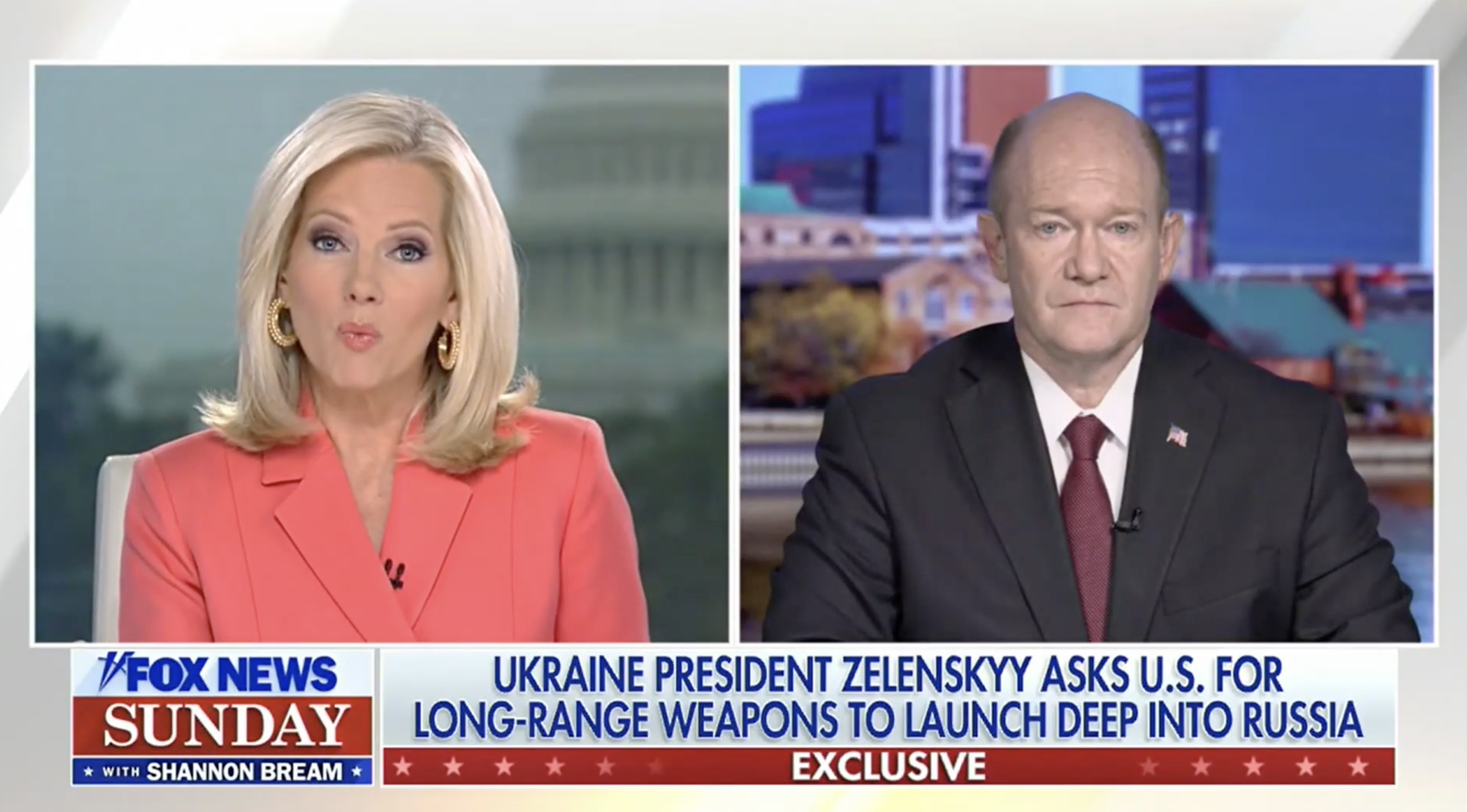
ICYMI: Senator Coons joins FOX News Sunday, emphasizes importance of continued support for Ukraine

WILMINGTON, Del. – In case you missed it, U.S. Senator Chris Coons (D-Del.) joined FOX News Sunday with Shannon Bream this weekend to discuss escalating tensions in the Middle East as well as the importance of continuing to ensure Ukraine has what it needs to win the war against Russia, emphasizing President Biden and Vice President Harris’ strong leadership to unite partners from around the world to support Ukraine. They also discussed the possibility of the bipartisan border deal passing in the next Congress. 

pic

Senator Coons: Well, let’s be clear, Shannon. Vice President Harris put out a forceful statement, as did President Biden, that I join in saying that Hassan Nasrallah, the leader of Hezbollah, is a murderous terrorist who had American blood on his hands from the attack on the American Marine barracks back in the 1980s. [And] he’s killed thousands of innocent civilians: Lebanese, Syrian, as well as Israeli; and as you said in your question, they have been raining rockets and missiles onto northern Israel since October 7. So, I think Israel is justified in their strikes against Hezbollah. The call for a cease-fire is really because of a concern that a ground invasion of southern Lebanon by the IDF [Israel Defense Forces] might well turn into a long and grinding war of attrition, and concerns that Iran may well now retaliate, but President Biden and Vice President Harris are clear that we will stand by our ally, Israel, and defend them against attacks by Iranian proxies or direct attacks by Iran.

… 

Shannon Bream: Were you encouraged by the meeting between President Trump and President [Volodymyr] Zelenskyy? Because they came out of it and seemed that they had, met, you know, had some kind of meeting of the minds; that they heard each other. President Trump said, you know, it hasn’t changed where he is overall on trying to get this thing ended. But even President Zelenskyy – and he talked with our Griff Jenkins, too – sounded like he felt like it was a good meeting.

Senator Coons: I’m glad they met. It’s important that there be conversations between President Zelenskyy and both Republican and Democratic leaders of our nation, and candidates to be the next president of our nation – but in the clip that you’re showing right now, President Trump said, ‘I’m a very good friend of Putin’s.’ And you could see Zelenskyy sort of stiffen up and go, ‘Well, I hope you’re a better friend of Ukraine than you are a friend of Russia under Putin.’ So, it was a strikingly awkward moment. Putin is a war criminal. Putin has carried out horrific attacks in Ukraine. We should not have a president of the United States saying that he is seeking to be a better friend of Vladimir Putin.

The full interview can be watched here. 


Senators Coons, Capito, Peters introduce resolution to mark National Chemistry Week

WASHINGTON – U.S. Senators Chris Coons (D-Del.), Shelley Moore Capito (R-W.Va.), and Gary Peters (D-Mich.), Co-Chairs of the Congressional Chemistry Caucus, introduced a resolution recognizing October 20-26 as National Chemistry Week to celebrate chemistry’s important role in addressing critical challenges around the world. 

National Chemistry Week aims to motivate young people, especially women and members of underrepresented groups, to study science, technology, engineering, and mathematics (STEM) and pursue science-related careers. Senator Coons introduced the National Chemistry Week resolution in previous years.

“As a proud chemistry graduate and Co-Chair of the Chemistry Caucus, I always look forward to celebrating National Chemistry Week,” said Senator Coons. “Chemistry is all around us, including in the processes involved in developing a photograph – which is why I’m thrilled this year’s theme is ‘Picture Perfect Chemistry.’ This resolution reminds us that encouraging kids’ interest in careers in science is more important than ever to spur innovation and economic growth in Delaware and across the nation.”

“Chemistry and other STEM fields are critical for future of our state and the next generation of West Virginians,” said Senator Capito. “I’m proud to join my colleagues in designating this year’s National Chemistry Week to celebrate the remarkable achievements that chemical innovation has brought to our communities, as well as the tremendous potential chemistry offers to West Virginia and our students.”

“Each year, National Chemistry Week gives us an opportunity to celebrate the extraordinary achievements in chemistry innovation that improve our everyday lives and support good-paying jobs in Michigan,” said Senator Peters. “I’m honored to join my colleagues in leading this bipartisan resolution to recognize chemistry professionals and encourage students to pursue a career in STEM fields.”

National Chemistry Week is a community-based program of the American Chemical Society that unites students, professional communities, businesses, schools, and individuals in communicating the importance of chemistry to our quality of life. This year’s National Chemistry Week theme is “Picture Perfect Chemistry.”

Additional information about National Chemistry Week is available here.

The text of the resolution is available here.