Related Issues

Related Issues

Senator Coons’ statement on chemical attack in Syria

WILMINGTON – U.S. Senator Chris Coons (D-Del.), a member of the Senate Foreign Relations Committee, released the following statement on the deadly chemical attack in Douma, Syria.

“President Bashar al-Assad’s latest chemical attack on his own people is a war crime and a heartbreaking reminder that he is among the world’s most brutal, vicious dictators.  The international community must not allow this to continue, and that starts by holding Russia and Iran accountable for propping up this murderous regime. I am encouraged that President Trump finally called out both Iran and Russian President Vladimir Putin by name for their support of the Assad regime, but the fact remains that the Trump Administration has not only failed to present a strategy for the crisis, but has sent dangerous mixed signals about our commitment to defeating ISIS, supporting innocent civilians, and meeting the challenges posed by expanding Russian and Iranian influence in Syria. I hope Secretary of State nominee Mike Pompeo will clarify the Administration’s policy towards Syria and the wider Middle East during his confirmation hearing on Thursday. We need clear-eyed, strong U.S. leadership in Syria, and I am committed to working with my colleagues on both sides of the aisle and the Trump Administration to provide that.”


###

Sens. Coons, Tillis release statement on Special Counsel Robert Mueller

WASHINGTON – Today, U.S. Senators Thom Tillis (R-NC) and Chris Coons (D-DE) released the following statement. In August of 2017, Senators Tillis and Coons introduced the bipartisan Special Counsel Integrity Act.  

“We have heard from constituents – Republicans, Democrats, and Independents alike – who agree that Special Counsel Robert Mueller should be able to conduct his investigation without interference.  This should not be a partisan issue.  We introduced the Special Counsel Integrity Act because we believe that the American people should have confidence in the Department of Justice’s ability to conduct independent investigations and its commitment to the rule of law. We urge President Trump to allow the Special Counsel to complete his work without impediment, which is in the best interest of the American people, the President, and our nation.”

###


Sen. Coons’ statement on 2018 federal funding bill, including Delaware ‘wins’

WASHINGTON – U.S. Senator Chris Coons (D-Del.), a member of the Senate Appropriations Committee, released the following statement on the 2018 federal funding bill, which was approved by Congress early this morning. Many priorities for serving Americans’ needs were addressed in this funding package, including opioids, veterans, child care, infrastructure, and college affordability.

The $1.3 trillion bipartisan appropriations bill includes an $80 billion increase in defense spending, which will allow for investments in training, equipment, and benefits that our servicemembers have earned.  It will also help the military confront rising national security challenges posed by international terrorist groups, Russia, China, Iran, and North Korea.  The bill also includes a total of $3.3 billion in increased funding to fight the opioids and mental health crises for Fiscal Year 2018, including an increase of $2.8 billion in treatment, prevention, and research, an additional $2 billion for the Department of Veterans Affairs to address its hospital maintenance and construction backlogs, a $3 billion increase for the National Institutes for Health (NIH), more than $10 billion to help communities throughout America build new infrastructure, and more.  The bill also includes $2 billion in additional funding for college affordability programs, spread across increased investments in Pell Grants, Federal Work-Study, and Supplemental Educational Opportunity Grants.  

“When Congress is gridlocked, the annual spending bill is one of the best opportunities we have to authorize and fund key programs that Delaware and our entire country rely on.  While this bill isn’t perfect, and both parties had to compromise to reach an agreement, I believe this bill provides important investments in our military and domestic programs that will make a real difference across the country,” said Senator Coons. “I’m disappointed that we weren’t able to include stronger gun safety legislation or a fix for Dreamers in this bill, but I’m going to keep fighting to get both of those things done as soon as possible.”

Senator Coons helped to secure key investments in the federal spending bill for Fiscal Year 2018 that will have a direct impact on Delaware. In addition to Senator Coons’ work to secure $380 million in election security funding for states, Senator Coons successfully fought for investments in state and local law enforcement and fire services, national service, Delaware’s National Guard, Amtrak and other passenger rail programs, the Delaware River Basin Restoration Program, and more. 

Senator Coons fought for funding for fire and local law enforcement support. The bill includes $700 million for the nation’s fire services, $350 million for Assistance to Firefighter Grants, and $350 million for Staffing for Adequate Fire and Emergency Response Grants. The bill also includes critical support for state and local law enforcement, including $22.5 million for the Bulletproof Vest Partnership Program (BVP) and $415.5 million for the Edward Byrne Memorial Justice Assistance Grant program. 

The federal funding bill also includes the Fix NICS Act, which Senator Coons co-sponsored. Fix NICS ensures essential information is provided to law enforcement when conducting firearms background checks.  The funding bill also permits the Centers for Disease Control and Prevention to conduct needed research into gun violence.  

Every year, Senator Coons fights for full funding for the Victims of Child Abuse Act (VOCA), which helps fund Children’s Advocacy Centers in the United States. He is very pleased that the bill appropriates $21 million for programs authorized by VOCA. Delaware has three centers, one in each county that investigate about 250 cases and conduct more than 1,400 interviews a year. Additionally, for the Office of National Drug Control Policy, the agreement provides $415 million, an increase of $27 million above the fiscal year 2017 enacted level and $47 million more than the budget request, to help reduce drug trafficking and drug use.  For the High-Intensity Drug Trafficking Areas (HIDTA) program, the agreement provides $280 million, a $26 million increase more than the fiscal year 2017 enacted level and $33 million more than the budget request. New Castle County was designated as part of the Liberty Mid-Atlantic HIDTA in late 2014.

Senator Coons fought hard to fund key federal programs that support the manufacturing sector. Notably, the Omnibus includes a $10 million increase for the Manufacturing Extension Partnership program, which helps small manufacturers across the country improve their operations to remain competitive. The bill also includes a nearly 200 percent increase in funding for the Manufacturing Engineering Education Program, $29 million, which is a manufacturing workforce development program that was established through legislation authored by Senator Coons. Finally, the Omnibus includes full funding to continue the Department of Commerce’s commitment to the University of Delaware’s National Institute for Innovation in Manufacturing (NIIMBL). In 2016, the Department of Commerce awarded the largest-ever grant to the University of Delaware, $70 million over 5 years, to establish a Manufacturing USA institute focused on developing innovations in biopharmaceutical manufacturing. 

Senator Coons successfully secured an additional $33.6 million investment in the Corporation for National and Community Service (CNCS) to expand the number of AmeriCorps members serving in communities across the country.  AmeriCorps members help meet a wide range of local and national needs, including providing recovery assistance after natural disasters, tutoring and mentoring struggling students, addressing public health crises like the opioid epidemic, and providing job-training and other services to returning veterans.  Currently, more than 220 AmeriCorps members can be found working in Delaware at a number of nonprofits such as Habitat for Humanity, Reading Assist, Delaware State Parks, and the Ministry of Caring. 

Senator Coons helped to secure $15 million in additional funding for C-130H aircraft modernization, a $120 million increase for the National Guard Counterdrug Program, and $36 million for an Army National Guard maintenance shop in New Castle.  This money will ensure the Delaware National Guard has the funding necessary to continue its missions and keep Delawareans safe.

Senator Coons fought for funding for Amtrak and other passenger rail programs, including $1.941 billion to support Amtrak and $250 million for the Federal-State Partnership for State of Good Repair, which will help Amtrak address the $38 billion maintenance backlog on the Northeast Corridor. The bill also includes $1.5 billion for the Transportation Investments Generating Economic Recovery (TIGER) Program, which has helped build important projects in Delaware like the Claymont and Newark train stations.

Additionally, in the final spending bill, HBCUs will receive a 14 percent increase in federal funding, from $244.7 million in FY17 to $279.6 million in FY18.  This includes key investments in programs such as Strengthening HBCUs, HBCU capital financing, and HBCU loan subsidies, among others. Delaware State University, Delaware’s Historically Black College and University, will be able to apply for many of these funds, which will significantly contribute in helping their students succeed.  

Another key program that Senator Coons fought for is the Delaware River Basin Restoration Program within the U.S. Fish and Wildlife Service. This program, created as part of the Delaware River Basin Conservation Act in 2016, was funded at $5 million for the very first time this year. This money will support clean water and other conservation projects throughout the whole Delaware River watershed, including in Delaware. Senator Coons led a bipartisan and bicameral letter, signed by many of his colleagues from the watershed, to ensure that this funding would be included in the Omnibus. 

The Omnibus also includes an increase in the allocation of Low Income Housing Tax Credits (LIHTC), which will support the construction of more affordable housing across the United States. This was a top priority for Senator Coons, who has consistently fought to expand this highly successful program. This provision is based on the Affordable Housing Credit Improvement Act, which Senator Coons co-sponsors.  

Senator Coons has consistently fought for affordable housing programs and, for the Fiscal Year 2018 Omnibus, he helped secure an increase in funding for the HOME Investment Partnerships Program (HOME) at $1.362 billion, which is $412 million above FY17, and $3.3 billion for the Community Development Block Grant Program (CDBG), which is $300 million above FY17. Additionally, he helped secure level funding for the Self-Help Homeownership Opportunity Program (SHOP) at $10 million. During Senator Coons’ career in public service, and especially when he served in New Castle County government, he has seen the real impact that these programs have had on neighborhoods throughout Delaware. 

###
Senator Coons’ statement on John Bolton

WASHINGTON – U.S. Senator Chris Coons (D-Del.), a member of the Senate Foreign Relations Committee, released the following statement after John Bolton was named President Trump’s new national security advisor.

“In the midst of international challenges from North Korea and Iran to China and Russia, I’m concerned that President Trump has chosen to abruptly dismiss the well-regarded HR McMaster and hire his third national security advisor in just 15 months. Though Ambassador John Bolton has extensive foreign policy experience, I’m deeply concerned by the prospect of him advising President Trump and directing key debates on national security policy.  Ambassador Bolton’s stated positions on today’s major issues, most notably North Korea’s and Iran’s nuclear programs, are overly aggressive at best and downright dangerous at worst.  I hope that Ambassador Bolton will moderate his positions and work closely with our military, diplomatic, intelligence, and development professionals before rushing into armed conflict.  I thank Lieutenant General McMaster for his service and continue to urge the administration to work with Congress to develop a sound bipartisan foreign policy approach to the very real challenges we face around the world.” 

###

Sens. Coons, Hatch introduce legislation to grant the USPTO continued autonomy over its fees while holding it accountable for modernizing its IT systems

WASHINGTON – U.S. Senators Chris Coons (D-Del.) and Orrin Hatch (R-Utah) today introduced legislation that will extend the USPTO’s fee setting authority, established by the Leahy-Smith America Invents Act of 2011.  In exchange for this financial autonomy that facilitates long-term planning and investment, the bill would hold the USPTO accountable for making it a priority to complete the transition to modern IT systems as well as planning for future incorporation of emerging technologies in the examination process, where appropriate.  

IT systems are critical for the USPTO’s mission to issue patents and trademarks, but some of their systems are badly outdated and the modernization process presents significant challenges.  This makes it even more important that the USPTO be forward-thinking in adopting next-generation IT technologies, as the bill encourages through its reporting requirements. To this end, the Building Innovation Growth through Data for Intellectual Property Act of 2018 will call for the USPTO to set forth a plan on how it will use advanced data science to improve consistency of examination, detect common sources of error, and improve productivity.  

A one-pager of the bill is available here.

The bill text is available here.  

“I am pleased to introduce this bipartisan bill with Senator Hatch that extends the USPTO’s authority to set its own fees while calling upon the agency to report on its IT modernization efforts and how it will incorporate emerging new technologies into the examination process,” said Senator Coons.  “By all accounts, the USPTO has responsibly exercised its authority to set the prices for its services, so it makes sense to continue to allow the USPTO to do so.  At the same time, the public needs to be assured that the USPTO is not just completing updates of its IT systems, but actively exploring the use of cutting-edge technologies like machine learning and big data to ensure that the examination process keeps up with state of the art.” 

“In order to best serve the public and protect American innovation, USPTO needs efficient, up-to-date data analytics and information systems,” said Senator Hatch. “The agency’s mission includes surveying vast amounts of data and tracking millions of submissions. The BIG Data for IP will help keep USPTO at the forefront of information technology and ensure it’s able to do its job efficiently and effectively moving forward.”

###

Flake, Coons Outline Framework for U.S. – Zimbabwe Relations

WASHINGTON – U.S. Sens. Jeff Flake (R-Ariz.) and Chris Coons (D-Del.), both members of the Senate Foreign Relations Committee, today introduced a bill to lay the framework for U.S. relations with the new government in Zimbabwe. This legislation updates the Zimbabwe Democracy and Economic Recovery Act of 2001 and sets forth the steps Zimbabwe needs to take to have sanctions on its country lifted.                                                                                                                                                    

“President Mnangagwa has signaled his intent to bring about change in Zimbabwe. His words need to be followed by concrete actions,” said Flake.“This measure outlines steps that, if taken, would go a long way to demonstrate that President Mnangagwa is earnest in his desire to bring about long-overdue change for the people of Zimbabwe, who suffered under authoritarian rule for far too long.”    

“After 37 years of suffering under the repressive rule of Robert Mugabe, the people of Zimbabwe should be excited about the possibility of a brighter future.  To ensure conditions throughout the country improve, the international community should insist on concrete actions from the new government of Zimbabwe before lifting sanctions and renewing investment in the country. This bill is intended to outline the U.S. Senate’s expectations of the steps President Mnangagwa and other leaders should take,” said Coons. “We look forward to visiting Zimbabwe, meeting with its top officials, and assessing the steps they are taking to hold free, fair, and credible elections as well as to advance broader economic and political reforms to improve the lives of all the citizens of Zimbabwe.”

To view a PDF of the bill, click here.

###

CLOUD Act from Sens. Hatch, Coons included in 2018 funding bill

WASHINGTON – Today, U.S. Senators Orrin Hatch (R-UT) and Chris Coons (D-DE) applauded the inclusion of their legislation, the Clarifying Lawful Overseas Use of Data (CLOUD) Act, in the 2018 federal funding bill poised to become law over the next few days.  The CLOUD Act will help put the United States and other countries on a path towards resolving the problem of cross-border data requests by law enforcement in the age of email and cloud computing.

“For over four years now I’ve been working to update our privacy laws to account for revolutions in the way we store and access email and other data in the cloud,” Senator Hatch said. “My efforts began with the Law Enforcement Access to Data Stored Abroad (LEADS) Act, continued with the International Communications Privacy Act (ICPA), and culminated with this year’s Clarifying Lawful Overseas Use of Data (CLOUD) Act, which will be enacted into law as part of the omnibus spending package. The CLOUD Act will create a clear, balanced framework for law enforcement to access data stored in other countries while at the same time encouraging our allies to strengthen their domestic privacy laws. I’m grateful to Senators Coons, Graham, and Whitehouse for their tireless efforts on this legislation and to Senator McConnell and Speaker Ryan for supporting its inclusion in the omnibus.”

“In a globalized world, we need clear rules governing access to data stored abroad,”said Senator Coons. “Our legislation is supported by law enforcement and the tech community, and I’m excited that it’s been included in the 2018 federal funding bill.  This legislation will go a long way toward protecting data across borders and encouraging fair treatment by our international partners. I’m grateful to have worked with Senators Hatch, Graham, and Whitehouse on this important issue.” 

Existing law, both in the United States and around the world, has failed to keep pace with the evolution of internet-based communications technology, often referred to as cloud computing. U.S. and foreign law enforcement investigating crimes increasingly rely on the assertion of extraterritorial authority to seek data stored outside their borders—data that is often essential to preventing and solving crime. Technology companies, in turn, are caught between a rock and a hard place: confronting obligations to disclose data in one country while simultaneously facing laws in other countries that prohibit disclosure. 

The CLOUD Act will encourage governments to develop a clear framework for technology companies to comply with investigative demands. The legislation incentivizes countries to remove conflicts of law and raise privacy standards.

Clarifying Lawful Overseas Use of Data (CLOUD) Act of 2018 Pillars: 

·          Bilateral Agreements: The CLOUD Act enables the United States to enter into formal agreements with other nations to set clear standards for cross-border investigative requests for digital evidence. The CLOUD Act further identifies a series of statutory requirements that these agreements must satisfy, including privacy and security protections. 

·         Extraterritoriality of US Warrants and International Comity: The CLOUD Act amends US law to make clear that US warrants and other legal process issued for data held by communications providers reach data stored anywhere in the world. The reach of US warrants and legal process, however, would be limited by international comity. The CLOUD Act would give providers, for the first time, a statutory right to challenge legal process based on international comity concerns.

·          Transparency: When a communications provider receives a request from US law enforcement related to a national or resident of a country that has entered into a bilateral agreement with the United States, the provider will be permitted to notify that government of the existence of the request. This will allow the foreign government to assess compliance with the terms of the bilateral agreement and enable it to intervene diplomatically if it believes the request is inappropriate.

·         Reciprocity: The CLOUD Act would also require participating countries to remove legal restrictions that prevent compliance with data requests from US law enforcement. To qualify for the statutory benefits of the legislation (removal of the US blocking statute, a right for providers to object based on international comity and a right for providers to notify the government of the existence of requests), a foreign government must provide reciprocal rights and benefits to US law enforcement and communications providers. 

###

Sen. Coons leads successful effort to include $380 million in election security grants in 2018 government funding bill

WASHINGTON, DC. – U.S. Senator Chris Coons (D-DE), a member of the Senate Appropriations Committee, and the top Democrat on the Financial Services and General Government Subcommittee, led the successful effort to include $380 million in funding for election security grants to help states to protect their election systems in the 2018 federal funding bill poised to pass Congress and become law in the coming days. Delaware’s 1,600 voting machines are among the oldest in the nation and have outlived their expected lifespan. 

“There is no question that our election systems came under attack in 2016 and that our future elections – starting this fall – are likely to be targeted by Russia and other actors. The question, for months, has been: What is Congress going to do about it?” said Senator Coons.  “As a member of the Appropriations Committee, I’ve been fighting for months to ensure that the federal government provides states the funding they need to protect their local election systems, and I’m thrilled that $380 million in election security grants is included in the 2018 federal funding bill. There’s more work to be done to protect our election systems, but this is an important start.” 

This funding will be made available immediately to states so that they can begin to implement security improvements ahead of the 2018 and 2020 elections.

·         The funding ensures that each state will receive a minimum of $3 million to improve election security with additional funds provided based on the population of each state. Funds will be available immediately and states must provide a short plan for how they will use the funds and agree to a 5 percent match within two years of receiving the funds.

·         Within 45 days, the Election Assistance Commission will send an award letter to each state’s chief election official with information that funding is available on a non-competitive basis and provide guidance for how to immediately receive funds. 

This funding must be used to:

o   Replace outdated voting machines that do not provide a voter-verified paper record;

o   Implement a post-election audit system that provides a high-level of confidence in the accuracy of final vote tallies;

o   Upgrade election­ computer systems to address cyber vulnerabilities;

o   Facilitate cyber security training for the state chief election official’s office and local election officials;

o   Implement established cybersecurity best practices for election systems; and fund other activities that will improve the security of elections for federal office. 

·         While this funding would be specifically targeted at improving cybersecurity for our election systems, it allows for state flexibility. No two states run their elections exactly the same way. This flexibility allows state and local election officials to make determinations about what is most needed in their own jurisdictions.

###

[VIDEO] Sen. Coons: “Anyone who thinks the Special Counsel Robert Mueller isn’t in imminent danger of being fired isn’t paying attention”

Washington, D.C. – U.S. Senators Chris Coons (D-Del.), a member of the Senate Foreign Relations Committee, today joined MSNBC’s Morning Joe to discuss Special Counsel Robert Mueller and the Russia investigation.

“Anyone who thinks the Special Counsel Robert Mueller isn’t in imminent danger of being fired isn’t paying attention. Just look at your phones,” said Senator Coons. “The tweets coming out from President Trump this morning make it clear that he is rattling the cage and threatening to fire him. We should take up and pass the special counsel bill that Senator Tillis and I introduced months ago. I think we should be moving forward on a protection bill for the special counsel.”

Full audio and video is available here. 

Excerpts from the interview below:

Sen. Coons on President Trump’s foreign policy: I’m also deeply concerned and think many of my colleagues, both Republicans and Democrats, see clearly that there is no good answer, there’s no good reason why time and time again, when our President is in a position to confront Vladimir Putin, either on the assassination in the United Kingdom, interference in our elections, ways he’s undermining our allies across the world, he knuckles under, he wants Putin win, he ignores his own security team’s advice. He called President Putin and congratulate him on his election and make no mention of the pressing national security concerns of this country. There is no good explanation for that. 

Sen. Coons on Russia: They’re following his lead and sadly he’s not leading. He’s not leading our country in a way that defends our values. We are a significantly more powerful country than Russia and we need to lead with our values if we’re going to be respected around the world as the great country we’ve been. He’s not making America great again. He’s taking us back to the isolationism of 70 years ago. 

Sen. Coons on Mueller: Well, there were some strong statements from a number of Republican senators. Jeff Flake in particular. John McCain put out a very strong statement. The leaders both Speaker Ryan and Majority Leader McConnell said Robert Mueller should be allowed to complete his investigation unhindered but I think we need to do more. Anyone who thinks the Special Counsel Robert Mueller isn’t in imminent danger of being fired isn’t paying attention. Just look at your phones. The tweets coming out from President Trump this morning make it clear that he is rattling the cage and threatening to fire him. We should take up and pass the special counsel bill that Senator Tillis and I introduced months ago. I think we should be moving forward on a protection bill for the special counsel. 

More on Mueller: It’s been frustratingly difficult. Yes, it would be horrible for Robert Mueller to be fired. It would undermine rule of law. It’s a red line the President shouldn’t cross. Co-sponsor this bill, make a public statement. Let’s do something on the floor. They say, that’s not going to happen. I’ve gotten reassurances from the White House it’s not going to happen. My mom used to say an ounce of prevention is worth a pound of cure. Frankly, this is a train rolling right at us. The easiest way to stop it is through action now. 

More on Mueller:  How many examples do we have in the last month of him blustering, threatening in one way and reversing course immediately. You can’t know exactly where he’s going to go, but he drew a red line. He communicated to Robert Mueller through the press months ago if you start investigating my finances, that’s a red line and that’s what he’s doing. 

More on the special counsel bill: We’ve explored every option to find a way to move forward with the special counsel bill. At this point, I think moving forward in the Senate with it legislatively not through the omnibus is the only path open. 

###

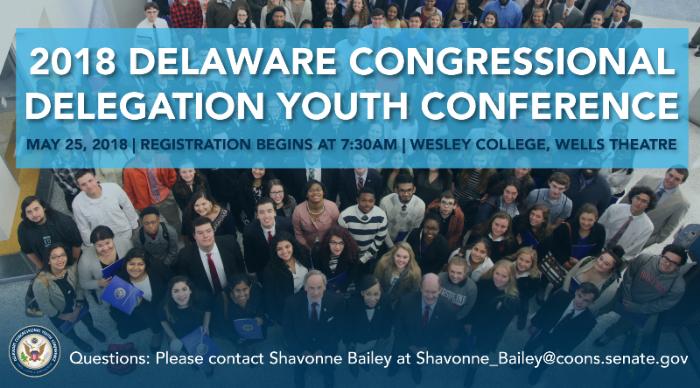
Delaware Delegation seeks applicants for annual Congressional Youth Conference

Youth Conference

DOVER, Del. – Senators Tom Carper, Chris Coons and Representative Lisa Blunt Rochester (all D-Del.) will host their annual Congressional Youth Conference for more than 100 Delaware high school juniors on Friday, May 25 at Wesley College. The delegation is currently seeking civic-minded high school juniors to apply for the conference. Interested students should contact their school’s administration or guidance office for application details. The late U.S. Senator Bill Roth organized the first Youth Leadership Conference in 1969. Roth hosted the annual conference until 2000.

Students will have an opportunity to interact with their congressional delegation in an open forum setting, during which the students will discuss issues important to them. After their discussion with the delegation, students break into sessions where they will spend time with a member of the delegation in a more personalized setting discussing topics such as: 

  • This Land Is Your Land, This Land Is My Land: Immigration in the 21st Century
    Restricting access or providing safety?
  • The Right to Bear Arms…In a Classroom?
    Guns in Education, a necessary or a negative
  • The Rise of Generation Z, a discussion on activism, engagement and equality
    What can be done?

“Our Youth Conference brings together some of the brightest young minds in Delaware to share their ideas, questions and aspirations with their Congressional delegation,” said Senator Carper. “While at the conference, they will gain valuable connections with their peers and learn about how they can be engaged in their school and community. For years I’ve enjoyed listening to students and sharing my personal story, and I look forward to convening this next group of future leaders in this very pivotal year for student engagement.”

“For the last 40 years, Congressional Youth Conference attendees have benefited enormously from Senator Roth’s vision,” Senator Coons said. “This conference is an opportunity for students and young leaders from all over the First State to share their thoughts and gain some real insight about the challenges facing our country today. I look forward to hearing from these young people who truly are Delaware’s future leaders.”

“Delaware’s students are leading marches to end gun violence and advocating for the issues that matter to them, and during this critical time, we need to listen to what our youth has to say,” said Congresswoman Blunt Rochester. “For 49 years, our annual Congressional Youth Conference has provided an engaging forum for students to interact with Delaware’s Congressional delegation, share their aspirations, and gain an understanding of the major policy issues facing our country. I am excited to hear from the First State’s young leaders, and I look forward to convening this important discussion.”

School administrators or guidance counselors who are interested in registering students should contact Shavonne Bailey at Shavonne_bailey@coons.senate.gov