Related Issues

Related Issues

Young and Coons Applaud Senate Passage of National FFA Week Resolution

WASHINGTON – The Senate passed a bipartisan resolution yesterday introduced by Senators Todd Young (R-Ind.) and Chris Coons (D-Del.), and cosponsored by a bipartisan group of over 40 additional Senators, to mark February 16-23, 2019 as National FFA Week. In addition to designating National FFA Week, the resolution recognizes the important role of the National FFA Organization in developing young leaders and providing educational and career opportunities to students, and celebrates 50 years of female membership in the National FFA Organization.

“With more than 11,000 FFA members in Indiana, it’s important to Hoosiers that we recognize the significant work the FFA does preparing our students to become leaders in the agriculture field and in their communities. This is a mission we should all support, and I’m glad that my Senate colleagues agree,” said Senator Young

“The Delaware FFA and the National FFA Organization play an important role in strengthening our communities and preparing the next generation of leaders to meet agricultural challenges, and I’m proud to join them in celebrating National FFA Week by passing this bipartisan resolution,” said Senator Coons.

“National FFA Week is an incredible nationwide celebration of students rising up to meet the demands of tomorrow,” said Mark Poeschl, Chief Executive Officer of the National FFA Organization and Foundation. “Our members are the future of agriculture, science, business and much more. They’re innovators and leaders in their communities, and it’s an honor to celebrate their accomplishments and future plans.” 

 View the full text of the resolution here and below.  

Title: Designating the week of February 16 through 23, 2019, as “National FFA Week,” recognizing the important role of the National FFA Organization in developing young leaders, and celebrating 50 years of female membership in the National FFA Organization. 

Whereas Future Farmers of America (FFA) was established in 1928 and is now known as the

National FFA Organization;

Whereas the National FFA Organization is comprised of more than 8,500 chapters in all 50

States, Puerto Rico, the United States Virgin Islands, and Washington, D.C.;

Whereas more than 650,000 students in secondary schools, community and technical colleges, and universities are members of the National FFA Organization;

Whereas 2019 marks 50 years of female membership in the National FFA Organization; 

Whereas the National FFA Organization welcomes students with diverse backgrounds;

Whereas the mission of the National FFA Organization is to develop the potential of students for premier leadership, personal growth, and career success through agricultural education;

Whereas, through classroom education and hands-on work experience, the National FFA Organization prepares students for college and a broad range of careers, including more than 255 careers in agriculture;

Whereas members of the National FFA Organization strengthen their communities through service and by preparing the next generation of leaders to meet agricultural challenges; and 

Whereas members of the National FFA Organization will celebrate National FFA Week during the week of February 16 through 23, 2019: Now, therefore, be it

Resolved, That the Senate— 

  1. designates February 16 through 23, 2019, as “National FFA Week”;
  2. recognizes the important role of the National FFA Organization in developing young leaders and providing educational and career opportunities to students; and
  3. celebrates 50 years of female membership in the National FFA Organization.

Sen. Coons secures funding for FEMA, transportation infrastructure, small businesses, and a pay-raise for federal civilian employees

WASHINGTON – U.S. Senator Chris Coons (D-Del.), the first Delaware Senator in more than four decades to serve on the critical Appropriations Committee, secured funding for key economic development priorities, including support for transportation infrastructure, small businesses, disaster relief, advanced manufacturing, housing, and research and development in the remaining appropriations bills for fiscal year 2019, which passed the Senate and House yesterday with strong, bipartisan support. President Trump signed the legislation into law today.

“I am pleased that this appropriations bill provides critical investments in our communities and the small businesses, innovators, and families that keep our state and country strong and vibrant,” said Senator Coons. “This bill supports programs that boost economic development, help families secure safe and affordable housing, support our first responders, and ensure our communities can recover if disaster strikes. It also includes critical infrastructure funding to keep our airports and rail systems running smoothly and to improve our roads, bridges, and highways. These investments will boost our local economies and help create jobs in Delaware. I’m also pleased that this bill provides a well-deserved 1.9 percent pay raise for federal civilian employees.”

Support for Community Development Financial Institutions (CDFI)

The bill provides $250 million for the CDFI Fund to promote economic and community development in low-income communities, equal to the fiscal year 2018 enacted level and $236 million more than the President’s budget request.

Support for the Small Business Administration (SBA)

The bill includes $715 million for the SBA, $15 million more than fiscal year 2018. Within this amount, the bill funds SCORE at $11.7 million, Small Business Development Centers at $131 million, and Women’s Business Centers at $18.5 million. The bill also increases the cap on SBA’s 7(a) loan program to $30 billion, $1 billion above the current level.

Support for Community Development Block Grants

Senator Coons fought for $3.3 billion for the Community Development Block Grant (CDBG) program. CDBG funding supports homeownership, housing rehabilitation, public improvements, and economic development projects while encouraging additional local investment. Every $1.00 of CDBG funds leverages an additional $4.09 in other funding. CDBG makes its way into local economies through an extensive network of local organizations and remains a necessary resource for families and communities. In Delaware, CDBG funding helped residents in Pinetown and Georgetown address long-standing housing rehabilitation and infrastructure development issues, made home ownership possible for New Castle County residents through the Housing Choice Voucher Program, and helped struggling homeowners tackle essential repairs that allowed them to stay in their homes.

Support for Transportation Infrastructure

Senator Coons fought for $1.94 billion in funding for Amtrak, $300 million for Federal-State Partnership for State of Good Repair grants, and $255 million for Consolidated Rail Infrastructure and Safety Improvements (CRISI) grants. This funding will help keep passenger rail operating safely and efficiently throughout the Northeast Corridor, as well as throughout the country. Senator Coons also fought for $4.1 billion for the Airport Improvement Program and $46 billion for the Federal-Aid Highways Program. The Airport Improvement Program has funded many upgrades in the past few years at a number of airports throughout the state. Funding for the Federal-Aid Highways Program supports Delaware highway systems by providing financial assistance for construction, maintenance, and operations.

Senator Coons also fought for $1 billion for the Better Utilizing Investments to Leverage Development (BUILD) grant program, formerly known as TIGER grants. While President Trump had proposed eliminating the BUILD grant program, the Appropriations Committee has strongly supported it. The BUILD grant program is extremely popular, helping fund a wide variety of infrastructure projects through a competitive grant process. This program helps state and local governments pay for new highways and bridges, public transit projects, railways, and port infrastructure; and finances innovative shovel-ready projects to improve the U.S. transportation system. Delaware has received BUILD grants that have been used to design and build the Newark rail station, improve the Port of Wilmington, and build the new Claymont station. The most recent BUILD grant awarded to Delaware will be used to improve the intersection of US 9, Airport Road, and Sand Hill Road in Georgetown.

Support for FEMA

Senator Coons advocated strongly for $11.69 billion to fund the Federal Emergency Management Agency, $7.23 billion of which will be directed toward the Disaster Relief Fund. The bill includes strong support for state and local first responders and emergency management personnel, providing a total of $3.27 billion for grant and training programs, including $700 million for the nation’s fire services, $350 million for Assistance to Firefighter Grants, and $350 million for Staffing for Adequate Fire and Emergency Response Grants, which directly helps local fire departments increase the number of trained firefighters available in their communities. Additionally, the bill provides $512 million for State Homeland Security grants, $100 million each for Port and Transit Security grants, and $250 million for pre-disaster mitigation. 

Support for Commerce 

Senator Coons advocated strongly for $15 million to fund the National Institute of Standards and Technology’s (NIST) Manufacturing USA program. In Delaware, a consortium of companies and universities led by the University of Delaware received an award from the Manufacturing USA Institute known as NIIMBL to lead the country’s first manufacturing innovation institute focused on biopharmaceutical manufacturing.

Senator Coons also fought for $140 million for the Hollings Manufacturing Extension Partnership (MEP), rejecting the administration’s proposal to eliminate the program. MEP is the only public-private partnership dedicated to providing technical support and services to small and medium-sized manufacturers. Delaware’s MEP operates through Delaware Technical Community College in partnership with the U.S. Department of Commerce, NIST, the Delaware Office of Economic Development, and the Delaware State and local Chambers of Commerce. Senator Coons leads the Manufacturing Jobs for America (MJA) campaign in the Senate to rally bipartisan support for legislation that would help manufacturers grow and create jobs.  Further, Senator Coons also pushed hard to appropriate funds for the Economic Development Administration (EDA) at $304 million, as well as EDA’s Regional Innovation Strategies Program, which was funded at $23.5 million. 

Senator Coons believes that the $3.8 billion included for the upcoming Census is very important. Fiscal year 2019 is a critical year for the 2020 decennial census, as field operations start up.  Data collected by the decennial census is essential to drawing congressional districts and also helps distribute more than $450 billion annually in federal funds to states and localities.  Moreover, hosts of programs that focus on the protection of civil liberties and economic development depend on accurate census data.  Senator Coons will continue to fight for robust funding as the Census draws near.    

Support for HOME Investment Partnerships Program

Senator Coons secured $1.25 billion for the HOME Investment Partnerships Program. The HOME program serves as the only federal block grant program for state and local governments designed exclusively to produce affordable housing for low-income families. Since 1992, the HOME program has created more than 1.27 million affordable homes and helped provide direct rental assistance to more than 337,000 low-income families. The program provides a flexible resource to meet communities’ highest priority affordable housing needs like tenant-based rental assistance, rehabilitation of affordable rental and ownership housing, and construction of affordable housing. The program also has an exceptionally broad reach, serving urban, suburban, and rural communities and providing vital resources for seniors, persons with disabilities, the homeless, and veterans. The Delaware State Housing Authority leveraged HOME funding to repair and save affordable rental properties in Millsboro and in Dover.  The City of Wilmington and New Castle County governments used HOME funding to build a new affordable senior housing at Sacred Heart Village II, and New Castle County put HOME funding to work to preserve affordable housing for seniors in Newark.

Support for Other Housing Programs

Senator Coons also fought for increased funding for Section 8 Project-Based Rental Assistance at $11.7 billion, Section 8 Tenant-Based Rental Assistance at $20.6 billion, and Homeless Assistance Grants at $2.64 billion, which is $123 million above the fiscal year 2018 level. This funding allows Delaware’s housing community to implement an innovative program to serve all homeless families with temporary safe shelter accommodations. It also allows them to provide case management support and temporary financial assistance to help families obtain and remain in stable housing. 

Support for Science

The bill supports numerous programs that Delaware’s university communities rely on to enhance local economic development and conduct their ongoing research.  Senator Coons fought for strong funding for both the National Science Foundation (NSF) and the National Aeronautics and Space Administration (NASA), including programs like NASA Space Grant Program that benefits science and engineering students throughout Delaware.  Senator Coons also fought for strong funding for the Established Program to Stimulate Competitive Research (EPSCoR) at both NSF and NASA.  These programs ensure that research funding is relevant and available to all areas of the country.  Delaware is one of the 27 states and territories that qualify for NSF and NASA EPSCoR funding.

Support for federal employees

The bill includes a well-deserved 1.9% pay adjustment (cost-of-living adjustment) for federal civilian employees.

###
 

Sen. Coons’ agriculture and rural development, coastal protection, and environmental priorities included in final appropriations bill

WASHINGTON – U.S. Senator Chris Coons (D-Del.), the first Delaware Senator in more than four decades to serve on the critical Appropriations Committee, secured funding for vital agriculture, rural development, and environmental priorities, including support for the poultry industry, conservation, and rural housing programs in the remaining appropriations bills for fiscal year 2019, which passed the Senate and House yesterday with strong, bipartisan support. President Trump signed the legislation into law today.    

“Delaware plays a critical role in feeding America’s families, and finding ways to support our hardworking farmers and poultry growers is one of my top priorities,” Senator Coons said. “I’m pleased that this final appropriations bill includes funding for critical programs that will protect Delaware’s poultry growers from disease and catastrophic loss and help farmers continue their conservation efforts. This bill also provides increased support for rural housing to make sure low-income families can secure an affordable home. All of these investments mean jobs, economic opportunity, and a cleaner environment for Delaware and the nation. I’m thrilled Congress has worked in a bipartisan way to support these and many related programs.”

Support for the Poultry Industry
Senator Coons fought for $63 million for avian health programs, which support partnerships with state departments of agriculture, universities, and the poultry industry to monitor poultry flocks and prevent and control the spread of diseases, including avian influenza (AI).  

Support for Conservation Programs
Senator Coons fought for strong funding for several U.S. Department of Agriculture (USDA) conservation programs, including the Conservation Stewardship Program, the Environmental Quality Incentives Program, and the Regional Conservation Partnership Program.  These programs offer crucial tools that help farmers in Delaware and around the U.S. protect water quality, conserve soil, enhance wildlife habitat, and protect land.  This supports conservation of our nation’s natural resources, sustains our hunting and fishing traditions, and helps keep America’s working lands in the hands of farm families for generations to come. 

Support for Agricultural Research
Senator Coons fought for $415 million for the Agricultural and Food Research Initiative, which provides critical funding for research on food, agriculture, natural resources, clean energy production, rural development, and nutrition.  

Support for Rural Housing
Senator Coons fought for increased funding for rural housing support, including $1.3 billion for the Rental Assistance Program, a USDA program under which payments are made to the owners of rental housing to cover the difference between the tenant’s payment and the approved rental rate established for the unit. Senator Coons also supported $30 million for the Mutual and Self-Help Housing Grants Program, another USDA program that provides grants to non-profit organizations, like Habitat for Humanity, who work with low-income families in rural areas to buy, build, and renovate their own affordable homes. 

Support for Coastal Protection and Navigation
Senator Coons fought to protect Delaware’s greatest natural resource, our coastal and ocean resources, through strong funding for the National Oceanic and Atmospheric Administration (NOAA). This includes $75.5 million for Coastal Zone Management Grants, $7.5 million for the Marine Debris Program, and $27million for the National Estuarine Research Reserve System (NERRS). Senator Coons also fought for $68 million for NOAA’s Sea Grant College Program, of which University of Delaware’s Lewes campus is a member. Finally, Senator Coons fought for $30 million for the National Coastal Resilience Fund. The City of Wilmington was recently awarded $3 million from this fund to restore a degraded wetland, improve soil and water quality, and prevent flooding in the Southbridge neighborhood. 

Support for the Environment
Senator Coons fought to secure strong federal funding for important programs at the Department of the Interior that help conserve and protect our nation’s rivers, wetlands, and other valuable natural resources. This includes $6 million for the Delaware River Basin Restoration Program, $42 million for the North American Wetlands Conservation Fund (NAWCA), and $435 million for the Land and Water Conservation Fund (LWCF). Senator Coons also fought for strong funding for several Environmental Protection Agency programs that provide states with the tools they need to protect and restore clean water, land, and air at the local level, including the Chesapeake Bay Program and the National Estuary Program. These programs provide grants to protect water from nonpoint source water pollution, ensure clean and safe beaches, and support clean water and drinking water infrastructure. As in past years, Delawareans will directly benefit from the many local programs these grants help support. 

###

Sen. Coons secures funding for law enforcement, bulletproof vests and programs to support victims of child abuse

WASHINGTON – U.S. Senator Chris Coons (D-Del.), the first Delaware Senator in more than four decades to serve on the Appropriations Committee, secured funding for critical law enforcement priorities, including support for the Bulletproof Vest Partnership, Children’s Advocacy Centers, the Byrne-JAG program, Missing and Exploited Children programs, and the Community Oriented Policing Services (COPS) program in the remaining appropriations bills for fiscal year 2019, which passed the Senate and House yesterday with strong, bipartisan support. President Trump signed the legislation into law today.    

“Serving on the Appropriations Committee is an honor, but it’s also a unique opportunity that allows me to fight for funding and programs that are important to Delaware,” said Senator Coons. “As co-chair of the Senate Law Enforcement Caucus, I’m particularly proud that I was able to secure funding for important programs like the COPS program, the Bulletproof Vest Partnership, and the Byrne-JAG program, that keep our men and women of law enforcement safe.  I’m very glad that we also secured funds for Children’s Advocacy Centers and Missing and Exploited Children programs that help children and families who have endured the unthinkable.” 

Support for Department of Justice Priorities

Senator Coons fought for the $22.5 million appropriation to the Victims of Child Abuse Act (VOCAA), which helps fund Children’s Advocacy Centers (CACs) in the United States. Delaware has three CACs, one in each county. Delaware’s CACs served over 1,600 children and conducted more than 1,500 forensic interviews last year. VOCAA is supported by the National Association of Police Organizations, Association of Prosecuting Attorneys, Major County Sheriffs’ Association, the National Criminal Justice Training Center, Major Cities Chiefs’ Association, the National Children’s Alliance, the National Children’s Advocacy Center, the National Center for Victims of Crime, the Sergeants Benevolent Association of the New York City Police Department, and the National Child Protection Training Center.

Senator Coons also fought for $82 million to fund Missing and Exploited Children programs across the country and in Delaware.  A portion of this funding will be dedicated to investing in the technology needed to keep pace with the evolving threat against children and will be used to assist law enforcement in protecting child victims of trafficking and sexual abuse.

This appropriations bill also supports numerous programs that Delaware’s law enforcement has come to rely on.  Senator Coons, co-chair of the Senate Law Enforcement Caucus, was pleased to see $25 million in funding for the Bulletproof Vest Partnership.  Since 1999, the BVP has provided over $350 million in federal funds for over 1.3 million vests. Additionally, the Byrne-JAG program is funded at $423.5 million, an increase of $8 million more than the fiscal year 2018 level and $21.5 million more than the President’s request.

Additionally, the bill supported more than $228.5 million in funding for Community Oriented Policing Services (COPS).  Community policing begins with a commitment to building trust and mutual respect between police and communities. It is critical to public safety, ensuring that all stakeholders work together to address crime in our communities.  Since 1994, the COPS Office has invested more than $14 billion to help advance community policing.

Support for the U.S. Coast Guard

The appropriations bill includes $10.11 billion for the U.S. Coast Guard, which will support a robust U.S. Coast Guard operations and support budget, including additional military personnel. Senator Coons fought to secure additional funding for the U.S. Coast Guard Shore Facilities and Aids to Navigation account at $255 million. This funding will help vessels navigate safely and efficiently when moving cargo on America’s waterways. Senator Coons is hopeful that a portion of this funding will be directed to the repair of the many priority aids to navigation on the Delaware River.

Support for the Office of National Drug Control Policy (ONDCP)

The bill includes a total of approximately $417 million for anti-drug programs, which is $1 million more than the fiscal year 2018 level and $388 million more than the President’s budget request.  The Senate bill rejects the President’s proposed move of the High Intensity Drug Trafficking Areas (HIDTA) and the Drug-Free Communities (DFC) programs from ONDCP to other agencies.  The HIDTA Program is funded at $280 million, the same level as last year.  The DFC program is funded at $100 million, a $1 million increase over the fiscal year 2018 enacted level. 

Support for the Federal Judiciary

The bill includes $7.25 billion in discretionary funding for the U.S. Courts, which is $142 million more than the fiscal year 2018 level and $29 million more than the President’s budget request.  The Defender Services account is funded at a level of $1.150 billion, $72 million more than the fiscal year 2018 enacted level. 

###

Sen. Coons’ statement on bipartisan government funding bill, President’s possible emergency declaration

WASHINGTON – U.S. Senator Chris Coons (D-Del.) released the following statement.

“While I am encouraged that President Trump will finally sign into law the bipartisan agreement reached by Republicans and Democrats in Congress to fund the government and make robust investments in smart border security, his decision to declare a national emergency in order to build a wall along our southern border is a serious mistake. 

“It is the responsibility of President Trump – and any President – to declare national emergencies when appropriate and respond urgently with the full resources of the federal government, but clearly, there is no such emergency for him to declare. I suspect the President’s declaration will quickly be challenged in court I and believe it is likely to be overturned.

“Democrats and Republicans agree that border security is important, but the President’s fear mongering about immigrants, his refusal to listen to border security experts about what our real needs are at the border, and his attempts to end run the appropriations process are counterproductive and undermine congressional authority. 

“The President should reconsider this disaster declaration and work with Congress to ensure our approach to border security is driven by facts, not fear, and good policy, not politics.”

###

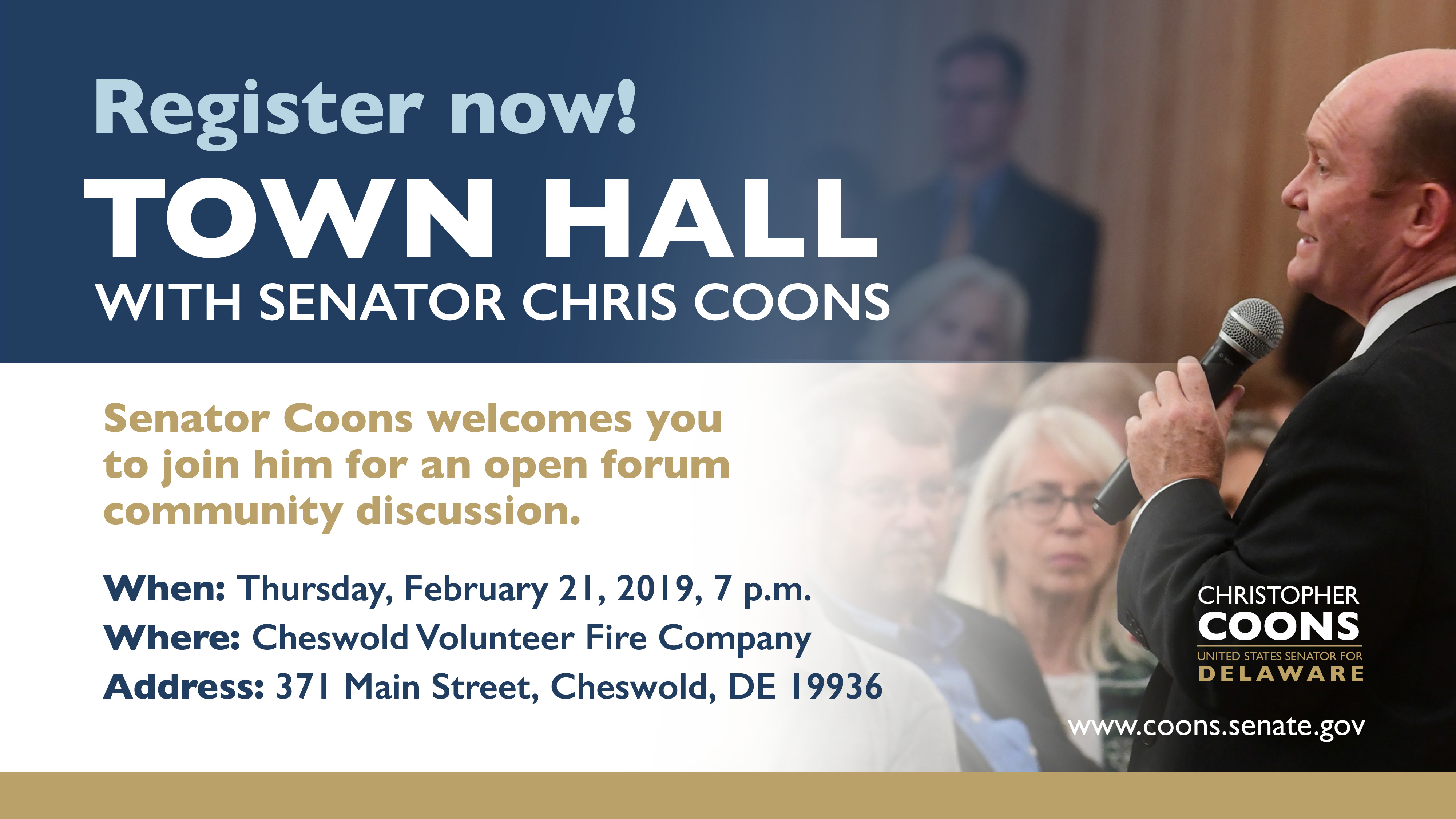
NEXT THURSDAY: Sen. Coons to host town hall meeting in Cheswold at 7 p.m.

WILMINGTON, Del. – U.S. Senator Chris Coons (D-Del.) will host a town hall on Thursday, February 21 at 7 p.m. at the Cheswold Fire Company in Cheswold, Delaware. The discussion is open-forum and is free and open to the public.

To attend, please register at https://www.eventbrite.com/o/senator-chris-coons-18816070918 or call Senator Coons’ office at (302) 573-6347. Registered guests will be admitted on a first come, first serve basis.  Seating capacity is limited.

Members of Sen. Coons’ constituent services team will be in attendance to assist Delawareans having difficulties with federal agencies, including the Social Security Administration, the Veterans Administration, the IRS, the State Department and more.

WHO United States Senator Chris Coons Town Hall  
WHAT Open forum town hall
WHEN Thursday, February 21 at 7 p.m.
WHERE

Cheswold Fire Company
371 Main Street
Cheswold, DE 19936

town hall graphic

[VIDEO] Sen. Coons explains vote on William Barr: “We must be clear-eyed about the moment our country is facing”

WASHINGTON – U.S. Senator Chris Coons (D-Del.), a member of the Senate Judiciary Committee, today delivered remarks on the Senate floor on President Trump’s nominee for Attorney General, William Barr. 

“We must be clear-eyed about the moment our country is facing and the Attorney General’s potentially pivotal role in ensuring the integrity of the rule of law and our democratic institutions,” said Senator Coons. “I believe it is my responsibility in the Senate to protect the Special Counsel investigation, to ensure that other ongoing federal investigations are not interfered with for a narrow or partisan purpose, and to safeguard the rule of law.”

Audio and video of the Senator’s remarks available here.

Senator Coons’ remarks are below: 

Thank you, Mr. President. I rise today to offer briefly my remarks on William Barr’s nomination to serve as Attorney General of the United States. This past Thursday, when the Judiciary Committee of the United States Senate considered him, I was absent being the co-chair of the National Prayer Breakfast and wanted to offer briefly on the floor my conclusions. I have weighed carefully over several weeks William Barr’s nomination to serve as the next Attorney General. Initially, I have to say I was greatly encouraged that President Trump selected a nominee whose service had included leadership roles in the Justice Department, including Attorney General of the United States. 

However, I believe that my responsibility to assess Mr. Barr’s candidacy requires me to consider his entire record, including his more recent writings and statements, and to focus on Mr. Barr’s ability to actually meet the tests of our current time.  

Having thoroughly reviewed his record, met with him in person, questioned him during his Judiciary Committee hearing, and having reviewed his written answers to questions submitted for the record, I ultimately believe Mr. Barr does not meet this test. I am not confident that he will uphold the Attorney General’s critical role in defending the Department of Justice as an institution, and in ensuring the Special Counsel’s investigation proceeds with independence, and by so doing to restore the trust of the American people in the rule of law. 

In weighing his nomination, the memo that Mr. Barr chose to author in June 2018 and to submit criticizing the Special Counsel’s investigation into obstruction of justice, I concluded was significant and cannot be ignored. Though Mr. Barr tried to narrow or minimize the import of the memo by saying it was a specific application to a particular statute, the fact remains that the memo is rooted in and embraces an exceptionally broad theory of executive power that could threaten not only the Special Counsel’s investigation, but a lot of our current understanding of the scope and reach of executive power.  When I asked him if he sent other lengthy, detailed legal memos he had researched and written himself to the Department of Justice as a private citizen, he could only cite the one memo from this year dealing critically with the Special Counsel’s investigation. 

At his nomination hearing in the Committee, I sought simple and concreate assurances from Mr. Barr that he would give the Special Counsel’s investigation the independence and separation from politics that it needs and deserves. 

In some instances, I was genuinely encouraged by his answers. I was glad to hear a forceful answer from Mr. Barr that he would not fire Special Counsel Mueller without cause and would resign rather than do so if so ordered. However, on other issues, he failed to give the simple, clear commitments that former Attorney General Elliot Richardson gave at his confirmation hearing before the Senate Judiciary Committee during the period of an important investigation in the 1970s.  

Mr. Barr would not commit to following the guidance of career DOJ ethics officials on whether he should recuse himself. He would not commit to deferring to Special Counsel Mueller’s investigative decisions. Finally, he would not commit to making Special Counsel Mueller’s final report public.

In essence, Mr. Barr is asking the American people and those of us who represent them to trust him to do the right thing. There are reasons to believe that he will. But there, as I’ve laid out briefly, are reasons to be gravely concerned that he will not. Something that my predecessor in the Senate, Joe Biden, expressed in voting to confirm him back in 1991 was his grave concerns on his expansive view of executive power. But that was at a very different time in this country’s history with a different court and a different context.  

We must be clear-eyed about the moment our country is facing and the Attorney General’s potentially pivotal role in ensuring the integrity of the rule of law and our democratic institutions.

I believe it is my responsibility in the Senate to protect the Special Counsel investigation, to ensure that other ongoing federal investigations are not interfered with for a narrow or partisan purpose, and to safeguard the rule of law. 

If Mr. Barr is confirmed, I hope that he will prove me wrong. I hope he will demonstrate to the American people of all parties and backgrounds that he will put the interests of our democracy above the moment and partisan priorities. I hope that he will prove to be a terrific and solid steward for the investigation that Special Counsel Mueller is leading into Russian interference in the 2016 presidential election. 

If so, I will be gladly put our many policy differences aside to work with him for the good of the American people during this critical time, but I regret that I’ve reached the conclusion that I cannot support his nomination this week.  

Thank you, and I yield my time.

###

Senate passes bill from Sens. Scott, Coons to strengthen partnerships between HBCUs like DSU and federal agencies

WASHINGTON – Yesterday, the U.S. Senate passed legislation announced by U.S. Senators Chris Coons (D-Del.) and Tim Scott (R-S.C.) less than one week ago that will strengthen partnerships between federal agencies and the country’s more than 100 Historically Black Colleges and Universities (HBCUs). The legislation is likely to soon pass the House of Representatives and could become law within the coming weeks.  The HBCU Propelling Agency Relationships Towards a New Era of Results for Students (HBCU PARTNERS) Act is also co-sponsored by U.S. Senators Doug Jones (D-AL), David Perdue (R-GA), Kamala Harris (D-CA), Roger Wicker (R-MS), Tim Kaine (D-VA), Marsha Blackburn (R-TN), Chris Van Hollen (D-MD), Cindy Hyde-Smith (R-MS), Cory Booker (D-NJ), Thom Tillis (R-NC), Amy Klobuchar (D-MN), Elizabeth Warren (D-MA), Bernie Sanders (I-VT), and Mike Braun (R-IN). A companion bill is led in the House by U.S. Representatives Mark Walker (NC-06) and Alma Adams (NC-12).  

The HBCU PARTNERS Act builds on the President’s 2017 executive order on HBCUs. It will require federal agencies with relevant grants and programs to undertake annual planning and coordinate their efforts to support and expand HBCU participation those programs. The bill strengthens the rigor and transparency requirements of existing law by requiring that agencies track their progress toward past goals and share their plans with Congress. In addition, it codifies the President’s Board of Advisors on HBCUs, ensuring an ongoing avenue for the institutions’ priorities and policy concerns to be raised.

“HBCUs today continue their tradition of opening higher education to new generations of students,” Senator Coons said. “They educate 300,000 students across the country, 70 percent of whom receive Pell grants, and charge almost 30 percent less tuition than their peer institutions. I’m proud to make sure that federal agencies actively work to support HBCUs’ critical missions.”

“Our HBCUs have provided amazing opportunities for generations of students, and I am excited that our bipartisan bill to help our HBCUs continue that tradition is on its way to becoming law. The HBCU PARTNERS Act is a great step forward for these schools and their students,” said Senator Scott.

“The Thurgood Marshall College Fund (TMCF) is proud to support the ‘HBCU Propelling Agency Relationships Towards a New Era of Results for Students Act’ (HBCU PARTNERS Act),” said Dr. Harry L. Williams, TMCF president & CEO. “Having all federal agencies formally develop and submit annual plans for increasing HBCU capacity building for grants, contracts, and cooperative agreements, to Congress will ensure that the most important elements of President Trump’s HBCU Executive Order are not only developed, but acted upon.”

###

ICMYI: Sen. Coons op-ed: “Congress must do more to stem opioid tide”

LEWES, Del. – In case you missed it, U.S. Senators Chris Coons (D-Del.) recently published an op-ed in Delaware’s Cape Gazette, calling for congress to do more to fight the opioid epidemic.

“Overdose deaths from prescription opioid painkillers and related heroin use have reached epidemic levels in Delaware and across the country. Each time we open the newspaper, it seems we’re confronted with new, jarring headlines that capture the painful reality of this crisis.

In 2017, nearly 350 people died from overdoses in Delaware, up 12 percent from the 308 people who died in 2016. Even worse, August 2018 was the deadliest month on record for drug-related overdoses, claiming 39 lives in 31 days.” 

This epidemic is ravaging families and communities, and without significant attention and investment, our country will not be able to stem the tide of this crisis and break the cycle of addiction. That’s why I’m urging my colleagues in Congress to do more.

The good news is that Republicans and Democrats have made progress. Last year, we passed a funding bill that included $3.7 billion to help states like Delaware fight the opioid epidemic, an increase of $2.7 billion over 2017.

This bipartisan bill recognized the strain the epidemic has placed on our first responders and our communities. It included funding to enhance opioid overdose surveillance and prevention efforts, improve State Prescription Drug Monitoring Programs, and increase access to opioid and substance use disorder treatment in rural and underserved areas.

Democrats and Republicans also worked together to pass the bipartisan SUPPORT for Patients and Communities Act, which will improve our ability to tackle opioid abuse through our healthcare and law enforcement systems.

I’m glad that members of Congress on both sides of the aisle could work together to get these bills signed into law, but there’s still more that we can do to end this epidemic once and for all.

One important step we should take is to pass the bipartisan DEA Clearinghouse Act that I introduced with Republican Sen. Cory Gardner from Colorado. This bill will help prevent drug diversion in real time before it has the ability to inflict damage in our communities.

What is drug diversion? It’s one of the ways opioids and other pharmaceuticals are getting into our communities. Bad actors are taking advantage of a blind spot in the supply chain to ship a disproportionate amount of prescription drugs to pharmacies across the country. These drugs can then get into the hands of users and dealers, continuing the cycle of addiction.

Think about it this way: a small pharmacy in a sparsely populated town orders one million oxycodone pills. Seems like a lot for a town that size, right?

Unfortunately, though, the Drug Enforcement Agency, using the Automated Reports and Consolidated Ordering System, currently has no way of knowing in real time that this is happening.

That means distributors – who fill orders from pharmacies – do not necessarily know that one of their customers might be placing orders with multiple distributors, thus ordering more controlled substances than they actually need.

DEA is the only law enforcement entity that can see all of that data and flag any suspicious orders that are submitted, but they do not currently track this information instantaneously. So, once DEA finds a suspicious order, it’s already too late and these dangerous drugs have already been distributed to our communities.

Our bill would require DEA to notify the distributor in real time if a potentially suspicious order is detected. If, after further evaluation, the DEA is able to see that drug diversion is taking place, they would be able to flag this for distributors and notify them that something suspicious is going on.

The bipartisan DEA Clearinghouse Act is a commonsense proposal that will shore up our drug supply chain, eliminate blind spots, and prevent prescription opioids from flooding our communities, and we will work closely with DEA to ensure this bill leads to effective improvements.

As we continue to fight the opioid epidemic, our focus should be on putting forward commonsense proposals like the DEA Clearinghouse Act that will keep our communities safe.

Chris Coons is the junior senator representing Delaware in United States Senate.

Sen. Coons celebrates Senate passage of Public Lands Package, including wins for Delaware

WASHINGTON – U.S. Senator Chris Coons (D-Del.) today applauded the Senate passage of the Natural Resources Management Act (S. 47), which includes over 100 public lands bills and several provisions that directly benefit the state of Delaware, including legislation to permanently reauthorize the Land and Water Conservation Fund (LWCF). The package also includes a bipartisan provision based on legislation introduced by Coons and Senator Shelley Moore Capito (R-W.Va.) to bring national recognition to the American Discovery Trail, the nation’s only coast-to-coast, non-motorized recreational trail stretching from Delaware’s Cape Henlopen State Park to Point Reyes National Seashore in California.

“This comprehensive package will help conserve our precious natural resources for years to come, expand recreational opportunities, and improve quality of life in our state and around the country,” said Senator Coons. “I’m pleased it will expand access to the American Discovery Trail, which connects trails from coast to coast, giving more Americans the opportunity to enjoy the outdoors while supporting tourism and economic development for local parks and communities.”

The Natural Resources Management Act will:

  • Authorize the Department of the Interior (DOI) and United States Department of Agriculture (USDA) to place signage along the American Discovery Trail. The provision mirrors S. 1573, the American Discovery Trail Act, a bill championed by Senator Coons and Senator Capito last Congress. The provision would bring national attention to the American Discovery Trail and connect communities by giving more Americans the opportunity to enjoy the unique network of trails it represents.
  • Permanently reauthorize the expired Land and Water Conservation Fund (LWCF), which facilitates federal land acquisitions and provides grants to local and state governments to conserve land, water, and wetlands. The provision is modeled on S. 569, the Land and Water Conservation Authorization and Funding Act, which was cosponsored by Senator Coons.
  • Reauthorize the Historically Black Colleges and Universities (HBCU) Historic Preservation Program, which provides funding for grants to preserve and restore sites of historic significance at HBCUs across the U.S. and improve accessibility on several HBCU campuses. Reauthorization of the program would benefit HBCUs across the country, including Delaware State University. Senator Coons is also committed to securing strong funding for this program through the appropriations process each year.
  • Reauthorize the Neotropical Migratory Bird Conservation Act to help protect habitat and sustain populations of migratory birds, including many birds that stop in Delaware Bay such as the rufa red knot. The provision is based on S. 310, the Migratory Birds of the Americas Conservation Act, which Senator Coons joined as an original cosponsor.
  • Codify the National Parks Service’s Every Kid in a Park (EKIP) program to support opportunities for fourth graders and their families to connect with our parks and public lands.

cape henlopen