Related Issues

Related Issues

Tomorrow, 10:45 AM: Sen. Coons will question Attorney General Barr about the Special Counsel report

WASHINGTON, DC – Tomorrow at approximately 10:45AM, U.S. Senator Chris Coons (D-Del.), a member of the Senate Judiciary and Appropriations Committees, will question Attorney General William Barr about Special Counsel Mueller’s report.

WHO: U.S. Senator Chris Coons, Attorney General William Barr

WHAT: Senator Coons will question Attorney General Barr at a Senate Appropriations Committee hearing about Special Counsel Mueller’s report.

WHEN: Senator Coons’ questioning is likely to begin at approximately 10:45 AM

WATCH: The hearing will be broadcast on C-SPAN and carried on most cable news networks

VIDEO: Video/audio of Senator Coons’ questioning will be provided by Senator Coons’ office shortly after it concludes.

Gardner, Coons Reintroduce CLIPS Act to Address Cybercrime

Washington, D.C. – Senators Chris Coons (D-DE) and Cory Gardner (R-CO) reintroduced the bipartisan Cyber League of Indo-Pacific States (CLIPS) Act, which would establish a cyber community of regional allies and partners to combat cyberattacks that threaten the U.S. economy. The legislation would further the robust cybersecurity cooperation called for in the Asia Reassurance Initiative Act.

“The increasing use of cyber attacks and cyber crime to steal information, influence populations, and attack infrastructure requires a global solution,” said Senator Coons. “I am proud to introduce this resolution to urge the Administration to work with our partners in the Indo-Pacific to ensure a free and open Internet safe from economically crippling cyberattacks.”

“Estimates put losses from cybercrime at $600 billion annually and growing, impacting companies from Wall Street to Main Street, as well as the infrastructure supporting the entire U.S. economy,” said Senator Gardner. “This bipartisan legislation would unite like-minded countries to address the fundamentally unfair competition when other countries support or directly engage in cyber theft.”

CLIPS Treaty member countries would agree to:

  • Create an Information Sharing and Analysis Center
  • Consult on emerging cyber threats
  • Pledge not to conduct or support theft of intellectual property
  • Introduce and enforce minimum criminal punishment for cyber theft
  • Extradite cyber thieves 
  • Enforce laws protecting intellectual property, including patents
  • Ensure government agencies comply with software license terms
  • Minimize data localization requirements consistent with the United States- Mexico-Canada Agreement
  • Seek cooperation with respect to standards
  • Provide for public input when devising legislation on cybersecurity
  • Cooperate on the attribution of cyberattacks and impose appropriate consequences

###

Sens. Coons and Klobuchar introduce landmark personal savings and retirement bill

WASHINGTON – Today, U.S. Senator Chris Coons (D-Del.) and Amy Klobuchar (D-Minn.) are introducing The Saving for the Future Act, landmark legislation to address a looming retirement savings crisis and help ensure that Americans are able to afford emergency expenses.  Like the minimum wage, The Saving For the Future Act establishes a minimum employer contribution to a savings plan of 50 cents per hour worked, which equals $20 per week and more than $1000 per year. 

Read a summary of the bill HERE

The legislation is supported by the AARP, SEIU, the National Urban League, Prosperity Now, Third Way, and LISC. Companion legislation will be introduced in the House today by Representatives Scott Peters (D-Cali.), Lucy McBath (D-Ga.), and Lisa Blunt Rochester (D-Del.).

“Right now, a full third of non-retirees have zero retirement savings, and four in ten adults don’t have enough cash savings to meet a $400 emergency expense. That’s a crisis, and it’s proof that while parts of our economy are strong, many Americans are still being left behind,” said Senator Coons.  “By establishing a minimum savings contribution for the American worker, we can ensure that Americans working hard to pay their bills have savings in place to eventually retire and to deal with emergency expenses along the way.  We need big, bold proposals to make our economy work for everyone – not just a few wealthy people at the top – and I believe this bill can not only create that change, but also has a chance of actually becoming law.”

“Hardworking families in America often don’t have enough money in their savings account for an emergency—let alone retirement down the road. The Saving for the Future Act will help close the wealth gap, prepare families in case of an emergency, and set workers up for a successful retirement,” said Senator Klobuchar.

At a time when three in ten American workers lack access to workplace retirement plans, and 45% do not participate in one, The Saving for the Future Act would help guarantee that all Americans – even those working part time – have some savings put away for retirement and emergency situations.

Under The Saving for the Future Act, men and women who work at a company with ten or more employees would be entitled to an employer savings contribution of at least 50 cents per hour worked into a savings plan, which could include existing plans, such as a 401(k). Employees at smaller companies would be able to save through federally provided “UP Accounts,” modeled after the popular Thrift Savings Plan for federal workers. UP Accounts would have low fees, could easily be transferred from job to job, and would be tailored to the employee’s age and savings needs.  

Businesses of all sizes complying would receive tax credits to help fund these contributions, and small businesses with 15 or fewer employees would receive credits covering a full half of the required contributions. Independent workers and employees at the smallest companies would receive access to UP Accounts and an individual tax credit to help them contribute.

To view the bill text, please click here.

Support for The Saving for the Future Act:

“55 million Americans lack access to a workplace retirement savings plan. AARP applauds Senators Coons and Klobuchar’s efforts to promote automatic enrollment and escalation in retirement plans, and their broad support of state efforts to increase retirement savings opportunities,” said David Certner, Legislative Counsel, AARP.

“As the nation’s oldest and largest civil rights and direct services organization, the National Urban League strongly supports the Saving for the Future Act.  Helping our constituents attain economic self-sufficiency has been our mission since 1910. The Saving for the Future Act allows American workers to do just that. The bill allows low- to moderate-income Americans to save for everyday emergencies and their retirement, with the financial support of their employers. Passage of the Saving for the Future Act would help American families get a leg-up in today’s economy,” said Marc H. Morial, President and CEO of the National Urban League.

“The Saving for the Future Act will do more to reduce wealth disparity and improve the fortunes of working wage Americans than any single piece of legislation in Congress. This bill is bold, far-sighted, affordable, and pragmatic,” said Jim Kessler, Executive Vice President for Policy, Third Way:

“Americans are woefully unprepared for financial emergencies in the short term, let alone their retirement years. Forty percent of Americans are one emergency away from financial ruin and almost 30 percent of households ages 55 and over do not have retirement savings or a pension. Households of color are especially vulnerable. On average, White families had about six times more in retirement savings than Black and Hispanic families. Government and employers need to work together to give Americans access to savings supports through workplace retirement plans and also to help bolster them through the financial emergencies that inevitably hit every family. The Saving for the Future Act will build upon promising research on retirement and emergency savings, allowing employers to help their workers successfully save for the long and short term,” said Andrea Levere, President of Prosperity Now.

“The Local Initiatives Support Corporation (LISC) supports The Saving for the Future Act, which builds financial security, strengthens retirement preparedness and reduces wealth inequality through employer-led workplace savings. We believe that allowing people to tackle facets of their financial life like saving for a rainy day or supporting retirement goals, as well as to build a buffer to protect against financial hardships, will improve one’s long-term economic security and financial well-being,” said Matt Josephs, Senior Vice President for Policy, LISC.

“The Saving for the Future Act takes important steps to help address the country’s looming retirement crisis. It enables workers that lack access to save in a high-quality retirement plan and pushes all employers to contribute towards their employee’s retirement so that workers don’t have to do it on their own,” said David Madland, Senior Fellow, Center for American Progress Action Fund.
Sens. Coons, Collins, Klobuchar, Capito introduce bipartisan bill to promote innovation in sustainable chemistry

WASHINGTON – U.S. Senators Chris Coons (D-Del.), Susan Collins (R-Maine), Amy Klobuchar (D-Minn.), and Shelley Moore Capito (R-W.Va.) today reintroduced the Sustainable Chemistry Research and Development Act of 2019. A companion bill was introduced in the House by Representatives John Moolenaar (R-Mich.) and Dan Lipinski (D-Ill.).

This bipartisan, bicameral bill encourages the development of new and innovative chemicals, products and processes with an improved environmental footprint through efficient use of resources, reducing or eliminating exposure to hazardous substances, or otherwise minimizing harm to human health and the environment.

“Encouraging innovation, creating new jobs, and improving human health and the environment is something that should bring us all together,” said Senator Coons. “We can do more to ensure the things we use every day—from our laundry detergent to our cars—are produced in a way that maintains their high quality while protecting our health and our planet. The bipartisan Sustainable Chemistry Research and Development Act will create a cohesive vision for sustainable chemistry research and development, improve training and retraining of scientists and other professionals, and build new partnerships with the private sector. This is an exciting opportunity to maintain our scientific leadership and ensure the sustainability of our chemical enterprise for years to come.”

“Sustainable chemistry aims to improve the efficiency of the chemical production process while reducing risks to human health and the environment,” said Senator Collins. “Our legislation would establish a coordinated national effort to promote this promising field of research; provide grants, training, and educational opportunities for scientists and engineers; and support American jobs by maintaining our nation’s scientific leadership.”

“We must continue to invest in sustainable research and development to unleash the next generation of scientific breakthroughs,” Klobuchar said. “This bipartisan bill will encourage innovation in approaches to chemistry research, development, and training – helping to increase partnerships and economic benefits across the field.”

“The American chemical industry was born in West Virginia and remains a key economic driver and job creator in our state,” Senator Capito said. “Industry stakeholders and researchers at our universities are making great strides in creating products and processes that are more environmentally sustainable. The bipartisan Sustainable Chemistry Research and Development Act will direct federal research agencies to act as partners with industry and institutions of higher education in advancing these goals that are so vital for our economy, environment, and public health – all at no additional cost to taxpayers.”

“This legislation strengthens cooperation between the federal government, the private sector, and the scientific community to further research and development in chemistry,” said Congressman Moolenaar. “It will keep our country at the forefront of innovation and help create new products that will benefit all Americans.”

“I’m proud to lead the Sustainable Chemistry Act of 2019 in the House, along with my colleague, Representative Moolenaar,” said Congressman Lipinski. “Chemistry is the foundation of countless industries, including agricultural pesticides, cleaning products, cosmetics, and textiles.  As global demand increases for products that are safer and sourced in a more environmentally-friendly way, significant coordination and research is needed to support these industries as they transition to alternative chemicals.  This bill will direct coordination at the federal level to encourage research and practices that incorporate sustainable chemistry, including technology transfer programs.  These efforts can lead to economic growth while also improving environmental quality.”

The Sustainable Chemistry Research and Development Act of 2019 supports efforts in sustainable chemistry across all federal research agencies through research and development programs, technology transfer, commercialization, education, and training; including partnerships with the private sector. The bill aims to better coordinate federal activities in sustainable chemistry and encourage industry, academia, nonprofits, and the general public to innovate, develop, and bring to market new sustainable chemicals, materials, products, and processes.

A one-pager is available here.

The legislation has been endorsed by the GC3 Sustainable Chemistry Alliance, the American Chemical Society, the American Chemistry Council, the American Sustainable Business Council, Ashland, BASF, Beautycounter, the Biotechnology Innovation Organization (BIO), Delaware Sustainable Chemistry Alliance, Dow, DuPont, Environmental Working Group, The LEGO Group, Procter & Gamble, and the University of Delaware. Statements of support can be found here.

Sens. Coons, Collins, Reed, Shaheen re-introduce bipartisan bill to enhance and extend landmark energy efficiency program

WASHINGTON – U.S. Senators Chris Coons (D-Del.), Susan Collins (R-Maine), Jack Reed (D-R.I.), and Jeanne Shaheen (D-N.H.) re-introduced bipartisan legislation to strengthen and reauthorize the heart of the federal government’s energy efficiency strategy—the Weatherization Assistance Program (WAP). The Weatherization Enhancement and Local Energy Efficiency Investment and Accountability Act of 2019would reauthorize the program through 2024. A companion bill is being led in the House by U.S. Representatives Paul Tonko (D-N.Y.), Bobby Rush (D-Ill.), and Marcy Kaptur (D-Ohio).

“Saving energy is the first step to reducing our energy costs and increasing our nation’s energy security,”said Senator Coons. “The Weatherization Assistance Program allows millions of Americans to reap the benefits of a wide range of energy-efficient technologies and practices. This bill will not only ensure that this landmark program can continue to help make American homes safer, healthier, and more energy efficient, it also further enhances the program by creating a new competitive grant for innovation. This is commonsense, bipartisan legislation that I hope will once again earn strong support in the Senate.” 

“Access to affordable home energy during the cold winter months is a matter of health and safety for many low-income households, children, and seniors in Maine and across the country, which is why I support reauthorizing the Weatherization Assistance Program,” said Senator Collins. “Weatherization is a cost-effective way to reduce energy usage and cut low-income homeowners’ energy bills for the long-term.  I encourage my colleagues to support this legislation that would reauthorize this important program and establish a new, innovative pilot program to help make homes ‘weatherization-ready’ and support cost saving practices.”

“Americans want energy that’s affordable and doesn’t cause climate change. Weatherization funding is just that. It’s a smart way to lower costs, cut polluting fossil fuels, and strengthen our economy,” said Senator Reed

“Weatherization projects are among the most effective ways to conserve energy, create jobs and lower costs for New Hampshire families,” said Senator Shaheen. “The Weatherization Assistance Program has helped low-income families, seniors and individuals with disabilities throughout the state make lasting and cost-effective energy efficiency improvements to their homes. This is a proven program and Congress should act on our bipartisan proposal to reauthorize it immediately and see that its funds are used without delay.” 

“America’s weatherization program is more than just a smart investment in energy efficiency that saves money for low-income individuals and families,” said Congressman Tonko. “A strong and active weatherization program also makes our families and communities safer, reduces climate pollution and supports thousands of local jobs. I urge my colleagues to advance this common-sense legislation immediately on behalf of our nation’s future and our constituents who need it most.” 

For over 40 years, the WAP has assisted low-income families that lack the resources to make their homes more energy efficient. It supports 8,500 jobs and is responsible for energy efficiency upgrades in millions of homes across the country. For every dollar invested by the WAP, $4.50 is generated in combined energy savings and non-energy benefits such as local economic growth. 

The Weatherization Enhancement and Local Energy Efficiency Investment and Accountability Act of 2019would:

  • Reauthorize and extend the WAP through 2024;
  • Facilitate the use of renewable energy technologies in weatherization projects;
  • Allow DOE to take health and safety benefits into account when carrying out the program;
  • Ensure best practices and training among WAP contractors;
  • Create a competitive innovation grant program for non-profits that have a track record of success to access the WAP;
  • Allow homes to be reweatherized once 15 years have elapsed since the last weatherization and clarify that related services, such as education, installation evaluations, or non-Federally funded services, may be provided at any time; and
  • Encourage DOE to provide maximum flexibility when WAP funding is being used to leverage additional private sector funding. 

David Bradley, CEO of the National Community Action Foundation, which represents the nationwide network of Community Action Agencies that serve as local WAP providers, said: “Because of Senator Coons’ and Congressman Tonko’s leadership, Weatherization, a bipartisan policy with a real impact on families’ health and safety during the coldest months of winter and warmest months of summer, a policy that lowers everyone’s household energy bills, will have a chance to be reauthorized and available for the next five years. It’s hard to imagine how folks struggling to make ends meet could survive a winter in Maine or a summer in Mississippi without Weatherization. Additionally, this bill modernizes the program so that it can make the most of 21st century equipment and information now available. The Community Action network is grateful for Senator Coons’ and Congressman Tonko’s efforts, and we look forward to working toward the bill’s passage.”

Jenae Bjelland, Executive Director of the National Association for State Community Services Programs, commented: “The WAP is a critical program that reduces the home energy costs of vulnerable families and makes their homes healthier and safer. This legislation will reauthorize WAP and allow the weatherization network to build upon its legacy of over 40 years of helping low-income Americans. We applaud and appreciate the leadership of Senator Coons and Representative Tonko, who are tireless advocates for weatherization.” 

David Terry, Executive Director of the National Association of State Energy Officials (NASEO), applauded the introduction of the weatherization reauthorization legislation and stated: “Along with the reauthorization and modernization of the State Energy Program, this legislation is our highest priority for this Congress. We congratulate and thank Sen. Coons and Rep. Tonko for their long-time leadership on these issues. Americans will be significantly better off with the passage of the reauthorization legislation. Weatherization helps low-income Americans, veterans, disabled and the elderly stay in their homes by significantly reducing their energy bills. This is good public policy.” 

Keith Aldridge, President and CEO of the Home Performance Coalition, added: “The U.S. Department of Energy’s Weatherization Assistance Program is vital to improving the housing and lives of low-income families across the country.  Private contractors, and those who work for Weatherization Agencies, see first-hand the benefits to homeowners in both lower energy bills and a better quality of life.  We applaud Senator Coons and Congressman Tonko for introducing the Weatherization and Enhancement and Local Energy Efficiency Investment and Accountability Act.” 

A one-pager on the bill is available here.

The bill text is available here.

###

Coons, Kaine call on Trump to increase efforts to secure release of Americans wrongfully detained in Iran

WASHINGTON, D.C. – U.S. Senators Chris Coons and Tim Kaine, both members of the Senate Foreign Relations Committee, sent a letter to President Donald Trump urging him to use all leverage possible to help secure the release of the American citizens and residents imprisoned in Iran and elsewhere. In the letter, Kaine and Coons called on the Trump Administration to form a multinational task force to help secure the release of those wrongfully detained in Iran, raise this issue in negotiations with nations seeking conditional waivers from U.S. economic sanctions, and hold a briefing on these efforts no later than April 30th.

“The lives of these Americans are at risk. The United States needs to send a strong signal to Iran that it must stop taking Americans hostage. We urge you to use all leverage possible to intervene on their behalf,” the Senators wrote.

The full text of the letter is available here and below:

April 1, 2019


President Donald J. Trump

The White House

1600 Pennsylvania Avenue NW

Washington, DC 20500

Dear President Trump,

We understand that Secretary of State Mike Pompeo will this week meet with some of the families of Americans held hostage in Iran. While we are encouraged by your Administration’s emphasis on assisting detained Americans and their families, we urge you and your national security team, including Special Envoy for Hostage Affairs O’Brien, to continue to make use of all the tools at your disposal to secure the release of all American citizens and legal permanent residents held unjustly around the world.  

Iran has unlawfully detained several United States citizens, including Siamak Namazi, Baquer Namazi, Xiyue Wang, Morad Tahbaz, and Michael White, as well as United States legal permanent residents Nizar Zakka and Karan Vafadari. This month marks the twelfth year that Robert Levinson, a U.S. citizen and retired agent of the Federal Bureau of Investigation, disappeared in Iran. In May 2018, you called on Iran to stop its unjust detention of foreigners, including U.S. citizens.  However, we are still waiting for the first U.S. citizen held by Iran to be freed on your watch. 

The stories are heartbreaking. Mr. Namazi is 82 years old – members of the Iranian Revolutionary Guard Corps imprisoned him after his arrival in Iran in 2016 to visit his imprisoned son Siamak.  Xiyue Wang, a student at Princeton University, was conducting doctoral research in Iran’s National Archives when the Iranian authorities seized him, convicted him in a closed trial, and sentenced him to 10 years.  Their families and supporters have called attention to their situation in an open letter to world leaders, highlighting the inhumane conditions of their detention and the denial of fundamental rights including due process.  These American citizens and residents have been the subject of various Congressional hearings, resolutions, statements, and legislation.

The lives of these Americans are at risk. The United States needs to send a strong signal to Iran that it must stop taking Americans hostage. We urge you to use all leverage possible to intervene on their behalf.  For example, it is our understanding that several countries including Iraq, India, and China are seeking conditional waivers from U.S. economic sanctions on Iran. As part of these discussions, we strongly request you ask these nations to help secure the release of Americans and U.S. legal permanent residents held in Iran.

We also need the support of the international community in these efforts.  We understand that there are at least 12 other nations whose nationals are unlawfully held by Iran.  We urge the Administration to form a multinational task force to help find solutions to secure their release.

To work best in tandem with you, we request a staff-level briefing no later than April 30 by Administration officials to review all efforts to secure the release of Americans held in Iran.  This briefing should include the status of forming a multinational task force, an update on the work of the FBI’s Hostage Recovery Cell, and correspondence with our Swiss protecting power. Transparency is essential, and Congress wants to help your Administration take concrete steps to secure the release of U.S. persons unlawfully detained in Iran and elsewhere. 


Sincerely,

Tim Kaine

Christopher A. Coons

cc. The Honorable Michael Pompeo, U.S. Secretary of State

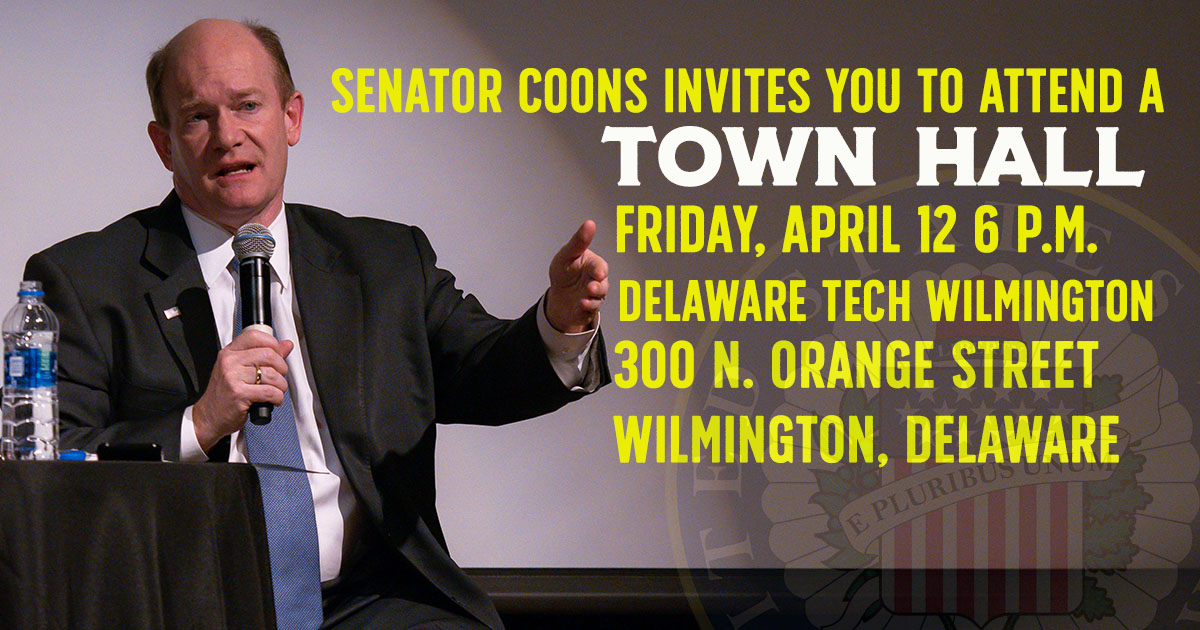
Sen. Coons to host town hall meeting in Wilmington Friday, April 12 at 6 p.m.

WILMINGTON, Del. – U.S. Senator Chris Coons (D-Del.) will host a town hall on Friday, April 12, at 6 p.m. at Delaware Technical Community College George Campus conference center. The discussion is open-forum, is free, and open to the public.

To register, guests are asked to visit https://www.eventbrite.com/e/wilmington-town-hall-tickets-59609797509 or call (302) 573-6347 to register. Registered guests will be admitted on a first come, first serve basis. Seating capacity is limited.

Members of Sen. Coons’ constituent services team will be in attendance to assist Delawareans having difficulties with federal agencies, including the Social Security Administration, the Veterans Administration, the IRS, the State Department and more.

Wilmington Town Hall

Ahead of National Service Recognition Day, Coons, Reed, Duckworth, Gillibrand, Klobuchar, Brown Call for ACTION to Expand Opportunities for National Service

WASHINGTON – In an effort to tackle the crippling cost of higher education and burden of student debt, U.S. Senators Chris Coons (D-Del.), Jack Reed (D-R.I.), Tammy Duckworth (D-Ill.), Kirsten Gillibrand (D-N.Y.), Amy Klobuchar (D-Minn.), and Sherrod Brown (D-Ohio) are leading the charge in the Senate to make college more affordable by encouraging young Americans to strengthen their communities and our nation through national service.

The Senators, along with U.S. Representatives John B. Larson (D-Conn.), John Lewis (D-Ga.), and Joe Kennedy III (D-Mass.) are teaming up to offer the America’s Call To Improve Opportunities Now (ACTION) for National Service Act.  This legislation would increase opportunities for service across the country and provide young Americans with the chance to get hands on experience in a variety of fields through national service programs. In exchange for their national service, this bill would direct the federal government to return that commitment by helping these young people pay for college.

The ACTION for National Service Act calls for elevating the Corporation for National and Community Service to a cabinet-level agency and providing resources to help support up to one million national service positions annually, enhancing participation in notable national service programs such as AmeriCorps and Senior Corps.

Currently, about one percent of Americans serve in either the military or a national service program.  Retired General Stanley A. McChrystal, who serves as Chairman of the Board for the nonprofit Service Year Alliance, has stated that expanding national service options could go a long way toward uniting Americans and bridging the military-civilian divide by fostering a better understanding of shared sacrifice.  General McChrsytal noted: “Right now, less than one percent of our population serves in the military and, in my view, we need to rethink and create a system where young Americans have an opportunity to serve their nation in other ways. We need to create a culture of service where we are all invested in our nation’s future and feel a shared sense of responsibility to our nation and to each other.”

Since 1994, over one million individuals have served through the AmeriCorps program, and roughly 245,000 seniors over the age of 55 volunteer annually through the Senior Corps programs.  These individuals have addressed critical community needs in education, economic development, health, and many other areas, coming to their fellow citizens’ aid in times of national disaster, including thousands who have been deployed in the wake of Hurricanes Harvey, Irma, and Maria.  The bill seeks to enhance the nation’s capacity to support all those who want to and do serve their communities and the nation.

“My experience helping to create and run one of the first national direct AmeriCorps programs with the I Have a Dream Foundation changed my life, touched my heart, and helped me see what national service can do for our communities and for our country,” said Senator Coons. “This legislation supports the next generation of Americans who seek to serve – whether it’s by educating children in underserved areas, building homes for families in need, or helping communities recover from disaster – while allowing them to earn funds for a full higher education. As we work to make college more accessible, expanding national service opportunities for young Americans that result in tuition funds for college is the answer. I look forward to working with my colleagues to advance this legislation through Congress and into law.”

“This bill will grow our capacity to enlist, equip, and empower young people to address pressing challenges while creating opportunities for advancement with respect to their education and job prospects.  It will increase volunteerism, strengthen our nation, and tap into an underutilized resource that can help transform communities across the country.  And it will provide tangible benefits to those who give back,” said Senator Reed, who, along with the late-Senator John McCain established the independent National Commission on Military, National and Public Service in 2017.   “Whether it is educating young people or helping communities rebuild, Americans are eager to find ways to serve, and we need to do a better job of connecting them to opportunities.  Making common cause with our fellow citizens and serving a purpose greater than ourselves is a hallmark of our nation.  It’s also crucial that we invest in the education and professional development of those who have sacrificed and given so much to our nation.  That’s why I’m pleased to introduce this legislation with my colleagues to help ensure that every American who wants to serve has the opportunity to do so, as well as future opportunities to get an education and build a better life.  I commend Congressmen Larson and Kennedy for their leadership on this issue, as well as my cosponsors in the Senate for their longstanding commitment to expanding national service opportunities and economic opportunities for all.”

“Expanding national service opportunities for young Americans is vital to the strength of our local communities and our entire nation,” said Senator Duckworth. “Just as picking up a rifle to defend our country is ‘American Service,’ so is delivering water filters to communities afflicted by lead-contaminated water, picking up a stick of chalk to reach children or a hammer to rebuild homes for those devastated by natural disasters. I’m proud to be working with my colleagues to make sure every young American has the opportunity to serve their country and get help paying for college.”

“This legislation was inspired by President Kennedy’s call to our nation: ‘Ask not what your country can do for you, ask what you can do for your country.’ The will to serve is there, but due to lack of sufficient funding, organizations have to turn away applicants. ACTION for National service will expand the opportunities for service while paying for higher education or paying down student loan debt,” said Congressman Larson.

The ACTION for National Service Act would greatly expand access to national service and higher education opportunities. Specifically, the ACTION for National Service Act

  • Gives all those who wish to serve the opportunity to do so, establishing a ten-year goal of providing the necessary federal funding to support at least one million service positions nationwide.
  • Significantly reduces student loan debt burdens by ensuring that individuals who serve two full terms of service are rewarded with an education benefit equivalent to four years of the average in-state tuition at a public, four-year college.
  • Increases access to national service opportunities by raising living stipend amounts, allowing volunteers to earn a meaningful wage during their service.
  • Makes the education benefit and living stipend free from federal taxation.
  • Elevates the existing CNCS to a Cabinet-level federal agency and appoints a Director of National Service with the same rank as Cabinet Secretaries. The Director would be required to establish an interagency working group to evaluate both education award eligibility for participants in programs outside of CNCS and the feasibility of granting Federal hiring preference to volunteers.
  • Creates a 21st Century American Service Outreach Program that will notify eligible individuals starting at the age of 17 about opportunities to serve in civilian national service programs and how to register.
  • Maintains the authority and programmatic responsibilities of state and local boards to direct federal resources to meet community needs and be responsive to local priorities.
  • Establishes a National Service Foundation to encourage private sector and philanthropic investment in expanding national service opportunities.

Tomorrow, April 2 is National Service Recognition Day – a day to mark the positive work of service and volunteerism in communities across the country.  The day is sponsored by CNCS, a federal agency for service and volunteering which annually engages millions of Americans in service at more than 50,000 locations through AmeriCorps, VISTA, Senior Corps and other programs.

Bipartisan, bicameral bill from Sens. Coons, Young, Moran, Brown & Reps. Norcross, McKinley expands registered apprenticeship programs in high-growth job sectors

WASHINGTON – Today, U.S. Senators Chris Coons (D-Del.), Todd Young (R-Ind.), Jerry Moran (R-Kan.), and Sherrod Brown (D-Ohio) and U.S. Representatives Donald Norcross (D-N.J.) and David B. McKinley P.E. (R-W.Va.) introduced the Apprenticeship Hubs Across America Act of 2019. This bill establishes a new initiative to grow and expand highly successful Apprenticeship Hubs, which are organizations that help employers design, develop, and deliver registered apprenticeship programs. The bill addresses the growing skills gap in America and helps businesses provide targeted training to compete in the 21st century economy.

“Apprenticeships are one of the smartest investments we can make because they lead to well-paying jobs, a clear career path, little to no debt, and skills that can be used for a lifetime,” said Senator Coons. “Apprentices earn wages during their training and in many cases are guaranteed a well-paying job when this training is complete. Our bill will help expand registered apprenticeships to a variety of job sectors to create more opportunities for America’s displaced workers and youth to address the growing skills gap in America. This legislation supports important initiatives like the Delaware Pathways program, which helps ensure a strong American workforce into the future.”

“With a constantly changing workforce, it is paramount that our students have the training and skills needed to succeed,” said Senator Young. “As a co-chair of the Senate Career and Technical Education (CTE) Caucus, I have seen first-hand the important role that apprenticeships and CTE programs can play in closing America’s skills gap. The bipartisan Apprenticeship Hubs Across America Act will help ensure Hoosiers and all Americans are prepared for the opportunities of tomorrow.”

“America’s workers are our greatest resource and by investing in apprenticeship programs we can help make sure they have the tools they need to succeed,” said Senator Brown.

“An apprenticeship program shaped my life – taking me from construction work to Congress,” said Representative Norcross, an electrician by trade. “My electrical apprenticeship training allowed me to learn-and-earn and set me on a path toward a fulfilling, family-sustaining career. America needs a well-trained workforce to help fill the jobs of the future, and apprenticeships are critical to our success. We need electricians and computer programmers, just like we need doctors and judges – and this bill expands high-quality career training programs.”

“We currently face a shortage of skilled workers, and that skills gap is causing high-paying jobs to go unfilled. By increasing access to apprenticeships we will be able to fill these vacancies,”Rep. McKinley said. “We must promote job training programs, and apprenticeships the same way we promote traditional four-year colleges because, without these trades, our economy cannot grow.”

A major barrier to expanding registered apprenticeships in high growth job sectors outside of the skilled trades is employers’ lack of familiarity with the process to set up and manage registered apprenticeship programs. The Apprenticeship Hubs Across America Act addresses this need by supporting a national network of Apprenticeship Hubs that convenes multiple stakeholders, including local workforce boards, community colleges, and employers, to help support the expansion of the extremely successful registered apprenticeship model.

Apprenticeship Hubs participate in a variety of activities, such as providing guidance and mentorship of apprentices to ensure retention and completion; working with employers to design the apprenticeship curriculum; and navigating the registration process for apprenticeships. The bill also instructs the Department of Labor to conduct national workshops on how to create Apprenticeship Hubs and disseminate best practices on the effective development and implementation of registered apprenticeship programs.

The bill text is available here.  

A one-pager on the bill is available here

Quotes from supporting organizations are here.  

The Apprenticeship Hubs Across America Act is endorsed by the American Federation of Labor and Congress of Industrial Organizations (AFL-CIO), Chamber of Commerce for Greater Philadelphia, Delaware Polytech Adult Education, Jobs For the Future (JFF), National Association of Tower Erectors (NATE), New America, North America’s Building Trades Unions (NABTU), Small Business Majority, and Third Way.

Coons, Gardner, Markey Warn Allies Global Security at Risk with Expansion of Chinese 5G Networks

WASHINGTON – U.S. Senators Chris Coons (D-Del.), Cory Gardner (R-Colo.), and Ed Markey (D-Mass.) today introduced a resolution declaring, “Chinese telecommunications companies such as Huawei and ZTE pose serious threats to the national security of the United States and allies of the United States.”

Many U.S. partners and allies are considering relying on these Chinese telecommunications companies to build their 5G networks, even after the U.S. government has called on these countries to abandon utilizing Huawei and ZTE. While some U.S. allies are heeding U.S. warnings regarding Chinese telecommunications equipment, others have not.

Allowing Huawei equipment to be installed in the United States or our allied nations would introduce serious risks in our communication systems. This bipartisan Resolution will complement the Administration’s efforts and show that the United States Congress has serious concerns about using certain Chinese telecommunications equipment in global 5G infrastructure.

“Our allies and partners should understand the risk Chinese telecommunications companies like Huawei and ZTE pose to their networks and our ability to communicate with each other in a secure manner,” said Senator Coons. “I urge the administration to continue its work with our allies so they are fully able to protect the 5G networks of the future.”

“Huawei and ZTE telecommunications products are not safe for the U.S. or any of our allies around the globe,” said Senator Gardner. “Our intelligence community has made it abundantly clear Huawei and ZTE put the security of our communications at risk and it is concerning that allies like Germany are considering relying on their products.  Now Congress is moving in a bipartisan fashion to emphasize what this Administration, previous Administrations, and many of our allies have said about the risks of Huawei and ZTE. It is my hope all of our allies in Europe and around the globe hear us loud and clear.”

“In today’s increasingly connected world, we must work with our allies and partners to animate technology with our values, especially in 5G networks,” said Senator Markey. “Chinese law requires its companies, including Huawei and ZTE, to fully cooperate with the Chinese Communist Party. If we don’t address emerging threats collectively, we stand to jeopardize our national security, the rules of the road, and the very underpinnings of the international system.”