DOVER, Del. – U.S. Senator Chris Coons (D-Del.) surprised Delaware students with principal nominations to U.S. service academies during a ceremony held at the Air Mobility Command Museum at Dover Air Force Base on Dec. 14.
Senator Coons named four high school seniors, all from Kent or Sussex Counties, as principal nominees for appointment to service academies should they meet all medical, physical, and academic requirements.
Amanda Carey, the principal nominee to the U.S. Naval Academy at Annapolis, Maryland, lives in Dover and serves as the executive officer of the JROTC at Dover High School. She is the commander of the color guard and is a member of the drill team. Carey, who takes advanced placement (AP) and honors classes, is a member of the National Honor Society and volunteers with the Dover Fire Department.
Andrew Garza, a principal nominee to the U.S. Air Force Academy in Colorado, is from Dover and is active with the JROTC at Polytech High School. He runs track, take AP classes, volunteers with Habitat for Humanity, and is a member of the National Honor Society. He is a self-proclaimed “Air Force brat” since his father works at the base mortuary. Garza, a member of the Civil Air Patrol with a private pilot license, wants to fly F-22 Raptors for the Air Force.
Donald Mendoza, a principal nominee to the U.S. Air Force Academy, resides in Dover and attends Caesar Rodney High School. Mendoza, who was born in the Philippines, serves as the executive officer with the JROTC and leads the drill team. He is an eagle scout in the Boy Scouts of America and has participated in Boys State. Mendoza, who is a member of the National Honor Society, wants to be a C-5 Galaxy pilot in the Air Force.
Mackenzie Irelan, the principal nominee to the U.S. Military Academy at West Point, New York, is from Harbeson in Sussex County and attends Cape Henlopen High School. She takes AP classes and is a member of the softball team. Irelan has completed mission trips to Kenya and the Dominican Republic with Foundation for Peace. She wants to major in political science and become an infantry officer in the Army.
Irelan was not at the Dec. 14 ceremony because of a previous commitment to attend the Army-Navy game in Philadelphia. Right before kickoff, Senator Coons called Irelan to notify her of the nomination officially. During the phone call, one of Senator Coons’ academy board members, Scott Kessel (U.S.M.A. Class of 1987), who himself was at the game, presented Irelan with a congratulatory letter from the senator.
Alternate nominees to the three Department of Defense academies listed above, the nominees for the U.S. Merchant Marine Academy at Kings Point, New York, and individuals not selected to receive congressional nominations will be notified within the next few weeks.
To download high-resolution photos from this event, visit https://bit.ly/2PVU5Mk.
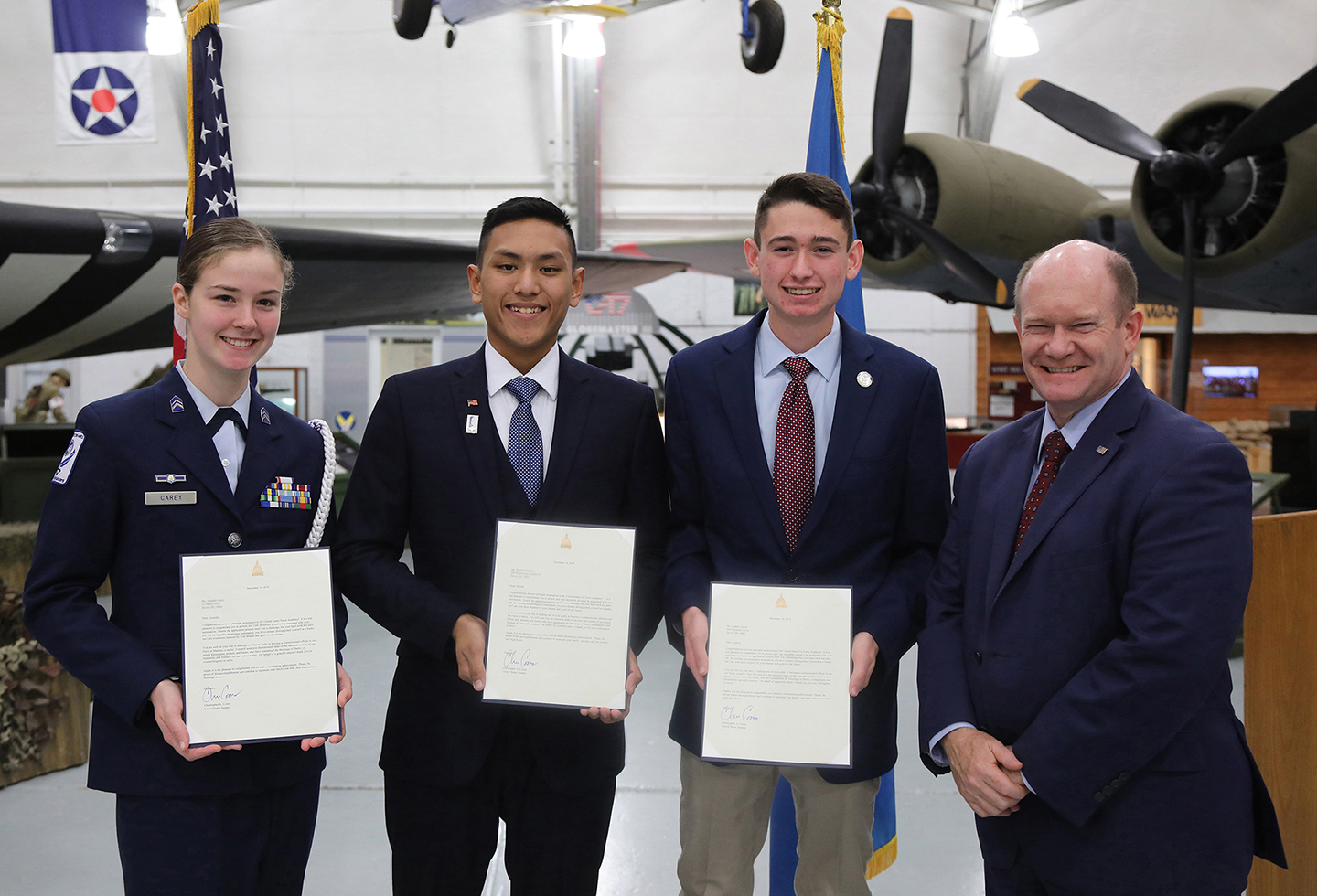
U.S. Senator Chris Coons joins (from left to right) Amanda Carey, Donald Mendoza, and Andrew Garza at the Air Mobility Command Museum in Dover, Del., Dec. 14, 2019. These students, who all live and attend high school in Dover, received principal nominations from Senator Coons for appointment to U.S. service academies for the Class of 2024. Download this photo: https://bit.ly/2RYb82Z.
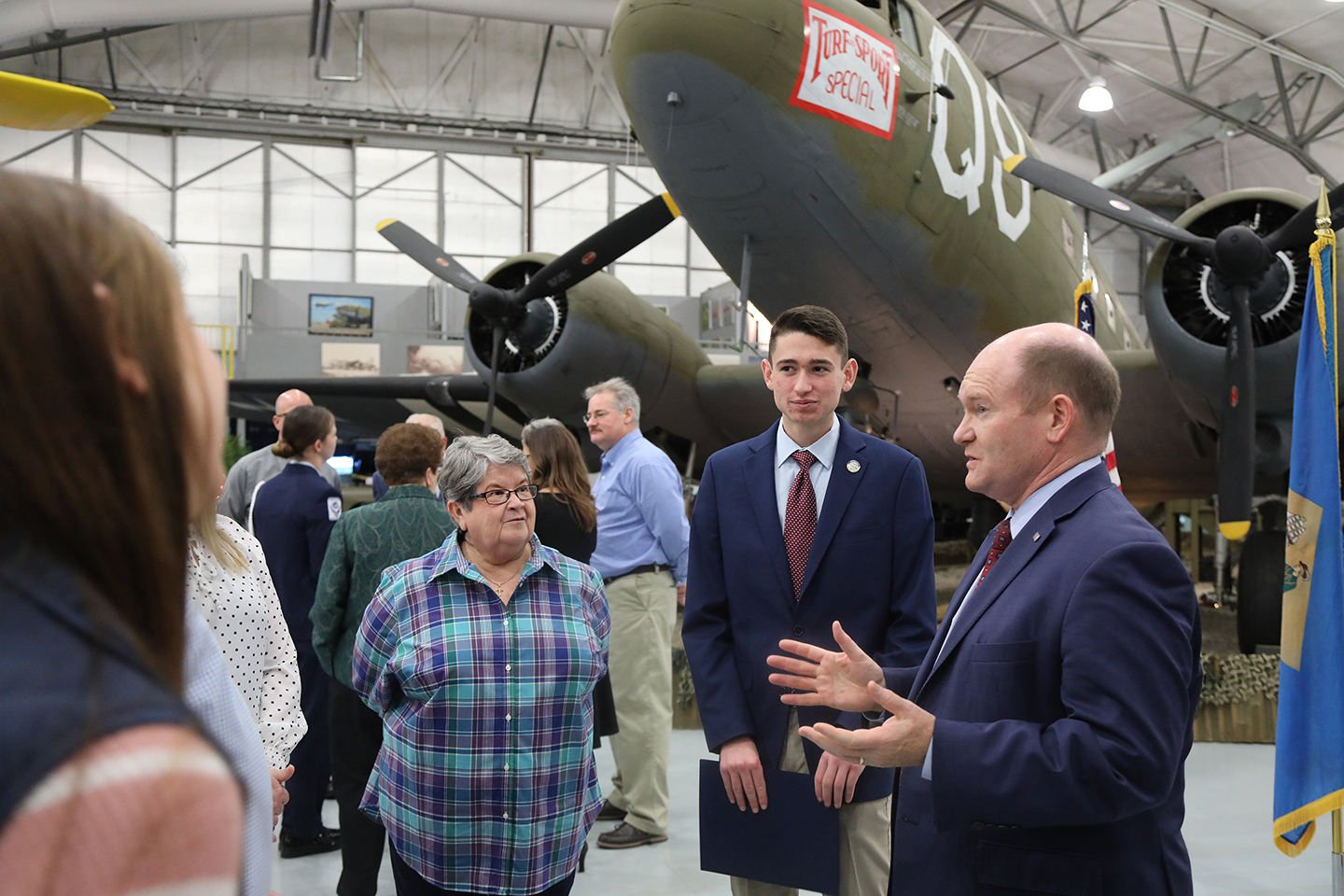
U.S. Senator Chris Coons speaks with Andrew Garza (center) and family members after a ceremony at the Air Mobility Command Museum in Dover, Del., Dec. 14, 2019. Garza, a senior at Polytech High School, received a principal nomination for appointment to the U.S. Air Force Academy in Colorado. Download this photo:https://bit.ly/36EANBZ.
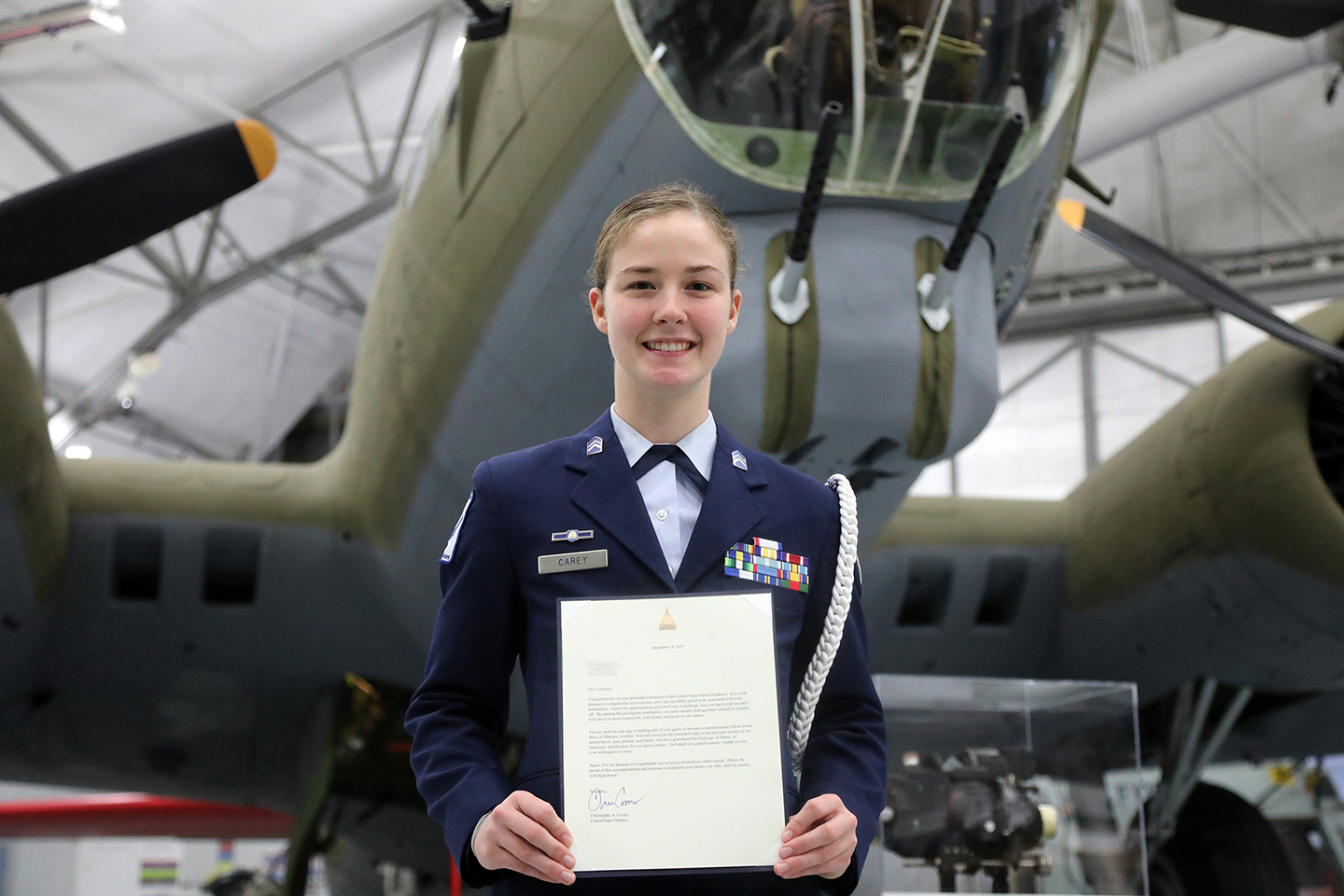
Amanda Carey stands in front of a B-17 Flying Fortress at the Air Mobility Command Museum in Dover, Del., Dec. 14, 2019. Carey, a senior at Dover High School, was named Senator Coons’ principal nominee to the U.S. Naval Academy’s Class of 2024. Download this photo: https://bit.ly/2ElbzfU.
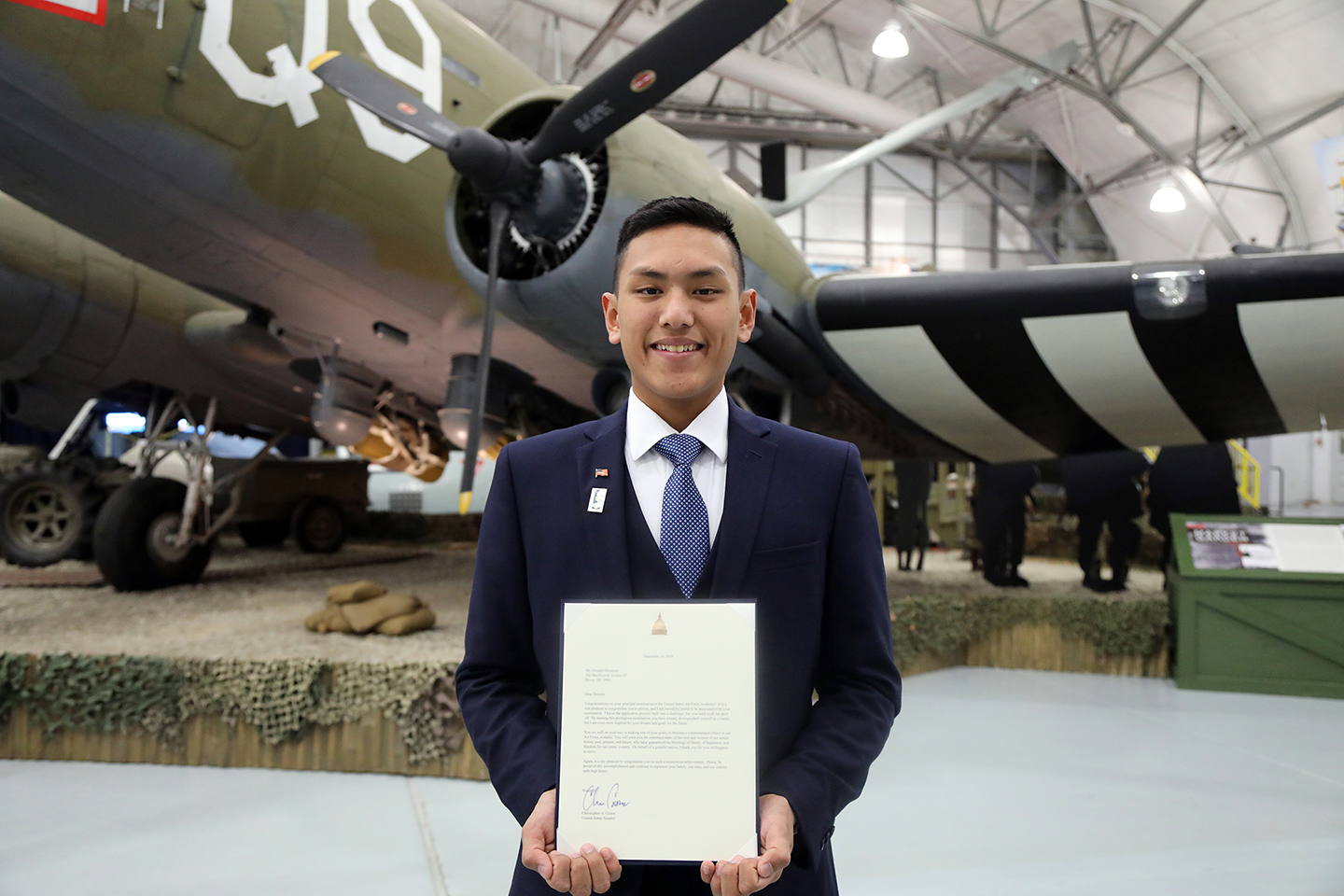
Donald Mendoza stands by a C-47 Skytrain at the Air Mobility Command Museum in Dover, Del., Dec. 14, 2019. Mendoza, a senior at Caesar Rodney High School, received a principal nomination from U.S. Senator Chris Coons for appointment to the U.S. Air Force Academy’s Class of 2024. Download this photo:https://bit.ly/35tFuhQ.
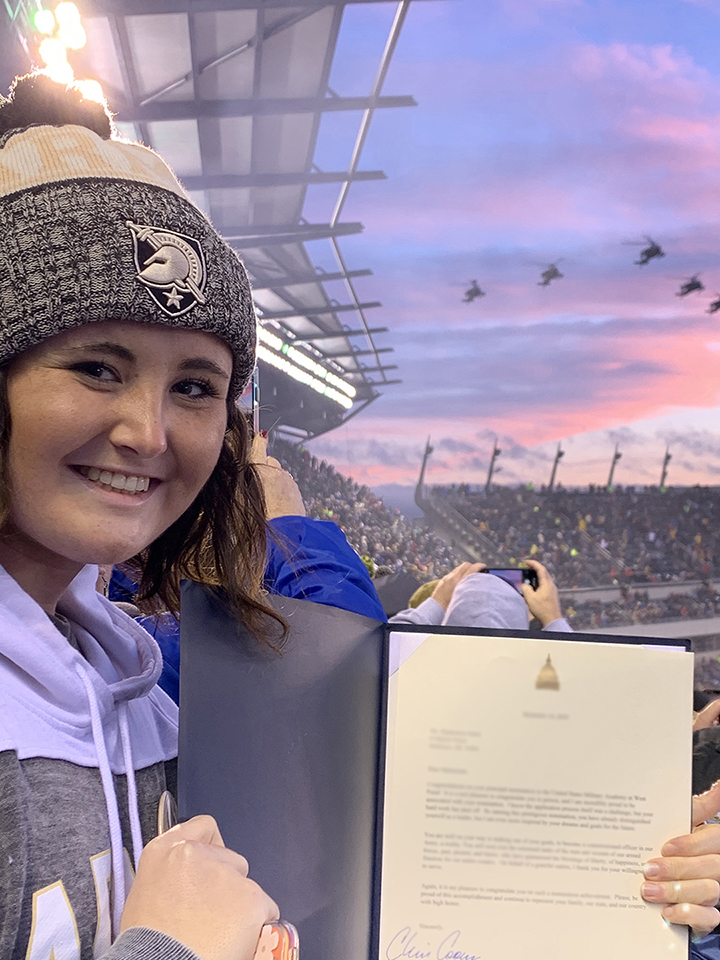
Mackenzie Irelan, of Harbeson, Del., holds a congratulatory letter from U.S. Senator Chris Coons while attending the Army-Navy football game in Philadelphia, Pa., Dec. 14, 2019. Irelan, a senior at Cape Henlopen High School, received the senator’s principal nomination for an appointment to the U.S. Military Academy’s Class of 2024. Download this photo: https://bit.ly/35t0jd3.
###
WASHINGTON – The National Defense Authorization Act (NDAA) conference report that passed the Senate today includes U.S. Senator Chris Coons’ (D-Del.) bipartisan bill to eliminate a federal funding limit on the National Institute for Innovation in Manufacturing Biopharmaceuticals, or NIIMBL, which is headquartered in Newark, Delaware. Currently slated to exhaust a stream of federal dollars after 2021, NIIMBL, under this legislation, could continually earn valuable federal funding, which to date has leveraged $129 million from industry. The bill, which passed the House Dec. 11, now heads to the president’s desk and is expected to become law this week.
Newark-based NIIMBL supports industry-leading research with 130 members from industry, academic institutes, nonprofit organizations, and states. The manufacturing hub, which could extend its $70 million federal grant thanks to Sen. Coons’ bill, connects local manufacturers to national resources to spur local innovation.
Many of the nation’s top companies and universities in the biopharmaceutical field have organized through Delaware to develop vaccines, gene therapies, and cancer drugs that aim to result in lifesaving cures and medical treatments. These innovations have the potential not only to save lives, but create new high-skill, high-paying jobs for Delawareans.
“It brings me great pride that Delawareans are leading the world in the development, testing, and production of medicines of the future,” Senator Coons said. “With this bill, and the vital federal funding opportunity it creates, Delaware’s innovators will continue to not only save lives, but also create jobs for generations of high-skilled Delawareans who will manufacture these lifesaving drugs. Also, other states are empowered to follow Delaware’s lead by forming new institutes specializing in other vital areas of manufacturing.”
“Passage of this Act continues our country’s investment in U.S. advanced manufacturing competitiveness, supports our long-term leadership in innovation, and also helps drive key activities in Delaware related to the bioeconomy,” said Dennis Assanis, president of the University of Delaware. “This Act will promote our nation’s economic growth and lead to a more skilled biomanufacturing workforce.”
“Our Delaware Manufacturing Association consistently hears from employers on their struggle to find skilled workers. With advancing technologies, the need to meet the talent demands of businesses who choose to reside and grow in Delaware is more important than ever,” said Michael Quaranta, president at the Delaware State Chamber of Commerce. “The passing of the GLAM Act will boost Delaware’s manufacturing sector not only through creating well-paying jobs but also by developing and maintaining a skilled workforce.”
Cosponsored by U.S. Sens. Cory Gardner (R-Colo.), Kirsten Gillibrand (D-N.Y.), Thom Tillis (R-N.C.), Maggie Hassan (D-N.H.), Gary Peters (D-Mich.), Jerry Moran (R-Kan.), Marco Rubio (R-Fla.), Amy Klobuchar (D-Minn.), and Susan Collins (R-Maine), the Global Leadership in Advanced Manufacturing Act, or GLAM Act, was filed as an amendment to the NDAA. In addition to the support for NIIMBL, this legislation promotes the development of new Manufacturing USA institutes.
The Manufacturing USA program is a national network of 14 public-private partnership institutes with 1,300-member companies and institutions working to keep the U.S. on the cutting edge of advanced manufacturing. The institutes have generated $2 billion in industry-matched funding to transition innovative technologies from lab to market and to expand the production of goods made in America.
The bill also embeds a liaison of the Manufacturing Extension Partnership in each Manufacturing USA institute to assist with cybersecurity training, workforce development, and technology transfer for small- and medium-sized manufacturers.
###
WASHINGTON — U.S. Senator Chris Coons’ (D-DE) bipartisan legislation, the Global Fragility Act, which will improve U.S. government efforts to prevent terrorism from taking root in developing countries around the world, is expected to become law after being included in the bipartisan appropriations package to fund the federal government for Fiscal Year 2020.
The United States has spent $5.9 trillion fighting terrorism since 9/11. We need a new strategy to address the conditions that enable terrorism to thrive. The passage of this legislation is an important first step towards a strategy to get ahead of the curve and prevent this national security threat.
“The United States has spent nearly $5.9 trillion in the 18 years since 9/11 to combat extremism and terrorism around the world, and it’s clear we need a new strategy to do that more effectively. This legislation is a genuinely bipartisan effort to prevent terrorism from taking hold in the first place, and, by doing that, save American lives and taxpayer dollars. This bipartisan legislation will promote the stabilization of fragile environments where terrorists thrive, build peace, and maximize the impact of U.S. foreign assistance.” said Senator Coons. “Thank you to my colleagues on both sides of the aisle for their support of this legislation, especially Senator Graham, Senator Leahy, Senator Risch, and Senator Menendez, as well as Representative Engel and Representative McCaul. I am also grateful to the United States Institute of Peace for their leadership on this important issue as well as the coalition of organizations led by the Alliance for Peacebuilding and Mercy Corps for their support of this effort. I am looking forward to working with the Trump administration, the private sector, foreign governments, and a wide-range of NGOs to realize the goals of this bill.”
Fragile states can become threats to the security of the United States because their governments are seen as ineffective or illegitimate by their citizens, heightening the risk of terrorism and terrorist recruitment, violent conflict, criminal activity, and corruption. Violent conflict also drives global displacement, with nearly 70 million people forcibly displaced around the world. The Global Fragility Act responds to these challenges by requiring the Secretary of State, Administrator of the United States Agency for International Development (USAID), and the Secretary of Defense to collaborate on a ten-year strategy to prevent and reduce instability in at least five priority countries or regions. The bill improves interagency coordination and enhances monitoring, evaluation, and oversight to ensure the effectiveness of U.S. investments. The legislation also authorizes the establishment of a Multi-donor Global Fragility Fund to leverage and coordinate public and private resources from partners around the world to combat this national security threat.
In addition to Sen. Coons, Senate co-sponsors of the legislation are: Sen. Graham (R-SC), Sen. Merkley (D-OR), Sen. Rubio (R-FL), Sen. Baldwin (D-WI), Sen. Young (R-IN), Sen. Boozman (R-AR), Sen. Markey (D-MA), Sen. Cardin (D-MD), Sen. Gardner (R-CO), Sen. Casey (D-PA), Sen. Collins (R-ME), Sen. Durbin (D-IL), Sen. Isakson (R-GA), Sen. Kaine (D-VA), Sen. Peters (D-MI), Sen. Cantwell (D-MI), Sen. Blumenthal (D-CT), Sen. Shaheen (D-NH), Sen. Van Hollen (D-MD), Sen. Wyden (D-OR), Sen. Klobuchar (D-MN), Sen. Hassan (D-NH), Sen. Reed (D-RI), Sen. King (I-ME), Sen. Murphy (D-CT), and Sen. Hirono (D-HI).
###
WASHINGTON – Today, U.S. Senator Chris Coons (D-Del.), a member of the Senate Appropriations Committee and the top Democrat on the Financial Services and General Government Subcommittee, led the successful effort to include $425 million in funding for election security grants to help states protect their election systems in the Fiscal Year 2020 federal funding bill poised to pass Congress and become law in the coming days.
“We know that foreign adversaries are actively planning to attack our elections once again in 2020, so we have to make investments now in updated voting systems that the American people can trust and rely on,” said Senator Coons. “As a member of the Appropriations Committee, I’ve been fighting for years to ensure that the federal government provides states with the funding they need to replace outdated election machinery and invest in cybersecurity. This is a responsible investment, and I’m pleased that, on a bipartisan basis, we were able to come to this agreement.”
Senator Coons also led the successful effort to include $380 million in funding for election security grants in the Fiscal Year 2018 federal funding bill.
Recently, the Senate Select Committee on Intelligence released a report that outlined Russian efforts to interfere in the 2016 presidential election and target our nation’s election infrastructure in all 50 states, conducting reconnaissance, probing and mapping systems, and looking for vulnerabilities to exploit. According to the report, the Russian government was able to gain access to election systems in two states, including successfully accessing and extracting up to 200,000 voter registration records in Illinois.
###