Related Issues

Related Issues

President set to sign Sen. Coons’ bipartisan bill to support local veterans treatment courts

WASHINGTON – On Monday, the House passed legislation sponsored by U.S. Senator Chris Coons (D-Del.), a member of the Senate Judiciary Committee, to expand access to veterans treatment courts and allow those who served our nation to receive the care they need. In addition to Senator Coons, the Veteran Treatment Court Coordination Act was championed by Senators Martha McSally (R-Ariz.) and Tim Kaine (D-Va.). 

The legislation to improve care for our nation’s veterans passed the Senate in January. On Monday, the U.S. House of Representatives, led by Representatives Charlie Crist (D-Fla.) and Elise Stefanik (R-N.Y.), passed the Senate’s amendment to the House bill by unanimous consent, paving the way for the President’s signature.

“As a country, we make a promise to our nation’s veterans to give them the support they need after their service. I’m proud to lead a bipartisan group of my colleagues on a bill that helps to uphold our commitment to the U.S. service members who’ve sacrificed so much for our country,” said Senator Coons. “Veterans treatment courts are critical in ensuring that veterans get access to the services they need and deserve. Delaware has been a leader in this effort with the launch of the first statewide veterans treatment court program in 2011, and with the passage of this bill, we can continue to build on the success we’ve had in Delaware for veterans across the nation.”

###

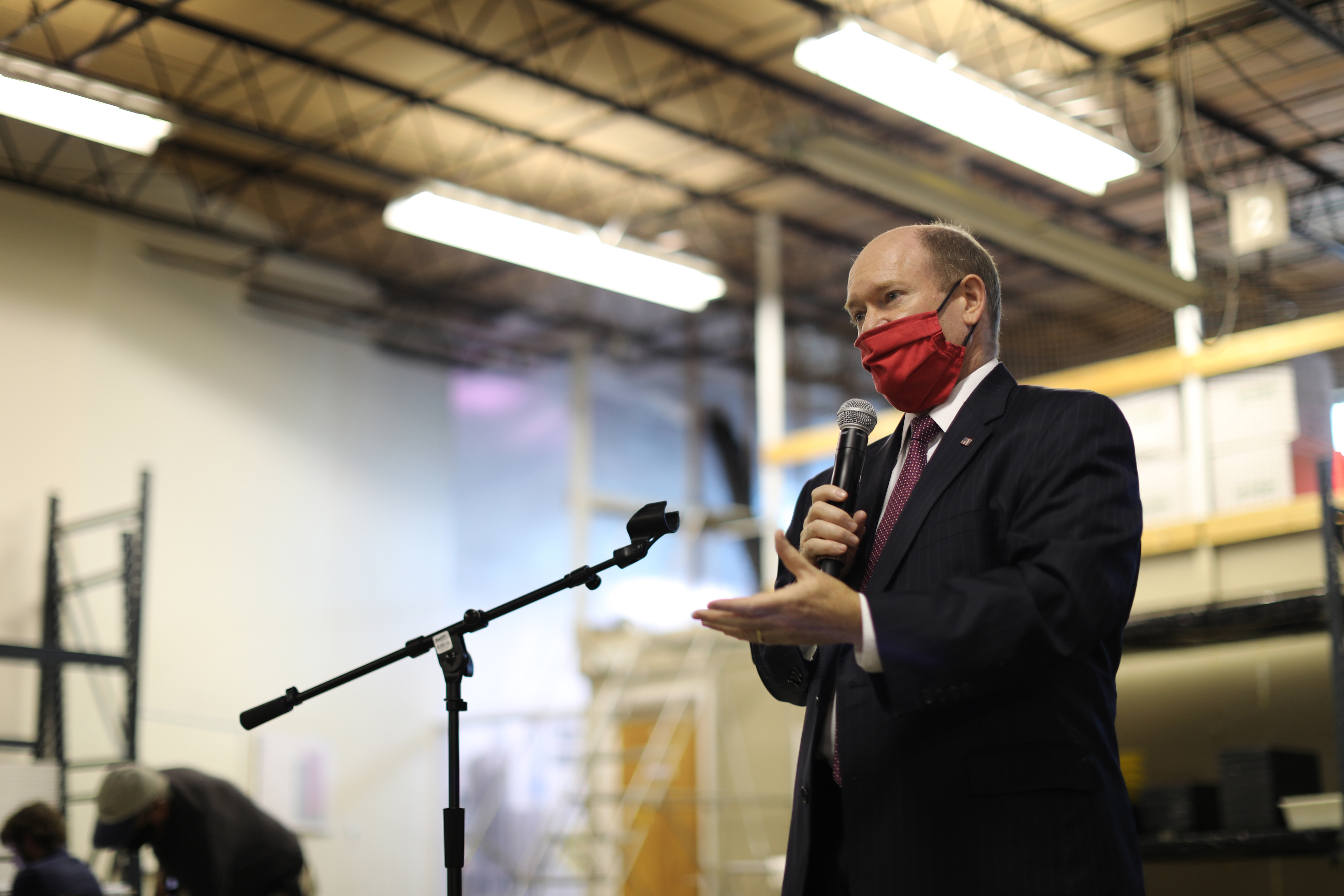
PHOTO: Coons talks Driving for Opportunity Act at federally-designated opportunity zone in Wilmington, Delaware

Before heading to Washington, U.S. Sen. Chris Coons (D-Del.) addresses a group of advocates working to reduce recidivism and like-minded business leaders at Second Chance Farms in Wilmington, Delaware, July 20, 2020. Coons talked about his work as an original cosponsor of the revised First Step Act of 2018 and provided details of the Driving for Opportunity Act, a bill introduced by Sen. Coons and Sen. Roger Wicker (R-Miss.) this month. This bipartisan bill aims to create incentives to stop debt-based driver’s license suspensions. Nationwide, at least 11 million people have their driver’s licenses suspended because they cannot pay fines or fees, not for any public safety reasons. These suspensions make it harder for Delawareans to commute to work to pay off the debts and places an unnecessary burden on the police to enforce suspensions, especially putting officers and citizens at increased risk of infection during a pandemic. (Photo by Office of U.S. Sen. Chris Coons/Released)

Download high-resolution images here: https://www.flickr.com/photos/senatorchriscoons/albums

For more about the Driving for Opportunity Act, visit https://bit.ly/2OGDDzB

Sens. Coons, Leahy introduce bill to block Pres. Trump’s attempt to withdraw from World Health Organization

WASHINGTON — Today, U.S. Senators Chris Coons (D-Del.), a member of the Senate Appropriations and Foreign Relations Committees, and Patrick Leahy (D-Vt.), Vice Chairman of the Senate Appropriations Committee, introduced the No WHO Withdrawal Act to block President Trump’s attempt to withdraw the United States from the World Health Organization (WHO) and prohibit congressionally appropriated funds from being used to execute a withdrawal.

The United States has been a member of the WHO since its founding in New York in 1946. The WHO has since played an essential role to help countries manage and respond to public health threats  including COVID-19  by improving preparedness, accelerating research for treatment and therapeutics, distributing supplies, and facilitating international coordination.

After over 70 years of membership, the Trump administration notified the WHO on July 6 that the United States would cut ties with the organization in the midst of the deadliest pandemic in decades.

According to a Joint Resolution of Congress, the United States can withdraw from the WHO under two conditions: the United States must provide notice one year before withdrawing and must fulfill its financial obligations. Congress holds the constitutional power to prevent appropriated funds from being used to support the President’s unilateral decision. The No WHO Withdrawal Act would block funding for a U.S. withdrawal and assert that it is U.S. policy to continue to work within the WHO to reform and improve the organization.

Congress can and should assert its constitutional authority to block the President’s reckless decision and ensure that the United States remains a member of the World Health Organization,” said Senator Coons. “Shifting blame and cutting ties with the WHO will not save lives, restart our economy, or stop the spread of COVID-19 around the world. In fact, it will do the opposite. The Congress should work to prevent the Trump administration’s continued deterioration of U.S. global leadership and block this dangerous move.”

“The decision to withhold funds, and to then formally withdraw, from the World Health Organization in the midst of the greatest public health catastrophe in a century — that has killed more Americans than in Korea, Vietnam, Iraq and Afghanistan combined and shows no sign of being brought under control — was one of the most colossal blunders of this error-prone White House.  The President blames WHO for not being tough enough with China, at the very time he was praising Xi Jinping for his handling of the coronavirus.  WHO made mistakes, but it is playing an essential role in fighting COVID-19 around the world as well as malaria, TB, polio, and many other public health threats.  The real blame goes to our self-proclaimed wartime President who dismissed the pandemic as nothing to worry about, turned wearing masks into a divisive political issue while over 140,000 Americans died, and has yet to come up with a national strategy to control the virus.  The United States should be a strong supporter of WHO, both so it can do its job today, and to strengthen its ability to respond to the next pandemic.  This is legislation to ensure that,” said Senator Leahy.

The bill text is available here.

###

Coons, Durbin, colleagues introduce resolution opposing Russia’s inclusion in G7

WASHINGTON – U.S. Senator Chris Coons (D-Del.) joined U.S. Senate Democratic Whip Dick Durbin (D-Ill.), Co-Chair of the bipartisan Senate Ukraine Caucus, and 11 of their colleagues in introducing a resolution opposing Russia’s inclusion into the Group of Seven (G7).  Despite Russia’s occupation of Ukraine, its destabilizing actions against the U.S. and other democracies worldwide, and the recent reporting that Russia offered bounties to target American troops deployed to Afghanistan, President Donald Trump has repeatedly called for Russia to be readmitted to a Group of Eight or to participate in a G7 proceeding.  The resolution makes it clear that the U.S. Senate would oppose Russia’s readmission unless it ceases its malign actions against Ukraine, the U.S., and our allies. 

Along with Coons and Durbin, the resolution is cosponsored by Senators Richard Blumenthal (D-Conn.), Cory Booker (D-N.J.), Mazie Hirono (D-Hawaii), Chris Van Hollen (D-Md.), Tammy Baldwin (D-Wis.), Bob Casey (D-Pa.), Sherrod Brown (D-Ohio), Dianne Feinstein (D-Calif.), Ed Markey (D-Mass.), Ron Wyden (D-Ore.), and Kamala Harris (D-Calif.).

A copy of today’s Senate resolution is available here. 

###

ICYMI – WaPo: Coons-Wicker bill targeting debt-based driver’s license suspensions “promising fix” to punishing poverty

WILMINGTON, Del. – In case you missed it, the Washington Post editorial board endorsed the Driving for Opportunity Act, bipartisan legislation introduced this month by U.S. Senators Chris Coons (D-Del.) and Roger Wicker (R-Miss.) to incentivize states to end debt-based driver’s license suspensions. An estimated 11 million people nationwide have their license suspended because of unpaid fines and fees, not for any public safety reasons. 

Washington Post: Millions have unfairly lost their driver’s licenses over unpaid fines. Here’s a promising fix.

Suspending driver’s licenses as a penalty for non-payment of fines and fees unrelated to public safety is a self-defeating policy. It intensifies pressure on individuals already struggling with job loss and financial hardship, and it adds strain to relations between police officers and the public they serve. It makes the slope of failure even more slippery for millions of the most vulnerable Americans. And it’s the law of the land in 42 states. 

In the Senate, a bill that would encourage states to repeal such laws was introduced this month. In a hopeful sign, a Republican and a Democrat are its two main sponsors: Sen. Roger Wicker (R-Miss.) and Sen.?Christopher A. Coons (D-Del.).

Advocates across the ideological spectrum — the Koch network to the ACLU — support the bill, known as the Driving for Opportunity Act. And no wonder: It doesn’t take much explaining to see that punishing poverty is a losing strategy, and one this country can ill afford.

The full editorial is available here. 

###

Sens. Carper, Coons join bipartisan effort to boost immunization infrastructure

WILMINGTON, Del. — U.S. Senators Tom Carper and Chris Coons (both D-Del.) joined Senators Jack Reed (D-R.I.) and Susan Collins (R-Maine) and 23 other colleagues in calling for Congress to provide at least $5.6 billion in federal funding to develop and support COVID-19 vaccine infrastructure.  The lawmakers say the funds are needed to boost the nation’s vaccine supply and distribution system and should be included in the next coronavirus relief package.  The federal funds could be used for distribution, provider training, public education, and to broaden vaccine access.

“We respectfully request at least $5.6 billion in funding to develop and support the critical vaccine infrastructure necessary to ensure that when a COVID-19 vaccine is available, it can be readily deployed across the country, particularly to high-risk populations,” the senators wrote. “Successful and equitable distribution of a safe and effective vaccine is vital to allow our country and our economy to fully recover from the COVID-19 pandemic, to save lives over the long term, and to get Americans back to work safely.  However, the public health potential of a vaccine can only be realized by the system that ensures sufficient vaccination rates across the country to protect people from the virus and keep the disease from reemerging.”

Through the Coronavirus Preparedness & Response Supplemental Appropriations Act (PL 116-123), the Coronavirus Aid, Relief, and Economic Security (CARES) Act (PL 116-136), and other measures, Congress has dedicated over $6.5 billion in federal funding through the Biomedical Advanced Research and Development Authority (BARDA) for the development of vaccines, treatments and other products to address COVID-19.  The Trump Administration has allocated more than $2.2 billion of this federal funding in deals with five vaccine manufacturers for COVID-19.  While this funding is critical, the senators say it is also important to strengthen the ability of states and local governments to boost their immunization infrastructure.

State and local immunization infrastructure elements include vaccine purchase; storage; handling and safety; provider and community education and outreach; immunization information systems (IIS) or registries; disease surveillance; and outbreak response.

“Just as Congress has invested in vaccine development, we must also invest in the deployment of a vaccine against COVID-19,” the senators wrote. “As such, we ask that the next COVID-19 relief legislation include at least $3.6 billion for state and local infrastructure to develop vaccine distribution systems, deploy the vaccine to ensure coverage across every community, track COVID-19 vaccine coverage, monitor the safety of the vaccine, and support a media and education campaign to educate providers, and ensure community outreach.  Such funding must be made available as soon as possible to allow states the time to build out this vaccine infrastructure and purchase the supplies needed so that systems are in place and ready to launch as soon as a vaccine is available.  We cannot afford to wait until a vaccine is approved to begin this critical work.”

And with public health experts predicting that a second wave of COVID-19 could hit in the fall and winter and overlap with the flu season, the senators are also seeking a dedicated $2 billion allocation over Fiscal Years 2020 and 2021 for flu awareness and education and flu vaccination campaigns to ensure people get vaccinated for the flu: “This effort will be critical to protect people from getting infected with the flu virus, keep them out of the hospital in order to preserve beds for COVID-19 patients, and prevent people from being infected with both viruses simultaneously, which could be even more lethal and overwhelm hospital systems,” the senators wrote.

The senators concluded by noting that there must be sufficient “funding for our existing vaccine infrastructure to ensure children keep getting their regular vaccines, especially as states and localities consider reopening schools in the fall.   We are concerned about reports of decreasing rates of routine immunizations among children, as parents may avoid non-emergency appointments and check-ups with their children’s pediatricians. Efforts to build up a COVID-19 vaccine infrastructure must supplement, not supplant, existing vaccine infrastructure.  In fact, more resources may be needed to keep up routine vaccination rates in the face of the challenges presented by COVID-19.” 

In addition to Carper, Coons, Reed, and Collins, the letter is signed by Senators Jeff Merkley (D-Ore.), Jacky Rosen (D-Nev.), Tina Smith (D-Minn.), Chris Van Hollen (D-Md.), Sherrod Brown (D-Ohio), Dianne Feinstein (D-Calif.), Ron Wyden (D-Ore.), Elizabeth Warren (D-Mass.), Richard Blumenthal (D-Conn.), Jeanne Shaheen (D-N.H.), Mazie K. Hirono (D-Hawaii), Brian Schatz (D-Hawaii), Dick Durbin (D-Ill.), Angus King (I-Maine), Edward J. Markey (D-Mass.), Kirsten Gillibrand (D-N.Y.), Tim Kaine (D-Va.), Gary Peters (D-Mich.), Kyrsten Sinema (D-Ariz.), Amy Klobuchar (D-Minn.), Debbie Stabenow (D-Mich.), Sheldon Whitehouse (D-R.I.), and Maggie Hassan (D-N.H.).

Full text of the letter follows:

July 15, 2020

Dear Majority Leader McConnell and Minority Leader Schumer:

Thank you for your bipartisan work to respond to the health and economic effects of the novel coronavirus (COVID-19) pandemic in the United States.  As you prepare for the next relief package, we respectfully request at least $5.6 billion in funding to develop and support the critical vaccine infrastructure necessary to ensure that when a COVID-19 vaccine is available, it can be readily deployed across the country, particularly to high-risk populations.  Successful and equitable distribution of a safe and effective vaccine is vital to allow our country and our economy to fully recover from the COVID-19 pandemic, to save lives over the long term, and to get Americans back to work safely.  However, the public health potential of a vaccine can only be realized by the system that ensures sufficient vaccination rates across the country to protect people from the virus and keep the disease from reemerging.

We were pleased to support previous COVID-19 emergency response bills that included critical funding for the development, production, and manufacturing of a vaccine and helped ensure health insurance coverage of a vaccine for many Americans.  The Coronavirus Preparedness & Response Supplemental Appropriations Act (PL 116-123) included nearly $900 million in supplemental appropriations for research and development of vaccines, therapeutics, and diagnostics for COVID-19.  Further, the Coronavirus Aid, Relief, and Economic Security (CARES) Act (PL 116-136) provided $3.5 billion in funding for manufacturing, production, and purchase of vaccines, therapeutics, and diagnostics for COVID-19.  In addition, the CARES Act ensures private insurance coverage and Medicare coverage of a vaccine with no cost sharing.  These are all critical steps to bolster vaccine development as quickly as possible and ensure the American people can afford the vaccine when available. 

Just as Congress has invested in vaccine development, we must also invest in the deployment of a vaccine against COVID-19. As such, we ask that the next COVID-19 relief legislation include at least $3.6 billion for state and local infrastructure to develop vaccine distribution systems, deploy the vaccine to ensure coverage across every community, track COVID-19 vaccine coverage, monitor the safety of the vaccine, and support a media and education campaign to educate providers, and ensure community outreach.  Such funding must be made available as soon as possible to allow states the time to build out this vaccine infrastructure and purchase the supplies needed so that systems are in place and ready to launch as soon as a vaccine is available.  We cannot afford to wait until a vaccine is approved to begin this critical work.

Given the prediction that a second wave of the COVID-19 pandemic will emerge in the fall and winter and overlap with the flu season, we also ask that the next COVID-19 relief package include $2 billion over Fiscal Years 2020 and 2021 for flu awareness and education and flu vaccination campaigns to ensure people get vaccinated for the flu.  This effort will be critical to protect people from getting infected with the flu virus, keep them out of the hospital in order to preserve beds for COVID-19 patients, and prevent people from being infected with both viruses simultaneously, which could be even more lethal and overwhelm hospital systems. 

We also must ensure sufficient funding for our existing vaccine infrastructure to ensure children keep getting their regular vaccines, especially as states and localities consider reopening schools in the fall.   We are concerned about reports of decreasing rates of routine immunizations among children, as parents may avoid non-emergency appointments and check-ups with their children’s pediatricians.  Efforts to build up a COVID-19 vaccine infrastructure must supplement, not supplant, existing vaccine infrastructure.  In fact, more resources may be needed to keep up routine vaccination rates in the face of the challenges presented by COVID-19. 

Thank you for your attention to this critical need as you negotiate the next COVID-19 package.  Widespread vaccination will be critical to restoring our economy, getting people back to work, and returning to normal, and we look forward to working with you towards that goal.

Sincerely,

###

ICYMI: More than 50 organizations, local governments call for passage of Coons-Wicker Driving for Opportunity Act

WILMINGTON, Del. — In a letter to Congressional leaders, more than 50 organizations, including civil rights groups and local governments, expressed support for the Driving for Opportunity Actlegislation introduced by U.S. Senators Chris Coons (D-Del.) and Roger Wicker (R-Miss.) to create incentives to stop debt-based driver’s license suspensions.

Nationwide, at least 11 million people have their driver’s licenses suspended because they cannot pay fines or fees, not for any public safety reasons. This makes it harder for Americans to go to work to pay off their debts and places an unnecessary burden on police to enforce suspensions, expending resources that should go to public safety, increasing hostilities in the communities they serve, and putting officers and citizens at increased risk of infection during a pandemic.  

“In order for our economy to flourish again, we must stop taking away people’s licenses for ‘driving while broke’. We must remove unnecessary barriers that keep individuals from finding and keeping employment. Driver’s license suspension should only be used to address dangerous driving and not as a collection tool. Debt-based driver’s license suspension serves no public safety purpose, while crippling those who are struggling with poverty,” the signatories wrote. “The federal government should do everything it can to assist states in ending debt-based driver’s license suspensions. By providing states with financial assistance to help reinstate licenses that were suspended for unpaid fines and fees, the Driving for Opportunity Act will expand the economy and improve public safety.”

Since the bipartisan bill was introduced two weeks ago, it has continued to garner support from a variety of organizations, including the U.S. Chamber of Commerce, the National District Attorneys Association, the Federal Law Enforcement Officers Association, the National Urban League, and Instacart. 

As of today, a broad coalition of 78 groups spanning the political spectrum, including civil rights and civil liberties advocates, law enforcement officers, prosecutors, defenselawyers, progressives, conservatives, local governments, and businesses have endorsed the Driving for Opportunity Act. For a full list of supportive groups, please click here.

The text of the letter and list of signers is available here

For a one-pager on the Driving for Opportunity Act, please click here. For the bill text, please click here.

###

New Christina River Bridge at Wilmington Riverfront dedicated to Former State Senator Margaret Rose Henry

WILMINGTON, Del. – U.S. Senator Chris Coons joined state and local officials in dedicating the recently opened Christina River Bridge at the Wilmington Riverfront in honor of former state senator Margaret Rose Henry.

“Senator Margaret Rose Henry’s proud legacy of service to the people of the eastside of Wilmington and the State of Delaware has made a lasting impact,” said Governor John Carney. “The Margaret Rose Bridge that will now carry her name serves as an important connector for our communities, and as a welcoming symbol to the city.”

“Few public servants have had such a profound effect on the lives of the people of Delaware – and her Wilmington constituents in particular – as Senator Margaret Rose Henry, the first African American woman to serve in the Delaware Senate,” said Wilmington Mayor Mike Purzycki. “As a legislator, Henry was adept at building bridges, so it is only fitting that the City’s newest bridge now bears her name.”

“This new bridge is about more than simply helping people cross the Christina River. It’s about connection and opportunity. With pedestrian and bicycle lanes, this multi-modal bridge will expand access to new educational and job opportunities for drivers, bikers and pedestrians alike. By opening up the east bank of the Riverfront, this bridge will help to spur the redevelopment of the Riverfront to Southbridge and connect small businesses along the Christina River with a larger customer base. As we celebrate the ribbon cutting of this new bridge, we also celebrate what greater connection and more opportunity can do for the future of Wilmington and the people who call it home,” Senator Carper said. “For years, I fought to secure funding for this project, and I’ve been proud to watch its progress every step of the way. This is a great day for Wilmington.”

“The Senator Margaret Rose Henry Bridge will have a lasting effect on the city of Wilmington, and I’m so glad that we can honor Margaret in this special way,” said Senator Coons. “This bridge is the product of years of work, planning, and building from Senator Carper, from DelDOT, and from people across Delaware. This project improves access for walkers and bikers, and, in turn, makes Wilmington a more vibrant and safer city for all.”

“Senator Margaret Rose Henry is a personal role model and icon in the State of Delaware. Her groundbreaking work and accomplishments in the General Assembly have touched and improved the lives of countless Delawareans and the impact of that work will be felt for generations to come,” said Rep. Blunt Rochester. “Today’s unveiling of the Senator Margaret Rose Henry Bridge in Wilmington is a fitting tribute to her work and an exciting addition to the city of Wilmington. Senator Henry spent her entire career building bridges to connect Delawareans and I’m confident this bridge in her namesake will do the same.”

Secretary of Transportation Jennifer Cohan commented, “The Senator Margaret Rose Henry Bridge and new approach roads are a game changer for the south side of Wilmington, improving access and traffic flow and making the entire area safer and more user-friendly whether you are on foot, bike, or in a car. It is a beautiful bridge named after a beautiful lady!”

The nearly $82 million project, which broke ground in June 2017, includes a 470-foot multi-modal bridge over the Christina River that includes two 12-foot travel lanes and a separated 14-foot wide bicycle and pedestrian path, and more than 1.5 miles of new and improved roads, sidewalks, parking, and drainage. The new access road for the Russel W. Peterson Wildlife Refuge will begin construction later this summer.

Senator Henry became the first African American woman to serve in the Delaware Senate in 1994, and has a decades-long career of public service, working in nonprofit administration and championing legislation for causes such as education, autism, health, housing, gun control, mental health, medical marijuana and expanded services for seniors. She last served in the General Assembly in 2018.

###

Delaware Delegation secures $1.6 million for Nanticoke Hospital

WILMINGTON, Del. – Today, U.S. Senators Tom Carper and Chris Coons and Congresswoman Lisa Blunt Rochester (all D-Del.) announced that the Department of Health and Human Service (HHS) will provide a $1.6 million payment to Nanticoke Hospital in Seaford, Delaware to help address the ongoing impact of the COVID-19 pandemic. The award comes after the Delaware Congressional Delegation wrote to HHS Secretary, Alex Azar requesting an award for Nanticoke after it did not initially receive funding from rural hospital support included in the CARES Act.

“Nanticoke, as a rural Medicare Dependent Hospital (MDH), is experiencing all of the same Covid-19 challenges that other small, rural hospitals across the nation are facing to include looming cuts without immediate assistance,” the Delegation wrote. “However, as a rural MDH in an all urban state, Nanticoke did not qualify for any of the badly needed funding from the rural set aside of the Provider Relief Fund. We are very concerned by this situation, and believe Nanticoke is unique in the nation in this regard. 

“I’m thrilled that our delegation was able to work together to get the relief funding that Nanticoke so rightfully deserves,” said Senator Carper. “Our health care workers and hospital support staff are the heroes that have emerged from this pandemic. Those on the front lines at Nanticoke Hospital have been providing critical health care services to Western Sussex County and beyond as we battle the coronavirus. We have a responsibility to make sure that health care workers throughout our state, but especially at small, rural hospitals where budgets are already stretched thin, have the necessary resources as they selflessly work to keep our communities healthy and safe. I want to thank Secretary Azar for recognizing the need to bolster funding for Nanticoke, and I will continue working with Senator Coons and Congresswoman Lisa Blunt Rochester to ensure this critical hospital gets the federal funding it needs to continue to serve and support this community.”

“In the midst of this pandemic and economic crisis, my first priority is delivering aid and resources to Delaware, and this $1.6 million federal funding is absolutely critical for Nanticoke Hospital to continue providing care to our neighbors in need,” said Senator Coons. “Our health systems are facing incredible pressure and treating more patients than ever, and I will continue doing everything I can to ensure they have the full support of the federal government.” 

“Nanticoke Hospital has been on the frontlines of the COVID-19 pandemic here in Delaware. Like many small, rural hospitals across the country, Nanticoke has faced an unprecedented drain on their resources in recent months,” said Rep. Blunt Rochester. “That’s why it was so disappointing to find out that Nanticoke did not qualify under the rural hospital provision of the CARES Act. Senators Carper, Coons, and I immediately went to work to try to get Nanticoke the funding they needed and deserved. I want to thank the Senators for their advocacy, Secretary Azar for giving Nanticoke this award, and the health care heroes on the frontlines at Nanticoke who continue to do the hard work of fighting COVID-19.” 

“Our charge, like hospitals across the country, is to care for our community regardless of the financial burden we may have to incur to do so,” said Penny Short, MSM, BSN, RN and President of Nanticoke Memorial Hospital. “Through the COVID-19 pandemic, Nanticoke has incurred losses in revenue as we continued to care for patients while having to close or significantly limit key services like outpatient cardiology procedures and outpatient or elective surgeries. The additional $1.6 million rural hospital payment from HHS helps to further replace some of those losses, allowing Nanticoke to continue its financial recovery from the first wave of COVID-19. We are truly grateful to the Delaware Congressional Delegation for supporting Nanticoke and helping to secure this critical funding designed for rural hospitals for Nanticoke and for our community.”

###

Carper, Coons, Blunt Rochester urge ICE and DHS to immediately withdraw new guidance that threatens international students with deportation

WILMINGTON, Del. – U.S. Senators Tom Carper and Chris Coons and U.S. Representative Lisa Blunt Rochester (all D-Del.) joined colleagues in both the House and Senate in sending a letter to U.S. Immigration and Customs Enforcement (ICE) and the U.S. Department of Homeland Security (DHS), urging the agencies to withdraw new guidance issued by ICE that imperils the status of international students who would be studying online at U.S. institutions this coming academic year. The guidance threatens international students with deportation if they do not comply with the requirement that they take in-person classes.

In the letter, the lawmakers expressed deep concerns that ICE’s guidance is motivated not by public health considerations, but rather by animus toward non-citizens and immigrants and is a flagrant attempt to hold international students hostage in order to force schools to reopen even as COVID-19 cases are rising. The 2018-2019 academic year saw more than one million international students in the United States. 

“ICE’s announcement of their plans to force out or deport international students who remain at U.S. colleges and universities and who are taking a full online course load is cruel and unconscionable,” the lawmakers wrote. “These students are already in the United States, are established members of educational communities, and have been determined through the visa screening process to pose no danger to the United States.” 

“We call out this policy for what it is: a cruel, senseless, and xenophobic attempt to use noncitizens as political pawns in order to financially coerce colleges and universities to reopen campuses this fall, despite what is best for public health,” the lawmakers continued. “This policy is dangerous to the health and well-being of numerous communities.”

Some colleges and universities have transitioned to online learning due to the pandemic, consistent with guidelines from the U.S. Centers for Disease Control and Prevention (CDC), which recognizes the diversity of various institutions of higher education and advises them to “adjust() to meet the unique needs and circumstances” they face when trying to keep their communities safe. On Monday, ICE issued guidance that altered the Student and Exchange Visitor Program’s requirements for international students, imposing a one-size-fits-all standard on all colleges and universities. According to that guidance, international students on F-1 visas (for full-time study at an academic institution) and M-1 visas (for vocational or other nonacademic training) will not be allowed to take a full online course load while in the United States. This affects incoming students, who will not be permitted to receive their visas or enter the country, as well as international students already in the United States. Under the new guidance, current international students in the United States will have to transfer to another school with in-person classes, leave the country, or face deportation.

COVID-19 continues to spread throughout the United States, causing many institutions of higher education to move most or all of their courses online to protect their students, faculty, and staff. Some colleges developed these plans in consultation with local public health officials, and these plans are consistent with the CDC’s guidance for colleges and universities, which advises them to “offer virtual learning and telework options, if feasible.”  ICE’s actions put that careful planning in disarray, and limit the flexibility of colleges and universities to address the pandemic as the needs of the moment require.

Although the Trump Administration is attempting to blame this new guidance on existing regulations, it is failing to preserve or pursue options to provide flexibility to international students and to institutions of higher education. At the same time, recent statements by Administration officials suggest that DHS and ICE released this guidance as a pretext to force institutions of higher education to reopen against the advice of public health experts and local officials.

In addition to urging ICE and DHS to rescind this policy immediately, the lawmakers requested a staff briefing to discuss the Administration’s rationale for this reckless policy by July 16, 2020. 

The letter was also signed by Senators Elizabeth Warren (D-Mass.), Edward J. Markey (D-Mass.), Jeff Merkley (D-Ore.), Richard Blumenthal (D-Conn.), Charles E. Schumer (D-N.Y.), Patty Murray (D-Wash.), Mazie K. Hirono (D-Hawaii), Cory Booker (D-N.J.), Jack Reed (D-R.I.), Tim Kaine (D-Va.), Patrick Leahy (D-Vt.), Amy Klobuchar (D-Minn.), Sheldon Whitehouse (D-R.I.), Bernie Sanders (I-Vt.), Tammy Baldwin (D-Wisc.), Sherrod Brown (D-Ohio.), Robert Menendez (D-N.J.), Catherine Cortez Masto (D-Nev.),  Kirsten Gillibrand (D-N.Y.), Martin Heinrich (D-N.M.), Chris Van Hollen (D-Md.), Ron Wyden (D-Ore.), Tammy Duckworth (D-Ill.), Dick Durbin (D-Ill.), Tina Smith (D-Minn.), Jacky Rosen (D-Nev.), Kamala D. Harris (D-Calif.), Bob Casey (D-Penn.), Michael Bennet (D-Colo.), and Tom Udall (D-N.M.). 

The letter was also signed by Representatives Ayanna Pressley (D-Mass.), Jerrold Nadler (D-N.Y.), Zoe Lofgren (D-Calif.), Pramila Jayapal (D-Wash.), Joe Neguse (D-Colo.), Katherine Clark (D-Mass.), Seth Moulton (D-Mass.), Jesús G. “Chuy” García (D-Ill.), Nydia M. Velázquez (D-N.Y.), Gerald E. Connolly (D-Va.), Alexandria Ocasio-Cortez (D-N.Y.), Bonnie Watson Coleman (D-N.J.) Ilhan Omar (D-Minn.), Eleanor Holmes Norton (D-D.C.), Danny K. Davis (D-Ill.), Jamie Raskin (D-Md.), Peter Welch (D-Vt.), Lori Trahan (D-Mass.), Jan Schakowsky (D-Ill.), Yvette D. Clarke (D-N.Y.), Betty McCollum (D-Minn.), Jim Cooper (D-Tenn.), Hakeem Jeffries (D-N.Y.), Mark Pocan (D-Wis.), Dina Titus (D-Nev.), Jackie Speier (D-Calif.), Henry C. “Hank” Johnson, Jr. (D-GA.), James P. McGovern (D-Mass.), Rosa L. DeLauro (D-Conn.), David Price (D-N.C.), Judy Chu (D-Calif.), Grace F. Napolitano (D-Calif.), Juan Vargas (D-Calif.), David N. Cicilline (D-R.I.), Adam Smith (D-Wash.), Deb Haaland (D-N.M.), Alan Lowenthal (D-Calif.), Diana DeGette (D-Colo.), Ted Deutch (D-Fla.), Carolyn B. Maloney (D-N.Y.), Lois Frankel (D-Fla.), Sylvia R. Garcia (D-Texas.), Debbie Wasserman Schultz (D-Fla.), Gregory W. Meeks (D-N.Y.), Val B. Demings (D-Fla.), Emanuel Cleaver, II (D-Mo.), Suzanne Bonamici (D-Ore.), Ted W. Lieu (D-Calif.), William R. Keating (D-Mass.), Albio Sires (D-N.J.), John Yarmuth (D-Ky.), Joseph P. Kennedy, III (D-Mass.), Filemon Vela (D-Texas), Rashida Tlaib (D-Mich.), Tony Cárdenas (D-Calif.), Debbie Dingell (D-Mich.), André Carson (D-Ind.), Nita M. Lowey (D-N.Y.), Mike Doyle (D-Penn.), Jahana Hayes (D-Conn.), Raúl M. Grijalva (D-Ariz.), Paul D. Tonko (D-N.Y.), Jimmy Panetta (D-Calif.), Eric Swalwell (D-Calif.), and Earl Blumenauer (D-Ore.).

The American Immigration Lawyers Association also supports the letter.

The full text of the letter is available here.

###