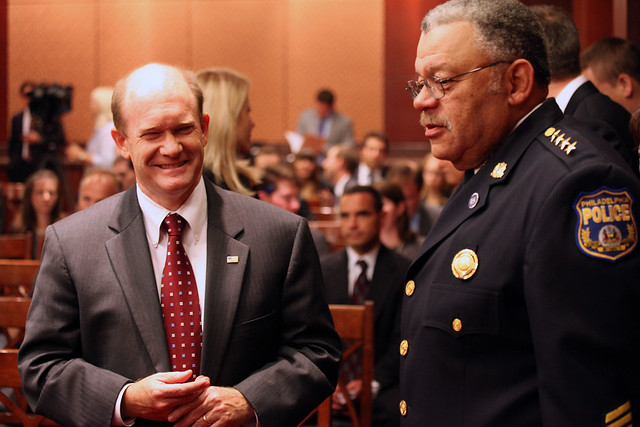
Senator Coons hosted an event kicking off the first ever Senate Law Enforcement Caucus on Wednesday. The goal of the caucus is to educate and inform senators and staff about the programs and initiatives that are keeping our communities safe, while advocating for the policies and resources law enforcement agencies need to carry out their missions.
“There has always been deep bipartisan support for law enforcement in Congress. Our aim in forming the caucus is to focus it on a meaningful conversation that reinforces the federal commitment to assisting state and local law enforcement,” Senator Coons said during his introductory remarks.
The Caucus has received an outpouring of support from senators of both parties. Prior to its announcement on Wednesday, the caucus had 16 additional senators join.
The event was held in the Capitol and attended by members of local, state and federal law enforcement agencies. In addition to remarks by the caucus co-chairs, Senators Coons and Blunt, Philadelphia Police Commissioner Charles Ramsey, Principal Deputy Assistant Attorney General for Justice Programs Mary Lou Leary, and National Fraternal Order of Police President Chuck Canterbury also gave remarks on their perspective on how federal, state, and local law enforcement can work more closely to protect the public.
The Senate Law Enforcement Caucus will primarily serve as a forum for officials, community groups, and other stakeholders to meet with legislators, staff, and one another to share experiences and develop strategies for fostering effective law enforcement. It will highlight ways in which the federal government can better assist agencies at the state and local levels, and will help circulate proven best practices in administering law enforcement programs during a time of severely limited budgets.
The caucus plans to hold regular briefings on pressing law enforcement issues for U.S. senators and staff, as well as to meet regularly with law enforcement officials to learn about best practices and the tools they need to keep our communities safe.