Related Issues

Related Issues

Senator Coons recognizes work of UD’s Engineers Without Borders
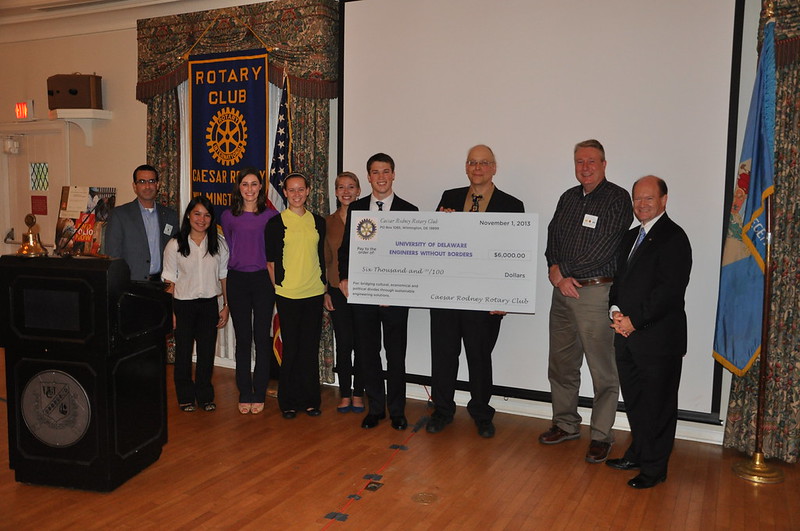
Senator Coons joined Caesar Rodney Rotary Club to congratulate University of Delaware's Engineers Without Borders on successful projects on November 1, 2013

Senator Coons was pleased to join the Caesar Rodney Rotary Club Friday to congratulate the University of Delaware’s Dr. Steve Dentel and his Engineers Without Borders students on the completion of successful projects in Cameroon and Guatemala, and hear about the group’s future plans to bring clean water to communities in Malawi.

“Clean water and sustainable infrastructure are basic human necessities that we often take for granted here in the United States,” said Senator Coons. “Under the leadership of Dr. Dentel, the Engineers Without Borders chapter of the University of Delaware has done inspiring work to expand access to clean drinking water in Cameroon and construct a bridge uniting a community in Guatemala. I look forward to hearing about the life-changing impacts they will make as they embark on their next project in Malawi. In each community they touch, these student leaders serve as remarkable ambassadors for both Delaware and the United States, and I thank them for their hard work and dedication to serving communities around the world.”

During Friday’s Rotary Club meeting, EWB students Jon Perna, Caroline Bibb, Erica Addonzinio, and Sam Meahan discussed in detail their successful Cameroon Water Distribution System project, which expanded access to quality clean drinking water in the villages of Bakang and Balatsit in Bamendjou. Students then announced their five-year commitment to projects in the areas of Blantyre and Zomba in Malawi.

The students were also on hand to accept financial support from the Rotarians. A special auction of 15 uniquely painted rain-barrels by local artists raised $6,000 for the EWB club. 

University of Delaware EWB’s mission is to design and implement sustainable solutions to problems in international developing communities and bridge cultural, economical, and political divides.

Senator Coons: U.S. must hold Assad accountable and renew commitment to Syria aid

Questioning witnesses during a Senate Foreign Relations Committee hearing Thursday on the status of events in Syria, Senator Coons called for sustained efforts to hold Syrian President Bashar al-Assad accountable for violence against Syrian civilians and urged swift action to address worsening humanitarian conditions.

“While I am glad that we were able to find a way to avert the need for military action last month following this committee’s strong approval of an authorization of the use of force, in my view we cannot forget, should not forget, that Assad has murdered more than 100,000 of his own people, and this unconscionable violence continues to this day,” Senator Coons said at Thursday’s hearing. 

“I am pleased that some real progress is being made in the removal of the means of delivering chemical weapons and that we are in the process of exhausting diplomatic alternatives to military force,” Senator Coons said. “But I find it jarring that eight weeks ago we sat in the same room and approved a strong policy, directed by President Obama, of holding Assad accountable for his crimes and continuing to stand with the Syrian people, yet do not seem to be making progress on a number of those shared commitments.” 

The hearing was convened to update Foreign Relations Committee members on the status of ongoing efforts to eliminate the Syrian chemical weapons stockpile, the potential for negotiations, and the ongoing humanitarian crises. Witnesses included U.S. Ambassador to Syria Robert Ford, Assistant Secretary of State for International Security and Nonproliferation Thomas Countryman, and USAID Assistant Administrator for the Bureau for Democracy, Conflict, and Humanitarian Assistance Nancy Lindborg.

Questioning Assistant Administrator Lindborg about steps USAID is taking to ensure delivery of U.S. aid to Syrian refugees, Senator Coons discussed meeting with Syrian refugees in Jordan earlier this year, noting that those he met “expressed anger and disappointment about the delays of promised U.S.-delivered assistance and support.” He expressed concern that months later, assistance continued to be delayed.

Lindborg noted that because many Syrian refugees are living with families in host communities, rather than in camps, USAID is focusing its efforts on development aid aimed at relieving the added stress placed on local water infrastructure, electrical systems, schools, and clinics. More work must be done to ensure we are maximizing our resources, Lindborg said.

Addressing Ambassador Ford, Senator Coons also expressed his concerns about “the very deep sense of abandonment felt by the Syrian opposition,” and emphasized the need for continued support for the Syrian opposition.

Ambassador Ford agreed, calling demonstrated solidarity with Syrian opposition “vital.” Ford pledged that the State Department would deliver on a statement issued last week by foreign ministers from 11 countries assuring Syrians that “Assad and his close associates with blood on their hands will have no role” when a transition government is established in Syria.

Delaware company demonstrates value of federally funded scientific research

Delaware’s ET International, Inc. was among 100 companies profiled in a new report released today by the Science Coalition – a nonprofit, nonpartisan organization of more than 50 of the nation’s leading public and private research universities, including the University of Delaware. The report, titled, “Sparking Economic Growth 2.0: Companies Created from Federally Funded University Research, Fueling Innovation and Economic Growth” highlights companies that trace their roots to federally funded university research. The companies in the report were self-selected by the member universities of the Science Coalition and are illustrative of how federal research can spur the creation of companies that bring innovations to market, create jobs, and contribute to economic growth.

ET International, Inc. (ETI) was founded in 2000 by Dr.Guang Rong Gao, a distinguished professor in computer and electrical engineering at the University of Delaware. The company originated in the university’s scientific labs and is now a leading provider of system software for advanced many-core computing systems ranging from supercomputers for highly scientific research to high-performance portable devices for smart phones. In a statement to the Science Coalition, the company noted that “Federally supported research completed at the University of Delaware and ETI” by Dr. Gao “allowed his deep-rooted belief in fundamental dataflow principles technologies to be successfully explored, designed and implemented…”

Indeed, ETI’s first phase of growth generated over $22 million in investments from the industry’s most renowned High Performance Computing organizations including The Defense Advanced Research Projects Agency, the Department of Defense, the Department of Energy, IBM, Intel, Cray, and Samsung. ETI’s software solutions increase performance, computing power, and efficiency to allow users to fully realize the power of many-core architectures. Built on a decade of highly complex research, ETI currently provides software, applications and custom engineering services for the energy, defense, semiconductor, digital media, and financial markets.

During a time when federal funding for R&D has been on the decline, with funding levels in 2013 at historic lows, ETI and the other companies highlighted in the report show the high return on investment yielded by federal funding of basic scientific research. Senator Coons is committed to ensuring that our nation continues to support innovative research and companies like ETI that create jobs and keep America on the cutting edge of technological innovation. 

Senator Coons Designates American Technological Innovation Day

A bipartisan resolution sponsored by Senator Coons declaring October 29, 2013 to be “National Technological Innovation Day” was adopted by the Senate Monday. The declaration recognizes the important role of technological innovation in job creation and the U.S. economy, and was timed to celebrate the anniversary of ARPANET, the Internet’s precursor, created on October 29, 1969. The resolution was led by Senator Coons and co-sponsored by a bipartisan group of senators, including Senators Mark Kirk (R-Ill.), Martin Heinrich (D-N.M.), Jerry Moran (R-Kan.), and Johnny Isakson (R-Ga).

“America has produced some of the world’s most transformative technological innovations that have helped our economy prosper while advancing societies across the globe,” Senator Coons said. “I hope that National Technological Innovation Day will encourage Americans across the country to pause to appreciate the great work of those who came before, and rise to the challenge of becoming the next generation of inspirational American thinkers and inventors.”

A significant portion of our economy’s growth can be traced to new innovations. Since our nation’s founding, American innovators have produced the light bulb, the polio vaccine, the transistor (the main component of a computer chip), communications satellites, Global Positioning System, and the Internet, to name just a few. National Technological Innovation Day recognizes the role of America’s innovative spirit in individuals who have started successful companies and pushed the frontiers of science in the lab. More than one-third of Nobel prizes awarded, 347 in total, have gone to American citizens, reflecting the domestic culture of achievement we have created.

The resolution designating National Technological Innovation Day calls on individuals to observe the day by participating in activities that celebrate the history of innovation in the US, such as educational events and exploration of how modern devices work. It also encourages American youth to continue to enhance the future by pursuing invention and entrepreneurship.

Senator Coons, colleagues launch Manufacturing Jobs for America

Senator Coons and 11 colleagues held a press conference on October 29, 2013 to announce the launch of Manufacturing Jobs for America, a campaign to refocus Washington’s attention on manufacturing jobs. The effort comprises 40 bills from 22 senators, many of which are bipartisan, that will help America’s manufacturers grow and prepare American workers for careers in advanced manufacturing.

Chris opened the press conference, discussing the need for progress on legislation that will strenghten America’s modern workforce, secure a more level global playing field, expand access to capital for new and smaller-scale manufactuerers, and establish a national manufacturing strategy. Citing the success of Miller Metal Fabrication in Bridgeville, Delaware, which has won manufacturing work back from China, Italy, and other countries, Chris urged renewed bipartisan efforts to accelerate America’s manufacturing revival.   

Participants in Tuesday’s press conference included Senators Debbie Stabenow (D-Mich.), Tammy Baldwin (D-Wis.), Richard Blumenthal (D-Conn.), Joe Donnelly (D-Ind.), Al Franken (D-Minn.), Jeff Merkley (D-Ore.), Chris Murphy (D-Conn.), Mark Pryor (D-Ark.), Jack Reed (D-R.I.), Brian Schatz (D-Hawaii), and Jeanne Shaheen (D-N.H.).

Watch Chris’ opening remarks:

Watch a highlight reel of senators’ remarks at the press conference:

Watch the full press conference:

Senator Coons sponsors bill to secure critical minerals

Most Americans are familiar with the importance of oil for gasoline and diesel, copper for electric wiring and motors, and aluminum for packing and vehicles.  However, we do not often hear about the importance of yttrium, cerium, neodymium, or lanthanum for consumer uses.  These basic elements are critical for more efficient light bulbs, oil refinery catalysts, lasers, and batteries respectively.  

To help secure the continued supply of minerals vital to our national defense, domestic energy, electronics production, and medical industry technologies, Senator Coons recently joined a bipartisan group of 16 senators to introduce the Critical Minerals Policy Act of 2013 (S. 1600). The legislation includes a number of provisions that would help revitalize the domestic supply of these precious minerals, many of which are in short supply domestically and come from overseas.

According to the U.S. Geological Survey (USGS), the United States is currently 100 percent dependent on foreign sources for 17 key mineral commodities and 50 percent dependent on overseas suppliers for some 24 additional minerals. The goal of the Critical Minerals Policy Act is to secure a more stable supply of mineral commodities by developing domestic sources, recycling existing supplies, and researching alternatives for critical minerals. Chris is also a strong supporter of efforts at the University of Delaware to develop alternatives to the use of rare earth elements, a subset of critical minerals.   

Through the establishment of a federal register in the Department of the Interior (DOI), the Critical Minerals Policy Act will help officials pinpoint which minerals are subject to potential supply restrictions and develop strategies to prevent price shocks and balance market demand. Other agencies, including the Department of Energy (DOE) and USGS, will join the DOI to strengthen educational research and workforce training critical to the development of domestic mineral supply chains. The legislation would also streamline the permit and review process of critical mineral mining on public lands to reduce costs and facilitate the environmentally responsible production of domestic resources.       

To further public understanding of critical mineral solutions, the Critical Minerals Policy Act would expand research programs aimed at promoting efficient mineral use and recycling across various U.S. industries. The DOE would also submit an assessment of domestically trained workers capable of carrying out critical mineral research, analysis, manufacturing, and production to enhance the domestic availability of critical minerals.

According to the National Academy of Sciences, more than 25,000 pounds of new minerals are needed every year for each person in the United States in order to make the items we use every day for infrastructure, energy, transportation, communications, health care and defense. By coordinating efforts across federal agencies, the Critical Minerals Policy Act will help to update mineral policy for the 21st century and ensure our position in the world as both an economic and technological leader.     

One year ago

One year ago, Superstorm Sandy devastated communities up and down the East Coast, destroying the homes and businesses of thousands of Americans. Since Sandy first made landfall, Delawareans and our neighbors have come a long way, picking up the pieces and rebuilding their lives.

In their volunteer and aid efforts, Americans demonstrated once again that we are all in this together – that when some of us face crisis, it affects us all, and requires a strong collective response. There is much work still to do, especially in those neighborhoods that were hardest hit, but I remain confident that together we will finish the work of rebuilding and renewal, and I promise I will continue to be there for all of Sandy’s victims every step of the way.

Senator Coons supports bill to protect U.S. helium supply

Though most Americans associate helium with balloons, a potential shortage of this critical element would mean more than just the loss of a popular party fixture – it would do real damage to our economy. That’s because helium has important applications in our everyday lives, with uses in arc welding, scientific research, microchip production, MRI scans, fire extinguishers, and tires. It is also used in nuclear reactors, space exploration, superconducting magnets….and yes, blimps and birthday parties. That’s why Senator Coons was proud to support legislation that passed the Senate on September 19th to ensure that a stable supply remains available for critical industrial, medical, and scientific activities dependent on the gas. 

On October 2nd, President Obama signed the Helium Stewardship Act to guarantee the continued federal management of the nation’s helium reserves, located in Kansas, Oklahoma, and Texas. The program was set to expire on October 7th. Chris is pleased that both the House and Senate were able to act in time to provide continued management of this critical resource.

The existing Federal Helium Reserve (FHR), managed by the Department of the Interior’s Bureau of Land Management, stores 42 percent of the nation’s supply, about one-third of global helium reserves. The FHR is the world’s only helium gas stockpile, and is located just outside of Amarillo, Texas. The Helium Stewardship Act permits the BLM to continue to sell helium from the national reserve to the private sector, relieving Delaware’s many industrial, medical, and university users of the fear of a national helium shortage.

The Federal Helium Program was created in 1925 to secure supplies of a safer, non-combustible alternative to hydrogen for use in buoyant aircraft for the military. As further uses were discovered for the gas in the post-WWII period, the U.S. Government began to purchase helium and store it in an empty gas reserve in Texas. The stockpile of unrefined “crude” helium has been stored at the Bush Dome Reservoir in Amarillo, Texas since the establishment of the conservation program with the passage of the Helium Act Amendments of 1960.  The FHR was established as part of the country’s cold war efforts, recognizing helium’s historic strategic importance in lighter-than-air aviation in the 1920’s. The FHR was intended to provide a ready supply of helium for the rapidly expanding needs of defense, the space program, and scientific research.

Fitch Ratings warns of U.S. credit downgrade

As the United States lurches closer to the debt ceiling deadline, Fitch Ratings, one of three major ratings agencies, has placed the United States credit rating on a Rating Watch Negative.  Ratings are placed on rating watch to notify investors that there is a reasonable probability of a ratings change.  According to Fitch, the federal credit was placed on negative watch because “political brinkmanship and reduced financing flexibility could increase the risk of a U.S. default.”  Some of the other reasons include:

  • The United States Treasury Department may have a limited capacity to make payments after October 17th, but the inflows and outflows will be volatile.  Delays in payments of obligations would damage U.S. creditworthiness and the economy.
  • The prolonged negotiations are undermining confidence in the role of the U.S. dollar as the global reserve currency.
  • The repeated brinkmanship over raising the debt ceiling damages confidence in the U.S. government and political institutions. 

Asked about the possibility of a first time U.S. default, Senator Coons told reporters Tuesday, “We are coming bracingly close to the edge. I think we’re looking over it now. We’re in very dangerous territory.”

During the last debate over paying our bills in July 2011, another ratings agency, Standard and Poor’s (S&P) issued a Negative Credit Watch.  Following a protracted debate which extended into August 2011, S&P announced a downgrade from AAA to AA+, where our credit rating stands today. 

According to S&P in 2011, “The political brinkmanship of recent months highlights what we see as America’s governance and policymaking becoming less stable, less effective, and less predictable than what we previously believed.  The statutory debt ceiling and the threat of default have become political bargaining chips in the debate over fiscal policy.”  In response to S&P downgrading the United States’ creditworthiness, the S&P 500 dropped 6.7 percent in a single day, marking one of the largest drops in history.  Globally, investors lost $1.35 trillion in one day.

United States Treasury Secretary Jack Lew has said that the government will exhaust its ability to reliably pay our obligations on October 17th.  If the debt ceiling is not raised, nonpartisan analysts expect the U.S. Treasury to run out of cash to pay our bills sometime in the two weeks following October 17th

“I’m stunned,” Senator Coons said. “I think this is really reckless. There is no better option for us going forward than to reopen the government, pay our national debt on time, raise the debt ceiling, and honor our obligations as a country.”

Video: Senator Coons warns about threat of default

Senator Coons spoke on the Senate floor again on Monday, this time warning Delawareans about the looming threat of defaulting on our nation’s debts. It was a sober and, at times, chilling look at what will happen, when it will happen, and what our potential paths forward really look like. He explains why “prioritizing” our debt, as some in Congress have recklessly suggested was a way to bypass the debt ceiling, would actually do more harm than good to our economy and our communities.